Multiplexer Role in Sustaining Cloud-Based Infrastructure Services
JUL 13, 20259 MIN READ
Generate Your Research Report Instantly with AI Agent
Patsnap Eureka helps you evaluate technical feasibility & market potential.
Multiplexer Evolution
The evolution of multiplexers in cloud-based infrastructure services has been marked by significant advancements in technology and design. Initially, multiplexers were primarily used in telecommunications to combine multiple signals into a single transmission medium. As cloud computing emerged, the role of multiplexers expanded to address the growing demands of data centers and network infrastructure.
In the early stages of cloud computing, simple time-division multiplexing (TDM) and frequency-division multiplexing (FDM) techniques were employed to manage network traffic. These methods allowed for basic sharing of communication channels but had limitations in terms of scalability and flexibility.
The next phase saw the introduction of statistical multiplexing, which dynamically allocated bandwidth based on traffic patterns. This approach significantly improved resource utilization and laid the groundwork for more sophisticated traffic management in cloud environments.
As cloud services proliferated, wavelength-division multiplexing (WDM) became crucial in optical networks, enabling massive increases in data transmission capacity. This technology allowed cloud providers to scale their infrastructure to meet the exponential growth in data traffic.
The advent of software-defined networking (SDN) marked a pivotal moment in multiplexer evolution. SDN decoupled the control plane from the data plane, allowing for more intelligent and programmable network management. This shift enabled multiplexers to become more adaptable and responsive to changing network conditions.
Recent developments have focused on integrating artificial intelligence and machine learning algorithms into multiplexing systems. These advanced techniques allow for predictive traffic management, automated load balancing, and real-time optimization of network resources.
The latest trend in multiplexer evolution is the move towards all-optical switching and multiplexing. This approach promises to reduce latency, increase bandwidth, and improve energy efficiency in cloud data centers. Photonic integrated circuits are at the forefront of this development, offering the potential for ultra-high-speed data routing and processing.
Looking ahead, the future of multiplexers in cloud infrastructure is likely to involve quantum multiplexing techniques. Research in this area suggests the possibility of unprecedented levels of data density and secure communication channels, which could revolutionize cloud-based services.
Throughout this evolution, the core objective of multiplexers has remained constant: to efficiently manage and optimize the flow of data in increasingly complex and demanding cloud environments. Each stage of development has brought new capabilities, enabling cloud providers to offer more reliable, scalable, and high-performance services to their customers.
In the early stages of cloud computing, simple time-division multiplexing (TDM) and frequency-division multiplexing (FDM) techniques were employed to manage network traffic. These methods allowed for basic sharing of communication channels but had limitations in terms of scalability and flexibility.
The next phase saw the introduction of statistical multiplexing, which dynamically allocated bandwidth based on traffic patterns. This approach significantly improved resource utilization and laid the groundwork for more sophisticated traffic management in cloud environments.
As cloud services proliferated, wavelength-division multiplexing (WDM) became crucial in optical networks, enabling massive increases in data transmission capacity. This technology allowed cloud providers to scale their infrastructure to meet the exponential growth in data traffic.
The advent of software-defined networking (SDN) marked a pivotal moment in multiplexer evolution. SDN decoupled the control plane from the data plane, allowing for more intelligent and programmable network management. This shift enabled multiplexers to become more adaptable and responsive to changing network conditions.
Recent developments have focused on integrating artificial intelligence and machine learning algorithms into multiplexing systems. These advanced techniques allow for predictive traffic management, automated load balancing, and real-time optimization of network resources.
The latest trend in multiplexer evolution is the move towards all-optical switching and multiplexing. This approach promises to reduce latency, increase bandwidth, and improve energy efficiency in cloud data centers. Photonic integrated circuits are at the forefront of this development, offering the potential for ultra-high-speed data routing and processing.
Looking ahead, the future of multiplexers in cloud infrastructure is likely to involve quantum multiplexing techniques. Research in this area suggests the possibility of unprecedented levels of data density and secure communication channels, which could revolutionize cloud-based services.
Throughout this evolution, the core objective of multiplexers has remained constant: to efficiently manage and optimize the flow of data in increasingly complex and demanding cloud environments. Each stage of development has brought new capabilities, enabling cloud providers to offer more reliable, scalable, and high-performance services to their customers.
Cloud Service Demands
The demand for cloud-based infrastructure services has been growing exponentially in recent years, driven by the increasing digitalization of businesses and the need for scalable, flexible, and cost-effective IT solutions. Organizations across various sectors are rapidly adopting cloud technologies to enhance their operational efficiency, agility, and competitiveness in the global market.
One of the primary factors fueling this demand is the shift towards remote work and distributed teams, accelerated by the global pandemic. Businesses require robust cloud infrastructure to support remote collaboration, secure data access, and seamless communication among geographically dispersed employees. This trend has led to a surge in demand for cloud-based productivity tools, virtual desktop infrastructure (VDI), and secure remote access solutions.
The rise of data-driven decision-making and advanced analytics has also contributed significantly to the growing demand for cloud services. Organizations are generating and processing vast amounts of data, necessitating scalable storage and computing resources that can handle big data analytics, machine learning, and artificial intelligence workloads. Cloud platforms offer the necessary infrastructure and services to support these data-intensive applications, making them an attractive option for businesses looking to leverage data for competitive advantage.
Another key driver of cloud service demand is the increasing adoption of Internet of Things (IoT) technologies. As more devices become connected and generate data, there is a growing need for cloud-based platforms that can collect, process, and analyze this information in real-time. Industries such as manufacturing, healthcare, and smart cities are leveraging cloud services to support their IoT initiatives, driving further demand for cloud infrastructure.
The financial services sector has also emerged as a significant consumer of cloud services, with banks and financial institutions migrating their core systems and applications to the cloud to improve agility, reduce costs, and enhance customer experiences. This trend is expected to continue as regulatory bodies become more accepting of cloud technologies in the financial sector.
Furthermore, the entertainment and media industry's shift towards streaming services and digital content delivery has created a substantial demand for cloud infrastructure. Content providers require robust, scalable platforms to store, manage, and deliver high-quality video and audio content to millions of users simultaneously, making cloud services an essential component of their operations.
As organizations continue to embrace digital transformation initiatives, the demand for cloud services is expected to grow further. This includes the adoption of hybrid and multi-cloud strategies, which allow businesses to leverage the benefits of different cloud providers and maintain flexibility in their IT infrastructure. The need for specialized cloud services, such as edge computing and industry-specific cloud solutions, is also on the rise, driving innovation and diversification in the cloud services market.
One of the primary factors fueling this demand is the shift towards remote work and distributed teams, accelerated by the global pandemic. Businesses require robust cloud infrastructure to support remote collaboration, secure data access, and seamless communication among geographically dispersed employees. This trend has led to a surge in demand for cloud-based productivity tools, virtual desktop infrastructure (VDI), and secure remote access solutions.
The rise of data-driven decision-making and advanced analytics has also contributed significantly to the growing demand for cloud services. Organizations are generating and processing vast amounts of data, necessitating scalable storage and computing resources that can handle big data analytics, machine learning, and artificial intelligence workloads. Cloud platforms offer the necessary infrastructure and services to support these data-intensive applications, making them an attractive option for businesses looking to leverage data for competitive advantage.
Another key driver of cloud service demand is the increasing adoption of Internet of Things (IoT) technologies. As more devices become connected and generate data, there is a growing need for cloud-based platforms that can collect, process, and analyze this information in real-time. Industries such as manufacturing, healthcare, and smart cities are leveraging cloud services to support their IoT initiatives, driving further demand for cloud infrastructure.
The financial services sector has also emerged as a significant consumer of cloud services, with banks and financial institutions migrating their core systems and applications to the cloud to improve agility, reduce costs, and enhance customer experiences. This trend is expected to continue as regulatory bodies become more accepting of cloud technologies in the financial sector.
Furthermore, the entertainment and media industry's shift towards streaming services and digital content delivery has created a substantial demand for cloud infrastructure. Content providers require robust, scalable platforms to store, manage, and deliver high-quality video and audio content to millions of users simultaneously, making cloud services an essential component of their operations.
As organizations continue to embrace digital transformation initiatives, the demand for cloud services is expected to grow further. This includes the adoption of hybrid and multi-cloud strategies, which allow businesses to leverage the benefits of different cloud providers and maintain flexibility in their IT infrastructure. The need for specialized cloud services, such as edge computing and industry-specific cloud solutions, is also on the rise, driving innovation and diversification in the cloud services market.
Multiplexer Challenges
Multiplexers play a crucial role in sustaining cloud-based infrastructure services, but they face several significant challenges that can impact their performance and reliability. One of the primary challenges is scalability. As cloud services continue to grow and expand, multiplexers must be able to handle an ever-increasing volume of traffic and data. This requires not only robust hardware but also sophisticated software algorithms to efficiently manage and route data streams.
Another major challenge is latency management. In cloud environments, where milliseconds can make a significant difference in user experience and application performance, multiplexers must minimize delay while processing and routing data. This becomes particularly complex when dealing with geographically distributed data centers and edge computing scenarios, where data may need to traverse multiple networks and regions.
Security is an ongoing concern for multiplexers in cloud infrastructure. As critical components in the data flow, multiplexers are potential targets for cyber attacks. They must incorporate advanced security features to protect against unauthorized access, data breaches, and denial-of-service attacks. This includes implementing encryption, access controls, and real-time threat detection mechanisms.
Reliability and fault tolerance present additional challenges. Cloud services often require 24/7 availability, meaning multiplexers must be designed with redundancy and failover capabilities. They need to quickly detect and respond to hardware failures, network issues, or other disruptions without causing service interruptions.
Compatibility and interoperability are crucial considerations as well. Multiplexers must support a wide range of protocols, data formats, and communication standards to seamlessly integrate with diverse cloud infrastructure components. This includes adapting to emerging technologies and standards while maintaining backward compatibility with legacy systems.
Energy efficiency is becoming increasingly important in cloud data centers. Multiplexers, as active components in the network, contribute to overall power consumption. Designing multiplexers that can operate efficiently under varying load conditions while minimizing power usage is a significant engineering challenge.
Finally, the complexity of modern cloud architectures poses challenges for multiplexer configuration and management. As networks become more software-defined and dynamic, multiplexers must be able to adapt quickly to changing conditions. This requires sophisticated management interfaces, automation capabilities, and integration with orchestration systems to enable rapid provisioning, reconfiguration, and troubleshooting in complex cloud environments.
Another major challenge is latency management. In cloud environments, where milliseconds can make a significant difference in user experience and application performance, multiplexers must minimize delay while processing and routing data. This becomes particularly complex when dealing with geographically distributed data centers and edge computing scenarios, where data may need to traverse multiple networks and regions.
Security is an ongoing concern for multiplexers in cloud infrastructure. As critical components in the data flow, multiplexers are potential targets for cyber attacks. They must incorporate advanced security features to protect against unauthorized access, data breaches, and denial-of-service attacks. This includes implementing encryption, access controls, and real-time threat detection mechanisms.
Reliability and fault tolerance present additional challenges. Cloud services often require 24/7 availability, meaning multiplexers must be designed with redundancy and failover capabilities. They need to quickly detect and respond to hardware failures, network issues, or other disruptions without causing service interruptions.
Compatibility and interoperability are crucial considerations as well. Multiplexers must support a wide range of protocols, data formats, and communication standards to seamlessly integrate with diverse cloud infrastructure components. This includes adapting to emerging technologies and standards while maintaining backward compatibility with legacy systems.
Energy efficiency is becoming increasingly important in cloud data centers. Multiplexers, as active components in the network, contribute to overall power consumption. Designing multiplexers that can operate efficiently under varying load conditions while minimizing power usage is a significant engineering challenge.
Finally, the complexity of modern cloud architectures poses challenges for multiplexer configuration and management. As networks become more software-defined and dynamic, multiplexers must be able to adapt quickly to changing conditions. This requires sophisticated management interfaces, automation capabilities, and integration with orchestration systems to enable rapid provisioning, reconfiguration, and troubleshooting in complex cloud environments.
Current MUX Solutions
01 Optical multiplexing systems
Optical multiplexers are used in fiber optic communication systems to combine multiple optical signals onto a single fiber. These systems often employ wavelength division multiplexing (WDM) to increase data transmission capacity. Advanced optical multiplexers may incorporate tunable lasers, optical switches, and signal processing techniques to optimize performance and flexibility.- Optical multiplexing systems: Optical multiplexers are used in fiber optic communication systems to combine multiple optical signals into a single fiber. These systems often employ wavelength division multiplexing (WDM) to increase data transmission capacity. Advanced optical multiplexers may incorporate tunable lasers, optical switches, and signal processing techniques to optimize performance and flexibility.
- Digital multiplexers for data communication: Digital multiplexers are essential components in data communication systems, allowing multiple data streams to be combined into a single transmission channel. These devices use time division multiplexing (TDM) or other techniques to interleave data from different sources. Advanced digital multiplexers may incorporate error correction, data compression, and adaptive modulation schemes to improve efficiency and reliability.
- Multiplexers in wireless communication systems: Multiplexers play a crucial role in wireless communication systems, enabling multiple users or data streams to share the same frequency spectrum. These multiplexers may use techniques such as frequency division multiple access (FDMA), time division multiple access (TDMA), or code division multiple access (CDMA). Advanced wireless multiplexers incorporate adaptive algorithms to optimize spectrum utilization and minimize interference.
- Analog multiplexers and signal routing: Analog multiplexers are used for routing and switching analog signals in various applications, including audio/video systems, test and measurement equipment, and sensor interfaces. These devices typically use solid-state switches or relays to select between multiple input channels. Advanced analog multiplexers may incorporate features such as low crosstalk, high bandwidth, and programmable gain control.
- Multiplexers in display systems: Multiplexers are used in display systems to control and drive multiple pixels or segments. These devices are particularly important in passive matrix displays and LED arrays, where they enable efficient addressing of individual elements. Advanced display multiplexers may incorporate features such as high refresh rates, grayscale control, and power management to improve image quality and energy efficiency.
02 Digital multiplexers for data communication
Digital multiplexers are essential components in data communication systems, allowing multiple data streams to be combined and transmitted over a single channel. These devices use time division multiplexing (TDM) or other techniques to interleave data from different sources. Advanced digital multiplexers may incorporate error correction, data compression, and adaptive modulation schemes to improve efficiency and reliability.Expand Specific Solutions03 Multiplexers in wireless communication systems
Multiplexers play a crucial role in wireless communication systems, enabling multiple users or data streams to share the same frequency spectrum. These multiplexers may use techniques such as frequency division multiple access (FDMA), time division multiple access (TDMA), or code division multiple access (CDMA). Advanced wireless multiplexers often incorporate adaptive algorithms to optimize spectrum utilization and minimize interference.Expand Specific Solutions04 Analog multiplexers and signal routing
Analog multiplexers are used for routing and switching analog signals in various applications, including audio/video systems, test and measurement equipment, and sensor interfaces. These devices typically use solid-state switches or relays to select and route signals. Advanced analog multiplexers may incorporate features such as low distortion, high bandwidth, and programmable gain to enhance signal integrity and flexibility.Expand Specific Solutions05 Multiplexers in display systems
Multiplexers are essential components in display systems, particularly in flat panel displays and image sensors. These multiplexers are used for addressing and driving individual pixels or sensor elements. Advanced display multiplexers may incorporate features such as charge redistribution, voltage boosting, and integrated drivers to improve image quality and power efficiency.Expand Specific Solutions
Key Industry Players
The multiplexer's role in sustaining cloud-based infrastructure services is at a mature stage of development, with a large and growing market size. The technology has reached a high level of maturity, with major players like Cisco, IBM, and Microsoft offering advanced solutions. Companies such as Qualcomm, Salesforce, and Oracle are also contributing to the field, leveraging their expertise in cloud technologies and network infrastructure. The competitive landscape is characterized by continuous innovation, with firms like Juniper Networks and Hewlett Packard Enterprise focusing on enhancing multiplexer capabilities to meet the increasing demands of cloud-based services. As the technology evolves, we can expect further advancements in efficiency, scalability, and integration with emerging cloud technologies.
Cisco Technology, Inc.
Technical Solution: Cisco's approach to multiplexing in cloud-based infrastructure services focuses on their Application Centric Infrastructure (ACI) technology. ACI utilizes software-defined networking (SDN) principles to create a highly scalable and flexible network fabric[1]. This fabric acts as a multiplexer, efficiently routing and managing traffic across cloud resources. Cisco's ACI implements micro-segmentation, allowing for granular control over application components and their communication paths[2]. The system uses a centralized policy controller to manage and distribute policies across the network, ensuring consistent application of security and performance rules. Additionally, Cisco integrates their Tetration analytics platform with ACI, providing real-time visibility and analysis of network traffic patterns, which helps in optimizing multiplexing decisions[3].
Strengths: Highly scalable and flexible network fabric, granular control through micro-segmentation, centralized policy management. Weaknesses: Complexity in initial setup and configuration, potential vendor lock-in due to proprietary technology.
Salesforce, Inc.
Technical Solution: Salesforce's approach to multiplexing in cloud infrastructure services is centered around their multi-tenant architecture and the Salesforce Lightning Platform. The Lightning Platform uses a metadata-driven architecture that allows for efficient resource sharing and isolation between tenants[4]. This architecture acts as a multiplexer by dynamically allocating and managing resources across multiple customers' instances. Salesforce employs advanced data partitioning techniques to ensure data isolation and security while maximizing hardware utilization. Their Hyperforce initiative further enhances this capability by leveraging public cloud infrastructure to provide even greater scalability and performance[5]. Salesforce also utilizes their Einstein AI platform to predict resource needs and optimize multiplexing decisions in real-time, ensuring efficient resource allocation across their customer base[6].
Strengths: Highly scalable multi-tenant architecture, advanced data partitioning for security, AI-driven resource optimization. Weaknesses: Limited customization options compared to some competitors, potential performance impacts during peak usage times.
Core MUX Innovations
Network service discovery
PatentPendingUS20240364632A1
Innovation
- The techniques involve generating and broadcasting advertisements conforming to established routing protocols, such as BGP, to directly communicate control planes between SDN clusters, eliminating the need for external DNS servers or complex service meshes, allowing for efficient and dynamic addition of virtual execution elements as endpoints.


Systems and/or methods for intelligent and resilient failover for cloud computing environments
PatentActiveUS20200092404A1
Innovation
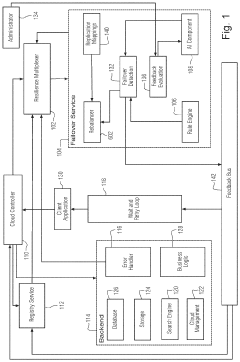
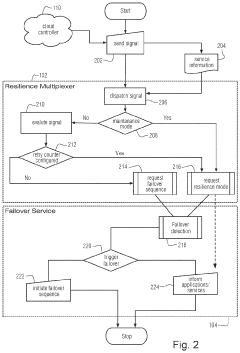
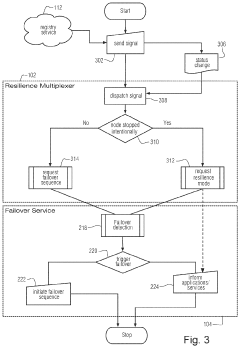
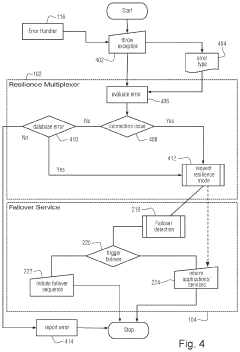
- A resilience multiplexer is introduced to collect and process information from various components, using machine-learned rules and rule-based decision-making to determine whether a failover is necessary, and if so, to initiate a preprogrammed failover sequence only when predefined conditions are met, thereby reducing unnecessary failovers and improving handling of issues in distributed computing environments.
Scalability Strategies
Scalability strategies play a crucial role in sustaining cloud-based infrastructure services, particularly when considering the multiplexer's function. These strategies are essential for ensuring that cloud services can handle increasing loads and maintain performance as demand grows.
One key scalability strategy involves implementing load balancing techniques. Multiplexers can be utilized to distribute incoming traffic across multiple servers or instances, effectively spreading the workload and preventing any single point of failure. This approach not only improves overall system performance but also enhances reliability and fault tolerance.
Horizontal scaling, or scaling out, is another vital strategy. By adding more instances of multiplexers and associated resources, cloud providers can increase their capacity to handle concurrent connections and process more requests simultaneously. This method allows for seamless expansion of services without significant downtime or disruption to existing operations.
Vertical scaling, or scaling up, involves increasing the resources allocated to individual multiplexer instances. This can include upgrading CPU, memory, or network capacity to handle higher loads. While this approach may have limitations compared to horizontal scaling, it can be effective for addressing specific performance bottlenecks.
Implementing auto-scaling mechanisms is a sophisticated strategy that leverages the flexibility of cloud environments. By automatically adjusting the number of multiplexer instances based on predefined metrics such as CPU utilization or request rates, cloud services can dynamically adapt to changing demand patterns. This ensures optimal resource utilization and cost-efficiency while maintaining service quality.
Caching strategies can significantly enhance scalability by reducing the load on backend systems. Multiplexers can be configured to cache frequently accessed content, minimizing the need for repeated requests to origin servers. This not only improves response times but also allows the infrastructure to handle a higher volume of requests with existing resources.
Efficient data management is crucial for scalability. Implementing database sharding techniques, where data is distributed across multiple database instances, can help manage large volumes of data more effectively. Multiplexers can be configured to route requests to the appropriate database shard, ensuring optimal performance and scalability of data-intensive operations.
Lastly, adopting microservices architecture can greatly enhance scalability. By breaking down complex applications into smaller, independently deployable services, each with its own multiplexer, organizations can achieve greater flexibility in scaling individual components based on specific demands. This approach allows for more granular control over resource allocation and enables easier maintenance and updates of the overall system.
One key scalability strategy involves implementing load balancing techniques. Multiplexers can be utilized to distribute incoming traffic across multiple servers or instances, effectively spreading the workload and preventing any single point of failure. This approach not only improves overall system performance but also enhances reliability and fault tolerance.
Horizontal scaling, or scaling out, is another vital strategy. By adding more instances of multiplexers and associated resources, cloud providers can increase their capacity to handle concurrent connections and process more requests simultaneously. This method allows for seamless expansion of services without significant downtime or disruption to existing operations.
Vertical scaling, or scaling up, involves increasing the resources allocated to individual multiplexer instances. This can include upgrading CPU, memory, or network capacity to handle higher loads. While this approach may have limitations compared to horizontal scaling, it can be effective for addressing specific performance bottlenecks.
Implementing auto-scaling mechanisms is a sophisticated strategy that leverages the flexibility of cloud environments. By automatically adjusting the number of multiplexer instances based on predefined metrics such as CPU utilization or request rates, cloud services can dynamically adapt to changing demand patterns. This ensures optimal resource utilization and cost-efficiency while maintaining service quality.
Caching strategies can significantly enhance scalability by reducing the load on backend systems. Multiplexers can be configured to cache frequently accessed content, minimizing the need for repeated requests to origin servers. This not only improves response times but also allows the infrastructure to handle a higher volume of requests with existing resources.
Efficient data management is crucial for scalability. Implementing database sharding techniques, where data is distributed across multiple database instances, can help manage large volumes of data more effectively. Multiplexers can be configured to route requests to the appropriate database shard, ensuring optimal performance and scalability of data-intensive operations.
Lastly, adopting microservices architecture can greatly enhance scalability. By breaking down complex applications into smaller, independently deployable services, each with its own multiplexer, organizations can achieve greater flexibility in scaling individual components based on specific demands. This approach allows for more granular control over resource allocation and enables easier maintenance and updates of the overall system.
Security Implications
The security implications of multiplexers in sustaining cloud-based infrastructure services are multifaceted and critical to consider. As these devices play a pivotal role in managing and directing network traffic, they become potential targets for malicious actors seeking to compromise cloud infrastructure.
One primary security concern is the potential for unauthorized access through multiplexer vulnerabilities. If an attacker gains control of a multiplexer, they could potentially redirect traffic, intercept sensitive data, or launch man-in-the-middle attacks. This risk is particularly acute in cloud environments where multiplexers handle vast amounts of data from multiple clients.
Denial of Service (DoS) attacks targeting multiplexers pose another significant threat. By overwhelming a multiplexer with traffic, attackers could disrupt service availability for multiple cloud-based applications and services simultaneously. This cascading effect could lead to widespread outages and substantial financial losses for cloud service providers and their clients.
Data integrity is also a crucial consideration. Multiplexers must ensure that data packets are not tampered with or corrupted during transmission. Any compromise in data integrity could lead to erroneous operations, data loss, or security breaches in cloud-based services.
Encryption plays a vital role in securing multiplexer operations. Implementing robust encryption protocols for data in transit through multiplexers is essential to protect against eavesdropping and data theft. However, encryption also introduces additional complexity and potential performance overhead that must be carefully balanced with security requirements.
Configuration management of multiplexers is another critical security aspect. Misconfigurations can lead to unintended exposure of sensitive data or services. Regular audits and automated configuration checks are necessary to maintain a secure posture.
The increasing adoption of software-defined networking (SDN) in cloud environments introduces new security considerations for multiplexers. While SDN offers greater flexibility and control, it also expands the attack surface. Securing the SDN controller that manages multiplexer behavior becomes paramount to prevent large-scale network compromises.
Lastly, the physical security of multiplexers in data centers cannot be overlooked. Unauthorized physical access to these devices could lead to hardware-level attacks or the installation of malicious firmware, potentially compromising the entire cloud infrastructure.
One primary security concern is the potential for unauthorized access through multiplexer vulnerabilities. If an attacker gains control of a multiplexer, they could potentially redirect traffic, intercept sensitive data, or launch man-in-the-middle attacks. This risk is particularly acute in cloud environments where multiplexers handle vast amounts of data from multiple clients.
Denial of Service (DoS) attacks targeting multiplexers pose another significant threat. By overwhelming a multiplexer with traffic, attackers could disrupt service availability for multiple cloud-based applications and services simultaneously. This cascading effect could lead to widespread outages and substantial financial losses for cloud service providers and their clients.
Data integrity is also a crucial consideration. Multiplexers must ensure that data packets are not tampered with or corrupted during transmission. Any compromise in data integrity could lead to erroneous operations, data loss, or security breaches in cloud-based services.
Encryption plays a vital role in securing multiplexer operations. Implementing robust encryption protocols for data in transit through multiplexers is essential to protect against eavesdropping and data theft. However, encryption also introduces additional complexity and potential performance overhead that must be carefully balanced with security requirements.
Configuration management of multiplexers is another critical security aspect. Misconfigurations can lead to unintended exposure of sensitive data or services. Regular audits and automated configuration checks are necessary to maintain a secure posture.
The increasing adoption of software-defined networking (SDN) in cloud environments introduces new security considerations for multiplexers. While SDN offers greater flexibility and control, it also expands the attack surface. Securing the SDN controller that manages multiplexer behavior becomes paramount to prevent large-scale network compromises.
Lastly, the physical security of multiplexers in data centers cannot be overlooked. Unauthorized physical access to these devices could lead to hardware-level attacks or the installation of malicious firmware, potentially compromising the entire cloud infrastructure.
Unlock deeper insights with Patsnap Eureka Quick Research — get a full tech report to explore trends and direct your research. Try now!
Generate Your Research Report Instantly with AI Agent
Supercharge your innovation with Patsnap Eureka AI Agent Platform!