
Optimize Biodegradable Polymers for Low-Energy Manufacturing
OCT 9, 20269 MIN READ
Generate Your Research Report Instantly with AI Agent
Patsnap Eureka helps you evaluate technical feasibility & market potential.
Biodegradable Polymer Tech History and Low-Energy Goals
Biodegradable polymers have evolved significantly since their initial discovery in the early 20th century. The first synthetic biodegradable polymer, polyglycolic acid, was developed in the 1950s primarily for medical sutures. Throughout the 1970s and 1980s, research expanded into polylactic acid and polyhydroxyalkanoates, driven by growing environmental concerns about persistent plastic waste. The 1990s marked a pivotal period when commercial production of biodegradable polymers began scaling up, though manufacturing processes remained energy-intensive and cost-prohibitive for widespread adoption.
The evolution accelerated in the 2000s as climate change awareness intensified global focus on sustainable materials. Researchers began exploring starch-based blends, cellulose derivatives, and protein-based polymers, yet conventional manufacturing methods continued to require high temperatures, extensive processing steps, and substantial energy inputs. Traditional polymer synthesis typically demands temperatures exceeding 200°C and multi-stage purification processes, creating significant carbon footprints that partially offset the environmental benefits of biodegradability.
Recent developments from 2015 onward have witnessed breakthrough innovations in enzymatic synthesis, microbial fermentation optimization, and low-temperature polymerization techniques. These advances have demonstrated potential for reducing energy consumption by 30-50% compared to conventional methods. Simultaneously, the integration of renewable energy sources into production facilities has emerged as a complementary strategy to minimize environmental impact.
The current technical goals center on achieving three interconnected objectives. First, reducing manufacturing energy requirements to below 50% of conventional polymer production levels while maintaining material performance standards. Second, developing scalable processes that remain economically viable at industrial production volumes, ensuring market competitiveness with traditional plastics. Third, optimizing polymer properties—including mechanical strength, thermal stability, and degradation rates—without compromising the energy efficiency gains achieved through innovative manufacturing approaches.
These goals reflect the industry's recognition that true sustainability requires holistic optimization. Biodegradable polymers must not only decompose safely but also be produced through processes that minimize energy consumption, reduce greenhouse gas emissions, and support circular economy principles from synthesis through end-of-life disposal.
The evolution accelerated in the 2000s as climate change awareness intensified global focus on sustainable materials. Researchers began exploring starch-based blends, cellulose derivatives, and protein-based polymers, yet conventional manufacturing methods continued to require high temperatures, extensive processing steps, and substantial energy inputs. Traditional polymer synthesis typically demands temperatures exceeding 200°C and multi-stage purification processes, creating significant carbon footprints that partially offset the environmental benefits of biodegradability.
Recent developments from 2015 onward have witnessed breakthrough innovations in enzymatic synthesis, microbial fermentation optimization, and low-temperature polymerization techniques. These advances have demonstrated potential for reducing energy consumption by 30-50% compared to conventional methods. Simultaneously, the integration of renewable energy sources into production facilities has emerged as a complementary strategy to minimize environmental impact.
The current technical goals center on achieving three interconnected objectives. First, reducing manufacturing energy requirements to below 50% of conventional polymer production levels while maintaining material performance standards. Second, developing scalable processes that remain economically viable at industrial production volumes, ensuring market competitiveness with traditional plastics. Third, optimizing polymer properties—including mechanical strength, thermal stability, and degradation rates—without compromising the energy efficiency gains achieved through innovative manufacturing approaches.
These goals reflect the industry's recognition that true sustainability requires holistic optimization. Biodegradable polymers must not only decompose safely but also be produced through processes that minimize energy consumption, reduce greenhouse gas emissions, and support circular economy principles from synthesis through end-of-life disposal.
Market Demand for Sustainable Low-Energy Bio-Plastics
The global shift toward sustainability has catalyzed unprecedented demand for biodegradable polymers manufactured through energy-efficient processes. Consumer awareness regarding plastic pollution and climate change has intensified pressure on industries to adopt environmentally responsible materials. Regulatory frameworks across major economies are mandating reductions in conventional plastic usage, creating substantial market opportunities for bio-based alternatives that minimize both material waste and production energy consumption.
Packaging industries represent the largest demand sector for sustainable low-energy bio-plastics, driven by food and beverage companies seeking to meet corporate sustainability commitments and comply with extended producer responsibility regulations. Single-use applications including food containers, films, and protective packaging are transitioning toward biodegradable solutions that can be produced with reduced thermal processing requirements. The agricultural sector demonstrates growing interest in biodegradable mulch films and controlled-release fertilizer coatings that eliminate post-harvest waste removal while supporting low-carbon manufacturing practices.
Medical and pharmaceutical applications constitute a high-value market segment where biocompatible polymers manufactured under stringent quality standards must balance performance requirements with environmental considerations. Demand for sutures, drug delivery systems, and temporary implants fabricated from materials processable at lower temperatures continues to expand as healthcare systems prioritize both patient safety and ecological responsibility.
Automotive and electronics industries are exploring biodegradable polymers for non-structural components and packaging applications, particularly where end-of-life recyclability poses challenges with conventional materials. These sectors prioritize materials that can be processed using existing manufacturing infrastructure with minimal energy modifications, creating demand for drop-in bio-plastic solutions compatible with injection molding and extrusion processes operating at reduced temperatures.
Emerging markets in developing regions show accelerating adoption rates as local governments implement plastic waste management policies and manufacturing facilities seek cost advantages through reduced energy consumption. The convergence of environmental regulations, corporate sustainability initiatives, and consumer preferences establishes a robust and expanding market foundation for biodegradable polymers optimized for low-energy manufacturing processes across diverse industrial applications.
Packaging industries represent the largest demand sector for sustainable low-energy bio-plastics, driven by food and beverage companies seeking to meet corporate sustainability commitments and comply with extended producer responsibility regulations. Single-use applications including food containers, films, and protective packaging are transitioning toward biodegradable solutions that can be produced with reduced thermal processing requirements. The agricultural sector demonstrates growing interest in biodegradable mulch films and controlled-release fertilizer coatings that eliminate post-harvest waste removal while supporting low-carbon manufacturing practices.
Medical and pharmaceutical applications constitute a high-value market segment where biocompatible polymers manufactured under stringent quality standards must balance performance requirements with environmental considerations. Demand for sutures, drug delivery systems, and temporary implants fabricated from materials processable at lower temperatures continues to expand as healthcare systems prioritize both patient safety and ecological responsibility.
Automotive and electronics industries are exploring biodegradable polymers for non-structural components and packaging applications, particularly where end-of-life recyclability poses challenges with conventional materials. These sectors prioritize materials that can be processed using existing manufacturing infrastructure with minimal energy modifications, creating demand for drop-in bio-plastic solutions compatible with injection molding and extrusion processes operating at reduced temperatures.
Emerging markets in developing regions show accelerating adoption rates as local governments implement plastic waste management policies and manufacturing facilities seek cost advantages through reduced energy consumption. The convergence of environmental regulations, corporate sustainability initiatives, and consumer preferences establishes a robust and expanding market foundation for biodegradable polymers optimized for low-energy manufacturing processes across diverse industrial applications.
Global Status and Barriers in Low-Energy Polymerization
The global landscape of low-energy polymerization for biodegradable polymers reveals significant regional disparities in technological advancement and industrial implementation. Europe and North America currently lead in research infrastructure and patent filings, with institutions in Germany, Switzerland, and the United States demonstrating the most sophisticated approaches to energy-efficient synthesis methods. Asian markets, particularly China, Japan, and South Korea, are rapidly expanding their capabilities but face challenges in transitioning from laboratory-scale innovations to commercial production. Developing regions show limited participation due to capital constraints and technological gaps, creating an uneven global distribution of expertise and manufacturing capacity.
The primary technical barriers center on achieving adequate molecular weight control while minimizing energy input during polymerization processes. Conventional ring-opening polymerization and polycondensation reactions typically require elevated temperatures between 150-200°C and extended reaction times, resulting in substantial energy consumption. Catalyst systems that enable room-temperature or near-ambient polymerization remain insufficiently developed for industrial scalability. The challenge intensifies when attempting to maintain polymer properties such as mechanical strength, thermal stability, and degradation profiles while reducing processing temperatures.
Economic constraints present another significant obstacle, as low-energy manufacturing equipment often demands higher initial capital investment despite promising long-term operational savings. The cost differential between traditional high-temperature reactors and emerging low-energy alternatives creates hesitation among manufacturers, particularly small and medium enterprises. Additionally, the limited availability of specialized catalysts and initiators for low-temperature polymerization increases raw material costs, offsetting potential energy savings.
Regulatory frameworks across different jurisdictions create further complications for global technology adoption. Varying standards for biodegradable polymer certification, environmental impact assessment, and manufacturing process validation require companies to navigate complex compliance landscapes. The absence of harmonized international standards for low-energy manufacturing processes slows technology transfer and limits collaborative development efforts between regions.
Knowledge transfer barriers also impede progress, as proprietary technologies remain closely guarded by leading research institutions and corporations. The gap between academic research breakthroughs and industrial application persists, with many promising low-energy polymerization techniques remaining confined to laboratory settings. Limited cross-sector collaboration between chemical engineers, materials scientists, and process engineers further fragments the development ecosystem, preventing holistic solutions to energy optimization challenges.
The primary technical barriers center on achieving adequate molecular weight control while minimizing energy input during polymerization processes. Conventional ring-opening polymerization and polycondensation reactions typically require elevated temperatures between 150-200°C and extended reaction times, resulting in substantial energy consumption. Catalyst systems that enable room-temperature or near-ambient polymerization remain insufficiently developed for industrial scalability. The challenge intensifies when attempting to maintain polymer properties such as mechanical strength, thermal stability, and degradation profiles while reducing processing temperatures.
Economic constraints present another significant obstacle, as low-energy manufacturing equipment often demands higher initial capital investment despite promising long-term operational savings. The cost differential between traditional high-temperature reactors and emerging low-energy alternatives creates hesitation among manufacturers, particularly small and medium enterprises. Additionally, the limited availability of specialized catalysts and initiators for low-temperature polymerization increases raw material costs, offsetting potential energy savings.
Regulatory frameworks across different jurisdictions create further complications for global technology adoption. Varying standards for biodegradable polymer certification, environmental impact assessment, and manufacturing process validation require companies to navigate complex compliance landscapes. The absence of harmonized international standards for low-energy manufacturing processes slows technology transfer and limits collaborative development efforts between regions.
Knowledge transfer barriers also impede progress, as proprietary technologies remain closely guarded by leading research institutions and corporations. The gap between academic research breakthroughs and industrial application persists, with many promising low-energy polymerization techniques remaining confined to laboratory settings. Limited cross-sector collaboration between chemical engineers, materials scientists, and process engineers further fragments the development ecosystem, preventing holistic solutions to energy optimization challenges.
State-of-the-Art Low-Thermal Bio-Polymer Processing Routes
01 Green synthesis and eco-friendly catalytic methods
Processes for synthesizing biodegradable polymers utilize renewable feedstocks, eco-friendly catalysts, or microbial biocatalysts to reduce environmental impact and optimize production efficiency.- Green synthesis using renewable resources and eco-friendly catalysts: Green synthesis approaches utilize renewable feedstocks, biomass, and eco-friendly catalysts or microbial biocatalysts to prepare biodegradable polymers. By substituting traditional high-energy petrochemical processes with sustainable raw materials and biocatalysis, these processes help reduce overall energy consumption and lower environmental impact.
- Development of biodegradable polymer blends and biocomposites: Combining biodegradable polymers with natural biomass, starch, nanofillers, or other polymer matrices forms blends and biocomposites with tailored physical and mechanical properties. These formulations allow for efficient processing into sustainable moldings, packaging, and structural films while optimizing material performance.
- Regenerative processing and recycling methods for biodegradable polymers: Methods focused on regenerating, recycling, and re-processing biodegradable polymers help establish a circular lifecycle. Reusing existing polymer streams lowers the total energy demand compared to synthesizing virgin polymers from raw feedstocks while mitigating waste generation.
- Functionalization for medical and biomedical applications: Biodegradable polymers can be functionalized with specific chemical groups, inhibitors, metal particles, or cross-linkable structures for use in medical implants, drug delivery systems, and 3D hydrogel scaffolds. These modifications control degradation behavior and biocompatibility to improve therapeutic performance within the body.
- Biodegradable polymers engineered for packaging and container production: Formulations and shaping methods allow biodegradable polymers to be converted into eco-friendly packaging materials, containers, and protective films with tunable degradation rates. These sustainable alternatives reduce plastic accumulation while providing sufficient mechanical integrity for commercial packaging applications.
02 Preparation of bio-based and natural composite materials
Biodegradable polymers can be formulated into biocomposites and blends using natural fibers, biomass, starch, or pectin nanoparticles to enhance material properties for sustainable applications.Expand Specific Solutions03 Manufacturing and processing of thermoplastic moldings
Methods and apparatuses are developed for producing biodegradable thermoplastic polymers and blends, which can be processed into moldings, films, sheets, and containers.Expand Specific Solutions04 Formulations for sustainable packaging applications
Biodegradable polymer compositions are designed with tunable physical properties specifically tailored for packaging materials, offering environmentally friendly alternatives to conventional plastics.Expand Specific Solutions05 Medical and specialized functional polymers
Functionalized biodegradable polymers, such as charged, cross-linkable, or stimulus-responsive variants, are synthesized for biomedical devices, drug delivery systems, hydrogel scaffolds, and implants.Expand Specific Solutions
Competitive Landscape of Eco-Friendly Polymer Manufacturers
The biodegradable polymer manufacturing sector is experiencing rapid growth driven by sustainability imperatives and regulatory pressures to reduce plastic pollution. The market demonstrates significant expansion potential as industries seek eco-friendly alternatives to petroleum-based materials. Technology maturity varies considerably across players: established chemical giants like Toray Industries and Total Petrochemicals leverage extensive polymer expertise for incremental innovations, while specialized firms such as Algenesis Corp. and BNT Force Biodegradable Polymers pioneer novel plant-based formulations. Academic institutions including Zhejiang University, East China University of Science & Technology, and University of California contribute fundamental research breakthroughs in polymer chemistry and processing optimization. Manufacturing technology providers like Stratasys advance additive manufacturing applications for biodegradable materials. Chinese entities such as Suzhou Macroocean Materials and Anhui Ruilesheng represent emerging regional capabilities in scalable production. The competitive landscape reflects a transitional phase where traditional petrochemical competencies intersect with biotechnology innovations, creating opportunities for low-energy processing methodologies that enhance commercial viability while maintaining environmental benefits.
Zhejiang University
Technical Solution: Zhejiang University has conducted extensive research on optimizing biodegradable polymer processing through innovative low-energy manufacturing techniques. Their research focuses on developing modified PLA and PBAT (polybutylene adipate terephthalate) blends with enhanced processability at reduced temperatures. The university's work includes novel nucleating agents and chain extenders that enable processing temperature reductions of 20-30°C while improving crystallization kinetics and mechanical properties. Their research has demonstrated successful implementation of reactive extrusion techniques that combine polymerization and compounding in single-step processes, reducing energy consumption by approximately 35%. The university has also explored supercritical CO2-assisted processing methods that lower viscosity and enable foam production at reduced thermal inputs, creating lightweight biodegradable materials with excellent insulation properties.
Strengths: Strong fundamental research capabilities, extensive academic publications, collaborative networks with industry partners, access to advanced characterization facilities. Weaknesses: Technology primarily at laboratory or pilot scale, limited commercial manufacturing experience, longer pathway to industrial implementation, focus on research rather than production.
Stratasys, Inc.
Technical Solution: Stratasys has developed advanced biodegradable polymer solutions specifically optimized for additive manufacturing processes that require minimal energy input. Their technology focuses on polylactic acid (PLA) and polyhydroxyalkanoate (PHA) based materials engineered for low-temperature fused deposition modeling (FDM) printing. The company's proprietary formulations enable processing temperatures reduced by 15-20°C compared to standard biodegradable polymers, significantly decreasing energy consumption during manufacturing. Their materials maintain excellent layer adhesion and mechanical properties while requiring lower heat input, making them ideal for sustainable production environments. The technology incorporates plasticizers and processing aids that enhance flowability at reduced temperatures without compromising biodegradability.
Strengths: Industry-leading expertise in additive manufacturing, established material science capabilities, proven commercial scalability. Weaknesses: Limited to specific manufacturing processes (primarily FDM), higher material costs compared to conventional polymers, dependency on specialized equipment.
Patent Analysis of Low-Energy Polymer Synthesis Techniques
Method and system for biodegradable polymer synthesis using renewable feedstocks for environmental remediation
PatentPendingIN202541052881A
Innovation
- A scalable and eco-friendly method for synthesizing biodegradable polymers from renewable non-edible feedstocks like plant oils, lignocellulosic biomass, and microbial oils, using enzymatic or low-energy catalytic polymerization under ambient conditions, integrated with in-line monitoring and modular processing for customized properties and reduced waste.

Method for regenerating biodegradable polymers
PatentPendingUS20250145790A1
Innovation
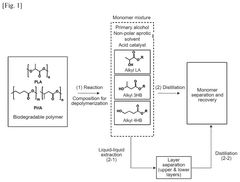
- A process involving the reaction of biodegradable polymers, such as polylactic acid (PLA) or polyhydroxyalkanoate (PHA), with a composition for depolymerization containing a primary alcohol, a non-polar aprotic solvent, and a Brønsted-Lowry acid catalyst at 90° C. or higher, achieving high monomerization conversion yields.
Environmental Life Cycle Assessment and Energy Regulations
The environmental life cycle assessment (LCA) of biodegradable polymers in low-energy manufacturing contexts represents a critical framework for evaluating true sustainability credentials. Comprehensive LCA studies must encompass all stages from raw material extraction through production, use phase, and end-of-life disposal. For biodegradable polymers manufactured through energy-optimized processes, the assessment reveals that reduced processing temperatures and simplified synthesis routes significantly lower the carbon footprint during production phases. However, the complete environmental picture requires careful examination of feedstock sourcing, particularly distinguishing between first-generation bio-based materials that may compete with food supplies versus second and third-generation alternatives derived from waste streams or non-food biomass.
Energy regulations governing polymer manufacturing have evolved substantially across major industrial regions, creating both constraints and opportunities for biodegradable polymer optimization. The European Union's Energy Efficiency Directive and Industrial Emissions Directive establish stringent benchmarks for manufacturing energy intensity, incentivizing adoption of low-temperature processing technologies. Similarly, regulatory frameworks in North America and Asia increasingly incorporate carbon pricing mechanisms and renewable energy mandates that favor manufacturing processes with reduced thermal energy requirements. These regulations directly influence the economic viability of biodegradable polymer production, as energy costs constitute a significant portion of total manufacturing expenses.
Emerging regulatory trends emphasize circular economy principles, requiring manufacturers to demonstrate not only reduced production energy but also verifiable end-of-life biodegradation under realistic environmental conditions. Standards such as ISO 14040 and ISO 14044 provide methodological guidance for conducting rigorous LCAs, while product-specific certifications like EN 13432 for compostability establish performance thresholds. The intersection of energy regulations and environmental assessment protocols creates a complex compliance landscape where optimization of biodegradable polymers must simultaneously address processing energy reduction, greenhouse gas emissions minimization, and validated biodegradation performance. This regulatory environment increasingly rewards innovations that achieve substantial energy savings during manufacturing while maintaining or enhancing material functionality and environmental compatibility throughout the complete product lifecycle.
Energy regulations governing polymer manufacturing have evolved substantially across major industrial regions, creating both constraints and opportunities for biodegradable polymer optimization. The European Union's Energy Efficiency Directive and Industrial Emissions Directive establish stringent benchmarks for manufacturing energy intensity, incentivizing adoption of low-temperature processing technologies. Similarly, regulatory frameworks in North America and Asia increasingly incorporate carbon pricing mechanisms and renewable energy mandates that favor manufacturing processes with reduced thermal energy requirements. These regulations directly influence the economic viability of biodegradable polymer production, as energy costs constitute a significant portion of total manufacturing expenses.
Emerging regulatory trends emphasize circular economy principles, requiring manufacturers to demonstrate not only reduced production energy but also verifiable end-of-life biodegradation under realistic environmental conditions. Standards such as ISO 14040 and ISO 14044 provide methodological guidance for conducting rigorous LCAs, while product-specific certifications like EN 13432 for compostability establish performance thresholds. The intersection of energy regulations and environmental assessment protocols creates a complex compliance landscape where optimization of biodegradable polymers must simultaneously address processing energy reduction, greenhouse gas emissions minimization, and validated biodegradation performance. This regulatory environment increasingly rewards innovations that achieve substantial energy savings during manufacturing while maintaining or enhancing material functionality and environmental compatibility throughout the complete product lifecycle.
Techno-Economic Viability and Industrial Scaling Strategy
The techno-economic viability of optimizing biodegradable polymers for low-energy manufacturing hinges on achieving cost parity with conventional petroleum-based plastics while maintaining competitive performance characteristics. Current production costs for biodegradable polymers range from $2.50 to $5.00 per kilogram, significantly higher than traditional plastics at $1.00 to $1.50 per kilogram. However, implementing low-energy manufacturing processes can reduce production costs by 15-30% through decreased energy consumption, which typically accounts for 20-35% of total manufacturing expenses. The economic equation becomes increasingly favorable when factoring in carbon credits, regulatory compliance benefits, and growing consumer willingness to pay premium prices for sustainable products.
Industrial scaling presents both opportunities and challenges that require strategic planning across multiple dimensions. Pilot-scale production facilities operating at 1,000-5,000 tons annually have demonstrated technical feasibility, yet transitioning to commercial-scale operations exceeding 50,000 tons annually demands substantial capital investment ranging from $50 million to $200 million depending on polymer type and processing technology. The scaling strategy must address equipment modifications to accommodate lower processing temperatures, integration of renewable energy sources, and optimization of supply chain logistics for bio-based feedstocks.
Critical success factors for industrial scaling include securing long-term feedstock supply agreements, establishing partnerships with equipment manufacturers for customized low-energy processing machinery, and developing robust quality control systems that ensure consistent product specifications at scale. Geographic considerations play a vital role, with optimal facility locations near agricultural feedstock sources reducing transportation costs by 10-15% while providing access to renewable energy infrastructure.
The investment payback period for low-energy biodegradable polymer facilities typically ranges from 5 to 8 years under current market conditions, improving to 3 to 5 years when government incentives and carbon pricing mechanisms are incorporated. Risk mitigation strategies should include modular facility design enabling phased capacity expansion, diversification of feedstock sources, and development of multiple product grades targeting different market segments to maximize revenue streams and operational flexibility.
Industrial scaling presents both opportunities and challenges that require strategic planning across multiple dimensions. Pilot-scale production facilities operating at 1,000-5,000 tons annually have demonstrated technical feasibility, yet transitioning to commercial-scale operations exceeding 50,000 tons annually demands substantial capital investment ranging from $50 million to $200 million depending on polymer type and processing technology. The scaling strategy must address equipment modifications to accommodate lower processing temperatures, integration of renewable energy sources, and optimization of supply chain logistics for bio-based feedstocks.
Critical success factors for industrial scaling include securing long-term feedstock supply agreements, establishing partnerships with equipment manufacturers for customized low-energy processing machinery, and developing robust quality control systems that ensure consistent product specifications at scale. Geographic considerations play a vital role, with optimal facility locations near agricultural feedstock sources reducing transportation costs by 10-15% while providing access to renewable energy infrastructure.
The investment payback period for low-energy biodegradable polymer facilities typically ranges from 5 to 8 years under current market conditions, improving to 3 to 5 years when government incentives and carbon pricing mechanisms are incorporated. Risk mitigation strategies should include modular facility design enabling phased capacity expansion, diversification of feedstock sources, and development of multiple product grades targeting different market segments to maximize revenue streams and operational flexibility.
Unlock deeper insights with Patsnap Eureka Quick Research — get a full tech report to explore trends and direct your research. Try now!
Generate Your Research Report Instantly with AI Agent
Supercharge your innovation with Patsnap Eureka AI Agent Platform!