

Optimize COFs for Efficient CO2 Capture Processes
APR 16, 20269 MIN READ
Generate Your Research Report Instantly with AI Agent
PatSnap Eureka helps you evaluate technical feasibility & market potential.
COFs Development Background and CO2 Capture Goals
Covalent Organic Frameworks (COFs) represent a revolutionary class of crystalline porous materials that have emerged as promising candidates for carbon dioxide capture applications. These materials were first introduced in 2005 by Yaghi and colleagues, marking a significant milestone in the development of designer porous materials. COFs are constructed through the formation of strong covalent bonds between organic building blocks, resulting in highly ordered, periodic structures with exceptional stability and tunability.
The development of COFs has been driven by the urgent need for efficient carbon capture technologies to address climate change challenges. Unlike traditional porous materials such as zeolites or metal-organic frameworks, COFs offer unique advantages including low density, high surface areas exceeding 2000 m²/g, and exceptional chemical stability under various operating conditions. Their purely organic composition eliminates concerns about metal leaching or toxicity, making them particularly attractive for environmental applications.
The evolution of COF synthesis has progressed from initial boronate-linked structures to more robust linkages including triazine, imine, and β-ketoenamine connections. This diversification has enabled the creation of materials with enhanced hydrolytic stability and improved performance under realistic operating conditions. Recent advances have focused on developing COFs with specific functionalities for selective CO2 adsorption, including the incorporation of amine groups, ionic sites, and other CO2-philic moieties.
Current research objectives in COF optimization for CO2 capture center on achieving several key performance metrics. Primary goals include maximizing CO2 uptake capacity under ambient conditions, enhancing selectivity over other gases such as nitrogen and methane, and improving regeneration efficiency to minimize energy penalties. Additionally, researchers aim to develop COFs with rapid adsorption kinetics and exceptional cycling stability to ensure long-term operational viability.
The strategic importance of COF development extends beyond laboratory curiosity to addressing real-world carbon capture challenges. Target applications include post-combustion capture from power plants, direct air capture systems, and industrial process gas purification. These applications demand materials capable of operating efficiently under varying temperature, pressure, and humidity conditions while maintaining cost-effectiveness and scalability for industrial deployment.
The development of COFs has been driven by the urgent need for efficient carbon capture technologies to address climate change challenges. Unlike traditional porous materials such as zeolites or metal-organic frameworks, COFs offer unique advantages including low density, high surface areas exceeding 2000 m²/g, and exceptional chemical stability under various operating conditions. Their purely organic composition eliminates concerns about metal leaching or toxicity, making them particularly attractive for environmental applications.
The evolution of COF synthesis has progressed from initial boronate-linked structures to more robust linkages including triazine, imine, and β-ketoenamine connections. This diversification has enabled the creation of materials with enhanced hydrolytic stability and improved performance under realistic operating conditions. Recent advances have focused on developing COFs with specific functionalities for selective CO2 adsorption, including the incorporation of amine groups, ionic sites, and other CO2-philic moieties.
Current research objectives in COF optimization for CO2 capture center on achieving several key performance metrics. Primary goals include maximizing CO2 uptake capacity under ambient conditions, enhancing selectivity over other gases such as nitrogen and methane, and improving regeneration efficiency to minimize energy penalties. Additionally, researchers aim to develop COFs with rapid adsorption kinetics and exceptional cycling stability to ensure long-term operational viability.
The strategic importance of COF development extends beyond laboratory curiosity to addressing real-world carbon capture challenges. Target applications include post-combustion capture from power plants, direct air capture systems, and industrial process gas purification. These applications demand materials capable of operating efficiently under varying temperature, pressure, and humidity conditions while maintaining cost-effectiveness and scalability for industrial deployment.
Market Demand for Advanced CO2 Capture Technologies
The global carbon dioxide capture market is experiencing unprecedented growth driven by escalating climate change concerns and increasingly stringent environmental regulations worldwide. Industrial sectors including power generation, cement production, steel manufacturing, and petrochemicals are under mounting pressure to reduce their carbon footprints, creating substantial demand for advanced CO2 capture technologies. Traditional amine-based absorption systems, while commercially available, suffer from high energy requirements for solvent regeneration and corrosive properties that limit their widespread adoption.
Covalent Organic Frameworks represent a transformative solution addressing these market pain points through their unique structural advantages. The demand for COF-based capture systems stems from their exceptional tunability, allowing precise pore size control and surface functionalization to optimize CO2 selectivity and capacity. Unlike conventional materials, COFs offer superior thermal and chemical stability while maintaining lower regeneration energy requirements, directly addressing industry cost concerns.
Market drivers for optimized COF technologies include the growing implementation of carbon pricing mechanisms across major economies and corporate sustainability commitments targeting net-zero emissions. The industrial gas separation market, valued significantly in recent years, shows particular interest in materials capable of selective CO2 capture from mixed gas streams with minimal energy penalties.
Direct air capture applications represent an emerging high-value market segment where COFs demonstrate particular promise. The technology's ability to capture CO2 from ultra-dilute atmospheric concentrations requires materials with exceptional selectivity and stability, characteristics inherent to well-designed COF structures. This application area commands premium pricing due to its critical role in achieving negative emissions targets.
The post-combustion capture market segment shows strong demand for COF materials that can operate effectively in the presence of water vapor and other flue gas contaminants. Industrial facilities seek drop-in replacement technologies that can integrate with existing infrastructure while delivering superior performance metrics. COF optimization efforts focusing on hydrothermal stability and contaminant tolerance directly address these market requirements.
Emerging carbon utilization pathways are creating additional demand for high-purity CO2 streams, where COF-based separation systems can provide the selectivity needed for downstream conversion processes. The integration of capture and utilization technologies represents a growing market opportunity for advanced materials capable of delivering both high purity and low energy consumption.
Covalent Organic Frameworks represent a transformative solution addressing these market pain points through their unique structural advantages. The demand for COF-based capture systems stems from their exceptional tunability, allowing precise pore size control and surface functionalization to optimize CO2 selectivity and capacity. Unlike conventional materials, COFs offer superior thermal and chemical stability while maintaining lower regeneration energy requirements, directly addressing industry cost concerns.
Market drivers for optimized COF technologies include the growing implementation of carbon pricing mechanisms across major economies and corporate sustainability commitments targeting net-zero emissions. The industrial gas separation market, valued significantly in recent years, shows particular interest in materials capable of selective CO2 capture from mixed gas streams with minimal energy penalties.
Direct air capture applications represent an emerging high-value market segment where COFs demonstrate particular promise. The technology's ability to capture CO2 from ultra-dilute atmospheric concentrations requires materials with exceptional selectivity and stability, characteristics inherent to well-designed COF structures. This application area commands premium pricing due to its critical role in achieving negative emissions targets.
The post-combustion capture market segment shows strong demand for COF materials that can operate effectively in the presence of water vapor and other flue gas contaminants. Industrial facilities seek drop-in replacement technologies that can integrate with existing infrastructure while delivering superior performance metrics. COF optimization efforts focusing on hydrothermal stability and contaminant tolerance directly address these market requirements.
Emerging carbon utilization pathways are creating additional demand for high-purity CO2 streams, where COF-based separation systems can provide the selectivity needed for downstream conversion processes. The integration of capture and utilization technologies represents a growing market opportunity for advanced materials capable of delivering both high purity and low energy consumption.
Current COFs Performance and CO2 Adsorption Challenges
Covalent Organic Frameworks (COFs) have emerged as promising materials for CO2 capture applications due to their unique structural properties, including high surface areas, tunable pore sizes, and excellent chemical stability. However, current COF performance in CO2 adsorption faces several significant challenges that limit their widespread industrial implementation.
The CO2 adsorption capacity of existing COFs varies considerably, with most materials achieving capacities ranging from 2-8 mmol/g at standard temperature and pressure conditions. While some high-performing COFs demonstrate capacities exceeding 10 mmol/g, these values often require elevated pressures or reduced temperatures, making them less practical for real-world applications. The theoretical maximum capacity remains significantly higher than experimentally achieved values, indicating substantial room for improvement.
Selectivity represents another critical performance bottleneck. Many COFs struggle to effectively separate CO2 from gas mixtures containing N2, CH4, or H2O vapor, which are common in industrial flue gas streams. The CO2/N2 selectivity ratios typically range from 10-50 for most COFs, falling short of the performance required for efficient post-combustion capture processes. Water vapor interference poses particularly severe challenges, as moisture can compete with CO2 for adsorption sites and potentially degrade framework stability.
Kinetic limitations further constrain COF performance in dynamic capture processes. Slow CO2 diffusion rates within certain pore structures lead to incomplete utilization of available adsorption sites during rapid gas flow conditions. This results in reduced working capacities and longer equilibration times, compromising the efficiency of pressure swing adsorption cycles commonly used in industrial CO2 capture systems.
Thermal stability issues present additional operational challenges. Many COFs experience structural degradation or reduced adsorption performance when subjected to the elevated temperatures required for regeneration cycles. The temperature swing processes necessary for CO2 desorption often operate at 80-120°C, conditions that can compromise the crystallinity and porosity of certain framework materials over extended cycling periods.
Chemical stability under realistic operating conditions remains problematic for numerous COF materials. Exposure to acidic components in flue gas, such as SO2 and NOx, can cause framework decomposition or pore blocking. Additionally, the presence of trace contaminants and varying humidity levels in industrial gas streams can gradually degrade COF performance through irreversible chemical interactions or physical pore obstruction mechanisms.
The CO2 adsorption capacity of existing COFs varies considerably, with most materials achieving capacities ranging from 2-8 mmol/g at standard temperature and pressure conditions. While some high-performing COFs demonstrate capacities exceeding 10 mmol/g, these values often require elevated pressures or reduced temperatures, making them less practical for real-world applications. The theoretical maximum capacity remains significantly higher than experimentally achieved values, indicating substantial room for improvement.
Selectivity represents another critical performance bottleneck. Many COFs struggle to effectively separate CO2 from gas mixtures containing N2, CH4, or H2O vapor, which are common in industrial flue gas streams. The CO2/N2 selectivity ratios typically range from 10-50 for most COFs, falling short of the performance required for efficient post-combustion capture processes. Water vapor interference poses particularly severe challenges, as moisture can compete with CO2 for adsorption sites and potentially degrade framework stability.
Kinetic limitations further constrain COF performance in dynamic capture processes. Slow CO2 diffusion rates within certain pore structures lead to incomplete utilization of available adsorption sites during rapid gas flow conditions. This results in reduced working capacities and longer equilibration times, compromising the efficiency of pressure swing adsorption cycles commonly used in industrial CO2 capture systems.
Thermal stability issues present additional operational challenges. Many COFs experience structural degradation or reduced adsorption performance when subjected to the elevated temperatures required for regeneration cycles. The temperature swing processes necessary for CO2 desorption often operate at 80-120°C, conditions that can compromise the crystallinity and porosity of certain framework materials over extended cycling periods.
Chemical stability under realistic operating conditions remains problematic for numerous COF materials. Exposure to acidic components in flue gas, such as SO2 and NOx, can cause framework decomposition or pore blocking. Additionally, the presence of trace contaminants and varying humidity levels in industrial gas streams can gradually degrade COF performance through irreversible chemical interactions or physical pore obstruction mechanisms.
Existing COFs Optimization Strategies for CO2 Capture
01 COFs for photocatalytic applications
Covalent organic frameworks (COFs) can be designed and synthesized with specific structural features to enhance photocatalytic efficiency. The crystalline porous structure and tunable electronic properties of COFs make them suitable for light-harvesting and photocatalytic reactions. By optimizing the building blocks and linkage chemistry, COFs can achieve improved charge separation and transfer, leading to enhanced photocatalytic performance in applications such as water splitting, CO2 reduction, and organic pollutant degradation.- COFs for photocatalytic applications: Covalent organic frameworks can be designed and synthesized with specific structural features to enhance photocatalytic efficiency. The frameworks can be engineered with appropriate band gaps and light absorption properties to facilitate photocatalytic reactions. Modifications to the framework structure, including the incorporation of specific functional groups and linkers, can improve charge separation and transfer efficiency, leading to enhanced photocatalytic performance in various applications such as water splitting and pollutant degradation.
- COFs for gas separation and adsorption: Covalent organic frameworks with tailored pore sizes and surface chemistry can be utilized for efficient gas separation and adsorption processes. The high surface area and tunable porosity of these frameworks enable selective capture and separation of specific gas molecules. The efficiency can be enhanced through strategic design of pore architecture and incorporation of functional sites that provide strong interactions with target gas molecules, improving selectivity and capacity.
- COFs for catalytic reactions: Covalent organic frameworks can serve as efficient catalytic platforms due to their high surface area, tunable pore structure, and ability to incorporate active catalytic sites. The frameworks can be functionalized with metal centers or organic catalytic groups to enhance catalytic activity. The ordered structure and accessible pore channels facilitate mass transfer and substrate accessibility, leading to improved catalytic efficiency in various organic transformations and chemical reactions.
- COFs for energy storage applications: Covalent organic frameworks can be designed for enhanced efficiency in energy storage devices such as batteries and supercapacitors. The frameworks provide high surface area and controllable pore structures that facilitate ion transport and charge storage. Incorporation of redox-active units and conductive components into the framework structure can improve electron transfer kinetics and overall energy storage performance, leading to devices with higher capacity and better cycling stability.
- COFs for sensing and detection: Covalent organic frameworks can be engineered for efficient sensing and detection applications through incorporation of responsive functional groups and chromophoric units. The high surface area and ordered structure enable effective interaction with target analytes, leading to enhanced sensitivity. The frameworks can be designed to provide selective recognition sites and signal transduction mechanisms, improving detection efficiency for various chemical and biological species through optical, electrochemical, or other sensing modalities.
02 COFs for gas separation and adsorption
COFs with high surface area and well-defined pore structures can be utilized for efficient gas separation and adsorption processes. The tunable pore size and surface chemistry of COFs enable selective capture and separation of specific gas molecules. These materials demonstrate high adsorption capacity and selectivity for various gases, making them promising candidates for applications in carbon capture, hydrogen storage, and air purification. The efficiency can be further enhanced through functionalization and structural optimization.Expand Specific Solutions03 COFs for catalytic reactions
COFs can serve as efficient heterogeneous catalysts or catalyst supports due to their high surface area, accessible active sites, and structural stability. The framework can be designed to incorporate catalytically active centers through direct synthesis or post-synthetic modification. These materials show enhanced catalytic efficiency in various organic transformations, including oxidation, reduction, and coupling reactions. The ordered porous structure facilitates mass transfer and substrate accessibility to active sites, improving overall catalytic performance.Expand Specific Solutions04 COFs for energy storage applications
COFs can be engineered for use in energy storage devices such as batteries and supercapacitors. The porous structure and redox-active building blocks enable efficient ion transport and charge storage. These materials demonstrate improved electrochemical performance including high capacity, good rate capability, and cycling stability. The efficiency of COFs in energy storage can be optimized through rational design of the framework structure, incorporation of conductive components, and control of pore architecture.Expand Specific Solutions05 COFs for sensing and detection
COFs with specific recognition sites and signal transduction capabilities can be developed for efficient sensing and detection applications. The high surface area and tunable functionality allow for selective interaction with target analytes. These materials exhibit enhanced sensitivity and selectivity in detecting various chemical and biological species. The efficiency of COF-based sensors can be improved through optimization of the framework structure, introduction of responsive functional groups, and integration with signal amplification strategies.Expand Specific Solutions
Key Players in COFs and Carbon Capture Industry
The CO2 capture using Covalent Organic Frameworks (COFs) represents an emerging technology sector in the early-to-mid development stage, with significant market potential driven by global decarbonization initiatives. The competitive landscape spans diverse players from academic institutions like University of California and King Abdullah University conducting fundamental research, to industrial giants including Air Liquide SA, Saudi Arabian Oil Co., and ExxonMobil Technology & Engineering Co. developing commercial applications. Technology maturity varies considerably across participants, with specialized companies like Climeworks AG and CarbonQuest Inc. demonstrating advanced direct air capture implementations, while traditional energy companies such as China Petroleum & Chemical Corp. and Air Products & Chemicals Inc. leverage existing infrastructure for scaled deployment. Research institutions including South China University of Technology and Georgia Tech Research Corp. continue advancing COF optimization, indicating ongoing innovation potential in this rapidly evolving carbon capture market.
Air Liquide SA
Technical Solution: Air Liquide has developed proprietary COF-based materials for industrial CO2 capture applications, focusing on post-combustion capture systems. Their approach involves metal-organic framework integration with COF structures to create hybrid materials that demonstrate enhanced CO2 adsorption capacity of 3-5 mmol/g at industrial flue gas conditions. The company's COF optimization strategy emphasizes thermal stability up to 200°C, rapid adsorption kinetics, and resistance to impurities like SOx and NOx commonly found in industrial emissions. Their technology includes advanced regeneration processes that reduce energy penalties by 15-20% compared to conventional amine-based systems.
Strengths: Industrial-scale experience, robust materials resistant to flue gas impurities, energy-efficient regeneration. Weaknesses: Limited to post-combustion applications, requires significant infrastructure investment.
Saudi Arabian Oil Co.
Technical Solution: Saudi Aramco has invested in COF research for CO2 capture applications in oil and gas operations, particularly focusing on enhanced oil recovery integration. Their technology development centers on creating COF materials that can selectively capture CO2 from natural gas streams and industrial processes while maintaining high thermal and chemical stability in desert operating conditions. The company's approach includes collaboration with research institutions to develop novel COF architectures with improved hydrothermal stability and resistance to H2S contamination. Their systems target CO2 capture efficiencies above 90% with integration into existing oil and gas infrastructure for carbon utilization and storage applications.
Strengths: Integration with oil and gas operations, focus on harsh environmental conditions, carbon utilization capabilities. Weaknesses: Limited commercial deployment, primarily research and development stage.
Core Innovations in COFs Structure Design Patents
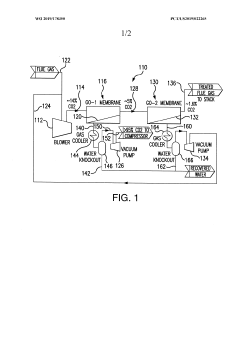
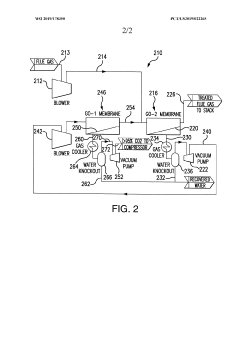
Energy efficient membrane-based process for co 2 capture
PatentWO2019178350A1
Innovation
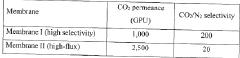
- The implementation of a membrane-based process using high CO2/N2 selectivity graphene oxide (GO) membranes in a two-stage separation system, where a first stage high selectivity membrane is followed by a second stage high flux membrane to efficiently capture CO2 from power plant flue gases, reducing energy consumption and costs.

Solvent-based co2 capture process incorporating overhead vapor compression
PatentPendingUS20240307820A1
Innovation
- The process increases the condensation temperature of water in the CO2 stripper overhead above the process pinch temperature, allowing for 90% recovery of water vapor latent heat, which is used to heat the feed, reducing the net heater duty by 17% and decreasing heat usage while increasing electricity usage, thus lowering global warming potential.


Environmental Regulations for Carbon Capture Technologies
The regulatory landscape for carbon capture technologies, particularly those involving Covalent Organic Frameworks (COFs) for CO2 capture, is rapidly evolving as governments worldwide intensify their climate commitments. The Paris Agreement has catalyzed a comprehensive framework of environmental regulations that directly impact the development and deployment of advanced CO2 capture materials and processes.
In the United States, the Environmental Protection Agency (EPA) has established stringent emission standards under the Clean Air Act, with specific provisions for large-scale CO2 emitters. The Infrastructure Investment and Jobs Act allocates substantial funding for carbon capture research and deployment, creating regulatory pathways that favor innovative materials like optimized COFs. The 45Q tax credit program provides significant financial incentives for CO2 capture projects, with enhanced credits for direct air capture technologies that could benefit from high-performance COF materials.
The European Union's Green Deal and the European Climate Law mandate carbon neutrality by 2050, establishing the EU Emissions Trading System (ETS) as a key regulatory mechanism. The Carbon Border Adjustment Mechanism (CBAM) creates additional pressure for efficient CO2 capture solutions across industrial sectors. EU regulations emphasize material safety and environmental impact assessments, requiring comprehensive lifecycle analyses for new capture technologies including COF-based systems.
China's national carbon trading scheme and commitment to carbon neutrality by 2060 have generated extensive regulatory frameworks supporting carbon capture innovation. The country's 14th Five-Year Plan specifically promotes advanced materials research for environmental applications, creating favorable conditions for COF optimization research and industrial implementation.
International standards organizations, including ISO and ASTM, are developing specific protocols for carbon capture material testing and performance verification. These emerging standards will likely influence how optimized COFs are evaluated, certified, and deployed in commercial applications. Regulatory compliance requirements increasingly focus on capture efficiency metrics, material durability, and environmental safety profiles that directly align with COF optimization objectives.
The regulatory trend toward mandatory carbon reporting and science-based emission targets is driving demand for more efficient capture technologies, positioning optimized COFs as potentially crucial components in meeting stringent environmental compliance requirements across multiple jurisdictions.
In the United States, the Environmental Protection Agency (EPA) has established stringent emission standards under the Clean Air Act, with specific provisions for large-scale CO2 emitters. The Infrastructure Investment and Jobs Act allocates substantial funding for carbon capture research and deployment, creating regulatory pathways that favor innovative materials like optimized COFs. The 45Q tax credit program provides significant financial incentives for CO2 capture projects, with enhanced credits for direct air capture technologies that could benefit from high-performance COF materials.
The European Union's Green Deal and the European Climate Law mandate carbon neutrality by 2050, establishing the EU Emissions Trading System (ETS) as a key regulatory mechanism. The Carbon Border Adjustment Mechanism (CBAM) creates additional pressure for efficient CO2 capture solutions across industrial sectors. EU regulations emphasize material safety and environmental impact assessments, requiring comprehensive lifecycle analyses for new capture technologies including COF-based systems.
China's national carbon trading scheme and commitment to carbon neutrality by 2060 have generated extensive regulatory frameworks supporting carbon capture innovation. The country's 14th Five-Year Plan specifically promotes advanced materials research for environmental applications, creating favorable conditions for COF optimization research and industrial implementation.
International standards organizations, including ISO and ASTM, are developing specific protocols for carbon capture material testing and performance verification. These emerging standards will likely influence how optimized COFs are evaluated, certified, and deployed in commercial applications. Regulatory compliance requirements increasingly focus on capture efficiency metrics, material durability, and environmental safety profiles that directly align with COF optimization objectives.
The regulatory trend toward mandatory carbon reporting and science-based emission targets is driving demand for more efficient capture technologies, positioning optimized COFs as potentially crucial components in meeting stringent environmental compliance requirements across multiple jurisdictions.
Economic Feasibility of COFs-based CO2 Capture Systems
The economic feasibility of COFs-based CO2 capture systems represents a critical factor determining their commercial viability and widespread adoption. Current cost analyses indicate that COFs production remains expensive due to complex synthesis procedures, specialized precursor materials, and stringent purification requirements. Manufacturing costs typically range from $50-200 per kilogram depending on the specific COF structure and production scale, significantly higher than conventional adsorbents like activated carbon or zeolites.
Capital expenditure considerations encompass reactor design modifications, specialized handling equipment for COF materials, and enhanced process control systems. The modular nature of COFs allows for scalable deployment, potentially reducing initial investment barriers compared to traditional large-scale capture facilities. However, the current lack of established supply chains and manufacturing infrastructure creates additional cost premiums that impact overall project economics.
Operational expenditure analysis reveals mixed economic indicators. While COFs demonstrate superior CO2 selectivity and capacity, leading to reduced energy requirements for regeneration cycles, their long-term stability under industrial conditions remains a concern. Replacement costs and maintenance schedules significantly influence the total cost of ownership. Current estimates suggest regeneration energy savings of 15-25% compared to amine-based systems, translating to operational cost reductions of $10-15 per ton of CO2 captured.
Market penetration scenarios indicate that COFs-based systems could achieve cost parity with existing technologies when production scales reach 1000+ tons annually. Government incentives, carbon pricing mechanisms, and regulatory frameworks supporting advanced capture technologies create favorable economic conditions. The potential for COFs integration into existing industrial processes without major infrastructure overhauls presents additional economic advantages.
Economic projections suggest that optimized COFs systems could achieve capture costs below $50 per ton of CO2 by 2030, assuming continued technological advancement and manufacturing scale-up. This cost target aligns with industry requirements for economically viable carbon capture deployment across various industrial sectors.
Capital expenditure considerations encompass reactor design modifications, specialized handling equipment for COF materials, and enhanced process control systems. The modular nature of COFs allows for scalable deployment, potentially reducing initial investment barriers compared to traditional large-scale capture facilities. However, the current lack of established supply chains and manufacturing infrastructure creates additional cost premiums that impact overall project economics.
Operational expenditure analysis reveals mixed economic indicators. While COFs demonstrate superior CO2 selectivity and capacity, leading to reduced energy requirements for regeneration cycles, their long-term stability under industrial conditions remains a concern. Replacement costs and maintenance schedules significantly influence the total cost of ownership. Current estimates suggest regeneration energy savings of 15-25% compared to amine-based systems, translating to operational cost reductions of $10-15 per ton of CO2 captured.
Market penetration scenarios indicate that COFs-based systems could achieve cost parity with existing technologies when production scales reach 1000+ tons annually. Government incentives, carbon pricing mechanisms, and regulatory frameworks supporting advanced capture technologies create favorable economic conditions. The potential for COFs integration into existing industrial processes without major infrastructure overhauls presents additional economic advantages.
Economic projections suggest that optimized COFs systems could achieve capture costs below $50 per ton of CO2 by 2030, assuming continued technological advancement and manufacturing scale-up. This cost target aligns with industry requirements for economically viable carbon capture deployment across various industrial sectors.
Unlock deeper insights with PatSnap Eureka Quick Research — get a full tech report to explore trends and direct your research. Try now!
Generate Your Research Report Instantly with AI Agent
Supercharge your innovation with PatSnap Eureka AI Agent Platform!