Optimize Thermal Management Using Multi-Eutectic Systems
FEB 3, 20269 MIN READ
Generate Your Research Report Instantly with AI Agent
Patsnap Eureka helps you evaluate technical feasibility & market potential.
Multi-Eutectic Thermal Management Background and Objectives
Thermal management has emerged as a critical challenge in modern engineering systems, particularly as power densities continue to increase in electronics, energy storage, and transportation applications. Traditional single-phase change materials, while effective within narrow temperature ranges, often fail to provide adequate thermal regulation across the broad operational spectrums demanded by contemporary technologies. The limitations of conventional cooling approaches have driven researchers to explore more sophisticated solutions capable of managing heat loads across multiple temperature thresholds.
Multi-eutectic systems represent an innovative approach to thermal management by leveraging multiple phase change materials with distinct melting points within a single integrated system. These systems exploit the latent heat absorption characteristics of different eutectic compositions, enabling sequential or simultaneous thermal buffering across varied temperature zones. The fundamental principle involves strategically combining materials whose eutectic points align with critical operational temperatures, thereby creating a cascading thermal management effect that extends the effective temperature range and enhances overall heat dissipation efficiency.
The evolution of multi-eutectic thermal management traces back to early research in phase change materials during the 1980s, initially focused on building temperature regulation and solar energy storage. However, the exponential growth in computational power and miniaturization of electronic devices over the past two decades has intensified the need for more advanced thermal solutions. The semiconductor industry's transition to higher power densities, coupled with the proliferation of electric vehicles and high-performance battery systems, has accelerated development in this field.
The primary objective of optimizing thermal management through multi-eutectic systems is to achieve superior temperature stabilization across broader operational ranges while maintaining compact form factors and high energy efficiency. Specific technical goals include maximizing latent heat storage capacity, minimizing thermal resistance between heat sources and phase change materials, ensuring reliable cycling performance over extended operational lifetimes, and developing cost-effective manufacturing processes. Additionally, addressing challenges related to material compatibility, thermal conductivity enhancement, and system integration remains paramount to advancing practical implementations across diverse industrial applications.
Multi-eutectic systems represent an innovative approach to thermal management by leveraging multiple phase change materials with distinct melting points within a single integrated system. These systems exploit the latent heat absorption characteristics of different eutectic compositions, enabling sequential or simultaneous thermal buffering across varied temperature zones. The fundamental principle involves strategically combining materials whose eutectic points align with critical operational temperatures, thereby creating a cascading thermal management effect that extends the effective temperature range and enhances overall heat dissipation efficiency.
The evolution of multi-eutectic thermal management traces back to early research in phase change materials during the 1980s, initially focused on building temperature regulation and solar energy storage. However, the exponential growth in computational power and miniaturization of electronic devices over the past two decades has intensified the need for more advanced thermal solutions. The semiconductor industry's transition to higher power densities, coupled with the proliferation of electric vehicles and high-performance battery systems, has accelerated development in this field.
The primary objective of optimizing thermal management through multi-eutectic systems is to achieve superior temperature stabilization across broader operational ranges while maintaining compact form factors and high energy efficiency. Specific technical goals include maximizing latent heat storage capacity, minimizing thermal resistance between heat sources and phase change materials, ensuring reliable cycling performance over extended operational lifetimes, and developing cost-effective manufacturing processes. Additionally, addressing challenges related to material compatibility, thermal conductivity enhancement, and system integration remains paramount to advancing practical implementations across diverse industrial applications.
Market Demand for Advanced Thermal Solutions
The global demand for advanced thermal management solutions is experiencing unprecedented growth, driven by the escalating heat dissipation challenges across multiple high-performance sectors. Electronics miniaturization, particularly in consumer devices, data centers, and telecommunications infrastructure, has created critical thermal bottlenecks that conventional cooling methods struggle to address effectively. As semiconductor devices continue to shrink while power densities increase, the thermal management market faces mounting pressure to deliver innovative solutions capable of handling heat fluxes exceeding traditional system capabilities.
Electric vehicle adoption represents another significant demand driver, where battery thermal management directly impacts safety, performance, and longevity. The automotive industry requires thermal solutions that can maintain optimal operating temperatures across diverse environmental conditions while minimizing weight and energy consumption. Multi-eutectic phase change materials present compelling advantages in this context, offering passive thermal regulation without additional power requirements, which aligns with the industry's efficiency objectives.
Renewable energy systems, particularly solar photovoltaic installations and energy storage facilities, demonstrate growing requirements for sophisticated thermal management. Temperature fluctuations significantly affect conversion efficiency and equipment lifespan, creating substantial market opportunities for solutions that can stabilize operating conditions. The integration of multi-eutectic systems in these applications addresses both performance optimization and maintenance cost reduction, two critical factors influencing technology adoption decisions.
Industrial manufacturing sectors, including aerospace, defense, and high-performance computing, exhibit increasing demand for thermal solutions capable of operating reliably under extreme conditions. These applications require materials and systems that maintain consistent performance across wide temperature ranges while meeting stringent reliability standards. The ability of multi-eutectic systems to provide multiple phase transition points offers distinct advantages in managing complex thermal profiles encountered in these demanding environments.
Market growth is further accelerated by regulatory pressures emphasizing energy efficiency and environmental sustainability. Governments worldwide are implementing stricter thermal management standards for electronic products and industrial equipment, compelling manufacturers to adopt more effective cooling technologies. This regulatory landscape creates favorable conditions for advanced thermal solutions that demonstrate superior performance while reducing environmental impact through passive operation and extended system lifespans.
Electric vehicle adoption represents another significant demand driver, where battery thermal management directly impacts safety, performance, and longevity. The automotive industry requires thermal solutions that can maintain optimal operating temperatures across diverse environmental conditions while minimizing weight and energy consumption. Multi-eutectic phase change materials present compelling advantages in this context, offering passive thermal regulation without additional power requirements, which aligns with the industry's efficiency objectives.
Renewable energy systems, particularly solar photovoltaic installations and energy storage facilities, demonstrate growing requirements for sophisticated thermal management. Temperature fluctuations significantly affect conversion efficiency and equipment lifespan, creating substantial market opportunities for solutions that can stabilize operating conditions. The integration of multi-eutectic systems in these applications addresses both performance optimization and maintenance cost reduction, two critical factors influencing technology adoption decisions.
Industrial manufacturing sectors, including aerospace, defense, and high-performance computing, exhibit increasing demand for thermal solutions capable of operating reliably under extreme conditions. These applications require materials and systems that maintain consistent performance across wide temperature ranges while meeting stringent reliability standards. The ability of multi-eutectic systems to provide multiple phase transition points offers distinct advantages in managing complex thermal profiles encountered in these demanding environments.
Market growth is further accelerated by regulatory pressures emphasizing energy efficiency and environmental sustainability. Governments worldwide are implementing stricter thermal management standards for electronic products and industrial equipment, compelling manufacturers to adopt more effective cooling technologies. This regulatory landscape creates favorable conditions for advanced thermal solutions that demonstrate superior performance while reducing environmental impact through passive operation and extended system lifespans.
Current Status and Challenges in Multi-Eutectic Systems
Multi-eutectic systems have emerged as promising candidates for advanced thermal management applications due to their ability to provide multiple phase transition temperatures and enhanced thermal storage capacity. Currently, these systems are being explored across various industries including electronics cooling, building energy management, and automotive thermal regulation. The fundamental principle relies on combining multiple eutectic compositions that undergo phase transitions at different temperature ranges, thereby extending the operational temperature window and improving overall thermal buffering performance.
The development status of multi-eutectic systems varies significantly across different geographical regions. North America and Europe lead in fundamental research and patent filings, with substantial contributions from academic institutions and research laboratories. Asian countries, particularly China, Japan, and South Korea, demonstrate strong capabilities in manufacturing and commercialization of phase change materials. However, the specific application of multi-eutectic configurations remains predominantly in laboratory-scale demonstrations, with limited large-scale industrial implementations.
Several critical technical challenges impede the widespread adoption of multi-eutectic thermal management systems. Material compatibility represents a primary concern, as different eutectic compositions may exhibit chemical interactions that compromise long-term stability and cycling performance. The precise control of phase separation and maintenance of distinct transition temperatures during repeated thermal cycles poses significant engineering difficulties. Supercooling phenomena in multi-component systems can lead to unpredictable thermal behavior and reduced system reliability.
Thermal conductivity limitations continue to constrain the practical effectiveness of multi-eutectic systems. Most eutectic compositions inherently possess low thermal conductivity, necessitating the integration of thermal enhancement techniques such as metal foams, carbon-based additives, or finned structures. However, these enhancements often introduce additional complexity in system design and manufacturing costs. The optimization of thermal conductivity while maintaining the beneficial multi-phase transition characteristics remains an ongoing research priority.
Encapsulation technology presents another substantial challenge for multi-eutectic systems. Effective containment must prevent material leakage during phase transitions while ensuring adequate heat transfer and mechanical durability. Current encapsulation methods struggle to accommodate the volumetric expansion associated with multiple phase changes and maintain structural integrity over extended operational lifetimes. Furthermore, the scalability of encapsulation processes for commercial production requires significant technological advancement to achieve cost-effectiveness and manufacturing reliability.
The development status of multi-eutectic systems varies significantly across different geographical regions. North America and Europe lead in fundamental research and patent filings, with substantial contributions from academic institutions and research laboratories. Asian countries, particularly China, Japan, and South Korea, demonstrate strong capabilities in manufacturing and commercialization of phase change materials. However, the specific application of multi-eutectic configurations remains predominantly in laboratory-scale demonstrations, with limited large-scale industrial implementations.
Several critical technical challenges impede the widespread adoption of multi-eutectic thermal management systems. Material compatibility represents a primary concern, as different eutectic compositions may exhibit chemical interactions that compromise long-term stability and cycling performance. The precise control of phase separation and maintenance of distinct transition temperatures during repeated thermal cycles poses significant engineering difficulties. Supercooling phenomena in multi-component systems can lead to unpredictable thermal behavior and reduced system reliability.
Thermal conductivity limitations continue to constrain the practical effectiveness of multi-eutectic systems. Most eutectic compositions inherently possess low thermal conductivity, necessitating the integration of thermal enhancement techniques such as metal foams, carbon-based additives, or finned structures. However, these enhancements often introduce additional complexity in system design and manufacturing costs. The optimization of thermal conductivity while maintaining the beneficial multi-phase transition characteristics remains an ongoing research priority.
Encapsulation technology presents another substantial challenge for multi-eutectic systems. Effective containment must prevent material leakage during phase transitions while ensuring adequate heat transfer and mechanical durability. Current encapsulation methods struggle to accommodate the volumetric expansion associated with multiple phase changes and maintain structural integrity over extended operational lifetimes. Furthermore, the scalability of encapsulation processes for commercial production requires significant technological advancement to achieve cost-effectiveness and manufacturing reliability.
Existing Multi-Eutectic Thermal Management Solutions
01 Deep eutectic solvents for thermal energy storage
Deep eutectic solvents (DES) can be utilized as phase change materials for thermal energy storage applications. These systems exhibit favorable thermal properties including specific melting points, latent heat capacity, and thermal stability. The eutectic mixtures can be formulated from various hydrogen bond donors and acceptors to achieve desired thermal characteristics for heat management applications.- Deep eutectic solvents for thermal energy storage: Deep eutectic solvents (DES) can be utilized as phase change materials for thermal energy storage applications. These systems exhibit favorable thermal properties including suitable melting points, high latent heat capacity, and thermal stability. The eutectic mixtures can be formulated from various hydrogen bond donors and acceptors to achieve desired thermal characteristics for heat management applications.
- Multi-component eutectic systems for battery thermal management: Multi-eutectic compositions can be employed in battery thermal management systems to regulate temperature during charging and discharging cycles. These systems utilize the phase transition properties of eutectic mixtures to absorb and release thermal energy, maintaining optimal operating temperatures. The formulations can be integrated into battery packs or cooling systems to enhance safety and performance.
- Eutectic alloys for electronic device cooling: Eutectic alloy systems can be applied in thermal interface materials and heat sinks for electronic devices. These materials provide efficient heat dissipation due to their low melting points and high thermal conductivity. The eutectic compositions can be tailored to match specific thermal requirements of semiconductor devices and power electronics, improving overall thermal management performance.
- Encapsulated eutectic phase change materials: Encapsulation techniques can be used to contain eutectic phase change materials for thermal regulation applications. The encapsulated systems prevent leakage during phase transitions while maintaining thermal performance. These materials can be incorporated into building materials, textiles, or packaging to provide passive thermal management through latent heat storage and release.
- Composite eutectic systems with enhanced thermal conductivity: Composite materials combining eutectic mixtures with thermally conductive additives can improve heat transfer rates in thermal management applications. The incorporation of materials such as graphene, carbon nanotubes, or metal particles enhances the thermal conductivity while maintaining the phase change properties of the eutectic system. These composites are suitable for applications requiring rapid thermal response and efficient heat distribution.
02 Multi-component eutectic systems for battery thermal management
Multi-eutectic compositions can be employed in battery thermal management systems to regulate temperature during charging and discharging cycles. These systems provide efficient heat dissipation and temperature control through phase transition mechanisms. The eutectic materials can be integrated into battery pack designs to maintain optimal operating temperatures and enhance safety.Expand Specific Solutions03 Eutectic alloys for electronic device cooling
Eutectic alloy systems can be applied for thermal management in electronic devices and semiconductor applications. These materials offer high thermal conductivity and appropriate melting characteristics for heat spreading and dissipation. The alloy compositions can be tailored to provide effective thermal interface materials that improve heat transfer from heat-generating components.Expand Specific Solutions04 Encapsulated eutectic phase change materials
Encapsulation techniques can be used to contain eutectic phase change materials for thermal regulation applications. The encapsulated systems prevent leakage during phase transitions while maintaining thermal performance. Various encapsulation methods and shell materials can be employed to enhance the stability and durability of the eutectic thermal management systems.Expand Specific Solutions05 Composite eutectic materials with enhanced thermal properties
Composite materials incorporating eutectic systems with additives such as nanoparticles, graphene, or metal foams can provide enhanced thermal conductivity and heat transfer performance. These composite structures improve the overall thermal management efficiency by addressing limitations of pure eutectic materials. The composites can be designed for specific applications requiring rapid heat absorption or dissipation.Expand Specific Solutions
Key Players in Multi-Eutectic Thermal Materials Industry
The thermal management optimization using multi-eutectic systems represents an evolving technology landscape positioned at the intersection of advanced materials science and energy efficiency. The market is experiencing significant growth driven by electric vehicle proliferation and renewable energy storage demands, with major automotive manufacturers like BYD, Honda, Volkswagen, Jaguar Land Rover, and Xiaomi Automobile actively developing thermal solutions. Technology maturity varies considerably across players: established automotive suppliers such as Valeo Thermal Systems and Marelli Europe demonstrate advanced integration capabilities, while energy-focused companies including Huawei Digital Power, Rimac Technology, and Harvest Thermal are pioneering innovative battery thermal management systems. The competitive landscape also features semiconductor and materials specialists like Hygon Information Technology and photovoltaic companies such as Zhejiang Sino-Italian Photovoltaic, indicating cross-industry convergence. Research institutions like Commissariat à l'énergie atomique contribute fundamental breakthroughs, suggesting the technology remains partially in development phase while simultaneously achieving commercial deployment in specific applications.
Valeo Thermal Systems Japan Corp.
Technical Solution: Valeo has developed a multi-eutectic thermal management system specifically designed for automotive HVAC and battery thermal regulation, incorporating bio-based PCMs with multiple eutectic compositions (fatty acid esters with melting points ranging from 15°C to 45°C). The system utilizes a modular heat exchanger design where different eutectic PCM chambers are strategically positioned to handle varying thermal loads across the vehicle's thermal zones. The technology features enhanced thermal interface materials that improve heat transfer rates between the PCM modules and active cooling circuits, achieving heat flux management up to 5000 W/m². Valeo's approach emphasizes lightweight construction using polymer-based PCM encapsulation, reducing overall system weight by 20-25% compared to traditional thermal mass solutions while maintaining thermal storage capacity of 150-200 kJ/kg across the multi-eutectic range.
Strengths: Lightweight design optimized for automotive applications, environmentally friendly bio-based materials, modular architecture enabling flexible integration. Weaknesses: Bio-based PCMs may have lower thermal stability at temperature extremes, higher sensitivity to contamination, relatively shorter operational lifespan compared to synthetic alternatives.
BYD Co., Ltd.
Technical Solution: BYD has developed an advanced multi-eutectic thermal management system for electric vehicles that integrates phase change materials (PCMs) with multiple eutectic points to optimize battery temperature control across varying operational conditions. The system employs a composite PCM structure combining paraffin-based eutectics (melting point 25-28°C) for normal operation and salt hydrate eutectics (melting point 40-45°C) for high-load scenarios. This dual-eutectic approach enables the battery pack to maintain optimal temperature range (20-35°C) during both charging and discharging cycles, with heat absorption capacity exceeding 180 kJ/kg. The thermal management architecture incorporates liquid cooling channels interfaced with PCM modules, achieving temperature uniformity within ±2°C across the battery pack while reducing cooling system energy consumption by approximately 30% compared to conventional liquid cooling alone.
Strengths: Proven automotive-grade reliability, excellent temperature uniformity control, significant energy efficiency improvement. Weaknesses: Higher initial material costs, PCM degradation over extended thermal cycles, increased system complexity requiring sophisticated control algorithms.
Core Innovations in Multi-Eutectic Phase Change Materials
Multi-functional electrolyte for thermal management of lithium-ion batteries
PatentActiveUS10128530B2
Innovation
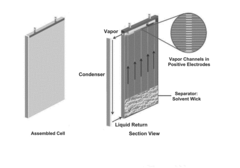
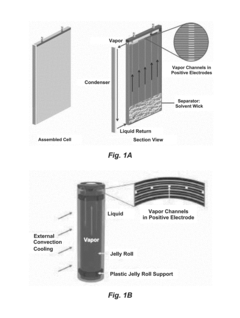
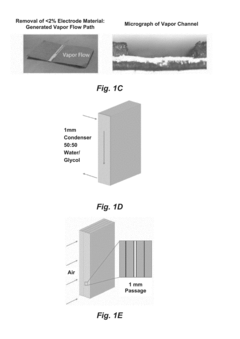
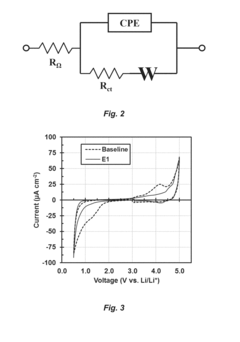
- A multi-functional electrolyte (MFE) is integrated within the battery cells, comprising a lithium salt, an organic electrolyte, and a volatile fluorinated hydrocarbon, which evaporates to absorb thermal energy, condenses, and recycles, providing internal passive thermal management by creating a loop heat pipe architecture to regulate temperature.
Device and method for multifunctional heat management in an electric vehicle
PatentActiveEP2437955A1
Innovation
- A multifunctional thermal management system integrating an air conditioning loop and an engine cooling loop with a heat exchanger and storage tank, allowing for heat exchange between coolant and air flow, enabling various thermal modes without modifying standard air conditioning, heating, and ventilation units.
Material Compatibility and System Integration Strategies
Material compatibility represents a fundamental consideration when implementing multi-eutectic thermal management systems, as the interaction between phase change materials and containment structures directly influences system longevity and performance reliability. The selection of encapsulation materials must account for chemical stability across repeated thermal cycling, preventing degradation reactions that could compromise eutectic composition or generate corrosive byproducts. Metallic containers such as stainless steel and aluminum alloys offer excellent thermal conductivity but require careful evaluation of electrochemical compatibility, particularly in systems operating near eutectic melting points where accelerated corrosion may occur. Polymer-based encapsulations provide chemical inertness and design flexibility, though their lower thermal conductivity necessitates optimized geometries to maintain heat transfer efficiency.
System integration strategies must address the spatial arrangement and thermal coupling of multiple eutectic materials to achieve coordinated phase transitions across target temperature ranges. Layered configurations enable sequential activation of different eutectic compositions, creating staged thermal buffering that adapts to varying heat loads. This architecture requires precise interface engineering to minimize thermal resistance between layers while preventing material cross-contamination during phase transitions. Alternative modular approaches employ discrete encapsulated units of different eutectics, offering enhanced flexibility for customization and maintenance but demanding sophisticated thermal distribution networks to ensure uniform heat dissipation.
The integration of multi-eutectic systems into existing thermal architectures presents challenges in volume allocation and weight management, particularly in space-constrained applications such as electronics cooling and automotive battery systems. Hybrid designs combining eutectic materials with conventional cooling technologies, including forced convection and heat pipes, demonstrate synergistic performance by leveraging the high latent heat capacity of phase change materials alongside active heat removal mechanisms. Such integration requires coordinated control strategies that optimize the operational balance between passive thermal storage and active cooling based on real-time thermal load monitoring.
Manufacturing scalability and assembly processes significantly influence the practical deployment of multi-eutectic systems. Techniques such as vacuum impregnation, injection molding, and additive manufacturing enable precise material placement and geometric control, though each method imposes distinct constraints on material selection and system complexity. Standardization of interface specifications and modular component designs facilitates system scalability while reducing integration costs across diverse application domains.
System integration strategies must address the spatial arrangement and thermal coupling of multiple eutectic materials to achieve coordinated phase transitions across target temperature ranges. Layered configurations enable sequential activation of different eutectic compositions, creating staged thermal buffering that adapts to varying heat loads. This architecture requires precise interface engineering to minimize thermal resistance between layers while preventing material cross-contamination during phase transitions. Alternative modular approaches employ discrete encapsulated units of different eutectics, offering enhanced flexibility for customization and maintenance but demanding sophisticated thermal distribution networks to ensure uniform heat dissipation.
The integration of multi-eutectic systems into existing thermal architectures presents challenges in volume allocation and weight management, particularly in space-constrained applications such as electronics cooling and automotive battery systems. Hybrid designs combining eutectic materials with conventional cooling technologies, including forced convection and heat pipes, demonstrate synergistic performance by leveraging the high latent heat capacity of phase change materials alongside active heat removal mechanisms. Such integration requires coordinated control strategies that optimize the operational balance between passive thermal storage and active cooling based on real-time thermal load monitoring.
Manufacturing scalability and assembly processes significantly influence the practical deployment of multi-eutectic systems. Techniques such as vacuum impregnation, injection molding, and additive manufacturing enable precise material placement and geometric control, though each method imposes distinct constraints on material selection and system complexity. Standardization of interface specifications and modular component designs facilitates system scalability while reducing integration costs across diverse application domains.
Energy Efficiency Standards and Sustainability Impact
Multi-eutectic thermal management systems are increasingly subject to stringent energy efficiency standards as governments and international organizations intensify efforts to reduce carbon emissions and promote sustainable building practices. The European Union's Energy Performance of Buildings Directive and similar regulations in North America and Asia mandate improved thermal efficiency in both residential and commercial structures, creating a regulatory framework that favors advanced phase change material solutions. These standards typically specify minimum thermal resistance values, energy consumption limits, and lifecycle performance metrics that multi-eutectic systems are well-positioned to meet due to their superior heat storage capacity and temperature regulation capabilities.
The sustainability impact of multi-eutectic thermal management extends beyond operational energy savings to encompass the entire product lifecycle. These systems contribute to reduced peak energy demand by shifting thermal loads, thereby decreasing strain on electrical grids and minimizing reliance on fossil fuel-based power generation during critical periods. The materials used in multi-eutectic formulations increasingly incorporate bio-based or recycled components, aligning with circular economy principles and reducing embodied carbon compared to traditional HVAC solutions. Furthermore, the longevity and stability of properly designed multi-eutectic systems result in extended service life, reducing material waste and replacement frequency.
Environmental certifications such as LEED, BREEAM, and WELL Building Standard now recognize advanced thermal management technologies as contributing factors to green building ratings. Multi-eutectic systems can earn credits in energy optimization, thermal comfort, and innovation categories, enhancing the market value of buildings that incorporate these technologies. The quantifiable reduction in greenhouse gas emissions, often ranging from fifteen to thirty percent in heating and cooling energy consumption, provides measurable sustainability metrics that align with corporate environmental goals and national climate commitments.
The economic dimension of sustainability is equally significant, as reduced operational costs and potential incentives for energy-efficient technologies improve return on investment. As carbon pricing mechanisms and energy taxes become more prevalent globally, the financial advantages of multi-eutectic thermal management systems will likely increase, accelerating adoption rates and driving further innovation in sustainable thermal regulation solutions.
The sustainability impact of multi-eutectic thermal management extends beyond operational energy savings to encompass the entire product lifecycle. These systems contribute to reduced peak energy demand by shifting thermal loads, thereby decreasing strain on electrical grids and minimizing reliance on fossil fuel-based power generation during critical periods. The materials used in multi-eutectic formulations increasingly incorporate bio-based or recycled components, aligning with circular economy principles and reducing embodied carbon compared to traditional HVAC solutions. Furthermore, the longevity and stability of properly designed multi-eutectic systems result in extended service life, reducing material waste and replacement frequency.
Environmental certifications such as LEED, BREEAM, and WELL Building Standard now recognize advanced thermal management technologies as contributing factors to green building ratings. Multi-eutectic systems can earn credits in energy optimization, thermal comfort, and innovation categories, enhancing the market value of buildings that incorporate these technologies. The quantifiable reduction in greenhouse gas emissions, often ranging from fifteen to thirty percent in heating and cooling energy consumption, provides measurable sustainability metrics that align with corporate environmental goals and national climate commitments.
The economic dimension of sustainability is equally significant, as reduced operational costs and potential incentives for energy-efficient technologies improve return on investment. As carbon pricing mechanisms and energy taxes become more prevalent globally, the financial advantages of multi-eutectic thermal management systems will likely increase, accelerating adoption rates and driving further innovation in sustainable thermal regulation solutions.
Unlock deeper insights with Patsnap Eureka Quick Research — get a full tech report to explore trends and direct your research. Try now!
Generate Your Research Report Instantly with AI Agent
Supercharge your innovation with Patsnap Eureka AI Agent Platform!