

Optimize Thermoelectric Transport for Efficiency
MAR 9, 20269 MIN READ
Generate Your Research Report Instantly with AI Agent
PatSnap Eureka helps you evaluate technical feasibility & market potential.
Thermoelectric Transport Background and Efficiency Goals
Thermoelectric transport represents a fundamental physical phenomenon where electrical and thermal energy conversion occurs through the movement of charge carriers in materials. This technology harnesses the Seebeck effect for power generation and the Peltier effect for cooling applications, offering solid-state energy conversion without moving parts or working fluids. The field has evolved from early discoveries in the 19th century to modern applications in waste heat recovery, automotive systems, and space exploration.
The historical development of thermoelectric materials began with bismuth telluride compounds in the 1950s, achieving figure of merit (ZT) values around 1.0. Subsequent decades witnessed gradual improvements through material engineering, nanostructuring, and quantum confinement effects. Recent breakthroughs have pushed ZT values beyond 2.0 in specific temperature ranges, marking significant progress toward commercial viability.
Current efficiency goals center on achieving ZT values exceeding 3.0 across broad temperature ranges, which would enable thermoelectric devices to compete with conventional energy conversion technologies. For power generation applications, target efficiencies of 15-20% are considered commercially attractive for waste heat recovery systems. Cooling applications aim for coefficient of performance values comparable to vapor compression systems while maintaining the inherent advantages of solid-state operation.
The optimization challenge involves simultaneously maximizing electrical conductivity and Seebeck coefficient while minimizing thermal conductivity - parameters that are often interdependent through fundamental material properties. Advanced strategies include band structure engineering, phonon scattering enhancement, and multi-scale hierarchical structuring to decouple these transport properties.
Emerging efficiency targets also encompass device-level considerations, including thermal interface optimization, module design improvements, and system integration factors. The ultimate goal involves developing materials and devices that can achieve practical energy conversion efficiencies while maintaining cost-effectiveness, mechanical reliability, and environmental sustainability across diverse operating conditions and temperature gradients.
The historical development of thermoelectric materials began with bismuth telluride compounds in the 1950s, achieving figure of merit (ZT) values around 1.0. Subsequent decades witnessed gradual improvements through material engineering, nanostructuring, and quantum confinement effects. Recent breakthroughs have pushed ZT values beyond 2.0 in specific temperature ranges, marking significant progress toward commercial viability.
Current efficiency goals center on achieving ZT values exceeding 3.0 across broad temperature ranges, which would enable thermoelectric devices to compete with conventional energy conversion technologies. For power generation applications, target efficiencies of 15-20% are considered commercially attractive for waste heat recovery systems. Cooling applications aim for coefficient of performance values comparable to vapor compression systems while maintaining the inherent advantages of solid-state operation.
The optimization challenge involves simultaneously maximizing electrical conductivity and Seebeck coefficient while minimizing thermal conductivity - parameters that are often interdependent through fundamental material properties. Advanced strategies include band structure engineering, phonon scattering enhancement, and multi-scale hierarchical structuring to decouple these transport properties.
Emerging efficiency targets also encompass device-level considerations, including thermal interface optimization, module design improvements, and system integration factors. The ultimate goal involves developing materials and devices that can achieve practical energy conversion efficiencies while maintaining cost-effectiveness, mechanical reliability, and environmental sustainability across diverse operating conditions and temperature gradients.
Market Demand for High-Efficiency Thermoelectric Devices
The global thermoelectric device market is experiencing unprecedented growth driven by increasing energy efficiency demands and environmental sustainability concerns. Industries across automotive, aerospace, electronics, and renewable energy sectors are actively seeking advanced thermoelectric solutions to address waste heat recovery challenges and improve overall system efficiency. The automotive industry represents a particularly significant market segment, where thermoelectric generators are being integrated into exhaust systems to convert waste heat into electrical energy, thereby enhancing fuel efficiency and reducing emissions.
Consumer electronics manufacturers are increasingly incorporating thermoelectric coolers into high-performance computing systems, gaming devices, and telecommunications equipment to manage thermal loads more effectively. The miniaturization trend in electronics has created substantial demand for compact, solid-state cooling solutions that can operate reliably in space-constrained environments without mechanical components or refrigerants.
Industrial applications present another major market opportunity, particularly in manufacturing processes where substantial amounts of waste heat are generated. Steel production, chemical processing, and power generation facilities are exploring thermoelectric systems to capture and convert thermal energy that would otherwise be lost, creating additional revenue streams while improving operational efficiency.
The renewable energy sector is driving demand for thermoelectric devices in solar thermal applications and geothermal energy harvesting systems. These applications require materials and devices capable of operating efficiently across wide temperature ranges while maintaining long-term stability and performance.
Market growth is further accelerated by stringent environmental regulations and carbon reduction targets established by governments worldwide. Energy efficiency mandates in building codes and industrial standards are creating regulatory pressure for adoption of advanced thermoelectric technologies. The increasing cost of energy and growing awareness of environmental impact are motivating organizations to invest in waste heat recovery solutions.
Emerging applications in Internet of Things devices, wearable electronics, and remote sensing systems are creating new market segments for low-power thermoelectric generators. These applications require highly efficient, maintenance-free energy harvesting solutions capable of operating autonomously for extended periods.
The market demand is characterized by requirements for higher conversion efficiency, improved material durability, cost-effective manufacturing processes, and enhanced performance across broader temperature ranges, driving continuous innovation in thermoelectric transport optimization.
Consumer electronics manufacturers are increasingly incorporating thermoelectric coolers into high-performance computing systems, gaming devices, and telecommunications equipment to manage thermal loads more effectively. The miniaturization trend in electronics has created substantial demand for compact, solid-state cooling solutions that can operate reliably in space-constrained environments without mechanical components or refrigerants.
Industrial applications present another major market opportunity, particularly in manufacturing processes where substantial amounts of waste heat are generated. Steel production, chemical processing, and power generation facilities are exploring thermoelectric systems to capture and convert thermal energy that would otherwise be lost, creating additional revenue streams while improving operational efficiency.
The renewable energy sector is driving demand for thermoelectric devices in solar thermal applications and geothermal energy harvesting systems. These applications require materials and devices capable of operating efficiently across wide temperature ranges while maintaining long-term stability and performance.
Market growth is further accelerated by stringent environmental regulations and carbon reduction targets established by governments worldwide. Energy efficiency mandates in building codes and industrial standards are creating regulatory pressure for adoption of advanced thermoelectric technologies. The increasing cost of energy and growing awareness of environmental impact are motivating organizations to invest in waste heat recovery solutions.
Emerging applications in Internet of Things devices, wearable electronics, and remote sensing systems are creating new market segments for low-power thermoelectric generators. These applications require highly efficient, maintenance-free energy harvesting solutions capable of operating autonomously for extended periods.
The market demand is characterized by requirements for higher conversion efficiency, improved material durability, cost-effective manufacturing processes, and enhanced performance across broader temperature ranges, driving continuous innovation in thermoelectric transport optimization.
Current State and Challenges in Thermoelectric Transport
Thermoelectric materials currently exhibit limited commercial viability due to their inherently low energy conversion efficiency. The dimensionless figure of merit ZT, defined as S²σT/κ, remains below 2.0 for most practical materials at operating temperatures, significantly constraining their widespread adoption. This efficiency bottleneck stems from the complex interdependence of thermoelectric properties, where optimizing one parameter often deteriorates others.
The fundamental challenge lies in the conflicting requirements for optimal thermoelectric performance. High electrical conductivity demands high carrier concentration, while maximum Seebeck coefficient requires low carrier density. Simultaneously, minimizing thermal conductivity without compromising electrical transport presents a persistent materials science dilemma. These competing factors create a narrow optimization window that limits achievable performance improvements.
Current state-of-the-art materials face significant temperature-dependent performance variations. Bismuth telluride compounds dominate near-room-temperature applications but suffer from mechanical brittleness and limited thermal stability. Lead telluride systems show promise for mid-temperature ranges but raise environmental concerns. High-temperature applications rely on silicon-germanium alloys, which exhibit modest ZT values and require expensive processing techniques.
Manufacturing scalability represents another critical constraint. Laboratory-scale synthesis methods often fail to translate into cost-effective mass production. Nanostructuring approaches, while theoretically promising for phonon scattering enhancement, face reproducibility challenges and increased processing complexity. The integration of advanced materials into practical devices introduces additional thermal and mechanical stress factors that degrade long-term performance.
Interface engineering between thermoelectric materials and metallic contacts creates substantial efficiency losses through thermal and electrical resistance. Contact degradation under thermal cycling conditions further compromises device reliability. These interfacial challenges become more pronounced in miniaturized applications where surface-to-volume ratios increase significantly.
Geographically, thermoelectric research concentrates in developed nations with advanced materials research infrastructure. The United States leads in fundamental research and nanostructuring techniques, while Japan excels in device integration and automotive applications. European efforts focus on waste heat recovery systems, and emerging economies primarily engage in manufacturing rather than innovation. This distribution creates knowledge gaps and limits global technology transfer, constraining overall field advancement and commercial deployment strategies.
The fundamental challenge lies in the conflicting requirements for optimal thermoelectric performance. High electrical conductivity demands high carrier concentration, while maximum Seebeck coefficient requires low carrier density. Simultaneously, minimizing thermal conductivity without compromising electrical transport presents a persistent materials science dilemma. These competing factors create a narrow optimization window that limits achievable performance improvements.
Current state-of-the-art materials face significant temperature-dependent performance variations. Bismuth telluride compounds dominate near-room-temperature applications but suffer from mechanical brittleness and limited thermal stability. Lead telluride systems show promise for mid-temperature ranges but raise environmental concerns. High-temperature applications rely on silicon-germanium alloys, which exhibit modest ZT values and require expensive processing techniques.
Manufacturing scalability represents another critical constraint. Laboratory-scale synthesis methods often fail to translate into cost-effective mass production. Nanostructuring approaches, while theoretically promising for phonon scattering enhancement, face reproducibility challenges and increased processing complexity. The integration of advanced materials into practical devices introduces additional thermal and mechanical stress factors that degrade long-term performance.
Interface engineering between thermoelectric materials and metallic contacts creates substantial efficiency losses through thermal and electrical resistance. Contact degradation under thermal cycling conditions further compromises device reliability. These interfacial challenges become more pronounced in miniaturized applications where surface-to-volume ratios increase significantly.
Geographically, thermoelectric research concentrates in developed nations with advanced materials research infrastructure. The United States leads in fundamental research and nanostructuring techniques, while Japan excels in device integration and automotive applications. European efforts focus on waste heat recovery systems, and emerging economies primarily engage in manufacturing rather than innovation. This distribution creates knowledge gaps and limits global technology transfer, constraining overall field advancement and commercial deployment strategies.
Current Solutions for Thermoelectric Transport Optimization
01 Nanostructured thermoelectric materials
Nanostructured materials can significantly enhance thermoelectric transport efficiency by reducing thermal conductivity while maintaining or improving electrical conductivity. These materials utilize quantum confinement effects and increased phonon scattering at grain boundaries to optimize the thermoelectric figure of merit. Nanocomposites and nanowire structures are particularly effective in achieving higher conversion efficiency.- Nanostructured thermoelectric materials: Nanostructured materials can significantly enhance thermoelectric transport efficiency by reducing thermal conductivity while maintaining or improving electrical conductivity. These materials utilize quantum confinement effects and increased phonon scattering at grain boundaries to optimize the thermoelectric figure of merit. Nanocomposites and nanowire structures are particularly effective in achieving higher conversion efficiency.
- Doping and composition optimization: Strategic doping of thermoelectric materials with specific elements can optimize carrier concentration and enhance power factor. Compositional engineering through the addition of dopants or alloying elements helps to tune the electronic band structure and improve charge carrier mobility. This approach allows for better control of the Seebeck coefficient and electrical conductivity balance.
- Multilayer and heterostructure designs: Multilayer thermoelectric devices and heterostructures can improve transport efficiency by creating energy barriers that filter low-energy carriers while allowing high-energy carriers to pass. These architectures enable independent optimization of electrical and thermal transport properties. Interface engineering in such structures provides additional mechanisms for enhancing the overall thermoelectric performance.
- Phonon engineering and thermal conductivity reduction: Reducing lattice thermal conductivity through phonon engineering is crucial for improving thermoelectric efficiency. Techniques include introducing point defects, creating complex crystal structures, and utilizing materials with intrinsically low thermal conductivity. Phonon scattering mechanisms can be enhanced without significantly affecting electrical properties, leading to improved figure of merit.
- Module design and contact optimization: Thermoelectric module architecture and contact interface optimization play critical roles in overall system efficiency. Proper design of electrical contacts, thermal interfaces, and geometric configurations minimizes parasitic losses. Advanced joining techniques and barrier layers prevent interdiffusion and reduce contact resistance, thereby improving the overall transport efficiency of thermoelectric devices.
02 Doping and composition optimization
Strategic doping of thermoelectric materials with specific elements can optimize carrier concentration and enhance power factor. Compositional engineering through the addition of multiple elements creates solid solutions that improve electrical properties while reducing lattice thermal conductivity. This approach allows for fine-tuning of electronic band structure to maximize thermoelectric performance.Expand Specific Solutions03 Multilayer and heterostructure designs
Multilayer thermoelectric structures and heterostructures can enhance transport efficiency through interface engineering and energy filtering effects. These designs create potential barriers that selectively filter charge carriers based on energy, improving the Seebeck coefficient. The interfaces also serve as additional phonon scattering centers, reducing thermal conductivity without significantly affecting electrical properties.Expand Specific Solutions04 High-temperature thermoelectric materials
Development of thermoelectric materials capable of operating efficiently at elevated temperatures expands application possibilities in waste heat recovery. These materials maintain structural stability and favorable transport properties at high temperatures through the use of refractory compounds and oxide-based systems. Temperature-dependent optimization of carrier concentration and band structure is crucial for maximizing efficiency across operating temperature ranges.Expand Specific Solutions05 Module design and contact optimization
Thermoelectric module architecture and contact interface engineering play critical roles in overall system efficiency. Optimized electrode materials and bonding techniques minimize contact resistance and ensure reliable thermal and electrical connections. Module geometry, leg dimensions, and thermal management strategies are designed to maximize power output and conversion efficiency while maintaining mechanical stability.Expand Specific Solutions
Key Players in Thermoelectric Industry
The thermoelectric transport optimization field represents a mature yet rapidly evolving market driven by increasing demand for energy-efficient thermal management solutions. The industry spans multiple development stages, from established automotive applications to emerging waste heat recovery systems. Market growth is propelled by automotive electrification trends and sustainability initiatives across sectors. Technology maturity varies significantly among key players: established companies like Gentherm, Panasonic, and Valeo demonstrate commercial-ready thermoelectric solutions for automotive climate control, while industrial giants such as ABB, Schneider Electric, and Siemens focus on large-scale energy conversion applications. Specialized firms like KELK and research institutions including CEA and Southeast University are advancing next-generation materials and efficiency improvements. The competitive landscape shows strong consolidation around automotive applications, with emerging opportunities in industrial waste heat recovery and consumer electronics cooling, indicating a technology transitioning from niche applications toward mainstream adoption.
Gentherm, Inc.
Technical Solution: Gentherm specializes in advanced thermoelectric climate control systems for automotive applications, utilizing proprietary thermoelectric materials and device architectures to optimize heat transfer efficiency. Their technology focuses on developing high-performance thermoelectric modules with enhanced ZT values through nanostructured materials and advanced doping techniques. The company implements multi-stage thermoelectric cooling systems that can achieve temperature differentials up to 70°C while maintaining power consumption efficiency. Their solutions integrate smart thermal management algorithms that dynamically adjust current flow based on ambient conditions and user requirements, resulting in up to 40% improvement in coefficient of performance compared to conventional systems.
Strengths: Market leader in automotive thermoelectric applications with proven commercial success and extensive patent portfolio. Weaknesses: Limited diversification beyond automotive sector and high manufacturing costs for advanced materials.
LG Innotek Co., Ltd.
Technical Solution: LG Innotek develops thermoelectric solutions primarily for electronic device thermal management, focusing on miniaturized thermoelectric coolers for smartphones, laptops, and LED applications. Their approach emphasizes thin-film thermoelectric materials using bismuth telluride-based compounds with optimized grain boundaries to enhance electrical conductivity while reducing thermal conductivity. The company has developed flexible thermoelectric generators that can harvest waste heat from electronic components, achieving power densities of up to 2.5 mW/cm² at temperature differences of 20°C. Their manufacturing process incorporates advanced sputtering techniques and precise temperature control to ensure consistent material properties across large-scale production.
Strengths: Strong expertise in miniaturization and consumer electronics integration with high-volume manufacturing capabilities. Weaknesses: Lower power output compared to bulk thermoelectric systems and limited high-temperature applications.
Core Innovations in Thermoelectric Transport Enhancement
Thermoelectric Structures and Devices Based on Topological Insulators
PatentInactiveUS20150155464A1
Innovation
- The approach involves optimizing topological insulator structures by increasing the length and decreasing the cross-sectional area, tuning the Fermi level, and introducing disorders to maximize the relative thermoelectric-transport contribution of the boundary state, specifically by making the length greater than the inelastic mean free path, width adjustments relative to the localization width, and adjusting the Fermi level through doping or composition tuning.


Thermoelectric systems employing distributed transport properties to increase cooling and heating performance
PatentActiveUS11421919B2
Innovation
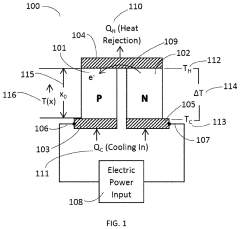
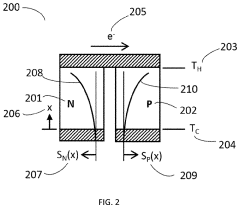
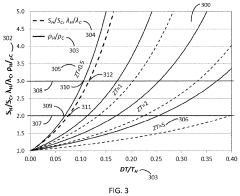
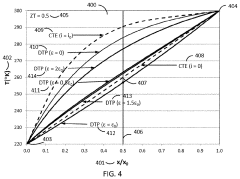
- The development of thermoelectric devices with distributed transport properties (DTP) that vary the Seebeck coefficient, thermal conductivity, and electrical resistivity along the direction of current flow, utilizing new design equations and fabrication methods to enhance performance metrics like maximum temperature differential, energy conversion efficiency, and heat pumping capacity.
Energy Policy Impact on Thermoelectric Development
Government energy policies worldwide have emerged as critical drivers shaping the development trajectory of thermoelectric technologies. The increasing emphasis on carbon neutrality targets and renewable energy mandates has created a favorable regulatory environment for advanced energy conversion technologies, including thermoelectrics. Policy frameworks such as the European Green Deal, China's carbon peak and neutrality goals, and various national clean energy initiatives have established long-term commitments that directly influence research funding allocation and commercial deployment strategies for thermoelectric systems.
Research and development funding mechanisms represent a primary channel through which energy policies impact thermoelectric advancement. Government agencies like the U.S. Department of Energy, European Commission's Horizon Europe program, and Japan's New Energy and Industrial Technology Development Organization have allocated substantial resources specifically targeting thermoelectric efficiency improvements. These funding programs often prioritize projects addressing waste heat recovery, automotive applications, and grid-scale energy storage, creating focused research directions that align with broader energy policy objectives.
Regulatory standards and efficiency mandates significantly influence the commercial viability of thermoelectric solutions. Automotive emission regulations, particularly in Europe and California, have accelerated the development of thermoelectric generators for waste heat recovery in internal combustion engines and hybrid vehicles. Similarly, building energy codes increasingly recognize thermoelectric cooling and heating systems as viable alternatives to conventional HVAC technologies, driving demand for higher-performance materials and system designs.
Tax incentives and subsidy programs have proven instrumental in bridging the gap between laboratory research and commercial deployment. Investment tax credits for renewable energy systems in various jurisdictions now include thermoelectric applications, while accelerated depreciation schedules for energy-efficient technologies reduce the financial barriers to adoption. These economic instruments have particularly benefited the industrial waste heat recovery sector, where thermoelectric systems compete with established technologies.
International trade policies and technology transfer regulations also shape the global thermoelectric landscape. Export controls on critical materials and advanced manufacturing technologies influence supply chain strategies, while bilateral research agreements facilitate knowledge exchange between leading research institutions. The ongoing emphasis on supply chain resilience in energy technologies has prompted governments to support domestic thermoelectric manufacturing capabilities, creating new opportunities for regional technology clusters and specialized suppliers.
Research and development funding mechanisms represent a primary channel through which energy policies impact thermoelectric advancement. Government agencies like the U.S. Department of Energy, European Commission's Horizon Europe program, and Japan's New Energy and Industrial Technology Development Organization have allocated substantial resources specifically targeting thermoelectric efficiency improvements. These funding programs often prioritize projects addressing waste heat recovery, automotive applications, and grid-scale energy storage, creating focused research directions that align with broader energy policy objectives.
Regulatory standards and efficiency mandates significantly influence the commercial viability of thermoelectric solutions. Automotive emission regulations, particularly in Europe and California, have accelerated the development of thermoelectric generators for waste heat recovery in internal combustion engines and hybrid vehicles. Similarly, building energy codes increasingly recognize thermoelectric cooling and heating systems as viable alternatives to conventional HVAC technologies, driving demand for higher-performance materials and system designs.
Tax incentives and subsidy programs have proven instrumental in bridging the gap between laboratory research and commercial deployment. Investment tax credits for renewable energy systems in various jurisdictions now include thermoelectric applications, while accelerated depreciation schedules for energy-efficient technologies reduce the financial barriers to adoption. These economic instruments have particularly benefited the industrial waste heat recovery sector, where thermoelectric systems compete with established technologies.
International trade policies and technology transfer regulations also shape the global thermoelectric landscape. Export controls on critical materials and advanced manufacturing technologies influence supply chain strategies, while bilateral research agreements facilitate knowledge exchange between leading research institutions. The ongoing emphasis on supply chain resilience in energy technologies has prompted governments to support domestic thermoelectric manufacturing capabilities, creating new opportunities for regional technology clusters and specialized suppliers.
Environmental Benefits of Thermoelectric Applications
Thermoelectric applications offer substantial environmental benefits by enabling direct conversion between thermal and electrical energy without moving parts, working fluids, or harmful emissions. This solid-state technology presents a clean alternative to conventional energy conversion systems, contributing significantly to global sustainability efforts and carbon footprint reduction across multiple sectors.
The most prominent environmental advantage lies in waste heat recovery applications. Industrial processes, automotive engines, and power generation facilities typically waste 20-50% of their energy input as heat. Thermoelectric generators can capture this otherwise lost thermal energy and convert it into useful electricity, effectively improving overall system efficiency and reducing primary energy consumption. This capability directly translates to decreased fossil fuel usage and lower greenhouse gas emissions.
In cooling applications, thermoelectric devices eliminate the need for refrigerants that contribute to ozone depletion and global warming potential. Traditional vapor-compression cooling systems rely on hydrofluorocarbons and other synthetic refrigerants with high environmental impact. Thermoelectric coolers operate purely through electronic means, avoiding refrigerant leakage risks and associated environmental damage throughout their lifecycle.
The technology's contribution to renewable energy integration represents another significant environmental benefit. Thermoelectric generators can harvest energy from various ambient heat sources including solar thermal, geothermal gradients, and biomass combustion, supporting distributed renewable energy generation. This capability enhances grid stability while reducing dependence on centralized fossil fuel power plants.
Thermoelectric devices also demonstrate exceptional longevity and reliability due to their solid-state nature, typically operating for decades without maintenance. This durability reduces electronic waste generation and resource consumption associated with frequent replacements. Additionally, many thermoelectric materials can be recycled, supporting circular economy principles and minimizing environmental impact at end-of-life.
The silent operation of thermoelectric systems eliminates noise pollution associated with mechanical cooling and heating equipment, particularly beneficial in urban environments and sensitive ecological areas. This characteristic makes thermoelectric technology ideal for applications requiring minimal environmental disturbance while maintaining energy efficiency objectives.
The most prominent environmental advantage lies in waste heat recovery applications. Industrial processes, automotive engines, and power generation facilities typically waste 20-50% of their energy input as heat. Thermoelectric generators can capture this otherwise lost thermal energy and convert it into useful electricity, effectively improving overall system efficiency and reducing primary energy consumption. This capability directly translates to decreased fossil fuel usage and lower greenhouse gas emissions.
In cooling applications, thermoelectric devices eliminate the need for refrigerants that contribute to ozone depletion and global warming potential. Traditional vapor-compression cooling systems rely on hydrofluorocarbons and other synthetic refrigerants with high environmental impact. Thermoelectric coolers operate purely through electronic means, avoiding refrigerant leakage risks and associated environmental damage throughout their lifecycle.
The technology's contribution to renewable energy integration represents another significant environmental benefit. Thermoelectric generators can harvest energy from various ambient heat sources including solar thermal, geothermal gradients, and biomass combustion, supporting distributed renewable energy generation. This capability enhances grid stability while reducing dependence on centralized fossil fuel power plants.
Thermoelectric devices also demonstrate exceptional longevity and reliability due to their solid-state nature, typically operating for decades without maintenance. This durability reduces electronic waste generation and resource consumption associated with frequent replacements. Additionally, many thermoelectric materials can be recycled, supporting circular economy principles and minimizing environmental impact at end-of-life.
The silent operation of thermoelectric systems eliminates noise pollution associated with mechanical cooling and heating equipment, particularly beneficial in urban environments and sensitive ecological areas. This characteristic makes thermoelectric technology ideal for applications requiring minimal environmental disturbance while maintaining energy efficiency objectives.
Unlock deeper insights with PatSnap Eureka Quick Research — get a full tech report to explore trends and direct your research. Try now!
Generate Your Research Report Instantly with AI Agent
Supercharge your innovation with PatSnap Eureka AI Agent Platform!