Optimizing Adsorbent Regeneration for CO2 Capture Efficiency
MAR 23, 20269 MIN READ
Generate Your Research Report Instantly with AI Agent
Patsnap Eureka helps you evaluate technical feasibility & market potential.
CO2 Capture Adsorbent Regeneration Background and Objectives
Carbon dioxide capture and storage (CCS) technology has emerged as a critical component in global climate change mitigation strategies, with adsorbent-based CO2 capture systems gaining significant attention due to their energy efficiency and operational flexibility. The development of effective CO2 capture technologies has evolved from early chemical absorption methods using liquid solvents to advanced solid adsorbent systems that offer improved selectivity and reduced energy penalties.
The historical progression of CO2 capture technology began with conventional amine-based absorption processes in the 1930s, primarily used in natural gas processing. However, the energy-intensive nature of solvent regeneration, requiring temperatures of 100-120°C, prompted researchers to explore solid adsorbent alternatives. The introduction of pressure swing adsorption (PSA) and temperature swing adsorption (TSA) processes in the 1960s marked a pivotal shift toward more sustainable capture mechanisms.
Contemporary CO2 capture systems utilizing solid adsorbents face a fundamental challenge: optimizing the regeneration process to maintain high capture efficiency while minimizing energy consumption. Current regeneration methods typically require significant thermal or pressure inputs, often consuming 20-30% of a power plant's total energy output. This energy penalty directly impacts the economic viability and environmental benefits of CCS deployment.
The primary technical objective centers on developing regeneration strategies that can restore adsorbent capacity to over 95% of its original performance while reducing energy requirements by at least 25% compared to conventional methods. This involves optimizing regeneration temperature profiles, pressure cycling parameters, and exploring novel regeneration techniques such as microwave heating, electrical swing adsorption, and hybrid regeneration approaches.
Advanced adsorbent materials including metal-organic frameworks (MOFs), zeolites, and amine-functionalized sorbents present unique regeneration challenges due to their distinct binding mechanisms and thermal stability characteristics. The regeneration optimization must account for material-specific properties while ensuring long-term structural integrity and preventing degradation over multiple capture-regeneration cycles.
The strategic importance of this technology extends beyond immediate CO2 reduction goals, positioning organizations at the forefront of the emerging carbon economy. Successful regeneration optimization could enable widespread deployment of point-source capture systems across industrial sectors, contributing to net-zero emission targets while creating new revenue streams through carbon utilization and storage markets.
The historical progression of CO2 capture technology began with conventional amine-based absorption processes in the 1930s, primarily used in natural gas processing. However, the energy-intensive nature of solvent regeneration, requiring temperatures of 100-120°C, prompted researchers to explore solid adsorbent alternatives. The introduction of pressure swing adsorption (PSA) and temperature swing adsorption (TSA) processes in the 1960s marked a pivotal shift toward more sustainable capture mechanisms.
Contemporary CO2 capture systems utilizing solid adsorbents face a fundamental challenge: optimizing the regeneration process to maintain high capture efficiency while minimizing energy consumption. Current regeneration methods typically require significant thermal or pressure inputs, often consuming 20-30% of a power plant's total energy output. This energy penalty directly impacts the economic viability and environmental benefits of CCS deployment.
The primary technical objective centers on developing regeneration strategies that can restore adsorbent capacity to over 95% of its original performance while reducing energy requirements by at least 25% compared to conventional methods. This involves optimizing regeneration temperature profiles, pressure cycling parameters, and exploring novel regeneration techniques such as microwave heating, electrical swing adsorption, and hybrid regeneration approaches.
Advanced adsorbent materials including metal-organic frameworks (MOFs), zeolites, and amine-functionalized sorbents present unique regeneration challenges due to their distinct binding mechanisms and thermal stability characteristics. The regeneration optimization must account for material-specific properties while ensuring long-term structural integrity and preventing degradation over multiple capture-regeneration cycles.
The strategic importance of this technology extends beyond immediate CO2 reduction goals, positioning organizations at the forefront of the emerging carbon economy. Successful regeneration optimization could enable widespread deployment of point-source capture systems across industrial sectors, contributing to net-zero emission targets while creating new revenue streams through carbon utilization and storage markets.
Market Demand for Enhanced CO2 Capture Technologies
The global carbon dioxide capture, utilization, and storage market has experienced unprecedented growth momentum driven by increasingly stringent climate policies and corporate sustainability commitments. Industrial sectors including power generation, cement production, steel manufacturing, and petrochemicals face mounting pressure to reduce emissions, creating substantial demand for efficient CO2 capture technologies. The urgency has intensified following international climate agreements and national carbon neutrality pledges, with many countries implementing carbon pricing mechanisms and emission reduction mandates.
Current CO2 capture technologies face significant operational challenges that limit widespread adoption. Traditional amine-based absorption systems suffer from high energy penalties during solvent regeneration, often requiring 15-30% of power plant output for the capture process alone. Solid adsorbent technologies, while promising lower energy requirements, encounter bottlenecks in regeneration efficiency that directly impact overall system economics and performance. These limitations have created a critical market gap for optimized regeneration solutions.
The market demand specifically targets enhanced adsorbent regeneration technologies that can reduce energy consumption while maintaining high capture rates. Industries seek solutions that minimize temperature swing requirements, accelerate desorption kinetics, and extend adsorbent lifespan. Power generation facilities particularly require technologies that can integrate seamlessly with existing infrastructure while minimizing parasitic energy losses.
Emerging market segments include direct air capture applications, where efficient regeneration becomes even more critical due to lower CO2 concentrations. The shipping and aviation industries also represent growing demand centers as they explore onboard capture systems requiring compact, energy-efficient regeneration processes. Additionally, industrial process integration opportunities are expanding where waste heat recovery can be coupled with optimized regeneration cycles.
Market drivers extend beyond regulatory compliance to include economic incentives such as carbon credits, tax benefits, and green financing opportunities. Companies increasingly view advanced CO2 capture as a competitive advantage and revenue generator rather than merely a compliance cost. The convergence of environmental necessity, regulatory pressure, and economic opportunity has created a robust market foundation for breakthrough regeneration technologies that can deliver superior efficiency and cost-effectiveness.
Current CO2 capture technologies face significant operational challenges that limit widespread adoption. Traditional amine-based absorption systems suffer from high energy penalties during solvent regeneration, often requiring 15-30% of power plant output for the capture process alone. Solid adsorbent technologies, while promising lower energy requirements, encounter bottlenecks in regeneration efficiency that directly impact overall system economics and performance. These limitations have created a critical market gap for optimized regeneration solutions.
The market demand specifically targets enhanced adsorbent regeneration technologies that can reduce energy consumption while maintaining high capture rates. Industries seek solutions that minimize temperature swing requirements, accelerate desorption kinetics, and extend adsorbent lifespan. Power generation facilities particularly require technologies that can integrate seamlessly with existing infrastructure while minimizing parasitic energy losses.
Emerging market segments include direct air capture applications, where efficient regeneration becomes even more critical due to lower CO2 concentrations. The shipping and aviation industries also represent growing demand centers as they explore onboard capture systems requiring compact, energy-efficient regeneration processes. Additionally, industrial process integration opportunities are expanding where waste heat recovery can be coupled with optimized regeneration cycles.
Market drivers extend beyond regulatory compliance to include economic incentives such as carbon credits, tax benefits, and green financing opportunities. Companies increasingly view advanced CO2 capture as a competitive advantage and revenue generator rather than merely a compliance cost. The convergence of environmental necessity, regulatory pressure, and economic opportunity has created a robust market foundation for breakthrough regeneration technologies that can deliver superior efficiency and cost-effectiveness.
Current Regeneration Challenges and Technical Barriers
The regeneration of CO2 adsorbents faces significant energy efficiency challenges that fundamentally limit the economic viability of carbon capture systems. Temperature swing adsorption (TSA) processes typically require heating temperatures between 80-150°C for solid amine sorbents, consuming substantial thermal energy that can account for 60-70% of the total capture system's energy penalty. This energy intensity directly translates to increased operational costs and reduced overall system efficiency.
Heat transfer limitations represent another critical barrier in current regeneration processes. Many solid adsorbents exhibit poor thermal conductivity, creating temperature gradients within the adsorbent bed that lead to incomplete regeneration and extended cycle times. The heterogeneous heat distribution results in some regions being over-heated while others remain insufficiently regenerated, compromising both energy efficiency and CO2 recovery rates.
Adsorbent degradation during repeated regeneration cycles poses long-term operational challenges. Thermal cycling causes structural changes in many CO2 capture materials, including pore collapse in metal-organic frameworks (MOFs) and backbone degradation in polymer-based sorbents. These degradation mechanisms reduce adsorption capacity over time, necessitating more frequent adsorbent replacement and increasing lifecycle costs.
Mass transfer constraints during desorption create additional technical barriers. The release of CO2 from adsorbent pores can be kinetically limited, particularly in materials with narrow pore structures or strong binding sites. This limitation extends regeneration times and may require higher temperatures or reduced pressures to achieve complete desorption, further increasing energy requirements.
Process integration complexities arise from the need to coordinate adsorption and regeneration cycles while maintaining continuous CO2 capture operations. The thermal management of multiple adsorbent beds, heat recovery systems, and process scheduling requires sophisticated control strategies. Inadequate integration can lead to energy losses, reduced capture efficiency, and operational instabilities that compromise overall system performance.
Moisture management presents ongoing technical challenges, as water vapor co-adsorption during CO2 capture can significantly impact regeneration efficiency. Water's high heat of vaporization increases the energy required for regeneration, while competitive adsorption effects can alter CO2 desorption kinetics and reduce the purity of recovered CO2 streams.
Heat transfer limitations represent another critical barrier in current regeneration processes. Many solid adsorbents exhibit poor thermal conductivity, creating temperature gradients within the adsorbent bed that lead to incomplete regeneration and extended cycle times. The heterogeneous heat distribution results in some regions being over-heated while others remain insufficiently regenerated, compromising both energy efficiency and CO2 recovery rates.
Adsorbent degradation during repeated regeneration cycles poses long-term operational challenges. Thermal cycling causes structural changes in many CO2 capture materials, including pore collapse in metal-organic frameworks (MOFs) and backbone degradation in polymer-based sorbents. These degradation mechanisms reduce adsorption capacity over time, necessitating more frequent adsorbent replacement and increasing lifecycle costs.
Mass transfer constraints during desorption create additional technical barriers. The release of CO2 from adsorbent pores can be kinetically limited, particularly in materials with narrow pore structures or strong binding sites. This limitation extends regeneration times and may require higher temperatures or reduced pressures to achieve complete desorption, further increasing energy requirements.
Process integration complexities arise from the need to coordinate adsorption and regeneration cycles while maintaining continuous CO2 capture operations. The thermal management of multiple adsorbent beds, heat recovery systems, and process scheduling requires sophisticated control strategies. Inadequate integration can lead to energy losses, reduced capture efficiency, and operational instabilities that compromise overall system performance.
Moisture management presents ongoing technical challenges, as water vapor co-adsorption during CO2 capture can significantly impact regeneration efficiency. Water's high heat of vaporization increases the energy required for regeneration, while competitive adsorption effects can alter CO2 desorption kinetics and reduce the purity of recovered CO2 streams.
Existing Regeneration Optimization Solutions
01 Temperature swing adsorption for adsorbent regeneration
Temperature swing adsorption (TSA) is a widely used method for regenerating CO2 adsorbents. This process involves heating the saturated adsorbent to release captured CO2, followed by cooling to restore its adsorption capacity. The regeneration temperature, heating rate, and cycle time are critical parameters that affect both the regeneration efficiency and the overall CO2 capture performance. Optimizing these parameters can significantly improve the energy efficiency of the capture process while maintaining high CO2 removal rates.- Temperature swing adsorption for adsorbent regeneration: Temperature swing adsorption (TSA) is a widely used method for regenerating CO2 adsorbents. This process involves heating the saturated adsorbent to release captured CO2, followed by cooling to restore its adsorption capacity. The regeneration temperature, heating rate, and cycle time are critical parameters that affect both the regeneration efficiency and the overall CO2 capture performance. Optimizing these parameters can significantly improve the energy efficiency of the capture process while maintaining high CO2 removal rates.
- Pressure swing adsorption for enhanced CO2 capture: Pressure swing adsorption (PSA) technology enables efficient CO2 capture and adsorbent regeneration by manipulating pressure conditions. The process involves adsorbing CO2 at high pressure and releasing it at low pressure, allowing for continuous operation with minimal energy input. Advanced PSA configurations, including vacuum swing adsorption (VSA) and rapid cycle PSA, can further enhance capture efficiency and reduce regeneration energy requirements. The selection of appropriate pressure ranges and cycle configurations is essential for optimizing system performance.
- Steam-assisted regeneration methods: Steam-assisted regeneration utilizes water vapor to facilitate the desorption of CO2 from saturated adsorbents. This method can reduce the required regeneration temperature and improve energy efficiency compared to conventional thermal regeneration. The steam helps to displace adsorbed CO2 molecules while providing heat for desorption. Process parameters such as steam temperature, flow rate, and partial pressure significantly influence the regeneration effectiveness and the stability of the adsorbent material over multiple cycles.
- Novel adsorbent materials with improved regeneration properties: Development of advanced adsorbent materials with enhanced regeneration characteristics is crucial for improving CO2 capture efficiency. These materials include modified zeolites, metal-organic frameworks, amine-functionalized sorbents, and carbon-based materials with tailored pore structures. Such adsorbents exhibit lower regeneration energy requirements, faster adsorption-desorption kinetics, and improved cyclic stability. The chemical and physical properties of these materials can be optimized to achieve high CO2 selectivity while facilitating easy regeneration under mild conditions.
- Integrated regeneration systems and process optimization: Integrated regeneration systems combine multiple techniques and process optimization strategies to maximize CO2 capture efficiency while minimizing energy consumption. These systems may incorporate heat recovery, multi-stage regeneration, hybrid adsorption-desorption processes, and advanced control strategies. Process integration allows for the utilization of waste heat from industrial sources, reducing the overall energy penalty of CO2 capture. Optimization of operating parameters, cycle configurations, and system design through modeling and simulation can significantly enhance the economic viability and performance of CO2 capture systems.
02 Pressure swing adsorption for enhanced CO2 capture
Pressure swing adsorption (PSA) technology enables efficient CO2 capture and adsorbent regeneration by manipulating pressure conditions. The process involves adsorbing CO2 at high pressure and releasing it at low pressure, allowing the adsorbent to be regenerated without significant thermal input. This method can reduce energy consumption compared to thermal regeneration methods. The cycle design, pressure ratios, and purge strategies are key factors in optimizing both capture efficiency and regeneration performance.Expand Specific Solutions03 Novel adsorbent materials with improved regeneration properties
Advanced adsorbent materials such as metal-organic frameworks, functionalized porous carbons, and amine-modified silica have been developed to enhance CO2 capture efficiency and facilitate easier regeneration. These materials exhibit high CO2 selectivity, large adsorption capacity, and lower regeneration energy requirements. The chemical and physical properties of these adsorbents, including pore structure, surface functionality, and thermal stability, directly impact both the capture performance and the number of adsorption-desorption cycles the material can withstand.Expand Specific Solutions04 Steam-assisted regeneration methods
Steam-assisted regeneration is an effective approach for recovering CO2 from saturated adsorbents while simultaneously restoring their adsorption capacity. This method utilizes steam to provide heat and create favorable conditions for CO2 desorption. The presence of water vapor can enhance the desorption kinetics and reduce the required regeneration temperature. Process parameters such as steam temperature, flow rate, and contact time must be optimized to maximize regeneration efficiency while minimizing energy consumption and preventing adsorbent degradation.Expand Specific Solutions05 Integrated system design for continuous CO2 capture
Integrated system designs that combine multiple adsorption beds with coordinated regeneration cycles enable continuous CO2 capture operations with high overall efficiency. These systems typically employ rotating beds, parallel reactor configurations, or multi-stage processes where some units are in adsorption mode while others undergo regeneration. Heat integration strategies, such as using waste heat from regeneration to preheat incoming gas streams, can significantly improve the energy efficiency of the overall process. System optimization considers factors including bed switching frequency, heat recovery, and process control strategies.Expand Specific Solutions
Major Players in CO2 Capture and Adsorbent Industries
The CO2 capture adsorbent regeneration optimization field represents a rapidly evolving sector within the broader carbon capture, utilization, and storage (CCUS) industry, currently in its growth phase with significant market expansion driven by global decarbonization mandates. The market demonstrates substantial scale potential, evidenced by major energy corporations like China National Petroleum Corp., China Petroleum & Chemical Corp., and Saudi Arabian Oil Co. investing heavily in carbon capture technologies. Technology maturity varies considerably across players, with established industrial giants such as Mitsubishi Heavy Industries, DAIKIN INDUSTRIES, and Shell Internationale Research leading in advanced adsorbent materials and regeneration processes, while research institutions like University of Melbourne, King Fahd University, and SRI International focus on breakthrough innovations. Korean power companies including Korea Electric Power Corp. and its subsidiaries are actively implementing pilot-scale projects, while Chinese entities like Huaneng Clean Energy Research Institute and various SINOPEC divisions are advancing commercial-scale applications, indicating a competitive landscape spanning from fundamental research to industrial deployment.
IFP Energies Nouvelles
Technical Solution: IFP Energies Nouvelles has developed the HiCapt+™ process featuring optimized adsorbent regeneration through advanced solvent formulations and process design. The technology utilizes a blend of primary and tertiary amines with proprietary additives that enable efficient regeneration at temperatures of 105-115°C. Their approach incorporates multi-stage flash regeneration with vapor recompression systems that recover and reuse thermal energy, achieving overall energy consumption reductions of 15-25% compared to conventional systems. The process includes advanced lean/rich heat exchanger networks and optimized stripper column designs that minimize energy requirements while maintaining high CO2 purity levels above 99.5%.
Strengths: Proven research capabilities, advanced solvent chemistry expertise, comprehensive process optimization. Weaknesses: Limited large-scale commercial implementation, potential solvent degradation issues in industrial environments.
GE Vernova Technology GmbH
Technical Solution: GE Vernova has developed advanced solid sorbent CO2 capture technology with optimized regeneration cycles using structured adsorbent materials. Their system employs temperature and pressure swing adsorption (TPSA) with proprietary metal-organic framework (MOF) and solid amine sorbents that enable regeneration at temperatures of 80-100°C. The technology incorporates advanced process control systems with predictive algorithms that optimize regeneration timing and conditions based on real-time sorbent performance data. GE's approach includes modular reactor designs with integrated heat recovery systems that can achieve energy efficiency improvements of 20-30% through optimized regeneration scheduling and waste heat utilization.
Strengths: Lower regeneration temperatures, modular design flexibility, advanced process control systems. Weaknesses: Solid sorbent degradation over multiple cycles, higher maintenance requirements for moving parts.
Core Patents in Adsorbent Regeneration Technologies
Distillation regeneration method of amine-based carbon dioxide absorbent using metal oxide catalyst
PatentWO2021117912A1
Innovation
- A method using a metal oxide catalyst, specifically ZrO2, in a vacuum distillation regeneration tower to decompose carbamates in the amine-based carbon dioxide absorbent, reducing regeneration heat and improving absorbent recovery efficiency.


Co2 capture sorbents with low regeneration temperature and high desorption rates
PatentPendingUS20240009613A1
Innovation
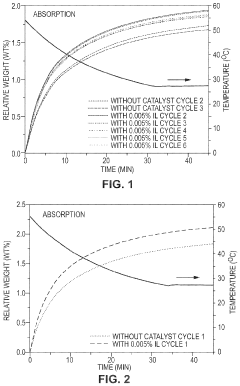
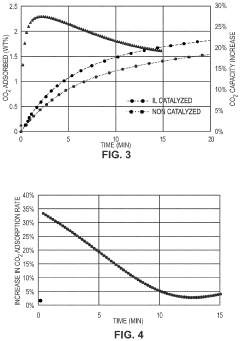
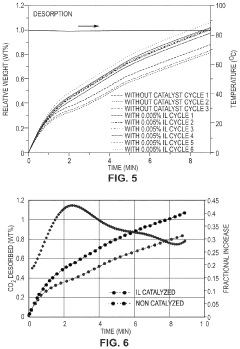
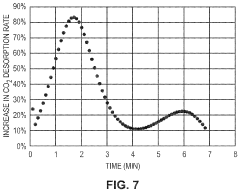
- Development of CO2 capture sorbents comprising a solid support with CO2-sorbing amine and ionic liquid, which enhances CO2 sorption and desorption characteristics, allowing for regeneration at lower temperatures and maintaining high selectivity and capacity through catalytic action.
Carbon Policy and Environmental Regulations
The global regulatory landscape for carbon emissions has undergone significant transformation over the past two decades, creating a complex framework that directly influences CO2 capture technology development and deployment. The Paris Agreement of 2015 established binding commitments for 196 countries to limit global temperature rise, with many nations subsequently implementing carbon pricing mechanisms, emission trading systems, and mandatory carbon capture requirements for industrial facilities. These policy frameworks have created substantial market drivers for efficient CO2 capture technologies, particularly those utilizing optimized adsorbent regeneration processes.
Carbon pricing mechanisms, including carbon taxes and cap-and-trade systems, have been implemented across over 40 national and regional jurisdictions, covering approximately 23% of global greenhouse gas emissions. The European Union Emissions Trading System (EU ETS), California's Cap-and-Trade Program, and China's national ETS represent the largest carbon markets, with prices ranging from $10 to $90 per ton of CO2 equivalent. These pricing structures create direct economic incentives for industries to invest in advanced CO2 capture technologies, making adsorbent regeneration efficiency a critical factor in determining project viability and return on investment.
Regulatory standards for industrial emissions have become increasingly stringent, with many jurisdictions mandating specific capture rates and efficiency thresholds. The United States Clean Air Act amendments and European Industrial Emissions Directive require large point sources to achieve CO2 capture rates exceeding 90%, while maintaining energy penalties below 25% of plant output. These performance standards directly impact adsorbent regeneration design requirements, necessitating technologies that can achieve rapid desorption cycles while maintaining material stability over thousands of operational cycles.
Environmental impact assessments for CO2 capture projects now incorporate comprehensive lifecycle analyses, evaluating not only capture efficiency but also the environmental footprint of adsorbent production, regeneration energy consumption, and waste management. Regulations in several countries require demonstration of net positive environmental benefits, considering factors such as water usage, chemical consumption, and secondary emissions from regeneration processes. This regulatory scrutiny has accelerated research into sustainable adsorbent materials and energy-efficient regeneration methods, including renewable energy integration and waste heat recovery systems.
Emerging regulatory frameworks are beginning to address the entire carbon capture, utilization, and storage value chain, with specific provisions for adsorbent-based technologies. Recent legislation in the United States, Canada, and Norway provides tax credits and financial incentives specifically tied to capture efficiency metrics, creating additional economic drivers for optimized regeneration technologies that can achieve higher CO2 recovery rates while minimizing energy consumption.
Carbon pricing mechanisms, including carbon taxes and cap-and-trade systems, have been implemented across over 40 national and regional jurisdictions, covering approximately 23% of global greenhouse gas emissions. The European Union Emissions Trading System (EU ETS), California's Cap-and-Trade Program, and China's national ETS represent the largest carbon markets, with prices ranging from $10 to $90 per ton of CO2 equivalent. These pricing structures create direct economic incentives for industries to invest in advanced CO2 capture technologies, making adsorbent regeneration efficiency a critical factor in determining project viability and return on investment.
Regulatory standards for industrial emissions have become increasingly stringent, with many jurisdictions mandating specific capture rates and efficiency thresholds. The United States Clean Air Act amendments and European Industrial Emissions Directive require large point sources to achieve CO2 capture rates exceeding 90%, while maintaining energy penalties below 25% of plant output. These performance standards directly impact adsorbent regeneration design requirements, necessitating technologies that can achieve rapid desorption cycles while maintaining material stability over thousands of operational cycles.
Environmental impact assessments for CO2 capture projects now incorporate comprehensive lifecycle analyses, evaluating not only capture efficiency but also the environmental footprint of adsorbent production, regeneration energy consumption, and waste management. Regulations in several countries require demonstration of net positive environmental benefits, considering factors such as water usage, chemical consumption, and secondary emissions from regeneration processes. This regulatory scrutiny has accelerated research into sustainable adsorbent materials and energy-efficient regeneration methods, including renewable energy integration and waste heat recovery systems.
Emerging regulatory frameworks are beginning to address the entire carbon capture, utilization, and storage value chain, with specific provisions for adsorbent-based technologies. Recent legislation in the United States, Canada, and Norway provides tax credits and financial incentives specifically tied to capture efficiency metrics, creating additional economic drivers for optimized regeneration technologies that can achieve higher CO2 recovery rates while minimizing energy consumption.
Energy Integration and Process Economics
Energy integration represents a critical factor in determining the commercial viability of CO2 capture systems utilizing adsorbent regeneration. The thermal energy requirements for desorbing CO2 from solid adsorbents typically constitute 60-80% of the total operational costs, making heat recovery and integration strategies essential for economic feasibility. Advanced heat exchanger networks can recover substantial amounts of thermal energy from hot regenerated adsorbents and flue gas streams, reducing external heating requirements by up to 40%.
Process economics analysis reveals that capital expenditure for CO2 capture facilities ranges from $400-800 per tonne of CO2 captured annually, with regeneration systems accounting for approximately 35% of total equipment costs. The levelized cost of CO2 capture varies significantly based on energy integration efficiency, ranging from $50-120 per tonne CO2 for well-integrated systems compared to $80-200 per tonne for conventional configurations without heat recovery.
Steam integration offers promising opportunities for reducing operational expenses, particularly in industrial settings where low-pressure steam is available as a byproduct. Multi-effect regeneration configurations can utilize waste heat from primary desorption stages to pre-heat subsequent regeneration cycles, achieving energy savings of 25-35%. Additionally, implementing variable temperature swing adsorption with optimized heating profiles can reduce energy consumption while maintaining high CO2 purity levels.
Economic sensitivity analysis indicates that energy costs represent the most significant variable affecting project profitability, with a 20% reduction in energy requirements potentially improving project net present value by 15-25%. Integration with renewable energy sources, particularly solar thermal systems, presents opportunities for further cost reduction and carbon footprint minimization, though intermittency challenges require careful consideration of thermal storage solutions.
The payback period for energy integration investments typically ranges from 2-4 years, depending on local energy prices and carbon credit values. Emerging technologies such as heat pumps and mechanical vapor recompression systems show potential for further improving energy efficiency, though their implementation requires careful evaluation of additional capital costs versus operational savings.
Process economics analysis reveals that capital expenditure for CO2 capture facilities ranges from $400-800 per tonne of CO2 captured annually, with regeneration systems accounting for approximately 35% of total equipment costs. The levelized cost of CO2 capture varies significantly based on energy integration efficiency, ranging from $50-120 per tonne CO2 for well-integrated systems compared to $80-200 per tonne for conventional configurations without heat recovery.
Steam integration offers promising opportunities for reducing operational expenses, particularly in industrial settings where low-pressure steam is available as a byproduct. Multi-effect regeneration configurations can utilize waste heat from primary desorption stages to pre-heat subsequent regeneration cycles, achieving energy savings of 25-35%. Additionally, implementing variable temperature swing adsorption with optimized heating profiles can reduce energy consumption while maintaining high CO2 purity levels.
Economic sensitivity analysis indicates that energy costs represent the most significant variable affecting project profitability, with a 20% reduction in energy requirements potentially improving project net present value by 15-25%. Integration with renewable energy sources, particularly solar thermal systems, presents opportunities for further cost reduction and carbon footprint minimization, though intermittency challenges require careful consideration of thermal storage solutions.
The payback period for energy integration investments typically ranges from 2-4 years, depending on local energy prices and carbon credit values. Emerging technologies such as heat pumps and mechanical vapor recompression systems show potential for further improving energy efficiency, though their implementation requires careful evaluation of additional capital costs versus operational savings.
Unlock deeper insights with Patsnap Eureka Quick Research — get a full tech report to explore trends and direct your research. Try now!
Generate Your Research Report Instantly with AI Agent
Supercharge your innovation with Patsnap Eureka AI Agent Platform!