
Quantify Real-Time Feedback in Notch Filter Applications
MAR 17, 20269 MIN READ
Generate Your Research Report Instantly with AI Agent
Patsnap Eureka helps you evaluate technical feasibility & market potential.
Real-Time Notch Filter Background and Quantification Goals
Notch filters represent a specialized class of signal processing components designed to attenuate specific frequency bands while preserving the integrity of surrounding spectral content. These filters have evolved from analog implementations using passive RLC circuits to sophisticated digital signal processing algorithms capable of adaptive frequency tracking and real-time parameter adjustment. The fundamental principle involves creating a sharp null at predetermined frequencies, effectively eliminating unwanted interference, noise, or specific signal components without significantly affecting the desired signal characteristics.
The historical development of notch filtering technology traces back to early telecommunications systems where power line interference at 50Hz or 60Hz required elimination from audio signals. Traditional analog notch filters provided fixed-frequency rejection but lacked the flexibility demanded by modern applications. The transition to digital implementations introduced programmable capabilities, enabling dynamic frequency adjustment and improved filter characteristics through advanced mathematical algorithms such as infinite impulse response (IIR) and finite impulse response (FIR) designs.
Contemporary notch filter applications span diverse technological domains including biomedical signal processing, audio engineering, radar systems, and wireless communications. In electrocardiogram processing, adaptive notch filters eliminate power line interference while preserving critical cardiac signal information. Audio systems utilize notch filters to suppress feedback oscillations and eliminate specific frequency artifacts. Radar applications employ notch filtering to reject clutter and interference signals, enhancing target detection capabilities.
The quantification of real-time feedback mechanisms in notch filter systems has emerged as a critical research area driven by increasing demands for adaptive performance and system optimization. Real-time feedback enables continuous monitoring of filter effectiveness, automatic parameter adjustment, and performance validation under varying operational conditions. This quantification process involves measuring key performance indicators such as rejection depth, bandwidth characteristics, transient response, and stability margins.
Primary quantification objectives include establishing standardized metrics for real-time performance assessment, developing automated calibration procedures, and implementing predictive maintenance capabilities. The integration of machine learning algorithms with traditional control theory approaches offers promising avenues for intelligent filter adaptation based on historical performance data and environmental conditions.
Advanced quantification frameworks incorporate multi-dimensional analysis considering frequency domain characteristics, time domain response, and statistical performance measures. These comprehensive evaluation methodologies enable precise characterization of filter behavior under dynamic conditions, facilitating optimal parameter selection and system configuration for specific application requirements.
The historical development of notch filtering technology traces back to early telecommunications systems where power line interference at 50Hz or 60Hz required elimination from audio signals. Traditional analog notch filters provided fixed-frequency rejection but lacked the flexibility demanded by modern applications. The transition to digital implementations introduced programmable capabilities, enabling dynamic frequency adjustment and improved filter characteristics through advanced mathematical algorithms such as infinite impulse response (IIR) and finite impulse response (FIR) designs.
Contemporary notch filter applications span diverse technological domains including biomedical signal processing, audio engineering, radar systems, and wireless communications. In electrocardiogram processing, adaptive notch filters eliminate power line interference while preserving critical cardiac signal information. Audio systems utilize notch filters to suppress feedback oscillations and eliminate specific frequency artifacts. Radar applications employ notch filtering to reject clutter and interference signals, enhancing target detection capabilities.
The quantification of real-time feedback mechanisms in notch filter systems has emerged as a critical research area driven by increasing demands for adaptive performance and system optimization. Real-time feedback enables continuous monitoring of filter effectiveness, automatic parameter adjustment, and performance validation under varying operational conditions. This quantification process involves measuring key performance indicators such as rejection depth, bandwidth characteristics, transient response, and stability margins.
Primary quantification objectives include establishing standardized metrics for real-time performance assessment, developing automated calibration procedures, and implementing predictive maintenance capabilities. The integration of machine learning algorithms with traditional control theory approaches offers promising avenues for intelligent filter adaptation based on historical performance data and environmental conditions.
Advanced quantification frameworks incorporate multi-dimensional analysis considering frequency domain characteristics, time domain response, and statistical performance measures. These comprehensive evaluation methodologies enable precise characterization of filter behavior under dynamic conditions, facilitating optimal parameter selection and system configuration for specific application requirements.
Market Demand for Real-Time Notch Filter Solutions
The market demand for real-time notch filter solutions is experiencing significant growth across multiple industrial sectors, driven by the increasing complexity of modern electronic systems and the critical need for precise interference suppression. Industries such as telecommunications, aerospace, medical devices, and automotive electronics are actively seeking advanced notch filtering technologies that can provide instantaneous feedback and adaptive performance characteristics.
Telecommunications infrastructure represents one of the largest demand drivers, where real-time notch filters are essential for eliminating specific frequency interferences in wireless communication systems. The proliferation of 5G networks and the densification of cellular infrastructure have created substantial requirements for adaptive filtering solutions that can dynamically respond to changing interference patterns. Network equipment manufacturers are particularly focused on solutions that can provide quantifiable feedback metrics to optimize system performance automatically.
The aerospace and defense sector demonstrates strong demand for real-time notch filter applications in radar systems, electronic warfare equipment, and satellite communications. These applications require highly reliable filtering solutions with precise feedback mechanisms to maintain operational effectiveness in challenging electromagnetic environments. The sector's emphasis on system reliability and performance verification drives the need for quantifiable real-time feedback capabilities.
Medical device manufacturing has emerged as a rapidly growing market segment, particularly in areas such as MRI systems, patient monitoring equipment, and implantable devices. Real-time notch filters with quantifiable feedback are crucial for eliminating power line interference and other electromagnetic disturbances that can compromise diagnostic accuracy or patient safety. Regulatory requirements in this sector further emphasize the importance of measurable and verifiable filter performance.
The automotive industry's transition toward electric vehicles and autonomous driving systems has created new demand patterns for real-time notch filtering solutions. Electric powertrains generate specific frequency interferences that require adaptive suppression, while advanced driver assistance systems demand reliable filtering with real-time performance monitoring capabilities.
Industrial automation and manufacturing sectors are increasingly adopting smart factory concepts, where real-time notch filters play critical roles in ensuring reliable operation of sensitive control systems and measurement equipment. The demand in this sector is characterized by requirements for robust performance in harsh industrial environments combined with integration capabilities for Industry 4.0 applications.
Market growth is further accelerated by the increasing adoption of Internet of Things devices and edge computing applications, where compact, efficient notch filtering solutions with real-time feedback capabilities are essential for maintaining signal integrity in dense electronic environments.
Telecommunications infrastructure represents one of the largest demand drivers, where real-time notch filters are essential for eliminating specific frequency interferences in wireless communication systems. The proliferation of 5G networks and the densification of cellular infrastructure have created substantial requirements for adaptive filtering solutions that can dynamically respond to changing interference patterns. Network equipment manufacturers are particularly focused on solutions that can provide quantifiable feedback metrics to optimize system performance automatically.
The aerospace and defense sector demonstrates strong demand for real-time notch filter applications in radar systems, electronic warfare equipment, and satellite communications. These applications require highly reliable filtering solutions with precise feedback mechanisms to maintain operational effectiveness in challenging electromagnetic environments. The sector's emphasis on system reliability and performance verification drives the need for quantifiable real-time feedback capabilities.
Medical device manufacturing has emerged as a rapidly growing market segment, particularly in areas such as MRI systems, patient monitoring equipment, and implantable devices. Real-time notch filters with quantifiable feedback are crucial for eliminating power line interference and other electromagnetic disturbances that can compromise diagnostic accuracy or patient safety. Regulatory requirements in this sector further emphasize the importance of measurable and verifiable filter performance.
The automotive industry's transition toward electric vehicles and autonomous driving systems has created new demand patterns for real-time notch filtering solutions. Electric powertrains generate specific frequency interferences that require adaptive suppression, while advanced driver assistance systems demand reliable filtering with real-time performance monitoring capabilities.
Industrial automation and manufacturing sectors are increasingly adopting smart factory concepts, where real-time notch filters play critical roles in ensuring reliable operation of sensitive control systems and measurement equipment. The demand in this sector is characterized by requirements for robust performance in harsh industrial environments combined with integration capabilities for Industry 4.0 applications.
Market growth is further accelerated by the increasing adoption of Internet of Things devices and edge computing applications, where compact, efficient notch filtering solutions with real-time feedback capabilities are essential for maintaining signal integrity in dense electronic environments.
Current State and Challenges in Notch Filter Feedback Systems
Notch filter feedback systems currently operate across diverse technological domains, from audio processing and telecommunications to biomedical signal conditioning and power electronics. The fundamental challenge lies in achieving precise real-time quantification of feedback parameters while maintaining system stability and performance. Contemporary implementations predominantly rely on analog feedback circuits, digital signal processing algorithms, and hybrid approaches that combine both methodologies.
The quantification of real-time feedback in notch filter applications faces several critical technical barriers. Traditional analog feedback mechanisms suffer from component drift, temperature sensitivity, and limited dynamic range, making precise real-time measurement challenging. Digital implementations, while offering superior accuracy and flexibility, introduce latency issues that can compromise real-time performance requirements. The sampling rate limitations and computational overhead associated with complex feedback algorithms create bottlenecks in high-frequency applications.
Current feedback quantification methods struggle with adaptive filtering scenarios where notch frequency and bandwidth must dynamically adjust based on input signal characteristics. The lack of standardized metrics for evaluating feedback effectiveness across different application domains creates inconsistencies in performance assessment. Many existing systems rely on indirect measurement techniques that estimate feedback parameters rather than providing direct quantification, leading to reduced accuracy and reliability.
Geographically, advanced notch filter feedback research concentrates primarily in North America and Europe, with significant contributions from academic institutions and semiconductor companies. Asian markets, particularly Japan and South Korea, focus heavily on consumer electronics applications, while emerging markets show growing interest in power grid and renewable energy applications. This geographic distribution creates knowledge gaps and varying technical standards across regions.
The integration of machine learning and artificial intelligence into feedback quantification represents an emerging trend, though current implementations remain largely experimental. Real-time processing constraints limit the complexity of algorithms that can be practically deployed, particularly in embedded systems with limited computational resources. The challenge of maintaining phase coherence while implementing adaptive feedback mechanisms continues to constrain system performance in critical applications.
Measurement accuracy versus processing speed trade-offs represent a fundamental constraint in current systems. High-precision feedback quantification typically requires extensive computational resources, creating conflicts with real-time performance requirements. Additionally, the lack of unified testing protocols and standardized benchmarks makes comparative evaluation of different feedback quantification approaches difficult, hindering systematic improvement efforts across the industry.
The quantification of real-time feedback in notch filter applications faces several critical technical barriers. Traditional analog feedback mechanisms suffer from component drift, temperature sensitivity, and limited dynamic range, making precise real-time measurement challenging. Digital implementations, while offering superior accuracy and flexibility, introduce latency issues that can compromise real-time performance requirements. The sampling rate limitations and computational overhead associated with complex feedback algorithms create bottlenecks in high-frequency applications.
Current feedback quantification methods struggle with adaptive filtering scenarios where notch frequency and bandwidth must dynamically adjust based on input signal characteristics. The lack of standardized metrics for evaluating feedback effectiveness across different application domains creates inconsistencies in performance assessment. Many existing systems rely on indirect measurement techniques that estimate feedback parameters rather than providing direct quantification, leading to reduced accuracy and reliability.
Geographically, advanced notch filter feedback research concentrates primarily in North America and Europe, with significant contributions from academic institutions and semiconductor companies. Asian markets, particularly Japan and South Korea, focus heavily on consumer electronics applications, while emerging markets show growing interest in power grid and renewable energy applications. This geographic distribution creates knowledge gaps and varying technical standards across regions.
The integration of machine learning and artificial intelligence into feedback quantification represents an emerging trend, though current implementations remain largely experimental. Real-time processing constraints limit the complexity of algorithms that can be practically deployed, particularly in embedded systems with limited computational resources. The challenge of maintaining phase coherence while implementing adaptive feedback mechanisms continues to constrain system performance in critical applications.
Measurement accuracy versus processing speed trade-offs represent a fundamental constraint in current systems. High-precision feedback quantification typically requires extensive computational resources, creating conflicts with real-time performance requirements. Additionally, the lack of unified testing protocols and standardized benchmarks makes comparative evaluation of different feedback quantification approaches difficult, hindering systematic improvement efforts across the industry.
Existing Real-Time Feedback Quantification Methods
01 Adaptive notch filter with real-time frequency tracking
Systems and methods for implementing adaptive notch filters that can automatically track and adjust to changing interference frequencies in real-time. These filters continuously monitor the input signal and dynamically update filter parameters to maintain optimal rejection of unwanted frequency components. The adaptive mechanism allows the notch filter to follow frequency variations without manual intervention, making it suitable for applications where interference frequencies may drift or change over time.- Adaptive notch filter with automatic frequency tracking: Adaptive notch filters can automatically detect and track the frequency of unwanted signals or feedback in real-time. These systems use feedback mechanisms to continuously adjust the notch frequency to match the interference frequency, ensuring effective suppression of narrow-band noise or howling feedback. The adaptive algorithm monitors the signal characteristics and dynamically updates filter parameters to maintain optimal performance even when the interference frequency changes over time.
- Digital signal processing for notch filter implementation: Digital signal processing techniques enable precise implementation of notch filters with real-time feedback control. These methods utilize digital filters that can be programmed and adjusted in real-time to target specific frequencies. The digital approach allows for complex filter designs with steep roll-off characteristics and minimal phase distortion. Real-time processing ensures immediate response to feedback conditions, making these systems suitable for audio applications, communication systems, and active noise cancellation.
- Feedback detection and suppression in audio systems: Real-time feedback detection systems identify acoustic feedback before it becomes audible and apply notch filtering to suppress it. These systems analyze the audio signal for characteristic feedback patterns and rapidly deploy narrow notch filters at the problematic frequencies. The detection algorithms can distinguish between feedback and desired audio content, ensuring that only unwanted feedback is attenuated while preserving sound quality. Multiple notch filters can be deployed simultaneously to handle feedback at different frequencies.
- Variable bandwidth notch filter with real-time adjustment: Variable bandwidth notch filters allow dynamic adjustment of both the center frequency and the bandwidth of the notch in response to real-time feedback conditions. These systems can optimize the trade-off between feedback suppression and audio quality by adjusting the notch width based on the characteristics of the interference. Narrow notches minimize impact on desired signals while wider notches provide more robust suppression of unstable feedback. The bandwidth adjustment can be automated based on feedback severity and signal analysis.
- Multi-channel notch filtering with feedback coordination: Multi-channel systems implement coordinated notch filtering across multiple audio channels with shared feedback detection and control. These architectures enable efficient processing of feedback in complex audio environments such as conference systems, public address systems, and multi-speaker installations. The coordination between channels allows for intelligent allocation of notch filters and prevents redundant processing. Real-time communication between channels ensures consistent feedback suppression across the entire system while optimizing computational resources.
02 Feedback control systems with notch filtering for stability enhancement
Implementation of notch filters within feedback control loops to improve system stability and reduce oscillations. The notch filter is strategically placed in the feedback path to attenuate specific resonant frequencies that could cause instability or unwanted oscillations in the control system. This approach enhances the overall performance of feedback systems by selectively removing problematic frequency components while preserving the desired control characteristics across other frequency ranges.Expand Specific Solutions03 Digital notch filter implementation with real-time processing
Digital signal processing techniques for implementing notch filters that operate in real-time with minimal latency. These implementations utilize efficient algorithms and hardware architectures to achieve fast computation and immediate response to input signals. The digital approach allows for precise control of filter characteristics, easy reconfiguration, and integration with other digital processing components in the signal chain.Expand Specific Solutions04 Multi-notch filtering with cascaded or parallel configurations
Systems employing multiple notch filters arranged in cascaded or parallel configurations to simultaneously reject multiple interference frequencies. This architecture enables the suppression of several distinct unwanted frequency components in real-time, which is particularly useful in complex signal environments with multiple sources of interference. The multi-notch approach can be implemented with independent control of each notch frequency and bandwidth.Expand Specific Solutions05 Notch filter with feedback-based parameter optimization
Methods for optimizing notch filter parameters using feedback mechanisms that evaluate filter performance in real-time. The system monitors output signal quality metrics and adjusts filter characteristics such as center frequency, bandwidth, and depth to achieve optimal performance. This feedback-driven optimization enables the filter to adapt to changing signal conditions and maintain effective interference rejection under varying operational scenarios.Expand Specific Solutions
Core Patents in Adaptive Notch Filter Algorithms
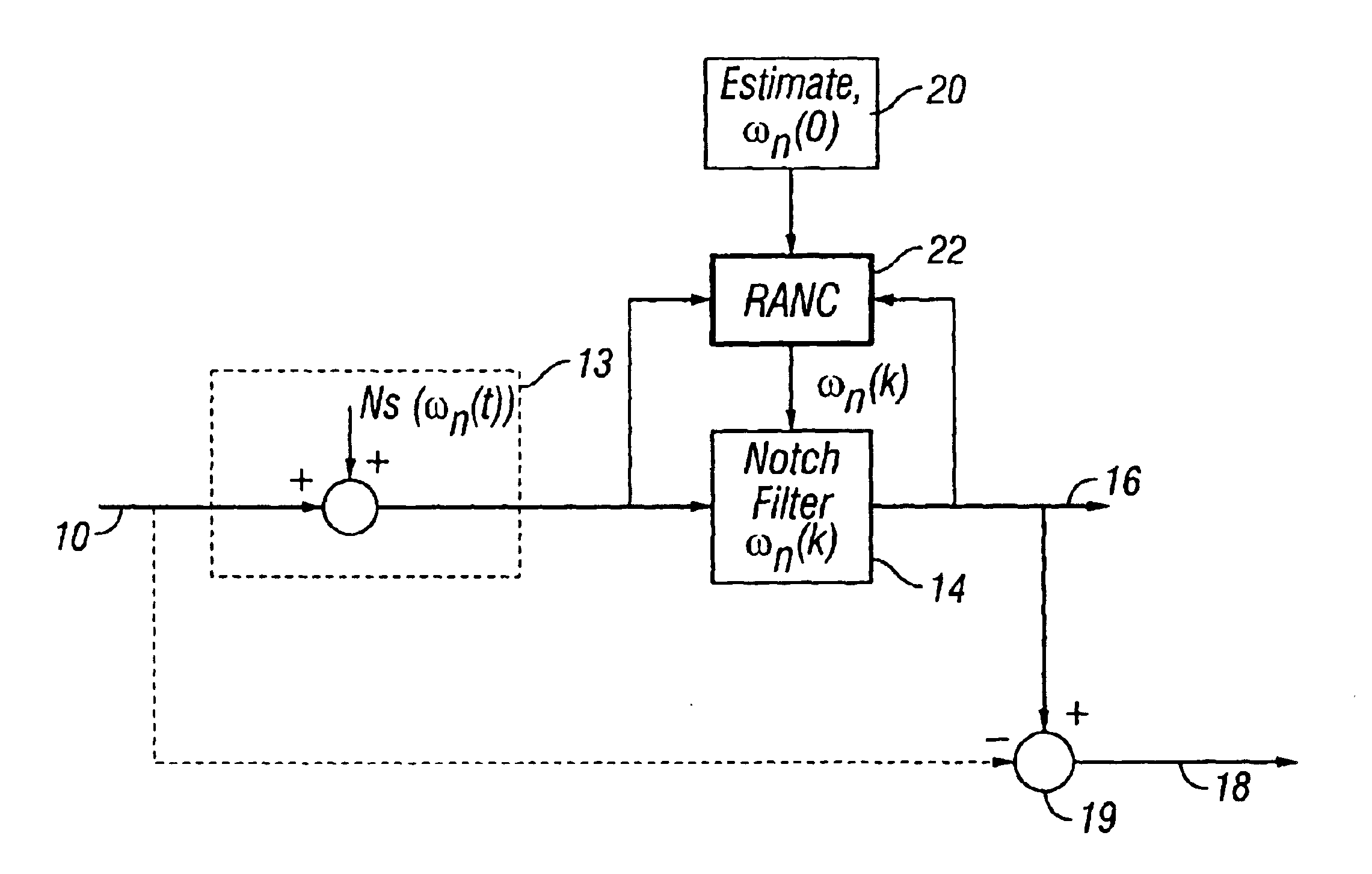
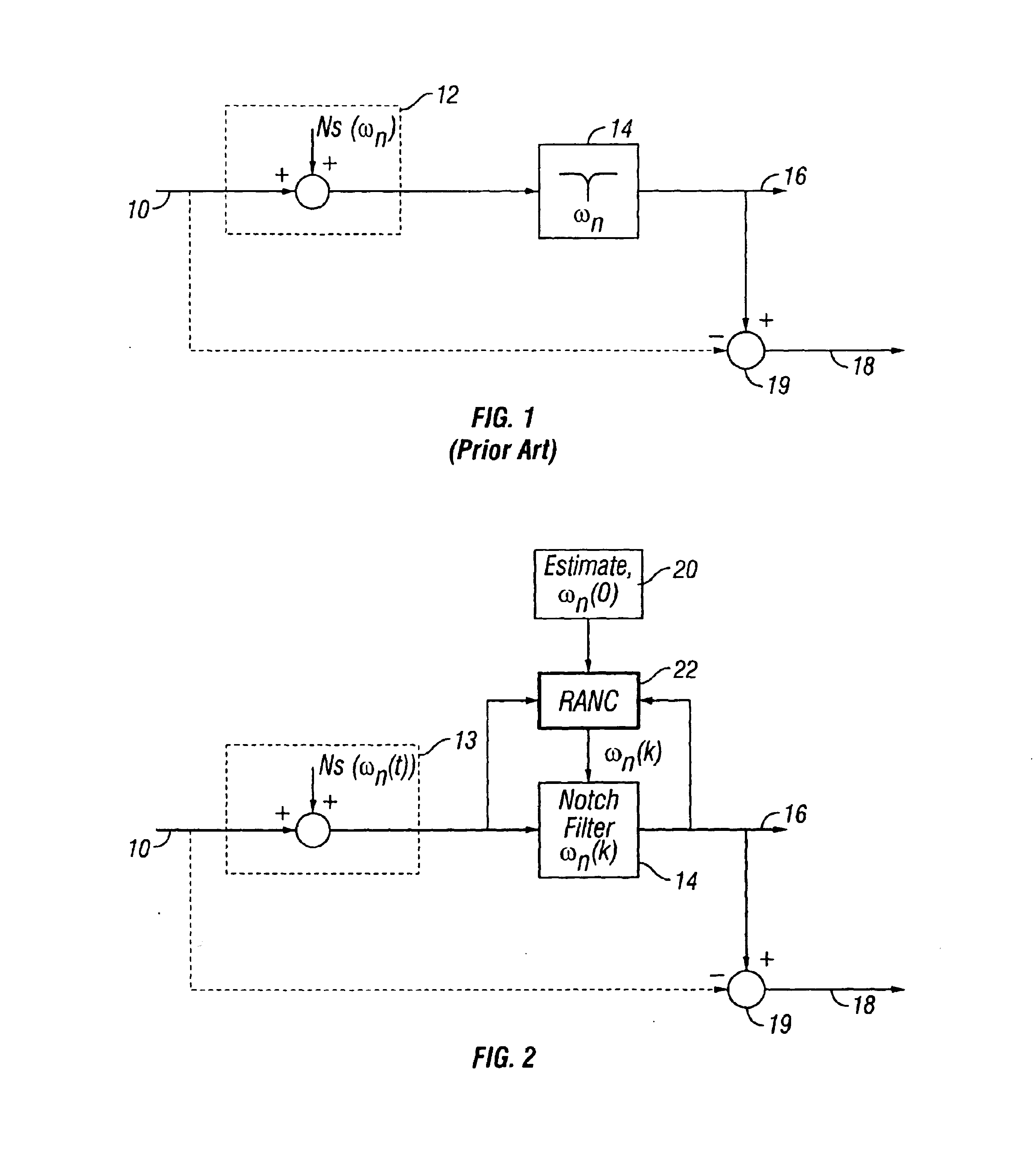
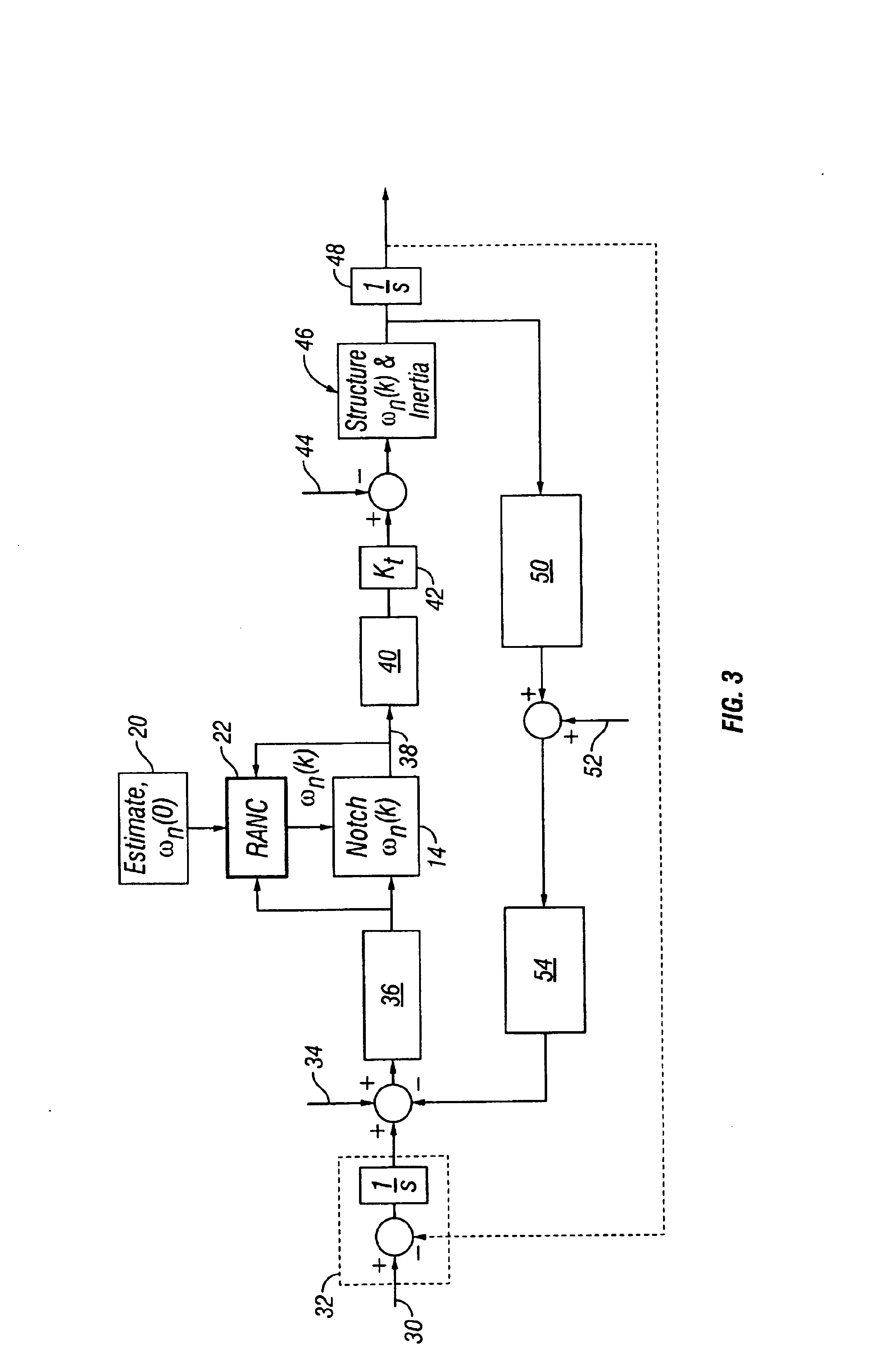
Realtime adaptive notch compensator
PatentInactiveUS6867642B1
Innovation
- The Realtime Adaptive Notch Compensator (RANC) dynamically calculates and updates the notch filter frequency to stabilize control loops by minimizing oscillations, using pre-filters, demodulation, and integral compensation to adapt to changing resonance frequencies and noise harmonics, allowing for narrower notches and reduced structural stiffness.

Method and system for elimination of acoustic feedback
PatentInactiveUS20100046768A1
Innovation
- A system and method that uses a digital processor to detect acoustic feedback by converting digital signals into the frequency domain, selecting candidate feedback frequencies using a Fourier transform and ballistics approach, and applying notch filters to reduce loop gain automatically, thereby eliminating feedback.


Performance Standards for Real-Time Signal Processing
Real-time signal processing in notch filter applications demands stringent performance standards to ensure effective interference suppression while maintaining signal integrity. The fundamental performance metrics center on latency constraints, where processing delays must typically remain below 1-10 milliseconds depending on the application domain. For audio applications, latency requirements are particularly critical, with acceptable delays ranging from 5-20 milliseconds to prevent perceptible audio artifacts.
Frequency response accuracy represents another crucial performance standard, requiring notch filters to achieve rejection depths of at least 40-60 dB at target frequencies while maintaining minimal impact on adjacent frequency components. The filter's quality factor (Q) must be precisely controlled to balance selectivity against stability, with typical Q values ranging from 10 to 100 for most real-time applications.
Computational efficiency standards mandate that notch filter algorithms operate within available processing resources, typically requiring execution times that consume less than 70% of available CPU cycles to maintain real-time performance. Memory usage constraints further limit implementation approaches, particularly in embedded systems where RAM availability may be severely restricted.
Stability margins constitute critical performance criteria, especially for adaptive notch filters that adjust parameters in real-time. The system must maintain stable operation across varying input conditions, with stability margins typically exceeding 6 dB gain margin and 30-degree phase margin to prevent oscillations or divergence.
Dynamic range requirements specify that notch filters must handle input signal variations spanning 60-120 dB without introducing significant distortion or clipping. Signal-to-noise ratio preservation demands that the filtering process adds minimal noise, typically maintaining SNR degradation below 1-3 dB.
Convergence speed standards for adaptive implementations require parameter adjustment algorithms to reach steady-state performance within 100-1000 iterations, depending on the application's tolerance for transient behavior. These performance standards collectively ensure that real-time notch filter systems deliver reliable, predictable interference suppression while meeting the demanding constraints of time-critical applications.
Frequency response accuracy represents another crucial performance standard, requiring notch filters to achieve rejection depths of at least 40-60 dB at target frequencies while maintaining minimal impact on adjacent frequency components. The filter's quality factor (Q) must be precisely controlled to balance selectivity against stability, with typical Q values ranging from 10 to 100 for most real-time applications.
Computational efficiency standards mandate that notch filter algorithms operate within available processing resources, typically requiring execution times that consume less than 70% of available CPU cycles to maintain real-time performance. Memory usage constraints further limit implementation approaches, particularly in embedded systems where RAM availability may be severely restricted.
Stability margins constitute critical performance criteria, especially for adaptive notch filters that adjust parameters in real-time. The system must maintain stable operation across varying input conditions, with stability margins typically exceeding 6 dB gain margin and 30-degree phase margin to prevent oscillations or divergence.
Dynamic range requirements specify that notch filters must handle input signal variations spanning 60-120 dB without introducing significant distortion or clipping. Signal-to-noise ratio preservation demands that the filtering process adds minimal noise, typically maintaining SNR degradation below 1-3 dB.
Convergence speed standards for adaptive implementations require parameter adjustment algorithms to reach steady-state performance within 100-1000 iterations, depending on the application's tolerance for transient behavior. These performance standards collectively ensure that real-time notch filter systems deliver reliable, predictable interference suppression while meeting the demanding constraints of time-critical applications.
Implementation Challenges in Hardware-Software Co-design
The implementation of real-time feedback quantification in notch filter applications presents significant hardware-software co-design challenges that require careful consideration of multiple interdependent factors. The primary challenge lies in achieving optimal partitioning between hardware and software components while maintaining real-time performance requirements and measurement accuracy.
Hardware implementation challenges center around the need for high-speed analog-to-digital converters and digital signal processors capable of handling the computational demands of real-time feedback analysis. The selection of appropriate FPGA architectures or dedicated DSP chips must balance processing power with power consumption and cost constraints. Additionally, the hardware must provide sufficient precision for accurate quantification while maintaining low latency to preserve the real-time nature of the feedback loop.
Software implementation faces the challenge of developing efficient algorithms that can process feedback signals within strict timing constraints. The software must handle complex mathematical operations including frequency domain analysis, phase detection, and adaptive filtering while ensuring deterministic execution times. Memory management becomes critical as real-time systems cannot tolerate garbage collection delays or memory allocation uncertainties.
Interface design between hardware and software components presents another layer of complexity. The communication protocols must ensure data integrity while minimizing latency. Buffer management strategies must prevent data overflow while maintaining continuous signal processing. Synchronization mechanisms are essential to coordinate between different processing stages and maintain temporal coherence of the feedback measurements.
System-level integration challenges include thermal management, electromagnetic interference mitigation, and ensuring stable operation across varying environmental conditions. The co-design must also accommodate future scalability requirements and potential algorithm updates without requiring complete hardware redesign.
Verification and validation of the integrated system pose additional challenges, as traditional testing methods may not adequately capture the real-time performance characteristics. Specialized testing frameworks and simulation environments are required to validate both functional correctness and timing performance under various operating conditions.
Hardware implementation challenges center around the need for high-speed analog-to-digital converters and digital signal processors capable of handling the computational demands of real-time feedback analysis. The selection of appropriate FPGA architectures or dedicated DSP chips must balance processing power with power consumption and cost constraints. Additionally, the hardware must provide sufficient precision for accurate quantification while maintaining low latency to preserve the real-time nature of the feedback loop.
Software implementation faces the challenge of developing efficient algorithms that can process feedback signals within strict timing constraints. The software must handle complex mathematical operations including frequency domain analysis, phase detection, and adaptive filtering while ensuring deterministic execution times. Memory management becomes critical as real-time systems cannot tolerate garbage collection delays or memory allocation uncertainties.
Interface design between hardware and software components presents another layer of complexity. The communication protocols must ensure data integrity while minimizing latency. Buffer management strategies must prevent data overflow while maintaining continuous signal processing. Synchronization mechanisms are essential to coordinate between different processing stages and maintain temporal coherence of the feedback measurements.
System-level integration challenges include thermal management, electromagnetic interference mitigation, and ensuring stable operation across varying environmental conditions. The co-design must also accommodate future scalability requirements and potential algorithm updates without requiring complete hardware redesign.
Verification and validation of the integrated system pose additional challenges, as traditional testing methods may not adequately capture the real-time performance characteristics. Specialized testing frameworks and simulation environments are required to validate both functional correctness and timing performance under various operating conditions.
Unlock deeper insights with Patsnap Eureka Quick Research — get a full tech report to explore trends and direct your research. Try now!
Generate Your Research Report Instantly with AI Agent
Supercharge your innovation with Patsnap Eureka AI Agent Platform!