Quantum Computing in Improving Precision Agricultural Techniques
JUL 17, 20259 MIN READ
Generate Your Research Report Instantly with AI Agent
Patsnap Eureka helps you evaluate technical feasibility & market potential.
Quantum Computing in Agriculture: Background and Objectives
Quantum computing represents a revolutionary paradigm in computational technology, leveraging the principles of quantum mechanics to perform complex calculations at unprecedented speeds. In the context of agriculture, this emerging technology holds immense potential to transform precision farming techniques, offering solutions to some of the most pressing challenges in modern agriculture.
The evolution of quantum computing can be traced back to the early 1980s when physicist Richard Feynman first proposed the concept of quantum simulation. Over the subsequent decades, theoretical foundations were laid, culminating in the development of the first rudimentary quantum computers in the late 1990s and early 2000s. Today, quantum computing stands at the cusp of practical applicability, with major tech companies and research institutions making significant strides in hardware development and algorithm design.
In agriculture, the integration of quantum computing aligns with the broader trend of digitalization and data-driven decision-making. The agricultural sector has witnessed a gradual shift from traditional farming methods to precision agriculture, which relies heavily on data analytics, IoT devices, and AI-driven insights. Quantum computing promises to elevate these capabilities to new heights, offering unprecedented computational power to tackle complex agricultural challenges.
The primary objective of incorporating quantum computing in precision agriculture is to optimize resource utilization, enhance crop yield, and mitigate environmental impact. By harnessing the power of quantum algorithms, farmers and agricultural scientists aim to process vast amounts of data from various sources - satellite imagery, soil sensors, weather stations, and genetic databases - to generate highly accurate predictive models and optimization strategies.
Specific goals include developing quantum-enhanced weather prediction models to improve crop planning and risk management, optimizing supply chain logistics to reduce food waste, and accelerating the discovery of new, more resilient crop varieties through quantum-assisted genomic analysis. Additionally, quantum computing could revolutionize pest and disease management by simulating complex ecological systems and predicting outbreak patterns with greater accuracy.
The convergence of quantum computing and agriculture also aims to address global food security challenges in the face of climate change and population growth. By enabling more efficient use of resources and increasing agricultural productivity, quantum-powered precision farming techniques could play a crucial role in ensuring sustainable food production for future generations.
As we stand on the brink of this technological revolution, the integration of quantum computing in agriculture represents not just an advancement in farming techniques, but a fundamental shift in how we approach food production and environmental stewardship. The journey ahead promises groundbreaking discoveries and innovations that could reshape the agricultural landscape for decades to come.
The evolution of quantum computing can be traced back to the early 1980s when physicist Richard Feynman first proposed the concept of quantum simulation. Over the subsequent decades, theoretical foundations were laid, culminating in the development of the first rudimentary quantum computers in the late 1990s and early 2000s. Today, quantum computing stands at the cusp of practical applicability, with major tech companies and research institutions making significant strides in hardware development and algorithm design.
In agriculture, the integration of quantum computing aligns with the broader trend of digitalization and data-driven decision-making. The agricultural sector has witnessed a gradual shift from traditional farming methods to precision agriculture, which relies heavily on data analytics, IoT devices, and AI-driven insights. Quantum computing promises to elevate these capabilities to new heights, offering unprecedented computational power to tackle complex agricultural challenges.
The primary objective of incorporating quantum computing in precision agriculture is to optimize resource utilization, enhance crop yield, and mitigate environmental impact. By harnessing the power of quantum algorithms, farmers and agricultural scientists aim to process vast amounts of data from various sources - satellite imagery, soil sensors, weather stations, and genetic databases - to generate highly accurate predictive models and optimization strategies.
Specific goals include developing quantum-enhanced weather prediction models to improve crop planning and risk management, optimizing supply chain logistics to reduce food waste, and accelerating the discovery of new, more resilient crop varieties through quantum-assisted genomic analysis. Additionally, quantum computing could revolutionize pest and disease management by simulating complex ecological systems and predicting outbreak patterns with greater accuracy.
The convergence of quantum computing and agriculture also aims to address global food security challenges in the face of climate change and population growth. By enabling more efficient use of resources and increasing agricultural productivity, quantum-powered precision farming techniques could play a crucial role in ensuring sustainable food production for future generations.
As we stand on the brink of this technological revolution, the integration of quantum computing in agriculture represents not just an advancement in farming techniques, but a fundamental shift in how we approach food production and environmental stewardship. The journey ahead promises groundbreaking discoveries and innovations that could reshape the agricultural landscape for decades to come.
Market Analysis for Quantum-Enhanced Precision Agriculture
The market for quantum-enhanced precision agriculture is poised for significant growth as the integration of quantum computing technologies with agricultural practices promises to revolutionize the industry. Precision agriculture, already a burgeoning sector, is expected to benefit greatly from the advanced computational capabilities of quantum systems, particularly in areas such as crop yield optimization, resource management, and climate adaptation strategies.
Current market trends indicate a growing demand for more efficient and sustainable agricultural practices. Farmers and agribusinesses are increasingly seeking technologies that can provide more accurate predictions, optimize resource allocation, and improve decision-making processes. Quantum computing, with its ability to process complex algorithms and vast datasets at unprecedented speeds, is well-positioned to address these needs.
The potential market size for quantum-enhanced precision agriculture is substantial. The global precision agriculture market, valued at approximately $5.5 billion in 2020, is projected to reach $12.8 billion by 2026, with a compound annual growth rate (CAGR) of 15.2%. While quantum-enhanced solutions currently represent a small fraction of this market, they are expected to capture an increasing share as the technology matures and becomes more accessible.
Key drivers for market growth include the need for increased food production to meet global population demands, the pressure to reduce environmental impact and resource consumption in agriculture, and the push for more resilient farming practices in the face of climate change. Quantum computing's potential to optimize crop yields, reduce water and fertilizer usage, and enhance pest management strategies aligns well with these market demands.
The adoption of quantum-enhanced precision agriculture is likely to follow a phased approach. Initially, large agribusinesses and research institutions are expected to be the primary adopters, given the current high costs and complexity of quantum systems. As the technology becomes more affordable and user-friendly, mid-sized farms and agricultural service providers are anticipated to enter the market, followed by broader adoption across the industry.
Geographically, North America and Europe are expected to lead in the early adoption of quantum-enhanced precision agriculture, due to their advanced technological infrastructure and strong research capabilities. However, rapidly developing agricultural markets in Asia-Pacific and South America present significant growth opportunities, particularly as these regions seek to modernize their agricultural practices and increase productivity.
Challenges to market growth include the current high costs of quantum computing infrastructure, the need for specialized expertise to develop and implement quantum algorithms for agricultural applications, and the time required for technology validation in real-world farming scenarios. Additionally, concerns about data security and privacy in quantum systems will need to be addressed to ensure widespread adoption.
Current market trends indicate a growing demand for more efficient and sustainable agricultural practices. Farmers and agribusinesses are increasingly seeking technologies that can provide more accurate predictions, optimize resource allocation, and improve decision-making processes. Quantum computing, with its ability to process complex algorithms and vast datasets at unprecedented speeds, is well-positioned to address these needs.
The potential market size for quantum-enhanced precision agriculture is substantial. The global precision agriculture market, valued at approximately $5.5 billion in 2020, is projected to reach $12.8 billion by 2026, with a compound annual growth rate (CAGR) of 15.2%. While quantum-enhanced solutions currently represent a small fraction of this market, they are expected to capture an increasing share as the technology matures and becomes more accessible.
Key drivers for market growth include the need for increased food production to meet global population demands, the pressure to reduce environmental impact and resource consumption in agriculture, and the push for more resilient farming practices in the face of climate change. Quantum computing's potential to optimize crop yields, reduce water and fertilizer usage, and enhance pest management strategies aligns well with these market demands.
The adoption of quantum-enhanced precision agriculture is likely to follow a phased approach. Initially, large agribusinesses and research institutions are expected to be the primary adopters, given the current high costs and complexity of quantum systems. As the technology becomes more affordable and user-friendly, mid-sized farms and agricultural service providers are anticipated to enter the market, followed by broader adoption across the industry.
Geographically, North America and Europe are expected to lead in the early adoption of quantum-enhanced precision agriculture, due to their advanced technological infrastructure and strong research capabilities. However, rapidly developing agricultural markets in Asia-Pacific and South America present significant growth opportunities, particularly as these regions seek to modernize their agricultural practices and increase productivity.
Challenges to market growth include the current high costs of quantum computing infrastructure, the need for specialized expertise to develop and implement quantum algorithms for agricultural applications, and the time required for technology validation in real-world farming scenarios. Additionally, concerns about data security and privacy in quantum systems will need to be addressed to ensure widespread adoption.
Current Challenges in Quantum Computing for Agriculture
While quantum computing holds immense potential for revolutionizing precision agriculture, several significant challenges currently hinder its widespread adoption and practical implementation in the agricultural sector.
One of the primary obstacles is the inherent complexity and instability of quantum systems. Quantum computers are highly sensitive to environmental disturbances, such as temperature fluctuations, electromagnetic interference, and vibrations. These factors can cause decoherence, leading to errors in quantum calculations. In agricultural applications, where field conditions are often unpredictable and harsh, maintaining the delicate quantum states required for accurate computations poses a substantial challenge.
The limited availability of quantum hardware and expertise presents another significant hurdle. Currently, only a handful of companies and research institutions possess operational quantum computers, and the technology is still in its early stages of development. This scarcity of resources makes it difficult for agricultural researchers and practitioners to access and experiment with quantum computing solutions, hindering progress in adapting the technology to specific agricultural needs.
Scalability remains a critical issue in quantum computing for agriculture. While small-scale quantum systems have demonstrated promising results in controlled environments, scaling up these solutions to address large-scale agricultural challenges is problematic. The number of qubits required for complex agricultural simulations and optimizations far exceeds the capabilities of current quantum processors, limiting their practical application in real-world farming scenarios.
The high cost associated with quantum computing infrastructure and maintenance is another significant barrier to its adoption in agriculture. Quantum computers require specialized equipment, cryogenic cooling systems, and highly skilled personnel to operate and maintain. These expenses are often prohibitive for many agricultural organizations, particularly small and medium-sized farms, which may struggle to justify the investment in such cutting-edge technology.
Furthermore, there is a notable lack of standardization and interoperability in quantum computing systems and software. This fragmentation makes it challenging to develop and deploy consistent quantum solutions across different agricultural applications and platforms. The absence of unified standards also complicates the integration of quantum computing with existing classical computing infrastructure and precision agriculture technologies.
Lastly, the shortage of quantum algorithms specifically tailored for agricultural problems presents a significant challenge. While quantum algorithms have shown promise in areas such as optimization and machine learning, their adaptation to address complex agricultural issues, such as crop yield prediction, pest management, and resource allocation, is still in its infancy. Developing robust, agriculture-specific quantum algorithms requires interdisciplinary collaboration between quantum physicists, computer scientists, and agricultural experts, which is currently limited.
One of the primary obstacles is the inherent complexity and instability of quantum systems. Quantum computers are highly sensitive to environmental disturbances, such as temperature fluctuations, electromagnetic interference, and vibrations. These factors can cause decoherence, leading to errors in quantum calculations. In agricultural applications, where field conditions are often unpredictable and harsh, maintaining the delicate quantum states required for accurate computations poses a substantial challenge.
The limited availability of quantum hardware and expertise presents another significant hurdle. Currently, only a handful of companies and research institutions possess operational quantum computers, and the technology is still in its early stages of development. This scarcity of resources makes it difficult for agricultural researchers and practitioners to access and experiment with quantum computing solutions, hindering progress in adapting the technology to specific agricultural needs.
Scalability remains a critical issue in quantum computing for agriculture. While small-scale quantum systems have demonstrated promising results in controlled environments, scaling up these solutions to address large-scale agricultural challenges is problematic. The number of qubits required for complex agricultural simulations and optimizations far exceeds the capabilities of current quantum processors, limiting their practical application in real-world farming scenarios.
The high cost associated with quantum computing infrastructure and maintenance is another significant barrier to its adoption in agriculture. Quantum computers require specialized equipment, cryogenic cooling systems, and highly skilled personnel to operate and maintain. These expenses are often prohibitive for many agricultural organizations, particularly small and medium-sized farms, which may struggle to justify the investment in such cutting-edge technology.
Furthermore, there is a notable lack of standardization and interoperability in quantum computing systems and software. This fragmentation makes it challenging to develop and deploy consistent quantum solutions across different agricultural applications and platforms. The absence of unified standards also complicates the integration of quantum computing with existing classical computing infrastructure and precision agriculture technologies.
Lastly, the shortage of quantum algorithms specifically tailored for agricultural problems presents a significant challenge. While quantum algorithms have shown promise in areas such as optimization and machine learning, their adaptation to address complex agricultural issues, such as crop yield prediction, pest management, and resource allocation, is still in its infancy. Developing robust, agriculture-specific quantum algorithms requires interdisciplinary collaboration between quantum physicists, computer scientists, and agricultural experts, which is currently limited.
Existing Quantum Solutions for Precision Agriculture
01 Quantum computing architectures
This category focuses on the design and implementation of quantum computing systems. It includes innovations in qubit arrangements, circuit layouts, and overall system architectures to improve quantum computation efficiency and scalability.- Quantum computing architectures: Various quantum computing architectures are being developed to improve qubit stability, scalability, and error correction. These include superconducting circuits, trapped ions, topological qubits, and photonic systems. Each architecture has its own advantages and challenges in terms of coherence time, gate fidelity, and integration with classical computing systems.
- Quantum error correction and fault tolerance: Quantum error correction techniques are crucial for maintaining the integrity of quantum information in the presence of noise and decoherence. Fault-tolerant quantum computing schemes are being developed to enable large-scale quantum computations. These include surface codes, topological codes, and other error-correcting protocols that can detect and correct errors without introducing additional errors.
- Quantum algorithms and applications: Quantum algorithms are being developed to solve problems that are intractable for classical computers. These include algorithms for optimization, machine learning, cryptography, and simulation of quantum systems. Potential applications span fields such as drug discovery, financial modeling, and materials science. Researchers are also exploring hybrid quantum-classical algorithms to leverage the strengths of both computing paradigms.
- Quantum-classical interface and control systems: Developing efficient interfaces between quantum and classical systems is essential for practical quantum computing. This includes the design of control systems for qubit manipulation, readout mechanisms, and the integration of quantum processors with classical computing infrastructure. Advanced control techniques are being explored to improve qubit initialization, gate operations, and measurement accuracy.
- Quantum software and development tools: Quantum software frameworks and development tools are being created to facilitate the programming and simulation of quantum algorithms. These include high-level programming languages, quantum circuit compilers, and quantum simulators. Efforts are also focused on developing quantum-specific optimization techniques and benchmarking methods to assess the performance of quantum hardware and algorithms.
02 Error correction and fault tolerance
This area addresses the challenges of maintaining quantum coherence and mitigating errors in quantum systems. It involves techniques for error detection, correction, and fault-tolerant quantum computation to enhance the reliability of quantum operations.Expand Specific Solutions03 Quantum algorithms and applications
This category covers the development of quantum algorithms for various applications, including optimization, machine learning, cryptography, and simulation. It explores ways to leverage quantum computing capabilities to solve complex problems more efficiently than classical computers.Expand Specific Solutions04 Quantum-classical hybrid systems
This area focuses on integrating quantum and classical computing technologies to create hybrid systems. It includes methods for interfacing quantum processors with classical hardware, optimizing resource allocation, and developing algorithms that leverage both quantum and classical components.Expand Specific Solutions05 Quantum hardware and qubit technologies
This category encompasses advancements in quantum hardware, including various qubit implementations such as superconducting qubits, trapped ions, and topological qubits. It also covers innovations in quantum control systems, readout mechanisms, and cryogenic technologies essential for quantum computing.Expand Specific Solutions
Key Players in Quantum Computing and AgriTech
The quantum computing landscape in precision agriculture is evolving rapidly, with the industry currently in its early growth stage. The market size is expanding as more companies recognize the potential of quantum computing to revolutionize agricultural techniques. While the technology is still maturing, several key players are making significant strides. Companies like IBM, Google, and Microsoft are leveraging their quantum computing expertise to develop applications for agriculture. Startups such as Zapata Computing and Universal Quantum are also contributing innovative solutions. Established agricultural firms like AGCO and BASF are exploring quantum computing to enhance their precision farming capabilities. The technology's maturity varies across different applications, with some areas showing more immediate promise than others.
Google LLC
Technical Solution: Google's approach to quantum computing in precision agriculture leverages its Sycamore quantum processor and TensorFlow Quantum framework. The company is developing quantum machine learning algorithms to analyze satellite imagery for crop health assessment and yield prediction[5]. Google's quantum neural networks are being applied to optimize fertilizer and pesticide use, potentially reducing environmental impact[6]. The company is also exploring quantum-enhanced weather modeling to improve long-term agricultural planning[7]. Google's collaboration with agricultural research institutions aims to create quantum algorithms for complex soil microbiome analysis, which could lead to more sustainable farming practices[8].
Strengths: Cutting-edge quantum hardware, strong machine learning expertise, and extensive data resources. Weaknesses: Limited direct experience in agriculture and potential challenges in scaling quantum solutions for widespread farm use.
Zapata Computing, Inc.
Technical Solution: Zapata Computing specializes in quantum software and algorithms, with applications in precision agriculture. Their Orquestra platform is being used to develop quantum-classical hybrid algorithms for optimizing crop rotation and resource allocation[17]. Zapata is working on quantum machine learning models to analyze complex soil composition data, potentially leading to more precise fertilizer recommendations[18]. The company is also exploring quantum-enhanced optimization for agricultural supply chains, aiming to reduce waste and improve efficiency in food distribution[19]. Zapata's collaboration with agrochemical companies focuses on using quantum computing for molecular simulations to develop more environmentally friendly pesticides and fertilizers[20].
Strengths: Specialized quantum software expertise, flexible platform for algorithm development, and focus on practical business applications. Weaknesses: Reliance on third-party quantum hardware and potential challenges in scaling solutions for smaller agricultural operations.
Core Quantum Algorithms for Agricultural Optimization
Techniques of quantum computing model
PatentPendingUS20240005189A1
Innovation
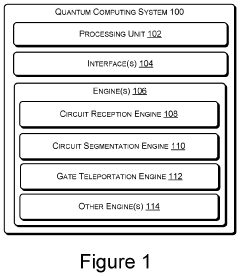
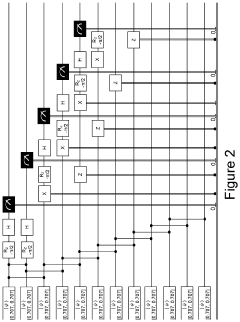
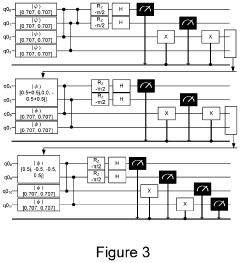
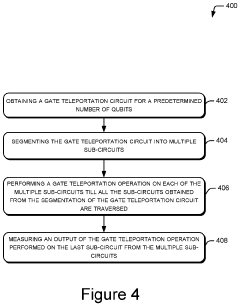
- Segmenting the gate teleportation circuit into multiple sub-circuits allows for sequential processing, reducing the complexity of entangled state preparation and minimizing the duration qubits need to be maintained in specific states, thereby enhancing operational efficiency and enabling reusability of qubits.
Solving computational tasks using quantum computing
PatentActiveUS20180307988A1
Innovation
- A quantum computation engine employs nested calls to multiple quantum computing devices to reduce task complexity through methods like principal component analysis, allowing classical or quantum resources to generate approximate solutions to originally complex tasks.


Environmental Impact of Quantum-Enhanced Agriculture
The integration of quantum computing in precision agriculture techniques has the potential to significantly reduce the environmental footprint of farming practices. Quantum-enhanced agriculture can optimize resource utilization, minimize waste, and mitigate negative ecological impacts through more precise and efficient management strategies.
One of the primary environmental benefits of quantum-enhanced agriculture is the reduction in chemical inputs. Quantum algorithms can analyze complex soil and crop data to determine the exact amount and timing of fertilizer and pesticide applications. This precision reduces over-application, minimizing chemical runoff into water systems and decreasing soil degradation. Studies have shown that quantum-optimized fertilizer use can reduce nitrogen leaching by up to 30%, significantly lowering the risk of water pollution and eutrophication.
Quantum computing can also enhance water management in agriculture. By processing vast amounts of data from soil moisture sensors, weather patterns, and crop water requirements, quantum algorithms can optimize irrigation schedules. This leads to substantial water savings, with some estimates suggesting up to 20% reduction in water usage compared to conventional irrigation methods. In water-stressed regions, this could have a profound impact on ecosystem preservation and groundwater conservation.
Furthermore, quantum-enhanced precision agriculture can contribute to carbon sequestration and climate change mitigation. By optimizing crop rotations and soil management practices based on quantum-processed data, farmers can increase soil organic matter content. This not only improves soil health but also enhances the soil's capacity to store carbon. Preliminary research indicates that quantum-optimized farming practices could increase carbon sequestration rates by 15-25% compared to traditional methods.
The application of quantum computing in agricultural robotics and autonomous systems also holds promise for reducing the environmental impact of farming operations. Quantum algorithms can enhance the efficiency of robotic harvesters and autonomous tractors, minimizing fuel consumption and soil compaction. This results in lower greenhouse gas emissions and better soil structure preservation, promoting long-term soil health and biodiversity.
Lastly, quantum-enhanced agriculture can contribute to biodiversity conservation through more targeted pest management strategies. By analyzing complex ecological data, quantum algorithms can predict pest outbreaks with greater accuracy, allowing for more precise and less disruptive interventions. This approach can reduce the overall use of pesticides by up to 50% in some cases, preserving beneficial insects and maintaining ecological balance in agricultural landscapes.
One of the primary environmental benefits of quantum-enhanced agriculture is the reduction in chemical inputs. Quantum algorithms can analyze complex soil and crop data to determine the exact amount and timing of fertilizer and pesticide applications. This precision reduces over-application, minimizing chemical runoff into water systems and decreasing soil degradation. Studies have shown that quantum-optimized fertilizer use can reduce nitrogen leaching by up to 30%, significantly lowering the risk of water pollution and eutrophication.
Quantum computing can also enhance water management in agriculture. By processing vast amounts of data from soil moisture sensors, weather patterns, and crop water requirements, quantum algorithms can optimize irrigation schedules. This leads to substantial water savings, with some estimates suggesting up to 20% reduction in water usage compared to conventional irrigation methods. In water-stressed regions, this could have a profound impact on ecosystem preservation and groundwater conservation.
Furthermore, quantum-enhanced precision agriculture can contribute to carbon sequestration and climate change mitigation. By optimizing crop rotations and soil management practices based on quantum-processed data, farmers can increase soil organic matter content. This not only improves soil health but also enhances the soil's capacity to store carbon. Preliminary research indicates that quantum-optimized farming practices could increase carbon sequestration rates by 15-25% compared to traditional methods.
The application of quantum computing in agricultural robotics and autonomous systems also holds promise for reducing the environmental impact of farming operations. Quantum algorithms can enhance the efficiency of robotic harvesters and autonomous tractors, minimizing fuel consumption and soil compaction. This results in lower greenhouse gas emissions and better soil structure preservation, promoting long-term soil health and biodiversity.
Lastly, quantum-enhanced agriculture can contribute to biodiversity conservation through more targeted pest management strategies. By analyzing complex ecological data, quantum algorithms can predict pest outbreaks with greater accuracy, allowing for more precise and less disruptive interventions. This approach can reduce the overall use of pesticides by up to 50% in some cases, preserving beneficial insects and maintaining ecological balance in agricultural landscapes.
Data Security in Quantum Agricultural Systems
As quantum computing continues to advance and integrate with precision agricultural techniques, the security of data within these systems becomes paramount. Quantum agricultural systems generate and process vast amounts of sensitive information, including crop yield data, soil composition analyses, and proprietary farming strategies. Protecting this data from unauthorized access and potential breaches is crucial for maintaining competitive advantages and safeguarding intellectual property in the agricultural sector.
The implementation of quantum-resistant cryptographic algorithms is a primary focus in securing quantum agricultural systems. These algorithms are designed to withstand potential attacks from both classical and quantum computers, ensuring long-term data protection. Post-quantum cryptography techniques, such as lattice-based and hash-based cryptography, are being actively researched and implemented to fortify data transmission and storage within quantum agricultural networks.
Quantum key distribution (QKD) offers another layer of security for data transmission in quantum agricultural systems. By leveraging the principles of quantum mechanics, QKD enables the secure exchange of encryption keys between parties, making it virtually impossible for eavesdroppers to intercept without detection. This technology is particularly valuable for protecting real-time data streams from sensors and IoT devices deployed across agricultural fields.
Secure multi-party computation (SMPC) is emerging as a critical tool for collaborative data analysis in quantum agriculture. SMPC allows multiple parties to jointly compute functions over their inputs while keeping those inputs private. This enables farmers, researchers, and agricultural companies to share insights and perform collective analyses without compromising individual data sets, fostering innovation while maintaining data sovereignty.
The development of quantum-safe blockchain technologies is also gaining traction in securing agricultural data. These advanced blockchain systems incorporate quantum-resistant algorithms to protect against potential quantum attacks, ensuring the integrity and immutability of agricultural records, supply chain information, and smart contracts governing automated farming processes.
As quantum agricultural systems become more sophisticated, the integration of artificial intelligence for threat detection and response is becoming increasingly important. Quantum-enhanced AI algorithms can analyze patterns in data access and usage, identifying potential security breaches or anomalies in real-time. This proactive approach to security helps mitigate risks before they escalate into significant threats to the agricultural data ecosystem.
The implementation of quantum-resistant cryptographic algorithms is a primary focus in securing quantum agricultural systems. These algorithms are designed to withstand potential attacks from both classical and quantum computers, ensuring long-term data protection. Post-quantum cryptography techniques, such as lattice-based and hash-based cryptography, are being actively researched and implemented to fortify data transmission and storage within quantum agricultural networks.
Quantum key distribution (QKD) offers another layer of security for data transmission in quantum agricultural systems. By leveraging the principles of quantum mechanics, QKD enables the secure exchange of encryption keys between parties, making it virtually impossible for eavesdroppers to intercept without detection. This technology is particularly valuable for protecting real-time data streams from sensors and IoT devices deployed across agricultural fields.
Secure multi-party computation (SMPC) is emerging as a critical tool for collaborative data analysis in quantum agriculture. SMPC allows multiple parties to jointly compute functions over their inputs while keeping those inputs private. This enables farmers, researchers, and agricultural companies to share insights and perform collective analyses without compromising individual data sets, fostering innovation while maintaining data sovereignty.
The development of quantum-safe blockchain technologies is also gaining traction in securing agricultural data. These advanced blockchain systems incorporate quantum-resistant algorithms to protect against potential quantum attacks, ensuring the integrity and immutability of agricultural records, supply chain information, and smart contracts governing automated farming processes.
As quantum agricultural systems become more sophisticated, the integration of artificial intelligence for threat detection and response is becoming increasingly important. Quantum-enhanced AI algorithms can analyze patterns in data access and usage, identifying potential security breaches or anomalies in real-time. This proactive approach to security helps mitigate risks before they escalate into significant threats to the agricultural data ecosystem.
Unlock deeper insights with Patsnap Eureka Quick Research — get a full tech report to explore trends and direct your research. Try now!
Generate Your Research Report Instantly with AI Agent
Supercharge your innovation with Patsnap Eureka AI Agent Platform!