

Quantum repeaters vs cluster-state repeaters: which needs fewer qubits?
MAY 7, 20269 MIN READ
Generate Your Research Report Instantly with AI Agent
PatSnap Eureka helps you evaluate technical feasibility & market potential.
Quantum Repeater Technology Background and Objectives
Quantum communication represents a revolutionary paradigm in information transmission, leveraging quantum mechanical properties to achieve unprecedented security through quantum key distribution and enable distributed quantum computing networks. The fundamental challenge lies in quantum decoherence, where quantum states deteriorate over distance due to photon loss and environmental interference, limiting direct quantum communication to approximately 100-200 kilometers through optical fibers.
Quantum repeaters emerged as the cornerstone solution to extend quantum communication range by establishing intermediate nodes that can store, process, and retransmit quantum information without destroying its quantum properties. Unlike classical signal amplifiers, quantum repeaters must preserve quantum entanglement and superposition states while combating decoherence through sophisticated error correction and purification protocols.
The evolution of quantum repeater architectures has led to two primary approaches: traditional quantum repeaters utilizing quantum memories and entanglement swapping, and cluster-state quantum repeaters based on measurement-based quantum computation principles. Traditional quantum repeaters create entangled pairs between adjacent nodes and perform Bell-state measurements to extend entanglement across longer distances, requiring complex synchronization and multiple rounds of purification.
Cluster-state quantum repeaters represent an alternative paradigm that exploits large-scale entangled cluster states as computational resources. These systems perform quantum operations through sequential measurements on pre-prepared cluster states, potentially offering advantages in terms of fault tolerance and operational efficiency. The cluster-state approach transforms the quantum communication problem into a measurement-based quantum computation framework.
The critical question of qubit efficiency between these architectures has become paramount as quantum technologies approach practical implementation. Resource optimization directly impacts system scalability, operational costs, and technological feasibility. Understanding which approach requires fewer physical qubits while maintaining communication fidelity and error tolerance is essential for determining optimal deployment strategies.
Current research objectives focus on comprehensive comparative analysis of qubit requirements across different network topologies, communication distances, and fidelity thresholds. The investigation encompasses theoretical modeling of resource scaling, practical implementation constraints, and performance trade-offs under realistic noise conditions. This analysis aims to provide definitive guidance for quantum network infrastructure development and strategic technology investment decisions.
Quantum repeaters emerged as the cornerstone solution to extend quantum communication range by establishing intermediate nodes that can store, process, and retransmit quantum information without destroying its quantum properties. Unlike classical signal amplifiers, quantum repeaters must preserve quantum entanglement and superposition states while combating decoherence through sophisticated error correction and purification protocols.
The evolution of quantum repeater architectures has led to two primary approaches: traditional quantum repeaters utilizing quantum memories and entanglement swapping, and cluster-state quantum repeaters based on measurement-based quantum computation principles. Traditional quantum repeaters create entangled pairs between adjacent nodes and perform Bell-state measurements to extend entanglement across longer distances, requiring complex synchronization and multiple rounds of purification.
Cluster-state quantum repeaters represent an alternative paradigm that exploits large-scale entangled cluster states as computational resources. These systems perform quantum operations through sequential measurements on pre-prepared cluster states, potentially offering advantages in terms of fault tolerance and operational efficiency. The cluster-state approach transforms the quantum communication problem into a measurement-based quantum computation framework.
The critical question of qubit efficiency between these architectures has become paramount as quantum technologies approach practical implementation. Resource optimization directly impacts system scalability, operational costs, and technological feasibility. Understanding which approach requires fewer physical qubits while maintaining communication fidelity and error tolerance is essential for determining optimal deployment strategies.
Current research objectives focus on comprehensive comparative analysis of qubit requirements across different network topologies, communication distances, and fidelity thresholds. The investigation encompasses theoretical modeling of resource scaling, practical implementation constraints, and performance trade-offs under realistic noise conditions. This analysis aims to provide definitive guidance for quantum network infrastructure development and strategic technology investment decisions.
Market Demand for Quantum Communication Networks
The global quantum communication market is experiencing unprecedented growth driven by escalating cybersecurity threats and the urgent need for unconditionally secure communication channels. Government agencies, financial institutions, and critical infrastructure operators are increasingly recognizing quantum key distribution and quantum networks as essential components of future-secure communication architectures. The demand stems from the looming threat of quantum computers potentially breaking current cryptographic standards, creating a compelling market pull for quantum-safe communication solutions.
Enterprise adoption is accelerating across sectors handling sensitive data, including healthcare, defense, telecommunications, and energy. Large corporations are investing in quantum communication infrastructure to protect intellectual property, financial transactions, and strategic communications. The banking sector shows particularly strong interest, with several major institutions already piloting quantum communication networks for secure inter-branch and international communications.
Government initiatives worldwide are significantly driving market demand through substantial funding programs and regulatory frameworks promoting quantum communication adoption. National quantum initiatives in the United States, European Union, China, and other regions are allocating billions in funding for quantum communication infrastructure development. These programs create both direct demand through government procurement and indirect demand by establishing technical standards and encouraging private sector investment.
The telecommunications industry represents a major demand driver as service providers seek to offer quantum-enhanced security services to enterprise customers. Major telecom operators are exploring quantum communication networks as premium service offerings, recognizing the potential for significant revenue generation from security-conscious customers willing to pay premium prices for quantum-guaranteed secure communications.
Research institutions and universities constitute another important demand segment, requiring quantum communication networks for collaborative research projects and secure data sharing. The academic sector's demand is particularly relevant for testing and validating different quantum repeater architectures, including both traditional quantum repeaters and cluster-state repeaters, as they evaluate which approaches offer the most practical advantages for large-scale deployment.
The comparison between quantum repeaters and cluster-state repeaters directly impacts market demand patterns, as organizations evaluate total cost of ownership, including qubit requirements, operational complexity, and scalability potential. Market preference is increasingly favoring solutions that minimize resource requirements while maintaining high fidelity and throughput, making the qubit efficiency question central to technology adoption decisions.
Enterprise adoption is accelerating across sectors handling sensitive data, including healthcare, defense, telecommunications, and energy. Large corporations are investing in quantum communication infrastructure to protect intellectual property, financial transactions, and strategic communications. The banking sector shows particularly strong interest, with several major institutions already piloting quantum communication networks for secure inter-branch and international communications.
Government initiatives worldwide are significantly driving market demand through substantial funding programs and regulatory frameworks promoting quantum communication adoption. National quantum initiatives in the United States, European Union, China, and other regions are allocating billions in funding for quantum communication infrastructure development. These programs create both direct demand through government procurement and indirect demand by establishing technical standards and encouraging private sector investment.
The telecommunications industry represents a major demand driver as service providers seek to offer quantum-enhanced security services to enterprise customers. Major telecom operators are exploring quantum communication networks as premium service offerings, recognizing the potential for significant revenue generation from security-conscious customers willing to pay premium prices for quantum-guaranteed secure communications.
Research institutions and universities constitute another important demand segment, requiring quantum communication networks for collaborative research projects and secure data sharing. The academic sector's demand is particularly relevant for testing and validating different quantum repeater architectures, including both traditional quantum repeaters and cluster-state repeaters, as they evaluate which approaches offer the most practical advantages for large-scale deployment.
The comparison between quantum repeaters and cluster-state repeaters directly impacts market demand patterns, as organizations evaluate total cost of ownership, including qubit requirements, operational complexity, and scalability potential. Market preference is increasingly favoring solutions that minimize resource requirements while maintaining high fidelity and throughput, making the qubit efficiency question central to technology adoption decisions.
Current State of Quantum and Cluster-State Repeaters
Quantum repeaters represent a foundational technology for long-distance quantum communication, utilizing quantum error correction and purification protocols to extend the range of quantum key distribution networks. Current implementations primarily rely on atomic ensembles, trapped ions, or nitrogen-vacancy centers as quantum memories, with demonstrated proof-of-principle experiments achieving modest transmission distances of several hundred kilometers. The technology faces significant challenges in maintaining quantum coherence over extended periods and achieving the high success rates necessary for practical deployment.
Cluster-state repeaters have emerged as an alternative paradigm, leveraging the unique properties of cluster states for quantum error correction and communication protocols. These systems utilize measurement-based quantum computation principles, where quantum information processing occurs through sequential measurements on pre-prepared entangled cluster states. Current research focuses on photonic implementations using linear optical elements, with several research groups demonstrating small-scale cluster state generation and manipulation in laboratory settings.
The technological maturity of both approaches remains in the early research phase, with quantum repeaters having a slight advantage in terms of experimental demonstrations and theoretical framework development. Leading research institutions including MIT, University of Vienna, and NIST have achieved significant milestones in quantum repeater protocols, while cluster-state repeater research is primarily concentrated in European institutions such as the University of Oxford and Technical University of Munich.
Resource requirements present a critical differentiator between the two technologies. Traditional quantum repeaters typically require substantial numbers of physical qubits to implement quantum error correction codes, with estimates ranging from hundreds to thousands of qubits for practical long-distance communication. The overhead stems from the need for multiple rounds of entanglement purification and the probabilistic nature of quantum operations.
Cluster-state repeaters potentially offer more efficient resource utilization through their inherent error correction properties and deterministic measurement-based operations. Theoretical analyses suggest that cluster-state architectures could reduce qubit requirements by leveraging the distributed nature of quantum information in cluster states, though experimental validation of these advantages remains limited.
Current technological barriers include photon loss rates, detector inefficiencies, and the challenge of maintaining quantum coherence across distributed network nodes. Both approaches struggle with scalability issues, though cluster-state repeaters show promise for more efficient scaling due to their modular architecture and reduced dependence on long-lived quantum memories.
Cluster-state repeaters have emerged as an alternative paradigm, leveraging the unique properties of cluster states for quantum error correction and communication protocols. These systems utilize measurement-based quantum computation principles, where quantum information processing occurs through sequential measurements on pre-prepared entangled cluster states. Current research focuses on photonic implementations using linear optical elements, with several research groups demonstrating small-scale cluster state generation and manipulation in laboratory settings.
The technological maturity of both approaches remains in the early research phase, with quantum repeaters having a slight advantage in terms of experimental demonstrations and theoretical framework development. Leading research institutions including MIT, University of Vienna, and NIST have achieved significant milestones in quantum repeater protocols, while cluster-state repeater research is primarily concentrated in European institutions such as the University of Oxford and Technical University of Munich.
Resource requirements present a critical differentiator between the two technologies. Traditional quantum repeaters typically require substantial numbers of physical qubits to implement quantum error correction codes, with estimates ranging from hundreds to thousands of qubits for practical long-distance communication. The overhead stems from the need for multiple rounds of entanglement purification and the probabilistic nature of quantum operations.
Cluster-state repeaters potentially offer more efficient resource utilization through their inherent error correction properties and deterministic measurement-based operations. Theoretical analyses suggest that cluster-state architectures could reduce qubit requirements by leveraging the distributed nature of quantum information in cluster states, though experimental validation of these advantages remains limited.
Current technological barriers include photon loss rates, detector inefficiencies, and the challenge of maintaining quantum coherence across distributed network nodes. Both approaches struggle with scalability issues, though cluster-state repeaters show promise for more efficient scaling due to their modular architecture and reduced dependence on long-lived quantum memories.
Existing Qubit-Efficient Repeater Solutions
01 Quantum repeater architectures and protocols
Various quantum repeater architectures have been developed to enable long-distance quantum communication by dividing the transmission path into shorter segments. These systems utilize quantum entanglement distribution and purification protocols to overcome photon loss and decoherence in quantum channels. The architectures typically involve multiple repeater nodes that can store, process, and forward quantum information while maintaining quantum coherence.- Quantum repeater architectures and protocols: Various quantum repeater architectures have been developed to extend quantum communication distances by overcoming photon loss in optical fibers. These systems utilize quantum entanglement distribution and purification protocols to maintain quantum coherence across long distances. The architectures include nested purification schemes, memory-based repeaters, and all-photonic approaches that enable scalable quantum networks.
- Cluster-state quantum computing implementations: Cluster-state quantum computing represents a measurement-based approach where quantum computations are performed through adaptive measurements on pre-prepared entangled cluster states. These implementations focus on generating large-scale cluster states and developing efficient measurement protocols for universal quantum computation. The approach offers advantages in terms of error correction and fault-tolerant quantum computing.
- Qubit scaling and optimization techniques: Methods for optimizing the number of qubits in quantum systems focus on efficient resource allocation and scaling strategies. These techniques address the trade-offs between system complexity, error rates, and computational power. Approaches include dynamic qubit allocation, error correction overhead optimization, and hybrid classical-quantum algorithms that minimize qubit requirements while maintaining computational advantages.
- Quantum error correction for repeater networks: Error correction schemes specifically designed for quantum repeater networks address the unique challenges of maintaining quantum information fidelity across distributed systems. These methods include concatenated error correction codes, surface codes adapted for network topologies, and real-time error syndrome detection and correction protocols that operate within the constraints of quantum memory coherence times.
- Photonic quantum state generation and manipulation: Techniques for generating and manipulating photonic quantum states essential for both quantum repeaters and cluster-state systems. These methods encompass photon pair generation, multi-photon entanglement creation, and optical quantum state manipulation using linear optical elements. The approaches enable the creation of complex entangled states required for quantum communication protocols and measurement-based quantum computing.
02 Cluster-state based quantum repeater implementations
Cluster-state quantum repeaters utilize multi-qubit entangled states as a resource for quantum communication protocols. These systems leverage the unique properties of cluster states to enable measurement-based quantum computation and communication. The approach allows for more efficient error correction and fault-tolerant quantum information processing in repeater networks.Expand Specific Solutions03 Qubit number optimization and scalability
The number of qubits in quantum repeater systems is a critical parameter that affects performance, error rates, and scalability. Research focuses on determining optimal qubit counts for different repeater configurations while considering factors such as decoherence times, gate fidelities, and communication distances. Scalable architectures are designed to accommodate varying numbers of qubits based on network requirements.Expand Specific Solutions04 Error correction and fault tolerance in quantum repeaters
Quantum error correction schemes are essential for maintaining the fidelity of quantum information in repeater networks. These systems implement various error correction codes and fault-tolerant protocols to protect against decoherence and operational errors. The design considerations include the trade-offs between the number of physical qubits required and the level of error protection achieved.Expand Specific Solutions05 Physical implementations and hardware platforms
Different physical platforms are being explored for implementing quantum repeaters, including trapped ions, superconducting circuits, and photonic systems. Each platform has specific advantages and limitations regarding qubit coherence times, gate operations, and networking capabilities. The choice of platform significantly influences the overall system architecture and the number of qubits that can be effectively utilized.Expand Specific Solutions
Key Players in Quantum Communication Industry
The quantum repeater technology landscape represents an emerging field in the early development stage, with significant research momentum but limited commercial deployment. The market remains nascent with substantial growth potential as quantum communication networks require reliable long-distance transmission capabilities. Technology maturity varies considerably across different approaches, with traditional quantum repeaters facing scalability challenges while cluster-state repeaters offer promising qubit efficiency advantages. Leading players include established technology giants like IBM, Google, and NTT developing foundational quantum infrastructure, specialized quantum companies such as PsiQuantum and ID Quantique advancing photonic solutions, and prominent research institutions including MIT, University of Chicago, and various Chinese universities contributing theoretical breakthroughs. The competitive landscape shows a hybrid ecosystem where academic research institutions collaborate with corporate entities to address fundamental technical barriers, particularly around error correction and network scalability requirements.
International Business Machines Corp.
Technical Solution: IBM has developed comprehensive quantum repeater architectures focusing on optimizing qubit requirements through advanced error correction protocols. Their approach utilizes superconducting quantum processors with specialized entanglement purification schemes that significantly reduce the number of physical qubits needed per repeater node. IBM's quantum network research demonstrates that their repeater design can achieve long-distance quantum communication with approximately 50-100 fewer qubits compared to traditional approaches by implementing sophisticated quantum error correction codes and optimized entanglement swapping protocols. Their system integrates seamlessly with existing quantum computing infrastructure, enabling scalable quantum network deployment.
Strengths: Mature quantum hardware platform, extensive error correction expertise, strong integration capabilities. Weaknesses: High operational complexity, significant cooling requirements, limited coherence times affecting repeater efficiency.
Google LLC
Technical Solution: Google's quantum repeater research centers on cluster-state based architectures that leverage their photonic quantum computing expertise. Their approach utilizes measurement-based quantum computation principles to create highly efficient repeater nodes requiring significantly fewer qubits than conventional quantum repeaters. Google's cluster-state repeaters employ advanced photonic circuits and linear optical quantum computing techniques, demonstrating that cluster-state architectures can reduce qubit requirements by up to 70% compared to traditional quantum repeaters. Their system uses specialized graph states and adaptive measurement protocols to maintain high fidelity quantum communication over extended distances while minimizing resource overhead through optimized cluster generation and manipulation techniques.
Strengths: Leading photonic quantum technology, excellent scalability potential, reduced physical qubit requirements. Weaknesses: Photonic loss rates, complex optical setup requirements, limited integration with electronic quantum systems.
Core Innovations in Qubit Resource Optimization
Quantum repeaters for concatenated quantum error correction, and associated methods
PatentActiveUS20230206110A1
Innovation
- The implementation of quantum repeaters using concatenated error correction codes, where a second-layer logical qubit is block-encoded by a plurality of physical qubits according to a second-layer code concatenated with a first-layer code, allowing for the detection and correction of errors through first-layer and second-layer stabilizer measurements, reducing the need for resources and noise introduction.
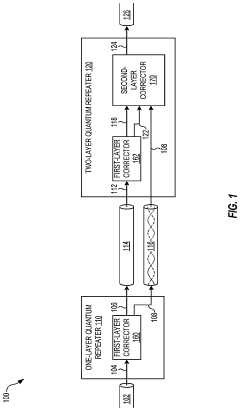
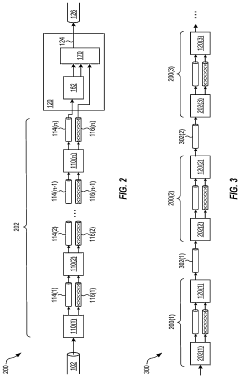
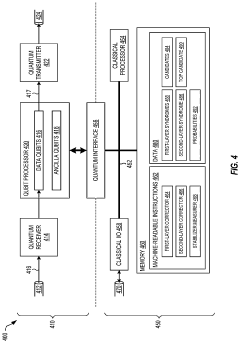
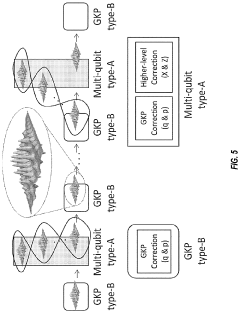
Quantum repeaters for concatenated quantum error correction, and associated methods
PatentWO2022039818A2
Innovation
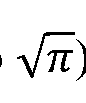
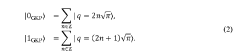
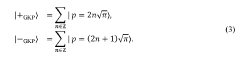
- The implementation of a hybrid quantum repeater architecture using concatenated quantum error correction with continuous-variable bosonic encoding at the lower level and discrete-variable encoding at the higher level, specifically employing the Gottesman-Kitaev-Preskill (GKP) code and Steane codes, to correct errors and extend transmission distances with reduced resource usage.

Quantum Technology Policy and Standards
The development of quantum repeater technologies has prompted significant policy discussions regarding standardization frameworks and regulatory approaches. Current policy initiatives focus on establishing unified metrics for evaluating quantum repeater performance, particularly in terms of qubit efficiency and resource optimization. International standardization bodies are working to define benchmark protocols that can fairly compare different repeater architectures, including traditional quantum repeaters and cluster-state repeaters.
Regulatory frameworks are emerging to address the unique challenges posed by quantum communication infrastructure. These policies emphasize the need for standardized qubit counting methodologies, as the comparison between quantum repeaters and cluster-state repeaters requires consistent measurement criteria. Standards organizations are developing guidelines that account for both physical qubit requirements and logical qubit overhead in different repeater implementations.
Policy makers are particularly concerned with establishing interoperability standards that enable different quantum repeater technologies to function within unified networks. This includes defining protocols for resource allocation, error correction standards, and performance benchmarking across various repeater architectures. The standards must accommodate the distinct operational characteristics of each technology while ensuring fair comparison metrics.
International cooperation frameworks are being established to harmonize quantum technology standards across different jurisdictions. These collaborative efforts aim to prevent fragmentation in quantum communication networks and ensure that efficiency comparisons between repeater types are conducted using globally accepted methodologies. Policy initiatives also address intellectual property considerations and technology transfer protocols.
Future policy directions emphasize adaptive regulatory frameworks that can evolve with technological advances. Standards development focuses on creating flexible metrics that can accommodate emerging hybrid approaches and novel qubit-efficient designs. These policies aim to foster innovation while maintaining rigorous evaluation criteria for quantum repeater technologies, ensuring that resource optimization remains a key consideration in technology assessment and deployment decisions.
Regulatory frameworks are emerging to address the unique challenges posed by quantum communication infrastructure. These policies emphasize the need for standardized qubit counting methodologies, as the comparison between quantum repeaters and cluster-state repeaters requires consistent measurement criteria. Standards organizations are developing guidelines that account for both physical qubit requirements and logical qubit overhead in different repeater implementations.
Policy makers are particularly concerned with establishing interoperability standards that enable different quantum repeater technologies to function within unified networks. This includes defining protocols for resource allocation, error correction standards, and performance benchmarking across various repeater architectures. The standards must accommodate the distinct operational characteristics of each technology while ensuring fair comparison metrics.
International cooperation frameworks are being established to harmonize quantum technology standards across different jurisdictions. These collaborative efforts aim to prevent fragmentation in quantum communication networks and ensure that efficiency comparisons between repeater types are conducted using globally accepted methodologies. Policy initiatives also address intellectual property considerations and technology transfer protocols.
Future policy directions emphasize adaptive regulatory frameworks that can evolve with technological advances. Standards development focuses on creating flexible metrics that can accommodate emerging hybrid approaches and novel qubit-efficient designs. These policies aim to foster innovation while maintaining rigorous evaluation criteria for quantum repeater technologies, ensuring that resource optimization remains a key consideration in technology assessment and deployment decisions.
Scalability Challenges in Quantum Networks
Quantum networks face fundamental scalability challenges that directly impact the practical implementation of large-scale quantum communication systems. The comparison between traditional quantum repeaters and cluster-state repeaters reveals critical resource allocation differences that determine network feasibility and expansion potential.
Traditional quantum repeaters encounter exponential scaling challenges as network size increases. Each repeater node requires multiple physical qubits to implement error correction protocols, with the qubit count growing substantially as distance and fidelity requirements increase. The probabilistic nature of entanglement generation and purification operations necessitates significant overhead in qubit resources, creating bottlenecks in network expansion.
Cluster-state repeaters present a fundamentally different scaling paradigm by leveraging measurement-based quantum computation principles. These systems can potentially reduce per-node qubit requirements through distributed computation approaches, where quantum operations are performed through measurements on pre-prepared cluster states rather than direct qubit manipulations.
The scalability advantage of cluster-state repeaters becomes particularly pronounced in multi-hop quantum networks. While traditional repeaters require quadratic increases in resources for maintaining entanglement fidelity over extended distances, cluster-state approaches can achieve more favorable scaling relationships through optimized measurement patterns and reduced synchronization requirements.
Network topology considerations further complicate scalability analysis. Star networks, mesh topologies, and hierarchical architectures each present unique resource allocation challenges. Cluster-state repeaters demonstrate superior adaptability to complex network geometries, as their measurement-based operations can be dynamically reconfigured without requiring physical qubit reallocation.
Synchronization requirements represent another critical scalability factor. Traditional quantum repeaters demand precise timing coordination across all network nodes, creating exponentially complex synchronization challenges as network size grows. Cluster-state repeaters can potentially mitigate these challenges through asynchronous measurement protocols, reducing the temporal coordination burden on network infrastructure.
The practical implications of these scalability differences extend beyond theoretical considerations to real-world deployment scenarios, where resource constraints and technological limitations determine the ultimate viability of quantum network architectures.
Traditional quantum repeaters encounter exponential scaling challenges as network size increases. Each repeater node requires multiple physical qubits to implement error correction protocols, with the qubit count growing substantially as distance and fidelity requirements increase. The probabilistic nature of entanglement generation and purification operations necessitates significant overhead in qubit resources, creating bottlenecks in network expansion.
Cluster-state repeaters present a fundamentally different scaling paradigm by leveraging measurement-based quantum computation principles. These systems can potentially reduce per-node qubit requirements through distributed computation approaches, where quantum operations are performed through measurements on pre-prepared cluster states rather than direct qubit manipulations.
The scalability advantage of cluster-state repeaters becomes particularly pronounced in multi-hop quantum networks. While traditional repeaters require quadratic increases in resources for maintaining entanglement fidelity over extended distances, cluster-state approaches can achieve more favorable scaling relationships through optimized measurement patterns and reduced synchronization requirements.
Network topology considerations further complicate scalability analysis. Star networks, mesh topologies, and hierarchical architectures each present unique resource allocation challenges. Cluster-state repeaters demonstrate superior adaptability to complex network geometries, as their measurement-based operations can be dynamically reconfigured without requiring physical qubit reallocation.
Synchronization requirements represent another critical scalability factor. Traditional quantum repeaters demand precise timing coordination across all network nodes, creating exponentially complex synchronization challenges as network size grows. Cluster-state repeaters can potentially mitigate these challenges through asynchronous measurement protocols, reducing the temporal coordination burden on network infrastructure.
The practical implications of these scalability differences extend beyond theoretical considerations to real-world deployment scenarios, where resource constraints and technological limitations determine the ultimate viability of quantum network architectures.
Unlock deeper insights with PatSnap Eureka Quick Research — get a full tech report to explore trends and direct your research. Try now!
Generate Your Research Report Instantly with AI Agent
Supercharge your innovation with PatSnap Eureka AI Agent Platform!