

Radiating Element vs E-plane Horn: Size Efficiency in Fixed Installations
MAR 6, 20269 MIN READ
Generate Your Research Report Instantly with AI Agent
PatSnap Eureka helps you evaluate technical feasibility & market potential.
Antenna Technology Background and Performance Goals
Antenna technology has undergone significant evolution since the early 20th century, transitioning from simple wire antennas to sophisticated electromagnetic radiating systems. The fundamental challenge in antenna design lies in achieving optimal electromagnetic performance while maintaining practical size constraints, particularly in fixed installation environments where space limitations and aesthetic considerations play crucial roles.
The development of radiating elements and horn antennas represents two distinct approaches to electromagnetic wave propagation. Radiating elements, including dipoles, monopoles, and patch antennas, operate on the principle of current distribution along conductive surfaces, creating electromagnetic fields through controlled current flow patterns. These elements typically offer compact form factors but may exhibit limitations in directivity and gain characteristics.
E-plane horn antennas emerged as a solution to overcome directivity limitations inherent in basic radiating elements. By utilizing a flared waveguide structure that expands in the E-field plane, these antennas achieve enhanced gain and improved radiation pattern control. The horn configuration allows for better impedance matching and reduced reflection losses, making them particularly suitable for applications requiring high-performance electromagnetic characteristics.
The performance goals for modern antenna systems in fixed installations center around achieving maximum size efficiency while maintaining acceptable electromagnetic performance parameters. Size efficiency encompasses the relationship between physical antenna dimensions and achieved gain, directivity, and bandwidth characteristics. This metric becomes increasingly critical in urban environments where installation space is limited and regulatory constraints impose strict dimensional requirements.
Contemporary antenna design objectives prioritize multi-parameter optimization, balancing gain performance, radiation pattern control, impedance matching, and physical footprint. The challenge intensifies when considering frequency bandwidth requirements, as broader operational frequencies typically demand larger antenna apertures or more complex geometries. Environmental factors, including wind loading, ice accumulation, and visual impact, further constrain design parameters in fixed installation scenarios.
The comparative analysis between radiating elements and E-plane horns reveals fundamental trade-offs in size efficiency optimization. While radiating elements offer superior compactness, E-plane horns provide enhanced electromagnetic performance at the cost of increased physical dimensions. Understanding these trade-offs enables informed decision-making in antenna selection for specific fixed installation applications, considering both technical requirements and practical deployment constraints.
The development of radiating elements and horn antennas represents two distinct approaches to electromagnetic wave propagation. Radiating elements, including dipoles, monopoles, and patch antennas, operate on the principle of current distribution along conductive surfaces, creating electromagnetic fields through controlled current flow patterns. These elements typically offer compact form factors but may exhibit limitations in directivity and gain characteristics.
E-plane horn antennas emerged as a solution to overcome directivity limitations inherent in basic radiating elements. By utilizing a flared waveguide structure that expands in the E-field plane, these antennas achieve enhanced gain and improved radiation pattern control. The horn configuration allows for better impedance matching and reduced reflection losses, making them particularly suitable for applications requiring high-performance electromagnetic characteristics.
The performance goals for modern antenna systems in fixed installations center around achieving maximum size efficiency while maintaining acceptable electromagnetic performance parameters. Size efficiency encompasses the relationship between physical antenna dimensions and achieved gain, directivity, and bandwidth characteristics. This metric becomes increasingly critical in urban environments where installation space is limited and regulatory constraints impose strict dimensional requirements.
Contemporary antenna design objectives prioritize multi-parameter optimization, balancing gain performance, radiation pattern control, impedance matching, and physical footprint. The challenge intensifies when considering frequency bandwidth requirements, as broader operational frequencies typically demand larger antenna apertures or more complex geometries. Environmental factors, including wind loading, ice accumulation, and visual impact, further constrain design parameters in fixed installation scenarios.
The comparative analysis between radiating elements and E-plane horns reveals fundamental trade-offs in size efficiency optimization. While radiating elements offer superior compactness, E-plane horns provide enhanced electromagnetic performance at the cost of increased physical dimensions. Understanding these trade-offs enables informed decision-making in antenna selection for specific fixed installation applications, considering both technical requirements and practical deployment constraints.
Market Demand for Compact Fixed Installation Antennas
The telecommunications infrastructure market is experiencing unprecedented demand for space-efficient antenna solutions, driven by the proliferation of 5G networks, IoT deployments, and densification of wireless communication systems. Fixed installation environments, particularly in urban areas, face severe spatial constraints that necessitate compact antenna designs without compromising performance. This market pressure has intensified the focus on optimizing the size-to-performance ratio of radiating elements and horn antennas.
Cellular network operators are increasingly prioritizing compact antenna solutions for rooftop installations, distributed antenna systems, and small cell deployments. The transition to higher frequency bands in 5G applications has created opportunities for smaller antenna form factors, yet the demand for maintaining adequate gain and directivity patterns remains critical. This has led to heightened interest in comparing traditional radiating elements with E-plane horn configurations for their size efficiency characteristics.
The satellite communication sector represents another significant market driver, where fixed ground stations require antennas that balance compactness with performance requirements. Commercial and government applications demand reliable communication links while operating under strict space limitations, particularly in urban installations and mobile command centers. The need for rapid deployment capabilities has further emphasized the importance of size-optimized antenna solutions.
Industrial IoT applications have emerged as a substantial market segment requiring compact fixed installation antennas. Manufacturing facilities, smart city infrastructure, and industrial automation systems require reliable wireless connectivity within confined spaces. These applications often involve multiple antenna installations in close proximity, making size efficiency a critical selection criterion to minimize interference and optimize system performance.
The defense and aerospace sectors continue to drive demand for compact antenna solutions in fixed installations such as radar systems, communication hubs, and surveillance equipment. These applications require high-performance antennas that can operate effectively within stringent size constraints while maintaining operational reliability under various environmental conditions.
Market research indicates growing preference for antenna solutions that offer superior size efficiency without sacrificing electrical performance. This trend has accelerated the development of advanced radiating element designs and optimized E-plane horn configurations specifically tailored for space-constrained fixed installations. The competitive landscape increasingly favors manufacturers who can demonstrate measurable improvements in size-to-performance ratios while maintaining cost-effectiveness for large-scale deployments.
Cellular network operators are increasingly prioritizing compact antenna solutions for rooftop installations, distributed antenna systems, and small cell deployments. The transition to higher frequency bands in 5G applications has created opportunities for smaller antenna form factors, yet the demand for maintaining adequate gain and directivity patterns remains critical. This has led to heightened interest in comparing traditional radiating elements with E-plane horn configurations for their size efficiency characteristics.
The satellite communication sector represents another significant market driver, where fixed ground stations require antennas that balance compactness with performance requirements. Commercial and government applications demand reliable communication links while operating under strict space limitations, particularly in urban installations and mobile command centers. The need for rapid deployment capabilities has further emphasized the importance of size-optimized antenna solutions.
Industrial IoT applications have emerged as a substantial market segment requiring compact fixed installation antennas. Manufacturing facilities, smart city infrastructure, and industrial automation systems require reliable wireless connectivity within confined spaces. These applications often involve multiple antenna installations in close proximity, making size efficiency a critical selection criterion to minimize interference and optimize system performance.
The defense and aerospace sectors continue to drive demand for compact antenna solutions in fixed installations such as radar systems, communication hubs, and surveillance equipment. These applications require high-performance antennas that can operate effectively within stringent size constraints while maintaining operational reliability under various environmental conditions.
Market research indicates growing preference for antenna solutions that offer superior size efficiency without sacrificing electrical performance. This trend has accelerated the development of advanced radiating element designs and optimized E-plane horn configurations specifically tailored for space-constrained fixed installations. The competitive landscape increasingly favors manufacturers who can demonstrate measurable improvements in size-to-performance ratios while maintaining cost-effectiveness for large-scale deployments.
Current State of Radiating Elements vs E-plane Horns
The current landscape of radiating elements versus E-plane horns in fixed installations reveals distinct technological trajectories shaped by evolving performance requirements and space constraints. Traditional radiating elements, including dipoles, patches, and slot antennas, have undergone significant miniaturization advances through substrate engineering and metamaterial integration. Modern implementations achieve size reductions of 30-50% compared to conventional designs while maintaining acceptable radiation characteristics.
E-plane horn antennas continue to dominate applications requiring high directivity and controlled beam patterns. Contemporary E-plane horn designs leverage advanced computational electromagnetics for optimization, resulting in structures that balance physical dimensions with electromagnetic performance. Recent developments include corrugated horn variants and hybrid designs incorporating dielectric loading to reduce overall footprint while preserving gain characteristics.
Manufacturing capabilities have significantly influenced the current state of both technologies. Additive manufacturing techniques enable complex geometries previously impossible with traditional fabrication methods, particularly benefiting horn antenna designs with intricate internal structures. This advancement has narrowed the size gap between horns and compact radiating elements in certain frequency ranges.
Integration challenges persist as a defining factor in technology selection. Radiating elements demonstrate superior integration flexibility with modern electronic systems, offering seamless incorporation into planar arrays and multi-function platforms. Conversely, E-plane horns require dedicated mounting structures and waveguide interfaces, limiting their deployment in space-constrained environments despite superior electromagnetic performance.
Performance standardization efforts have established clearer benchmarks for comparing these technologies. Current industry standards emphasize efficiency metrics that account for both electromagnetic performance and physical volume utilization. This holistic approach has driven innovation in both domains, with radiating elements focusing on bandwidth enhancement and horns pursuing size optimization without compromising directional characteristics.
The emergence of software-defined antenna systems has created new evaluation criteria beyond traditional size-efficiency trade-offs. Modern installations increasingly prioritize reconfigurability and multi-band operation, factors that influence the comparative assessment of radiating elements and E-plane horns in contemporary fixed installation scenarios.
E-plane horn antennas continue to dominate applications requiring high directivity and controlled beam patterns. Contemporary E-plane horn designs leverage advanced computational electromagnetics for optimization, resulting in structures that balance physical dimensions with electromagnetic performance. Recent developments include corrugated horn variants and hybrid designs incorporating dielectric loading to reduce overall footprint while preserving gain characteristics.
Manufacturing capabilities have significantly influenced the current state of both technologies. Additive manufacturing techniques enable complex geometries previously impossible with traditional fabrication methods, particularly benefiting horn antenna designs with intricate internal structures. This advancement has narrowed the size gap between horns and compact radiating elements in certain frequency ranges.
Integration challenges persist as a defining factor in technology selection. Radiating elements demonstrate superior integration flexibility with modern electronic systems, offering seamless incorporation into planar arrays and multi-function platforms. Conversely, E-plane horns require dedicated mounting structures and waveguide interfaces, limiting their deployment in space-constrained environments despite superior electromagnetic performance.
Performance standardization efforts have established clearer benchmarks for comparing these technologies. Current industry standards emphasize efficiency metrics that account for both electromagnetic performance and physical volume utilization. This holistic approach has driven innovation in both domains, with radiating elements focusing on bandwidth enhancement and horns pursuing size optimization without compromising directional characteristics.
The emergence of software-defined antenna systems has created new evaluation criteria beyond traditional size-efficiency trade-offs. Modern installations increasingly prioritize reconfigurability and multi-band operation, factors that influence the comparative assessment of radiating elements and E-plane horns in contemporary fixed installation scenarios.
Existing Size Optimization Solutions for Fixed Antennas
01 Horn antenna aperture dimension optimization
The efficiency of E-plane horn antennas can be improved by optimizing the aperture dimensions, including the height and width of the horn opening. Proper dimensioning of the aperture affects the radiation pattern and directivity. The flare angle and length of the horn structure are critical parameters that influence the impedance matching and overall antenna performance. Optimization techniques involve balancing the physical size constraints with desired electrical characteristics to achieve maximum radiation efficiency.- Horn antenna aperture dimension optimization: The efficiency of E-plane horn antennas can be improved by optimizing the aperture dimensions, including the height and width of the horn opening. Proper dimensioning of the aperture affects the radiation pattern and directivity. The flare angle and length of the horn structure are critical parameters that influence the impedance matching and overall antenna performance. Optimization techniques involve balancing the aperture size with wavelength considerations to maximize gain and minimize side lobes.
- Radiating element feed structure design: The feed structure connecting to the radiating element significantly impacts the efficiency of horn antennas. Various feed mechanisms including waveguide feeds, coaxial probes, and slot-coupled feeds can be employed to excite the radiating element. The transition from the feed to the horn aperture must be designed to minimize reflection losses and ensure proper field distribution. Impedance matching networks and transition sections are often incorporated to optimize power transfer from the feed to the radiating element.
- Multi-element and array configurations: Efficiency improvements can be achieved through multi-element configurations and array arrangements of horn radiators. Array designs allow for beam steering and enhanced directivity through proper phasing and spacing of individual elements. Corporate feed networks and beamforming techniques enable improved radiation characteristics. The interaction between adjacent elements and mutual coupling effects must be considered in the design to maintain efficiency across the array.
- Corrugated and ridged horn structures: Modified horn geometries including corrugated walls and ridge-loaded structures enhance the performance and efficiency of E-plane horns. Corrugations along the inner walls help control the field distribution and reduce cross-polarization. Ridge structures modify the cutoff frequency and impedance characteristics, enabling broader bandwidth operation. These structural modifications improve the radiation pattern symmetry and reduce side lobe levels while maintaining compact dimensions.
- Dielectric loading and lens integration: The incorporation of dielectric materials and lens structures within or in front of the horn aperture can enhance radiation efficiency. Dielectric loading modifies the effective electrical length and impedance characteristics of the horn. Lens elements help shape the radiation pattern and improve the aperture efficiency by correcting phase errors across the aperture. Material selection and positioning of dielectric components are optimized to achieve desired radiation characteristics while minimizing losses.
02 Corrugated horn design for improved efficiency
Corrugated or ridged structures in horn antennas enhance radiation efficiency by reducing cross-polarization and improving the symmetry of the radiation pattern. The corrugations help to control the field distribution within the horn and at the aperture. This design approach allows for better control of the E-plane and H-plane patterns, resulting in higher gain and efficiency. The depth and spacing of corrugations are key design parameters that affect the antenna performance across different frequency bands.Expand Specific Solutions03 Dielectric loading and lens integration
Incorporating dielectric materials or lens structures within or at the aperture of horn antennas can significantly improve radiation efficiency. Dielectric loading modifies the effective electrical length and impedance characteristics of the horn. Lens structures help to shape the wavefront and improve the phase distribution across the aperture, leading to enhanced directivity. This technique is particularly effective for compact horn designs where size reduction is required without compromising performance.Expand Specific Solutions04 Multi-mode excitation and hybrid feed structures
Utilizing multiple propagation modes or hybrid feed configurations can optimize the radiation characteristics of horn antennas. Multi-mode excitation allows for better control of the field distribution and can improve the aperture efficiency. Hybrid feed structures combine different feeding mechanisms to achieve desired radiation patterns with improved efficiency. These approaches enable the design of horn antennas with enhanced bandwidth and reduced sidelobe levels while maintaining high radiation efficiency.Expand Specific Solutions05 Stepped and profiled horn geometries
Implementing stepped transitions or profiled wall geometries in horn antenna design can enhance radiation efficiency by providing smoother impedance transformation. Stepped horns use discrete sections with varying dimensions to approximate an optimal taper profile. Profiled horns employ continuous curved surfaces to minimize reflections and improve the field distribution at the aperture. These geometric modifications help to reduce return loss and increase the overall antenna efficiency across the operating frequency range.Expand Specific Solutions
Key Players in Antenna Manufacturing Industry
The radiating element versus E-plane horn antenna technology landscape represents a mature market segment within the broader RF/microwave antenna industry, currently valued at several billion dollars globally. The technology has reached high maturity levels, with established players like Thales SA, Raytheon Co., and BAE Systems dominating defense applications, while Huawei Technologies and Murata Manufacturing lead commercial implementations. Research institutions including University of Birmingham and University of Electronic Science & Technology of China continue advancing theoretical foundations. The competitive environment shows clear segmentation between defense contractors focusing on high-performance military systems and commercial manufacturers emphasizing cost-effective solutions for telecommunications infrastructure. Companies like ELTA Systems and HRL Laboratories drive specialized applications, while component suppliers such as TDK Corp. and Mitsumi Electric support the broader ecosystem with enabling technologies.
Huawei Technologies Co., Ltd.
Technical Solution: Huawei has developed advanced radiating element arrays for 5G base stations and fixed wireless installations, focusing on massive MIMO technology with up to 64 radiating elements per panel. Their approach emphasizes compact form factors while maintaining high gain and directivity. The company's radiating element designs incorporate advanced materials and precise geometric optimization to achieve superior size efficiency compared to traditional horn antennas. Their solutions target fixed installations in urban environments where space constraints are critical, offering integrated beamforming capabilities and multi-band operation within significantly reduced physical footprints.
Strengths: Excellent miniaturization capabilities, integrated digital beamforming, cost-effective manufacturing. Weaknesses: Limited power handling compared to large horn antennas, potential thermal management challenges in high-power applications.
Thales SA
Technical Solution: Thales specializes in E-plane horn antenna systems for radar and satellite communication applications in fixed installations. Their horn designs utilize advanced waveguide technology with optimized aperture dimensions to achieve high directivity and low sidelobes. The company's approach focuses on precision-machined aluminum and composite materials to reduce weight while maintaining structural integrity. Their E-plane horn solutions are particularly effective for long-range detection systems and high-frequency applications where beam precision is critical. Thales integrates sophisticated feed networks and polarization control mechanisms to enhance performance in demanding operational environments.
Strengths: Superior beam precision, excellent power handling capacity, proven reliability in harsh environments. Weaknesses: Larger physical size requirements, higher manufacturing costs, limited frequency agility.
Core Innovations in Antenna Size Efficiency Design
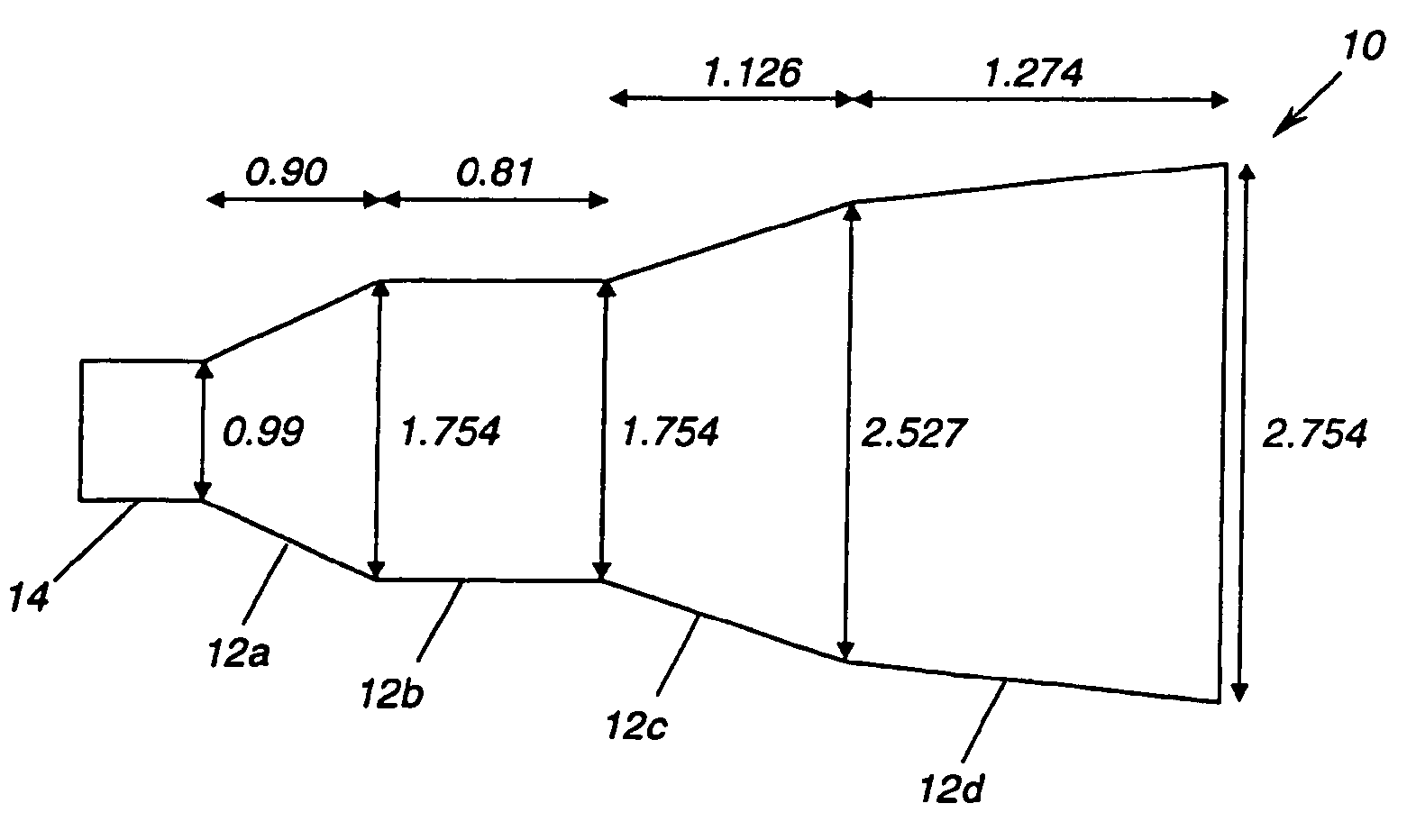
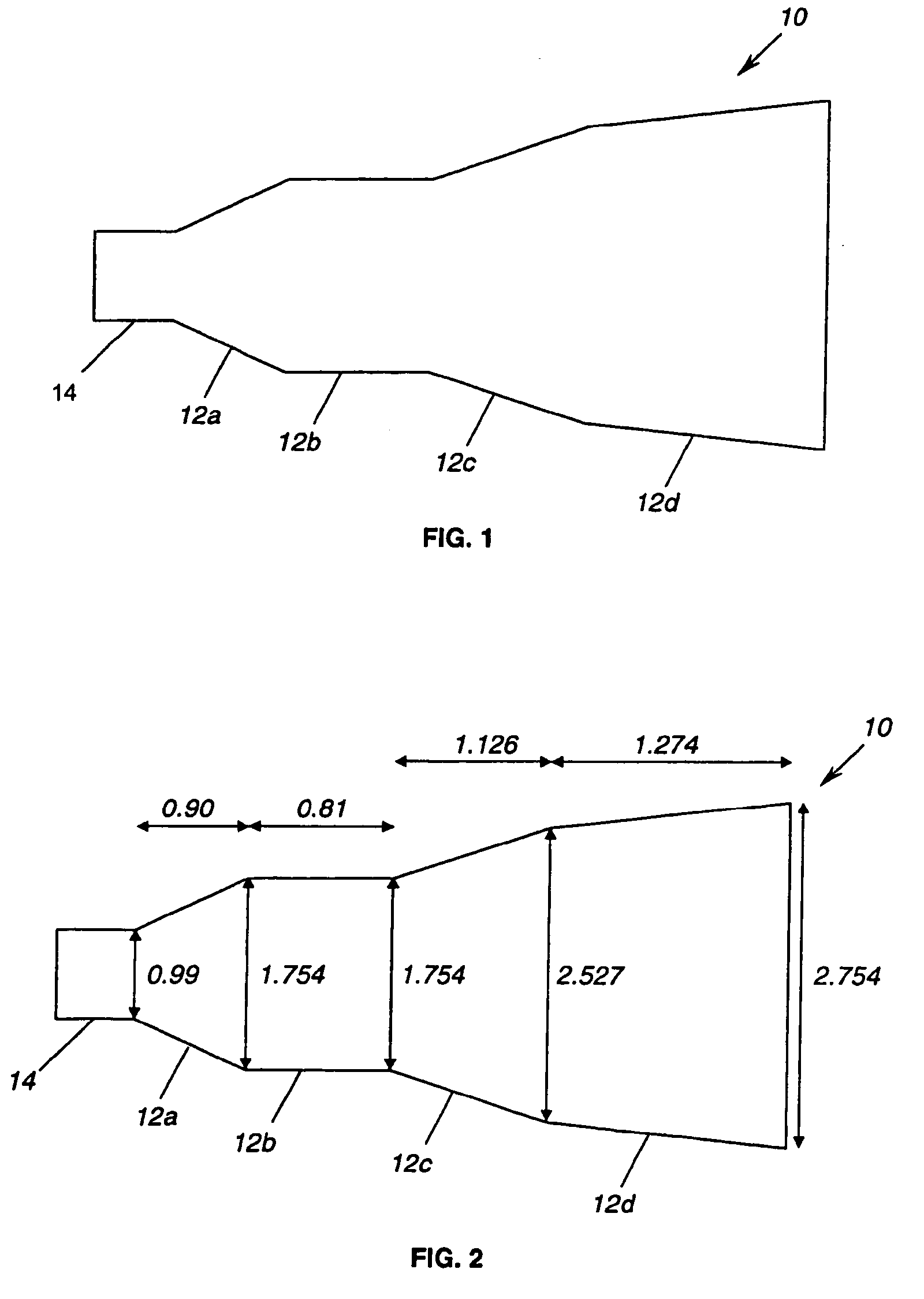
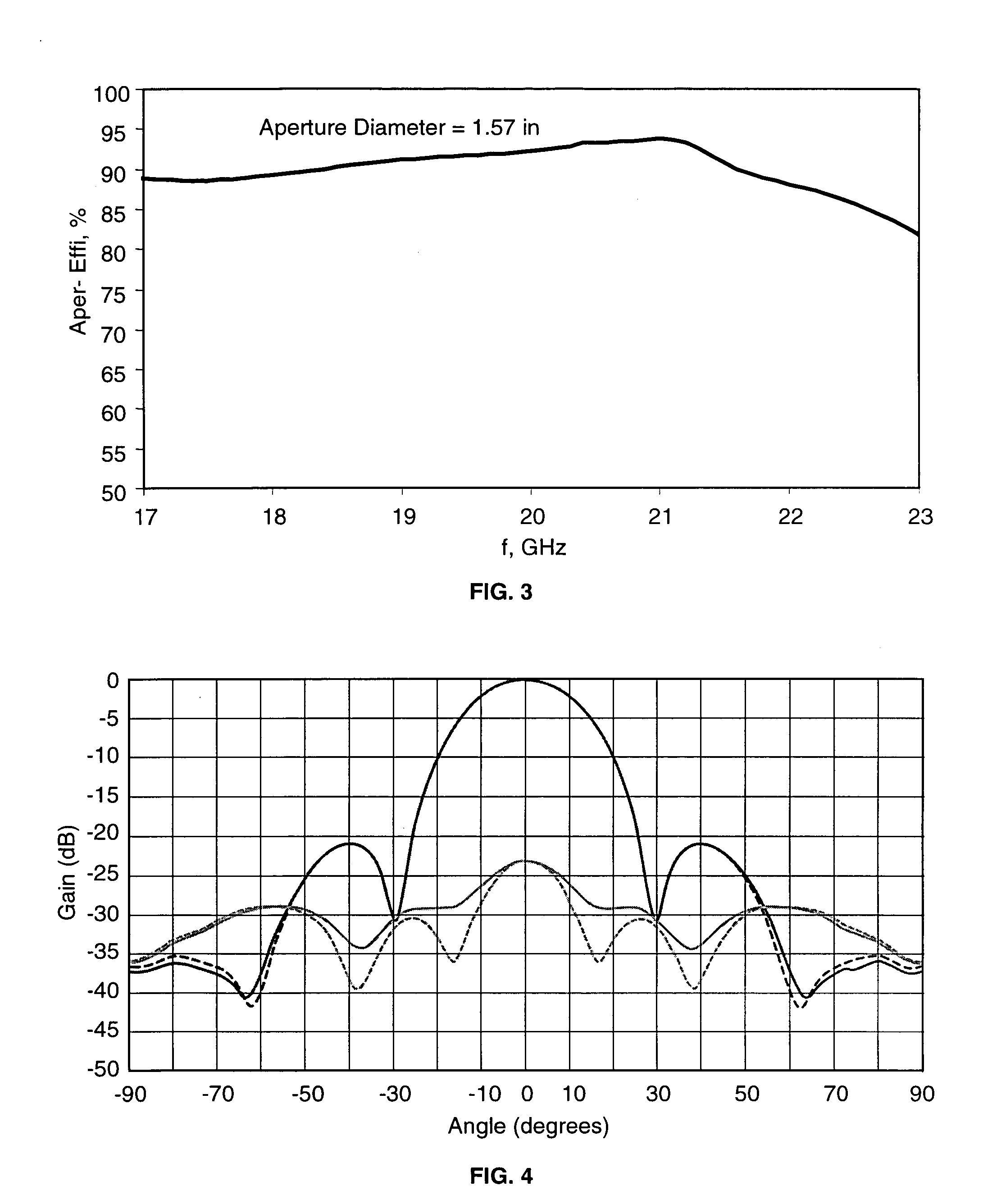
Multiple flared antenna horn with enhanced aperture efficiency
PatentInactiveUS7183991B2
Innovation
- The design incorporates multiple flared sections without step discontinuities, optimizing the generation of desirable electromagnetic TE modes and suppressing TM modes to enhance aperture efficiency, thereby increasing antenna gain.

Waveguide device and antenna array
PatentInactiveIN201827038270A
Innovation
- A slot array antenna system utilizing a hollow waveguide within vehicles, allowing for compact, efficient electromagnetic wave transmission and reception, enabling detection ranges beyond 200 meters without external interference.

Installation Standards and Compliance Requirements
Fixed installations of radiating elements and E-plane horns must comply with stringent regulatory frameworks that govern electromagnetic compatibility, safety standards, and environmental considerations. The Federal Communications Commission (FCC) Part 15 regulations in the United States establish fundamental requirements for unintentional radiators, while Part 97 addresses amateur radio installations. European installations must adhere to the Radio Equipment Directive (RED) 2014/53/EU and associated harmonized standards such as EN 301 489 series for electromagnetic compatibility.
Installation height restrictions vary significantly between radiating elements and E-plane horns due to their distinct radiation patterns and gain characteristics. Radiating elements typically require compliance with local zoning ordinances that may limit antenna heights to 35 feet in residential areas, while commercial installations may extend to 200 feet with proper permits. E-plane horns, despite their compact form factor, must meet identical height restrictions but often achieve equivalent performance at lower mounting positions due to their directional characteristics.
Structural loading requirements present critical compliance considerations for both antenna types. The Telecommunications Industry Association (TIA) standards, particularly TIA-222-H, specify wind loading calculations and structural analysis requirements. E-plane horns generally impose lower mechanical stress on support structures due to reduced wind loading profiles, potentially simplifying compliance with building codes and reducing installation costs.
Radio frequency exposure limits established by the FCC's Office of Engineering and Technology (OET) Bulletin 65 mandate specific power density calculations for both antenna types. E-plane horns typically demonstrate superior compliance margins due to their focused radiation patterns, reducing near-field exposure levels compared to omnidirectional radiating elements. This advantage becomes particularly significant in populated areas where exposure assessments are mandatory.
Environmental protection standards, including IP ratings for ingress protection and temperature cycling requirements per IEC 60068 series, apply equally to both antenna configurations. However, the enclosed nature of horn antennas often provides inherent advantages in meeting IP65 or higher ratings without additional protective radomes, streamlining compliance verification processes and reducing long-term maintenance requirements for fixed installations.
Installation height restrictions vary significantly between radiating elements and E-plane horns due to their distinct radiation patterns and gain characteristics. Radiating elements typically require compliance with local zoning ordinances that may limit antenna heights to 35 feet in residential areas, while commercial installations may extend to 200 feet with proper permits. E-plane horns, despite their compact form factor, must meet identical height restrictions but often achieve equivalent performance at lower mounting positions due to their directional characteristics.
Structural loading requirements present critical compliance considerations for both antenna types. The Telecommunications Industry Association (TIA) standards, particularly TIA-222-H, specify wind loading calculations and structural analysis requirements. E-plane horns generally impose lower mechanical stress on support structures due to reduced wind loading profiles, potentially simplifying compliance with building codes and reducing installation costs.
Radio frequency exposure limits established by the FCC's Office of Engineering and Technology (OET) Bulletin 65 mandate specific power density calculations for both antenna types. E-plane horns typically demonstrate superior compliance margins due to their focused radiation patterns, reducing near-field exposure levels compared to omnidirectional radiating elements. This advantage becomes particularly significant in populated areas where exposure assessments are mandatory.
Environmental protection standards, including IP ratings for ingress protection and temperature cycling requirements per IEC 60068 series, apply equally to both antenna configurations. However, the enclosed nature of horn antennas often provides inherent advantages in meeting IP65 or higher ratings without additional protective radomes, streamlining compliance verification processes and reducing long-term maintenance requirements for fixed installations.
Environmental Impact of Antenna Manufacturing
The manufacturing of antennas, particularly radiating elements and E-plane horns used in fixed installations, presents significant environmental considerations that extend throughout the entire production lifecycle. The choice between these antenna types directly influences material consumption, energy usage, and waste generation patterns during manufacturing processes.
Radiating element antennas typically require precision manufacturing of metallic components, often involving copper, aluminum, or specialized alloys. The production process generates substantial metal waste through machining operations, with cutting fluids and coolants contributing to chemical waste streams. Additionally, the surface treatment processes, including plating and coating applications, introduce heavy metals and volatile organic compounds into the manufacturing environment.
E-plane horn antennas present different environmental challenges due to their larger physical dimensions and complex geometries. The manufacturing process often involves sheet metal forming, welding, and extensive machining operations that consume significantly more energy per unit compared to smaller radiating elements. The increased material volume directly correlates with higher raw material extraction impacts and transportation-related carbon emissions.
The electronics integration phase affects both antenna types similarly, involving printed circuit board assembly with associated soldering processes that release flux vapors and require specialized ventilation systems. However, the packaging and protective housing requirements differ substantially, with E-plane horns typically requiring more robust enclosures and additional weatherproofing materials.
Supply chain considerations reveal that radiating element manufacturing often benefits from economies of scale due to standardized components, potentially reducing per-unit environmental impact through optimized production runs. Conversely, E-plane horn production frequently involves custom fabrication processes that limit manufacturing efficiency and increase energy consumption per unit.
End-of-life considerations also vary significantly between these technologies. Radiating elements generally contain higher concentrations of precious metals that facilitate recycling processes, while E-plane horns present challenges due to their composite materials and integrated weatherproofing compounds that complicate material separation and recovery efforts.
Radiating element antennas typically require precision manufacturing of metallic components, often involving copper, aluminum, or specialized alloys. The production process generates substantial metal waste through machining operations, with cutting fluids and coolants contributing to chemical waste streams. Additionally, the surface treatment processes, including plating and coating applications, introduce heavy metals and volatile organic compounds into the manufacturing environment.
E-plane horn antennas present different environmental challenges due to their larger physical dimensions and complex geometries. The manufacturing process often involves sheet metal forming, welding, and extensive machining operations that consume significantly more energy per unit compared to smaller radiating elements. The increased material volume directly correlates with higher raw material extraction impacts and transportation-related carbon emissions.
The electronics integration phase affects both antenna types similarly, involving printed circuit board assembly with associated soldering processes that release flux vapors and require specialized ventilation systems. However, the packaging and protective housing requirements differ substantially, with E-plane horns typically requiring more robust enclosures and additional weatherproofing materials.
Supply chain considerations reveal that radiating element manufacturing often benefits from economies of scale due to standardized components, potentially reducing per-unit environmental impact through optimized production runs. Conversely, E-plane horn production frequently involves custom fabrication processes that limit manufacturing efficiency and increase energy consumption per unit.
End-of-life considerations also vary significantly between these technologies. Radiating elements generally contain higher concentrations of precious metals that facilitate recycling processes, while E-plane horns present challenges due to their composite materials and integrated weatherproofing compounds that complicate material separation and recovery efforts.
Unlock deeper insights with PatSnap Eureka Quick Research — get a full tech report to explore trends and direct your research. Try now!
Generate Your Research Report Instantly with AI Agent
Supercharge your innovation with PatSnap Eureka AI Agent Platform!