

Radiating Element Signal Range Enhancement for Remote Connectivity
MAR 6, 20269 MIN READ
Generate Your Research Report Instantly with AI Agent
PatSnap Eureka helps you evaluate technical feasibility & market potential.
Antenna Technology Background and Range Enhancement Goals
Antenna technology has undergone remarkable evolution since the late 19th century, beginning with Heinrich Hertz's pioneering experiments that demonstrated electromagnetic wave propagation. The fundamental principles established by James Clerk Maxwell's electromagnetic theory laid the groundwork for modern radiating element design, where antennas serve as transducers converting electrical energy into electromagnetic waves and vice versa.
The progression from simple wire antennas to sophisticated array systems reflects the continuous pursuit of enhanced signal range and connectivity performance. Early developments focused on basic dipole and monopole configurations, which provided foundational understanding of radiation patterns and impedance matching. The introduction of directional antennas, including Yagi-Uda arrays and parabolic reflectors, marked significant milestones in achieving focused energy transmission and improved range capabilities.
Modern antenna technology encompasses diverse approaches to range enhancement, including phased array systems, multiple-input multiple-output configurations, and adaptive beamforming techniques. These innovations address the growing demand for reliable remote connectivity across various applications, from satellite communications to Internet of Things deployments. The integration of metamaterials and frequency-selective surfaces has opened new possibilities for miniaturization while maintaining or improving performance characteristics.
Contemporary range enhancement goals center on achieving maximum effective radiated power within regulatory constraints, optimizing antenna gain patterns for specific coverage requirements, and minimizing signal degradation over extended distances. Advanced techniques such as spatial diversity, polarization optimization, and intelligent reflecting surfaces represent current frontiers in extending communication range while maintaining signal quality and reliability.
The convergence of digital signal processing with antenna design has enabled dynamic adaptation to changing propagation conditions, allowing systems to automatically adjust parameters for optimal range performance. This technological synergy addresses the fundamental challenge of maintaining robust connectivity across varying environmental conditions and interference scenarios, establishing the foundation for next-generation remote communication systems.
The progression from simple wire antennas to sophisticated array systems reflects the continuous pursuit of enhanced signal range and connectivity performance. Early developments focused on basic dipole and monopole configurations, which provided foundational understanding of radiation patterns and impedance matching. The introduction of directional antennas, including Yagi-Uda arrays and parabolic reflectors, marked significant milestones in achieving focused energy transmission and improved range capabilities.
Modern antenna technology encompasses diverse approaches to range enhancement, including phased array systems, multiple-input multiple-output configurations, and adaptive beamforming techniques. These innovations address the growing demand for reliable remote connectivity across various applications, from satellite communications to Internet of Things deployments. The integration of metamaterials and frequency-selective surfaces has opened new possibilities for miniaturization while maintaining or improving performance characteristics.
Contemporary range enhancement goals center on achieving maximum effective radiated power within regulatory constraints, optimizing antenna gain patterns for specific coverage requirements, and minimizing signal degradation over extended distances. Advanced techniques such as spatial diversity, polarization optimization, and intelligent reflecting surfaces represent current frontiers in extending communication range while maintaining signal quality and reliability.
The convergence of digital signal processing with antenna design has enabled dynamic adaptation to changing propagation conditions, allowing systems to automatically adjust parameters for optimal range performance. This technological synergy addresses the fundamental challenge of maintaining robust connectivity across varying environmental conditions and interference scenarios, establishing the foundation for next-generation remote communication systems.
Market Demand for Extended Range Remote Connectivity Solutions
The global telecommunications landscape is experiencing unprecedented demand for extended range remote connectivity solutions, driven by the proliferation of Internet of Things devices, smart city initiatives, and the expansion of industrial automation systems. Traditional wireless communication technologies often fall short in providing reliable connectivity across vast geographical areas, particularly in rural regions, maritime environments, and industrial facilities where infrastructure deployment remains challenging.
Enterprise sectors are increasingly seeking robust connectivity solutions that can maintain stable communication links over extended distances without compromising signal quality or data transmission rates. The agricultural industry, for instance, requires reliable connectivity for precision farming applications, livestock monitoring, and automated irrigation systems across expansive farmlands. Similarly, oil and gas operations demand dependable communication networks for remote monitoring of pipelines, drilling sites, and offshore platforms.
The emergence of smart infrastructure projects has amplified the need for long-range connectivity solutions. Smart grid implementations require seamless communication between distributed energy resources, while intelligent transportation systems depend on reliable data exchange across extensive highway networks. These applications necessitate radiating elements capable of maintaining signal integrity over considerable distances while minimizing power consumption and infrastructure costs.
Market research indicates substantial growth potential in sectors requiring extended connectivity coverage. The mining industry presents significant opportunities, as operations often occur in remote locations where traditional cellular networks provide inadequate coverage. Environmental monitoring applications, including weather stations, seismic sensors, and pollution monitoring systems, require reliable long-range communication capabilities to transmit critical data from geographically dispersed locations.
Emergency response and public safety applications represent another crucial market segment driving demand for enhanced signal range solutions. First responders require dependable communication systems that function effectively in challenging environments and maintain connectivity across wide operational areas during critical incidents.
The increasing adoption of autonomous systems across various industries further intensifies the demand for extended range connectivity. Autonomous vehicles, drones, and robotic systems require continuous communication links to ensure safe and efficient operation, particularly in applications spanning large geographical areas or operating in remote locations where traditional connectivity infrastructure may be limited or unavailable.
Enterprise sectors are increasingly seeking robust connectivity solutions that can maintain stable communication links over extended distances without compromising signal quality or data transmission rates. The agricultural industry, for instance, requires reliable connectivity for precision farming applications, livestock monitoring, and automated irrigation systems across expansive farmlands. Similarly, oil and gas operations demand dependable communication networks for remote monitoring of pipelines, drilling sites, and offshore platforms.
The emergence of smart infrastructure projects has amplified the need for long-range connectivity solutions. Smart grid implementations require seamless communication between distributed energy resources, while intelligent transportation systems depend on reliable data exchange across extensive highway networks. These applications necessitate radiating elements capable of maintaining signal integrity over considerable distances while minimizing power consumption and infrastructure costs.
Market research indicates substantial growth potential in sectors requiring extended connectivity coverage. The mining industry presents significant opportunities, as operations often occur in remote locations where traditional cellular networks provide inadequate coverage. Environmental monitoring applications, including weather stations, seismic sensors, and pollution monitoring systems, require reliable long-range communication capabilities to transmit critical data from geographically dispersed locations.
Emergency response and public safety applications represent another crucial market segment driving demand for enhanced signal range solutions. First responders require dependable communication systems that function effectively in challenging environments and maintain connectivity across wide operational areas during critical incidents.
The increasing adoption of autonomous systems across various industries further intensifies the demand for extended range connectivity. Autonomous vehicles, drones, and robotic systems require continuous communication links to ensure safe and efficient operation, particularly in applications spanning large geographical areas or operating in remote locations where traditional connectivity infrastructure may be limited or unavailable.
Current Radiating Element Limitations and Technical Challenges
Current radiating element technologies face significant constraints in achieving optimal signal range for remote connectivity applications. Traditional antenna designs encounter fundamental physical limitations that restrict their effectiveness in long-distance communication scenarios. The primary challenge stems from the inverse square law of electromagnetic propagation, where signal strength diminishes rapidly with distance, creating substantial barriers for maintaining reliable connectivity over extended ranges.
Impedance matching represents a critical technical hurdle in radiating element design. Mismatched impedance between the antenna and transmission line results in signal reflection and power loss, directly impacting the effective radiated power and overall system efficiency. This issue becomes particularly pronounced when attempting to optimize antennas for multiple frequency bands or when operating in varying environmental conditions that alter the antenna's electrical characteristics.
Bandwidth limitations pose another significant constraint for modern radiating elements. Conventional antenna designs often exhibit narrow operational bandwidths, restricting their ability to support wideband communication protocols essential for contemporary remote connectivity applications. This limitation forces engineers to compromise between bandwidth coverage and radiation efficiency, often resulting in suboptimal performance across the desired frequency spectrum.
Environmental interference and multipath propagation effects severely degrade signal quality and range performance. Urban environments with dense building structures, natural terrain variations, and atmospheric conditions create complex propagation scenarios that traditional radiating elements struggle to overcome. These factors introduce signal fading, distortion, and unpredictable coverage patterns that limit reliable communication range.
Power consumption constraints in battery-operated remote devices create additional challenges for radiating element design. Higher transmission power levels can extend range but dramatically reduce operational lifetime, while lower power operation limits effective communication distance. This trade-off becomes particularly critical in IoT applications and remote monitoring systems where long-term autonomous operation is essential.
Manufacturing tolerances and material limitations further constrain radiating element performance. Precise dimensional control required for optimal antenna characteristics becomes increasingly difficult and expensive as frequency increases. Additionally, material properties such as dielectric constants and loss tangents directly impact radiation efficiency and bandwidth, limiting design flexibility and performance optimization opportunities.
Regulatory compliance requirements impose additional constraints on radiating element design, particularly regarding power spectral density limits and spurious emission standards. These regulations often force designers to operate well below theoretical performance limits, creating gaps between achievable and desired signal range capabilities for remote connectivity applications.
Impedance matching represents a critical technical hurdle in radiating element design. Mismatched impedance between the antenna and transmission line results in signal reflection and power loss, directly impacting the effective radiated power and overall system efficiency. This issue becomes particularly pronounced when attempting to optimize antennas for multiple frequency bands or when operating in varying environmental conditions that alter the antenna's electrical characteristics.
Bandwidth limitations pose another significant constraint for modern radiating elements. Conventional antenna designs often exhibit narrow operational bandwidths, restricting their ability to support wideband communication protocols essential for contemporary remote connectivity applications. This limitation forces engineers to compromise between bandwidth coverage and radiation efficiency, often resulting in suboptimal performance across the desired frequency spectrum.
Environmental interference and multipath propagation effects severely degrade signal quality and range performance. Urban environments with dense building structures, natural terrain variations, and atmospheric conditions create complex propagation scenarios that traditional radiating elements struggle to overcome. These factors introduce signal fading, distortion, and unpredictable coverage patterns that limit reliable communication range.
Power consumption constraints in battery-operated remote devices create additional challenges for radiating element design. Higher transmission power levels can extend range but dramatically reduce operational lifetime, while lower power operation limits effective communication distance. This trade-off becomes particularly critical in IoT applications and remote monitoring systems where long-term autonomous operation is essential.
Manufacturing tolerances and material limitations further constrain radiating element performance. Precise dimensional control required for optimal antenna characteristics becomes increasingly difficult and expensive as frequency increases. Additionally, material properties such as dielectric constants and loss tangents directly impact radiation efficiency and bandwidth, limiting design flexibility and performance optimization opportunities.
Regulatory compliance requirements impose additional constraints on radiating element design, particularly regarding power spectral density limits and spurious emission standards. These regulations often force designers to operate well below theoretical performance limits, creating gaps between achievable and desired signal range capabilities for remote connectivity applications.
Existing Solutions for Signal Range Enhancement Methods
01 Antenna array configuration for extended signal range
Multiple radiating elements can be arranged in array configurations to enhance signal coverage and extend the operational range. The array design includes specific spacing, phasing, and element positioning to optimize radiation patterns and achieve desired coverage areas. This approach allows for beam steering and improved directivity, enabling better signal propagation over longer distances.- Antenna array configuration for extended signal range: Multiple radiating elements can be arranged in array configurations to enhance signal coverage and extend the operational range. The array design includes specific spacing, phasing, and geometric arrangements of elements to optimize radiation patterns and achieve desired directivity. This approach enables improved signal transmission over longer distances and wider coverage areas through constructive interference and beam forming techniques.
- Frequency tuning and bandwidth optimization: Radiating elements can be designed with adjustable frequency characteristics to operate across multiple bands and optimize signal range for different frequencies. This includes the use of tunable components, multi-resonant structures, and impedance matching networks that allow the antenna to maintain efficient radiation across a wide frequency spectrum. The optimization of bandwidth directly impacts the effective signal range and communication reliability.
- Polarization diversity for signal range enhancement: Implementation of multiple polarization modes in radiating elements improves signal range by reducing polarization mismatch losses and enabling operation in diverse propagation environments. This includes dual-polarized and circularly polarized antenna designs that can maintain signal quality regardless of orientation. The polarization diversity technique enhances overall system performance and extends effective communication range.
- Reflector and director elements for range extension: Passive elements such as reflectors and directors can be strategically positioned relative to active radiating elements to focus and direct electromagnetic energy, thereby increasing signal range in specific directions. These parasitic elements modify the radiation pattern to achieve higher gain and improved directivity. The configuration creates enhanced signal propagation characteristics without requiring additional active components.
- Adaptive beamforming and signal processing: Advanced signal processing techniques combined with electronically controlled radiating elements enable dynamic adjustment of radiation patterns to maximize signal range toward specific targets or users. This includes phase shifting, amplitude control, and real-time beam steering capabilities that adapt to changing environmental conditions and user locations. The adaptive approach optimizes signal strength and extends effective range through intelligent resource allocation.
02 Frequency band optimization for signal range enhancement
Radiating elements can be designed to operate across multiple frequency bands or optimized for specific frequency ranges to maximize signal propagation characteristics. The selection of operating frequencies and bandwidth affects the range performance, with considerations for wavelength, atmospheric conditions, and penetration capabilities. Multi-band operation enables adaptive range optimization based on environmental conditions.Expand Specific Solutions03 Power distribution and feed network design
The signal range of radiating elements can be enhanced through optimized power distribution networks and feeding mechanisms. This includes impedance matching, power dividers, and transmission line configurations that minimize losses and maximize radiated power. Proper feed network design ensures efficient energy transfer to the radiating elements, thereby extending the effective signal range.Expand Specific Solutions04 Reflector and director elements for range extension
Passive elements such as reflectors and directors can be incorporated with radiating elements to focus and direct electromagnetic energy, thereby increasing signal range in specific directions. These parasitic elements modify the radiation pattern to achieve higher gain and directivity. The geometric arrangement and dimensions of these elements are optimized to enhance forward radiation and suppress back lobes.Expand Specific Solutions05 Adaptive beamforming and signal processing techniques
Advanced signal processing methods and adaptive beamforming algorithms can be employed to dynamically adjust radiation patterns and optimize signal range based on real-time conditions. These techniques include phase shifting, amplitude control, and digital signal processing to steer beams toward desired directions and null interference sources. Such adaptive systems enable extended range performance in varying operational environments.Expand Specific Solutions
Key Players in Antenna and Remote Connectivity Industry
The radiating element signal range enhancement technology for remote connectivity represents a rapidly evolving sector within the telecommunications and wireless communications industry. The market is experiencing significant growth driven by increasing demand for enhanced connectivity solutions across 5G networks, IoT applications, and remote communication systems. The competitive landscape features a diverse mix of established telecommunications giants like Huawei Technologies, Qualcomm, and ZTE Corp., alongside specialized antenna manufacturers such as Tongyu Communication and Murata Manufacturing. Technology maturity varies significantly across market segments, with companies like MediaTek and NXP USA advancing semiconductor-based solutions, while defense contractors including Lockheed Martin and Raytheon focus on military-grade applications. The industry demonstrates strong innovation momentum, particularly in antenna design and RF optimization, with emerging players like Autel Robotics and established firms like Google LLC driving next-generation connectivity solutions for diverse applications ranging from consumer electronics to aerospace systems.
Huawei Technologies Co., Ltd.
Technical Solution: Huawei has developed advanced massive MIMO antenna systems with up to 192 antenna elements for enhanced signal coverage and capacity. Their MetaAAU solution integrates beamforming algorithms that can dynamically adjust radiation patterns to extend signal range by up to 30% compared to traditional systems. The company employs advanced digital signal processing techniques including interference cancellation and adaptive power control to optimize radiating element performance across different frequency bands including sub-6GHz and mmWave spectrum.
Strengths: Industry-leading massive MIMO technology, comprehensive 5G portfolio, strong R&D capabilities. Weaknesses: Geopolitical restrictions limiting market access, supply chain constraints.
MediaTek, Inc.
Technical Solution: MediaTek's connectivity chipsets incorporate advanced antenna diversity and MIMO processing algorithms that optimize radiating element performance for extended range applications. Their Wi-Fi 7 and 5G solutions feature intelligent antenna switching and beamforming capabilities that dynamically select optimal radiating elements based on channel conditions. The company's integrated RF front-end modules include power amplifiers and low-noise amplifiers specifically designed to maximize the effective radiated power and sensitivity of connected antenna systems, enabling up to 35% range extension in typical deployment scenarios.
Strengths: Integrated chipset solutions, cost-effective implementations, broad market reach. Weaknesses: Limited infrastructure focus, primarily consumer-oriented solutions.
Core Innovations in Radiating Element Design Patents
Phased Array Antenna with Isotropic and Non-Isotropic Radiating and Omnidirectional and Non-Omnidirectional Receiving Elements
PatentActiveUS20230112587A1
Innovation
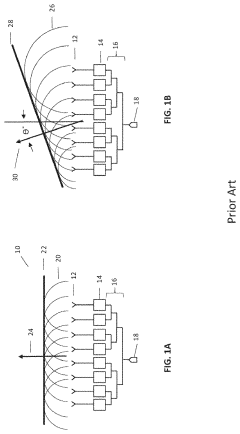
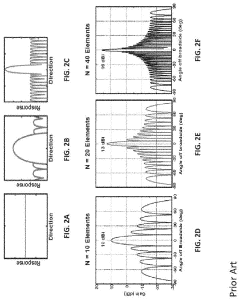
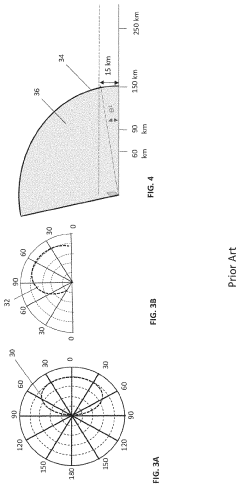
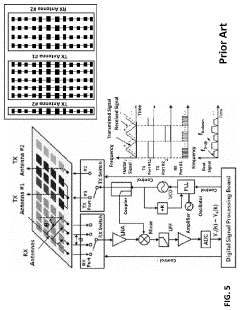
- Implementing a combination of isotropic and non-isotropic radiating elements, where isotropic elements cover non-remote fields and non-isotropic elements, with focused beams, cover remote fields, effectively redirecting excess power to increase the antenna's maximum detection range without increasing element count or power per element.
Communication device and communication method
PatentActiveUS20250174904A1
Innovation
- The communication device incorporates a first and second Frequency Selective Surface (FSS) element, a feeding radiation element, an electron gun, and an electron collector. The FSS elements and electron beams induce a coupling effect that enhances the radiation energy of the electromagnetic signal, thereby increasing the radiation gain.


Spectrum Regulation and Compliance Requirements
Spectrum regulation and compliance requirements represent critical constraints that fundamentally shape the development and deployment of radiating element signal range enhancement technologies for remote connectivity applications. The electromagnetic spectrum is a finite and heavily regulated resource, with national and international regulatory bodies establishing strict parameters for frequency allocation, power limitations, and emission standards that directly impact the feasibility of range enhancement strategies.
The Federal Communications Commission (FCC) in the United States, along with counterpart agencies such as the European Telecommunications Standards Institute (ETSI) and the International Telecommunication Union (ITU), maintain comprehensive frameworks governing unlicensed and licensed spectrum usage. These regulations establish maximum effective isotropic radiated power (EIRP) limits, spurious emission thresholds, and specific absorption rate (SAR) requirements that constrain the operational parameters of enhanced radiating elements. For instance, the 2.4 GHz ISM band typically restricts EIRP to 36 dBm, while the 5 GHz bands impose varying power limits depending on specific frequency ranges and geographic regions.
Compliance with electromagnetic compatibility (EMC) standards presents additional challenges for range enhancement implementations. Radiating elements operating at higher power levels or employing advanced beamforming techniques must demonstrate adherence to conducted and radiated emission limits as specified in standards such as FCC Part 15, EN 301 489, and CISPR publications. These requirements often necessitate sophisticated filtering, shielding, and power management strategies that can impact system complexity and cost.
International harmonization efforts, while beneficial for global market access, create complex compliance matrices that manufacturers must navigate. The varying regulatory approaches across different regions regarding dynamic frequency selection (DFS), transmit power control (TPC), and antenna gain restrictions require adaptive design strategies. For example, European regulations may permit higher antenna gains with corresponding power reductions, while other jurisdictions maintain fixed power limits regardless of antenna characteristics.
Emerging regulatory trends toward more flexible spectrum management, including concepts like spectrum sharing and cognitive radio technologies, present both opportunities and challenges for range enhancement applications. These evolving frameworks may enable more sophisticated power and frequency management strategies while simultaneously imposing new technical requirements for interference detection and avoidance capabilities.
The Federal Communications Commission (FCC) in the United States, along with counterpart agencies such as the European Telecommunications Standards Institute (ETSI) and the International Telecommunication Union (ITU), maintain comprehensive frameworks governing unlicensed and licensed spectrum usage. These regulations establish maximum effective isotropic radiated power (EIRP) limits, spurious emission thresholds, and specific absorption rate (SAR) requirements that constrain the operational parameters of enhanced radiating elements. For instance, the 2.4 GHz ISM band typically restricts EIRP to 36 dBm, while the 5 GHz bands impose varying power limits depending on specific frequency ranges and geographic regions.
Compliance with electromagnetic compatibility (EMC) standards presents additional challenges for range enhancement implementations. Radiating elements operating at higher power levels or employing advanced beamforming techniques must demonstrate adherence to conducted and radiated emission limits as specified in standards such as FCC Part 15, EN 301 489, and CISPR publications. These requirements often necessitate sophisticated filtering, shielding, and power management strategies that can impact system complexity and cost.
International harmonization efforts, while beneficial for global market access, create complex compliance matrices that manufacturers must navigate. The varying regulatory approaches across different regions regarding dynamic frequency selection (DFS), transmit power control (TPC), and antenna gain restrictions require adaptive design strategies. For example, European regulations may permit higher antenna gains with corresponding power reductions, while other jurisdictions maintain fixed power limits regardless of antenna characteristics.
Emerging regulatory trends toward more flexible spectrum management, including concepts like spectrum sharing and cognitive radio technologies, present both opportunities and challenges for range enhancement applications. These evolving frameworks may enable more sophisticated power and frequency management strategies while simultaneously imposing new technical requirements for interference detection and avoidance capabilities.
Environmental Impact of High-Power RF Systems
High-power RF systems designed for radiating element signal range enhancement present significant environmental considerations that require careful evaluation and mitigation strategies. These systems typically operate at elevated power levels to achieve extended connectivity ranges, potentially generating electromagnetic emissions that exceed standard environmental thresholds.
The primary environmental concern involves electromagnetic field exposure levels in surrounding areas. High-power RF transmitters can create electromagnetic radiation patterns that may affect both human populations and wildlife in proximity to transmission facilities. Regulatory compliance with international standards such as IEEE C95.1 and ICNIRP guidelines becomes critical, particularly in densely populated areas where enhanced connectivity systems are most needed.
Thermal effects represent another significant environmental impact category. High-power RF systems generate substantial heat during operation, requiring extensive cooling infrastructure that increases overall energy consumption. This thermal load can affect local microclimates around transmission facilities and contribute to urban heat island effects in metropolitan deployments.
Energy consumption patterns of enhanced range systems create indirect environmental impacts through increased carbon footprint. Power amplifiers operating at maximum efficiency levels still consume considerably more energy than standard connectivity systems, potentially requiring dedicated power generation capacity and contributing to grid strain during peak demand periods.
Wildlife interaction studies have documented behavioral changes in various species exposed to high-intensity RF fields. Migratory patterns of birds and navigation behaviors of insects can be disrupted by powerful electromagnetic emissions, particularly in frequency ranges that overlap with natural bioelectric processes.
Mitigation strategies include implementing adaptive power control algorithms that reduce transmission power when maximum range is not required, deploying directional antenna arrays to concentrate RF energy in specific coverage zones, and establishing buffer zones around high-power installations. Advanced beamforming technologies can significantly reduce environmental exposure while maintaining enhanced connectivity performance.
Long-term environmental monitoring protocols are essential for assessing cumulative impacts of widespread high-power RF deployment, ensuring sustainable implementation of enhanced connectivity infrastructure while maintaining ecological balance in deployment regions.
The primary environmental concern involves electromagnetic field exposure levels in surrounding areas. High-power RF transmitters can create electromagnetic radiation patterns that may affect both human populations and wildlife in proximity to transmission facilities. Regulatory compliance with international standards such as IEEE C95.1 and ICNIRP guidelines becomes critical, particularly in densely populated areas where enhanced connectivity systems are most needed.
Thermal effects represent another significant environmental impact category. High-power RF systems generate substantial heat during operation, requiring extensive cooling infrastructure that increases overall energy consumption. This thermal load can affect local microclimates around transmission facilities and contribute to urban heat island effects in metropolitan deployments.
Energy consumption patterns of enhanced range systems create indirect environmental impacts through increased carbon footprint. Power amplifiers operating at maximum efficiency levels still consume considerably more energy than standard connectivity systems, potentially requiring dedicated power generation capacity and contributing to grid strain during peak demand periods.
Wildlife interaction studies have documented behavioral changes in various species exposed to high-intensity RF fields. Migratory patterns of birds and navigation behaviors of insects can be disrupted by powerful electromagnetic emissions, particularly in frequency ranges that overlap with natural bioelectric processes.
Mitigation strategies include implementing adaptive power control algorithms that reduce transmission power when maximum range is not required, deploying directional antenna arrays to concentrate RF energy in specific coverage zones, and establishing buffer zones around high-power installations. Advanced beamforming technologies can significantly reduce environmental exposure while maintaining enhanced connectivity performance.
Long-term environmental monitoring protocols are essential for assessing cumulative impacts of widespread high-power RF deployment, ensuring sustainable implementation of enhanced connectivity infrastructure while maintaining ecological balance in deployment regions.
Unlock deeper insights with PatSnap Eureka Quick Research — get a full tech report to explore trends and direct your research. Try now!
Generate Your Research Report Instantly with AI Agent
Supercharge your innovation with PatSnap Eureka AI Agent Platform!