

Radiating Element Wave Manipulation for Maximum Transmission Range
MAR 6, 20268 MIN READ
Generate Your Research Report Instantly with AI Agent
PatSnap Eureka helps you evaluate technical feasibility & market potential.
Antenna Wave Manipulation Background and Objectives
The evolution of antenna technology has been fundamentally driven by the persistent demand for extended communication range and enhanced signal quality across diverse applications. From early radio broadcasting systems to modern satellite communications and 5G networks, the manipulation of electromagnetic waves through radiating elements has remained a cornerstone of wireless technology advancement. The historical progression from simple dipole antennas to sophisticated phased arrays demonstrates humanity's continuous pursuit of maximizing electromagnetic energy transmission efficiency.
Contemporary wireless communication systems face unprecedented challenges in achieving optimal transmission range while maintaining signal integrity. The exponential growth of connected devices, coupled with the increasing complexity of electromagnetic environments, has created a critical need for advanced wave manipulation techniques. Traditional antenna designs often struggle to balance directional gain, bandwidth requirements, and physical constraints, particularly in applications demanding maximum range performance such as deep space communications, maritime radar systems, and remote sensing platforms.
The fundamental objective of radiating element wave manipulation centers on optimizing the spatial distribution of electromagnetic energy to achieve maximum effective transmission range. This involves sophisticated control over amplitude, phase, and polarization characteristics of radiated waves to concentrate energy in desired directions while minimizing losses in unwanted directions. The challenge extends beyond simple beamforming to encompass adaptive response to changing environmental conditions and dynamic optimization of radiation patterns.
Modern research initiatives focus on developing intelligent antenna systems capable of real-time wave manipulation through advanced signal processing algorithms and adaptive beamforming techniques. These systems aim to overcome traditional limitations imposed by fixed radiation patterns and static gain characteristics. The integration of metamaterials, reconfigurable surfaces, and machine learning algorithms represents a paradigm shift toward autonomous optimization of transmission parameters.
The strategic importance of maximizing transmission range extends across multiple sectors including aerospace, defense, telecommunications, and Internet of Things applications. Enhanced range capabilities directly translate to reduced infrastructure costs, improved coverage in challenging environments, and enhanced reliability of critical communication links. The economic implications of breakthrough developments in this field could reshape entire industries dependent on long-range wireless communications.
Future technological objectives encompass the development of self-optimizing antenna systems that can dynamically adapt their radiation characteristics based on real-time channel conditions and mission requirements. This includes the pursuit of theoretical maximum transmission ranges through innovative approaches to wave manipulation, potentially revolutionizing how we approach long-distance wireless communication challenges.
Contemporary wireless communication systems face unprecedented challenges in achieving optimal transmission range while maintaining signal integrity. The exponential growth of connected devices, coupled with the increasing complexity of electromagnetic environments, has created a critical need for advanced wave manipulation techniques. Traditional antenna designs often struggle to balance directional gain, bandwidth requirements, and physical constraints, particularly in applications demanding maximum range performance such as deep space communications, maritime radar systems, and remote sensing platforms.
The fundamental objective of radiating element wave manipulation centers on optimizing the spatial distribution of electromagnetic energy to achieve maximum effective transmission range. This involves sophisticated control over amplitude, phase, and polarization characteristics of radiated waves to concentrate energy in desired directions while minimizing losses in unwanted directions. The challenge extends beyond simple beamforming to encompass adaptive response to changing environmental conditions and dynamic optimization of radiation patterns.
Modern research initiatives focus on developing intelligent antenna systems capable of real-time wave manipulation through advanced signal processing algorithms and adaptive beamforming techniques. These systems aim to overcome traditional limitations imposed by fixed radiation patterns and static gain characteristics. The integration of metamaterials, reconfigurable surfaces, and machine learning algorithms represents a paradigm shift toward autonomous optimization of transmission parameters.
The strategic importance of maximizing transmission range extends across multiple sectors including aerospace, defense, telecommunications, and Internet of Things applications. Enhanced range capabilities directly translate to reduced infrastructure costs, improved coverage in challenging environments, and enhanced reliability of critical communication links. The economic implications of breakthrough developments in this field could reshape entire industries dependent on long-range wireless communications.
Future technological objectives encompass the development of self-optimizing antenna systems that can dynamically adapt their radiation characteristics based on real-time channel conditions and mission requirements. This includes the pursuit of theoretical maximum transmission ranges through innovative approaches to wave manipulation, potentially revolutionizing how we approach long-distance wireless communication challenges.
Market Demand for Extended Range Communication Systems
The global telecommunications landscape is experiencing unprecedented demand for extended range communication systems, driven by the proliferation of Internet of Things devices, smart city initiatives, and remote connectivity requirements. Traditional communication infrastructure faces significant challenges in providing reliable coverage across vast geographical areas, particularly in rural regions, maritime environments, and emergency response scenarios where conventional cellular networks prove inadequate.
Industrial sectors are increasingly seeking robust long-range communication solutions to support critical operations. Oil and gas companies require reliable data transmission from remote drilling sites and offshore platforms. Agricultural enterprises demand comprehensive connectivity for precision farming applications, including sensor networks monitoring soil conditions and livestock tracking systems across extensive farmlands. Mining operations necessitate dependable communication links in challenging underground and remote surface environments where standard wireless technologies fail to deliver adequate performance.
The emergency services sector represents a particularly demanding market segment for extended range communication systems. First responders require uninterrupted communication capabilities during natural disasters when traditional infrastructure becomes compromised. Military and defense applications drive substantial demand for secure, long-range communication systems capable of operating in contested environments where conventional networks may be unavailable or compromised.
Maritime and aviation industries continue to expand their requirements for extended range communication capabilities. Commercial shipping companies seek improved vessel tracking and crew communication systems for transoceanic voyages. The growing autonomous vehicle sector, including unmanned aerial vehicles and autonomous ships, requires reliable long-range data links for remote operation and monitoring.
Emerging applications in space communications and satellite networks are creating new market opportunities for advanced radiating element technologies. Low Earth Orbit satellite constellations require sophisticated ground station communication systems with enhanced transmission ranges to maintain reliable connectivity as satellites traverse overhead.
The market demand is further amplified by regulatory requirements mandating improved emergency communication capabilities and coverage extension initiatives in underserved regions. Government agencies worldwide are investing in communication infrastructure upgrades to ensure comprehensive coverage for public safety and national security applications, creating substantial opportunities for innovative radiating element wave manipulation technologies.
Industrial sectors are increasingly seeking robust long-range communication solutions to support critical operations. Oil and gas companies require reliable data transmission from remote drilling sites and offshore platforms. Agricultural enterprises demand comprehensive connectivity for precision farming applications, including sensor networks monitoring soil conditions and livestock tracking systems across extensive farmlands. Mining operations necessitate dependable communication links in challenging underground and remote surface environments where standard wireless technologies fail to deliver adequate performance.
The emergency services sector represents a particularly demanding market segment for extended range communication systems. First responders require uninterrupted communication capabilities during natural disasters when traditional infrastructure becomes compromised. Military and defense applications drive substantial demand for secure, long-range communication systems capable of operating in contested environments where conventional networks may be unavailable or compromised.
Maritime and aviation industries continue to expand their requirements for extended range communication capabilities. Commercial shipping companies seek improved vessel tracking and crew communication systems for transoceanic voyages. The growing autonomous vehicle sector, including unmanned aerial vehicles and autonomous ships, requires reliable long-range data links for remote operation and monitoring.
Emerging applications in space communications and satellite networks are creating new market opportunities for advanced radiating element technologies. Low Earth Orbit satellite constellations require sophisticated ground station communication systems with enhanced transmission ranges to maintain reliable connectivity as satellites traverse overhead.
The market demand is further amplified by regulatory requirements mandating improved emergency communication capabilities and coverage extension initiatives in underserved regions. Government agencies worldwide are investing in communication infrastructure upgrades to ensure comprehensive coverage for public safety and national security applications, creating substantial opportunities for innovative radiating element wave manipulation technologies.
Current Antenna Design Limitations and Range Challenges
Contemporary antenna systems face significant constraints in achieving optimal transmission range due to fundamental design limitations rooted in traditional radiating element configurations. Conventional antennas typically employ fixed geometric structures that restrict their ability to dynamically manipulate electromagnetic wave propagation patterns, resulting in suboptimal energy distribution and limited directional control capabilities.
The primary challenge stems from the inherent trade-offs between antenna size, bandwidth, and radiation efficiency. Traditional dipole and monopole antennas suffer from omnidirectional radiation patterns that disperse energy across wide angular ranges, significantly reducing power density in desired transmission directions. This fundamental limitation becomes particularly pronounced in applications requiring long-range communication, where concentrated beam formation is essential for maximizing signal strength at distant receivers.
Current phased array systems, while offering some degree of beam steering capability, encounter substantial complexity and cost barriers that limit their widespread adoption. These systems require sophisticated phase control networks and multiple active elements, leading to increased power consumption and manufacturing expenses. Additionally, the mutual coupling effects between adjacent radiating elements create unwanted interference patterns that degrade overall system performance and reduce effective transmission range.
Frequency-dependent performance represents another critical limitation affecting modern antenna designs. Most conventional antennas exhibit narrow bandwidth characteristics, with radiation patterns and impedance matching deteriorating significantly outside their designed frequency ranges. This constraint becomes increasingly problematic in modern communication systems that demand wideband operation across multiple frequency bands simultaneously.
Ground plane interactions and environmental factors further compound range limitations in practical deployments. Traditional antenna designs often fail to account for near-field coupling effects and multipath propagation phenomena that significantly impact transmission efficiency. The inability to adaptively compensate for these environmental variations results in substantial power losses and reduced communication reliability over extended distances.
Polarization mismatch issues also contribute to range degradation, particularly in mobile communication scenarios where transmitter and receiver orientations vary dynamically. Conventional linearly polarized antennas experience significant signal attenuation when polarization alignment is suboptimal, directly limiting effective transmission range and system reliability.
The primary challenge stems from the inherent trade-offs between antenna size, bandwidth, and radiation efficiency. Traditional dipole and monopole antennas suffer from omnidirectional radiation patterns that disperse energy across wide angular ranges, significantly reducing power density in desired transmission directions. This fundamental limitation becomes particularly pronounced in applications requiring long-range communication, where concentrated beam formation is essential for maximizing signal strength at distant receivers.
Current phased array systems, while offering some degree of beam steering capability, encounter substantial complexity and cost barriers that limit their widespread adoption. These systems require sophisticated phase control networks and multiple active elements, leading to increased power consumption and manufacturing expenses. Additionally, the mutual coupling effects between adjacent radiating elements create unwanted interference patterns that degrade overall system performance and reduce effective transmission range.
Frequency-dependent performance represents another critical limitation affecting modern antenna designs. Most conventional antennas exhibit narrow bandwidth characteristics, with radiation patterns and impedance matching deteriorating significantly outside their designed frequency ranges. This constraint becomes increasingly problematic in modern communication systems that demand wideband operation across multiple frequency bands simultaneously.
Ground plane interactions and environmental factors further compound range limitations in practical deployments. Traditional antenna designs often fail to account for near-field coupling effects and multipath propagation phenomena that significantly impact transmission efficiency. The inability to adaptively compensate for these environmental variations results in substantial power losses and reduced communication reliability over extended distances.
Polarization mismatch issues also contribute to range degradation, particularly in mobile communication scenarios where transmitter and receiver orientations vary dynamically. Conventional linearly polarized antennas experience significant signal attenuation when polarization alignment is suboptimal, directly limiting effective transmission range and system reliability.
Existing Wave Manipulation Techniques for Range Enhancement
01 Antenna array configuration for extended transmission range
Multiple radiating elements can be arranged in array configurations to enhance transmission range and coverage. The spacing, orientation, and phasing of array elements significantly impact the overall radiation pattern and effective transmission distance. Array configurations allow for beam steering and directional control to optimize signal propagation over extended ranges.- Antenna array configuration for extended transmission range: Multiple radiating elements can be arranged in array configurations to enhance transmission range and coverage. The array design includes specific spacing, phasing, and element positioning to optimize signal propagation. Beamforming techniques and array geometries enable directional transmission with improved range characteristics. The configuration may include linear, planar, or three-dimensional arrangements of radiating elements to achieve desired transmission patterns and extended operational distances.
- Power amplification and feed network optimization: The transmission range of radiating elements can be increased through optimized power amplification systems and efficient feed networks. Power distribution networks ensure uniform energy delivery to multiple radiating elements while minimizing losses. Impedance matching techniques and transmission line designs contribute to maximizing radiated power. Advanced feeding structures enable higher power handling capabilities and improved efficiency, directly impacting the achievable transmission distance.
- Frequency tuning and bandwidth enhancement: Adjustable frequency characteristics and broadband operation enable radiating elements to maintain effective transmission range across multiple frequency bands. Tuning mechanisms allow adaptation to different operating frequencies while preserving range performance. Wideband designs incorporate matching networks and multi-resonant structures to extend operational bandwidth. Frequency-agile systems can dynamically optimize transmission parameters to maximize range under varying conditions.
- Polarization diversity and multi-mode operation: Implementation of multiple polarization modes and diversity techniques enhances transmission range reliability and coverage. Dual or circular polarization configurations reduce signal degradation due to orientation mismatches. Multi-mode radiating elements can switch between different radiation patterns to optimize range in various directions. Polarization diversity systems improve link robustness and effective transmission distance in complex propagation environments.
- Reflector and director elements for range extension: Passive elements such as reflectors and directors can be integrated with active radiating elements to focus and direct electromagnetic energy, thereby extending transmission range. Parasitic element configurations create directional radiation patterns with enhanced gain in specific directions. Reflector geometries concentrate radiated power along desired transmission paths. The combination of active and passive elements enables compact designs with significantly improved range performance compared to single-element configurations.
02 Impedance matching and feed network optimization
Proper impedance matching between radiating elements and feed networks is critical for maximizing power transfer and transmission efficiency. Feed network designs including power dividers, phase shifters, and matching circuits can be optimized to reduce losses and extend effective transmission range. Techniques for broadband matching enable consistent performance across frequency ranges.Expand Specific Solutions03 Polarization diversity and multi-band operation
Implementing multiple polarizations or multi-band capabilities in radiating elements enhances transmission reliability and range in diverse propagation environments. Dual or circular polarization configurations can mitigate polarization mismatch losses. Multi-band radiating structures enable operation across different frequency bands to optimize range based on propagation characteristics.Expand Specific Solutions04 Reflector and director elements for range enhancement
Passive elements such as reflectors and directors can be strategically positioned relative to active radiating elements to focus electromagnetic energy and increase transmission range in specific directions. These parasitic elements modify the radiation pattern to achieve higher gain and directivity. The geometry and spacing of these elements determine the achievable range improvement.Expand Specific Solutions05 Adaptive power control and beamforming techniques
Dynamic adjustment of transmission power levels and beam patterns based on channel conditions and target distance enables optimized range performance. Beamforming algorithms can concentrate radiated energy toward intended receivers to extend effective transmission range. Adaptive techniques compensate for path loss and interference to maintain communication links over greater distances.Expand Specific Solutions
Core Patents in Advanced Radiating Element Design
Phased Array Antenna with Isotropic and Non-Isotropic Radiating and Omnidirectional and Non-Omnidirectional Receiving Elements
PatentActiveUS20230112587A1
Innovation
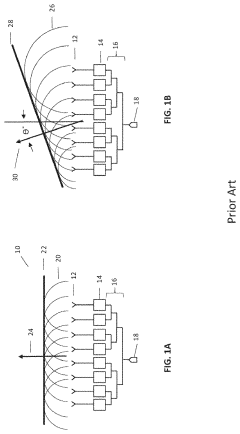
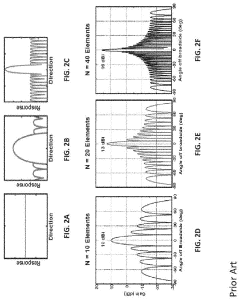
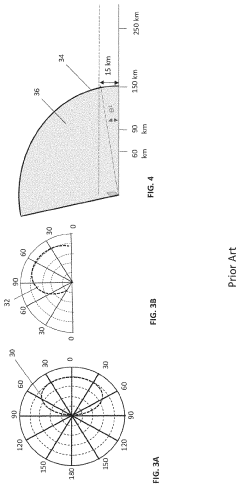
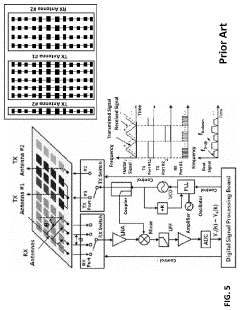
- Implementing a combination of isotropic and non-isotropic radiating elements, where isotropic elements cover non-remote fields and non-isotropic elements, with focused beams, cover remote fields, effectively redirecting excess power to increase the antenna's maximum detection range without increasing element count or power per element.
Wide band dipole radiating element with a slot line feed having a Klopfenstein impedance taper
PatentInactiveUS5428364A
Innovation
- A wideband radiating element design featuring a balanced feeding mechanism with a tapered narrow conductor slot line and dipole wings, optimized for impedance matching and radiation resistance across a 0.5 to 18 GHz frequency range, ensuring symmetrical current distribution and reduced energy reflection.


Spectrum Regulation and Compliance Requirements
Spectrum regulation and compliance requirements form a critical framework governing radiating element wave manipulation technologies designed for maximum transmission range. The electromagnetic spectrum is a finite resource managed by national and international regulatory bodies, with the International Telecommunication Union (ITU) serving as the primary global coordinator. These regulations establish fundamental boundaries within which transmission range optimization must operate, creating a complex landscape of technical and legal constraints.
The Federal Communications Commission (FCC) in the United States, along with equivalent bodies such as the European Telecommunications Standards Institute (ETSI) and other national regulators, impose strict limitations on transmit power levels, antenna gain, and effective isotropic radiated power (EIRP). These restrictions directly impact the achievable transmission range regardless of wave manipulation techniques employed. For instance, unlicensed bands like 2.4 GHz and 5 GHz typically limit EIRP to 36 dBm and 30 dBm respectively, while licensed spectrum may permit higher power levels under specific conditions.
Compliance requirements extend beyond simple power limitations to encompass spurious emission standards, out-of-band emission masks, and specific absorption rate (SAR) limits for human exposure. The IEEE 802.11 standards family demonstrates how technical specifications must align with regulatory frameworks while pursuing maximum range objectives. Advanced wave manipulation techniques such as beamforming, spatial multiplexing, and adaptive antenna arrays must operate within these predefined spectral masks and power density limitations.
International harmonization efforts have created regional variations in spectrum allocation and usage rules, particularly affecting cross-border deployments and global product development. The World Radiocommunication Conference (WRC) periodically reviews and updates spectrum allocations, influencing long-term technology development strategies. Recent regulatory trends toward dynamic spectrum access and cognitive radio technologies are opening new possibilities for intelligent wave manipulation systems that can adapt to regulatory environments in real-time.
Emerging compliance challenges include coordination requirements with incumbent services, interference mitigation obligations, and environmental impact assessments for high-power transmission systems. These regulatory considerations increasingly influence the design parameters of radiating element systems, requiring engineers to balance maximum range objectives against compliance costs and deployment flexibility constraints.
The Federal Communications Commission (FCC) in the United States, along with equivalent bodies such as the European Telecommunications Standards Institute (ETSI) and other national regulators, impose strict limitations on transmit power levels, antenna gain, and effective isotropic radiated power (EIRP). These restrictions directly impact the achievable transmission range regardless of wave manipulation techniques employed. For instance, unlicensed bands like 2.4 GHz and 5 GHz typically limit EIRP to 36 dBm and 30 dBm respectively, while licensed spectrum may permit higher power levels under specific conditions.
Compliance requirements extend beyond simple power limitations to encompass spurious emission standards, out-of-band emission masks, and specific absorption rate (SAR) limits for human exposure. The IEEE 802.11 standards family demonstrates how technical specifications must align with regulatory frameworks while pursuing maximum range objectives. Advanced wave manipulation techniques such as beamforming, spatial multiplexing, and adaptive antenna arrays must operate within these predefined spectral masks and power density limitations.
International harmonization efforts have created regional variations in spectrum allocation and usage rules, particularly affecting cross-border deployments and global product development. The World Radiocommunication Conference (WRC) periodically reviews and updates spectrum allocations, influencing long-term technology development strategies. Recent regulatory trends toward dynamic spectrum access and cognitive radio technologies are opening new possibilities for intelligent wave manipulation systems that can adapt to regulatory environments in real-time.
Emerging compliance challenges include coordination requirements with incumbent services, interference mitigation obligations, and environmental impact assessments for high-power transmission systems. These regulatory considerations increasingly influence the design parameters of radiating element systems, requiring engineers to balance maximum range objectives against compliance costs and deployment flexibility constraints.
Environmental Impact of High-Power Transmission Systems
High-power transmission systems designed for maximum range through radiating element wave manipulation present significant environmental considerations that must be carefully evaluated. These systems typically operate at elevated power levels to achieve extended transmission distances, potentially generating electromagnetic fields that exceed standard exposure limits in certain proximity zones.
The primary environmental concern stems from electromagnetic radiation exposure to both human populations and wildlife. High-power systems can create electromagnetic field intensities that may affect biological systems, particularly in areas surrounding transmission facilities. Studies indicate that prolonged exposure to intense electromagnetic fields can influence cellular processes in various organisms, though the extent of impact varies significantly based on frequency, power density, and exposure duration.
Thermal effects represent another critical environmental factor. High-power transmission systems generate substantial heat during operation, requiring extensive cooling mechanisms that can impact local ecosystems. The waste heat production may alter microclimates around transmission facilities, potentially affecting local flora and fauna. Additionally, cooling systems often require significant water resources, which can strain local water supplies and affect aquatic environments through thermal discharge.
Energy consumption patterns of maximum-range transmission systems create indirect environmental impacts through increased demand on power generation infrastructure. These systems typically require 20-40% more energy than conventional transmission equipment to achieve extended range capabilities, contributing to higher carbon footprints and increased reliance on electrical grid resources.
Interference with natural electromagnetic environments poses additional ecological concerns. High-power transmission can disrupt natural electromagnetic phenomena that various species rely upon for navigation and communication. Migratory birds, marine mammals, and insects that depend on electromagnetic sensing may experience behavioral disruptions in areas with intense transmission activity.
Regulatory frameworks increasingly address these environmental impacts through stricter emission standards and mandatory environmental impact assessments. Modern high-power transmission system designs must incorporate environmental mitigation strategies, including adaptive power control, directional beam focusing, and enhanced shielding technologies to minimize ecological disruption while maintaining transmission performance objectives.
The primary environmental concern stems from electromagnetic radiation exposure to both human populations and wildlife. High-power systems can create electromagnetic field intensities that may affect biological systems, particularly in areas surrounding transmission facilities. Studies indicate that prolonged exposure to intense electromagnetic fields can influence cellular processes in various organisms, though the extent of impact varies significantly based on frequency, power density, and exposure duration.
Thermal effects represent another critical environmental factor. High-power transmission systems generate substantial heat during operation, requiring extensive cooling mechanisms that can impact local ecosystems. The waste heat production may alter microclimates around transmission facilities, potentially affecting local flora and fauna. Additionally, cooling systems often require significant water resources, which can strain local water supplies and affect aquatic environments through thermal discharge.
Energy consumption patterns of maximum-range transmission systems create indirect environmental impacts through increased demand on power generation infrastructure. These systems typically require 20-40% more energy than conventional transmission equipment to achieve extended range capabilities, contributing to higher carbon footprints and increased reliance on electrical grid resources.
Interference with natural electromagnetic environments poses additional ecological concerns. High-power transmission can disrupt natural electromagnetic phenomena that various species rely upon for navigation and communication. Migratory birds, marine mammals, and insects that depend on electromagnetic sensing may experience behavioral disruptions in areas with intense transmission activity.
Regulatory frameworks increasingly address these environmental impacts through stricter emission standards and mandatory environmental impact assessments. Modern high-power transmission system designs must incorporate environmental mitigation strategies, including adaptive power control, directional beam focusing, and enhanced shielding technologies to minimize ecological disruption while maintaining transmission performance objectives.
Unlock deeper insights with PatSnap Eureka Quick Research — get a full tech report to explore trends and direct your research. Try now!
Generate Your Research Report Instantly with AI Agent
Supercharge your innovation with PatSnap Eureka AI Agent Platform!