

Electromagnetic Potential Variability in Rail Gun Setup
AUG 6, 20259 MIN READ
Generate Your Research Report Instantly with AI Agent
PatSnap Eureka helps you evaluate technical feasibility & market potential.
Rail Gun EM Potential Background and Objectives
The electromagnetic rail gun represents a significant leap in military technology, utilizing electromagnetic forces to propel projectiles at unprecedented velocities. This advanced weapon system has its roots in the late 19th century, with the first practical demonstrations occurring in the 1970s. Since then, the technology has evolved rapidly, driven by advancements in materials science, power electronics, and electromagnetic field manipulation.
The primary objective of researching electromagnetic potential variability in rail gun setups is to enhance the system's efficiency, reliability, and overall performance. By understanding and controlling the fluctuations in electromagnetic potential, researchers aim to optimize the rail gun's power delivery, reduce wear on components, and increase projectile velocity and accuracy. This research is crucial for overcoming current limitations and pushing the boundaries of electromagnetic launch technology.
One of the key trends in rail gun development is the pursuit of higher muzzle velocities, with current systems capable of accelerating projectiles to speeds exceeding Mach 7. This trend is driven by the need for increased range and penetration power in modern warfare scenarios. Simultaneously, there is a growing focus on miniaturization and power efficiency to make rail guns more practical for field deployment.
The evolution of rail gun technology is closely tied to advancements in related fields such as superconductivity, energy storage, and pulse power systems. These interdisciplinary connections highlight the complexity of rail gun research and the potential for breakthroughs in multiple scientific domains. As such, the study of electromagnetic potential variability is not only relevant to weapon systems but also has implications for other high-energy applications in physics and engineering.
Addressing the challenges associated with electromagnetic potential variability is expected to yield significant improvements in rail gun performance. This includes reducing rail erosion, minimizing energy losses, and enhancing projectile guidance. By achieving these goals, researchers aim to develop rail guns that are not only more powerful but also more reliable and sustainable for long-term use.
The ultimate objective of this research is to transition rail gun technology from experimental prototypes to operational weapons systems. This involves overcoming technical hurdles related to power supply, thermal management, and material durability. Success in this endeavor could revolutionize naval and ground-based artillery, offering a cost-effective alternative to traditional explosive-based projectile launchers while significantly extending engagement ranges.
The primary objective of researching electromagnetic potential variability in rail gun setups is to enhance the system's efficiency, reliability, and overall performance. By understanding and controlling the fluctuations in electromagnetic potential, researchers aim to optimize the rail gun's power delivery, reduce wear on components, and increase projectile velocity and accuracy. This research is crucial for overcoming current limitations and pushing the boundaries of electromagnetic launch technology.
One of the key trends in rail gun development is the pursuit of higher muzzle velocities, with current systems capable of accelerating projectiles to speeds exceeding Mach 7. This trend is driven by the need for increased range and penetration power in modern warfare scenarios. Simultaneously, there is a growing focus on miniaturization and power efficiency to make rail guns more practical for field deployment.
The evolution of rail gun technology is closely tied to advancements in related fields such as superconductivity, energy storage, and pulse power systems. These interdisciplinary connections highlight the complexity of rail gun research and the potential for breakthroughs in multiple scientific domains. As such, the study of electromagnetic potential variability is not only relevant to weapon systems but also has implications for other high-energy applications in physics and engineering.
Addressing the challenges associated with electromagnetic potential variability is expected to yield significant improvements in rail gun performance. This includes reducing rail erosion, minimizing energy losses, and enhancing projectile guidance. By achieving these goals, researchers aim to develop rail guns that are not only more powerful but also more reliable and sustainable for long-term use.
The ultimate objective of this research is to transition rail gun technology from experimental prototypes to operational weapons systems. This involves overcoming technical hurdles related to power supply, thermal management, and material durability. Success in this endeavor could revolutionize naval and ground-based artillery, offering a cost-effective alternative to traditional explosive-based projectile launchers while significantly extending engagement ranges.
Market Analysis for Rail Gun Technology
The market for rail gun technology is currently in a nascent stage, primarily driven by military applications and research initiatives. While the technology has been under development for several decades, recent advancements in materials science, power systems, and electromagnetic field control have reinvigorated interest in rail guns as potential next-generation weapon systems.
The global defense market is the primary focus for rail gun technology, with major military powers investing in research and development. The United States, China, and Russia are at the forefront of rail gun development, allocating significant resources to overcome technical challenges and operationalize the technology. These nations view rail guns as potential game-changers in naval warfare and long-range artillery applications.
Market demand for rail gun technology is closely tied to the evolving nature of modern warfare and the need for more advanced, cost-effective, and long-range weapon systems. The ability of rail guns to launch projectiles at hypersonic speeds without the use of chemical propellants offers several advantages, including increased range, reduced logistics burden, and potentially lower cost per shot compared to traditional missile systems.
The naval sector represents the most promising initial market for rail gun technology. Navies worldwide are exploring the integration of rail guns on warships to enhance their offensive and defensive capabilities. The extended range and high velocity of rail gun projectiles make them particularly attractive for anti-ship, anti-air, and land attack missions.
Beyond military applications, there is growing interest in the potential civilian applications of rail gun technology. The space launch industry is exploring rail guns as a possible alternative to conventional rocket propulsion for small satellite deployment. This could open up new market opportunities in the commercial space sector, particularly as the demand for low-cost satellite launches continues to grow.
However, the market for rail gun technology faces several challenges. The high power requirements, material wear issues, and the need for advanced fire control systems present significant technical hurdles. Additionally, the development of effective countermeasures by potential adversaries could impact the long-term market viability of rail gun systems.
Despite these challenges, market analysts project steady growth in the rail gun technology sector over the next decade. This growth is expected to be driven by continued government funding for research and development, as well as increasing interest from defense contractors and technology firms in developing supporting technologies and components for rail gun systems.
The global defense market is the primary focus for rail gun technology, with major military powers investing in research and development. The United States, China, and Russia are at the forefront of rail gun development, allocating significant resources to overcome technical challenges and operationalize the technology. These nations view rail guns as potential game-changers in naval warfare and long-range artillery applications.
Market demand for rail gun technology is closely tied to the evolving nature of modern warfare and the need for more advanced, cost-effective, and long-range weapon systems. The ability of rail guns to launch projectiles at hypersonic speeds without the use of chemical propellants offers several advantages, including increased range, reduced logistics burden, and potentially lower cost per shot compared to traditional missile systems.
The naval sector represents the most promising initial market for rail gun technology. Navies worldwide are exploring the integration of rail guns on warships to enhance their offensive and defensive capabilities. The extended range and high velocity of rail gun projectiles make them particularly attractive for anti-ship, anti-air, and land attack missions.
Beyond military applications, there is growing interest in the potential civilian applications of rail gun technology. The space launch industry is exploring rail guns as a possible alternative to conventional rocket propulsion for small satellite deployment. This could open up new market opportunities in the commercial space sector, particularly as the demand for low-cost satellite launches continues to grow.
However, the market for rail gun technology faces several challenges. The high power requirements, material wear issues, and the need for advanced fire control systems present significant technical hurdles. Additionally, the development of effective countermeasures by potential adversaries could impact the long-term market viability of rail gun systems.
Despite these challenges, market analysts project steady growth in the rail gun technology sector over the next decade. This growth is expected to be driven by continued government funding for research and development, as well as increasing interest from defense contractors and technology firms in developing supporting technologies and components for rail gun systems.
Current Challenges in Rail Gun EM Potential Variability
The electromagnetic potential variability in rail gun setups presents several significant challenges that hinder the advancement and practical application of this technology. One of the primary issues is the inconsistency in the electromagnetic field strength along the length of the rails. This variability can lead to unpredictable projectile acceleration and reduced overall efficiency of the system.
Another major challenge is the rapid wear and erosion of the rail surfaces due to the high-energy plasma arc formed during projectile launch. This erosion not only affects the structural integrity of the rails but also contributes to the variability in electromagnetic potential, as the changing surface conditions alter the electrical contact between the rails and the projectile.
The pulsed power supply systems used in rail guns also pose significant challenges. These systems must deliver extremely high currents in very short time frames, which can lead to instabilities in the power delivery and subsequent variations in the electromagnetic potential. The design and control of these power systems to maintain consistent performance under such extreme conditions remain a critical area of research.
Thermal management is another crucial challenge in rail gun systems. The intense heat generated during firing can cause thermal expansion of the rails, leading to misalignment and further contributing to electromagnetic potential variability. Developing effective cooling systems that can rapidly dissipate heat without compromising the structural integrity of the rail gun is an ongoing area of investigation.
The interaction between the projectile and the rails during launch also presents challenges in maintaining consistent electromagnetic potential. Factors such as projectile geometry, material properties, and surface conditions can all influence the electrical contact and current flow, leading to variations in the electromagnetic field and projectile acceleration.
Furthermore, the electromagnetic interference (EMI) generated by rail gun operation can affect the performance of onboard electronics and guidance systems. Mitigating this EMI while maintaining the high-power electromagnetic fields necessary for projectile acceleration is a complex challenge that requires innovative shielding and design solutions.
Lastly, the scaling of rail gun technology from laboratory prototypes to practical, field-deployable systems introduces additional challenges in maintaining consistent electromagnetic potential. Factors such as increased rail length, higher power requirements, and the need for sustained firing capabilities all contribute to the complexity of managing electromagnetic variability in larger-scale systems.
Another major challenge is the rapid wear and erosion of the rail surfaces due to the high-energy plasma arc formed during projectile launch. This erosion not only affects the structural integrity of the rails but also contributes to the variability in electromagnetic potential, as the changing surface conditions alter the electrical contact between the rails and the projectile.
The pulsed power supply systems used in rail guns also pose significant challenges. These systems must deliver extremely high currents in very short time frames, which can lead to instabilities in the power delivery and subsequent variations in the electromagnetic potential. The design and control of these power systems to maintain consistent performance under such extreme conditions remain a critical area of research.
Thermal management is another crucial challenge in rail gun systems. The intense heat generated during firing can cause thermal expansion of the rails, leading to misalignment and further contributing to electromagnetic potential variability. Developing effective cooling systems that can rapidly dissipate heat without compromising the structural integrity of the rail gun is an ongoing area of investigation.
The interaction between the projectile and the rails during launch also presents challenges in maintaining consistent electromagnetic potential. Factors such as projectile geometry, material properties, and surface conditions can all influence the electrical contact and current flow, leading to variations in the electromagnetic field and projectile acceleration.
Furthermore, the electromagnetic interference (EMI) generated by rail gun operation can affect the performance of onboard electronics and guidance systems. Mitigating this EMI while maintaining the high-power electromagnetic fields necessary for projectile acceleration is a complex challenge that requires innovative shielding and design solutions.
Lastly, the scaling of rail gun technology from laboratory prototypes to practical, field-deployable systems introduces additional challenges in maintaining consistent electromagnetic potential. Factors such as increased rail length, higher power requirements, and the need for sustained firing capabilities all contribute to the complexity of managing electromagnetic variability in larger-scale systems.
Existing Solutions for EM Potential Stabilization
01 Electromagnetic rail gun design and structure
Rail guns utilize electromagnetic forces to accelerate projectiles to high velocities. The design typically includes parallel conducting rails, a power source, and a projectile. The electromagnetic potential is created by passing a large electric current through the rails, generating a magnetic field that propels the projectile.- Electromagnetic rail gun design and structure: Rail guns utilize electromagnetic forces to accelerate projectiles to high velocities. The design typically includes parallel conducting rails, a power source, and a projectile. The electromagnetic potential is created by passing a large electric current through the rails, generating a magnetic field that propels the projectile.
- Power supply and energy storage systems: Efficient power supply and energy storage systems are crucial for rail gun performance. These systems often involve capacitor banks, pulse-forming networks, or other high-energy storage devices capable of delivering large amounts of electrical energy in a short time to create the necessary electromagnetic potential.
- Projectile design and materials: Specialized projectile designs are essential for maximizing the electromagnetic potential in rail guns. These projectiles are often made of conductive materials and may incorporate features to reduce friction, improve stability, and enhance aerodynamics for better performance during launch and flight.
- Cooling and thermal management: The high currents and electromagnetic forces in rail guns generate significant heat. Effective cooling and thermal management systems are necessary to maintain optimal performance and prevent damage to the gun components. These systems may include liquid cooling, heat sinks, or advanced materials with high thermal conductivity.
- Control and guidance systems: Advanced control and guidance systems are employed to optimize the electromagnetic potential and improve accuracy. These systems may include sensors, real-time monitoring, and adaptive control algorithms to adjust the electromagnetic fields and launch parameters for maximum efficiency and precision.
02 Power supply and energy storage systems
Efficient power supply and energy storage systems are crucial for rail gun performance. These systems often involve capacitors, pulse-forming networks, or other high-energy storage devices capable of delivering large amounts of electrical energy in a short time to create the necessary electromagnetic potential.Expand Specific Solutions03 Projectile design and materials
Specialized projectile designs are essential for rail guns to maximize the electromagnetic potential and achieve optimal performance. Materials with high conductivity and durability are used to withstand the extreme forces and temperatures generated during launch.Expand Specific Solutions04 Cooling and thermal management
The high currents and electromagnetic forces in rail guns generate significant heat. Effective cooling and thermal management systems are necessary to maintain operational efficiency and prevent damage to the gun components, ensuring consistent electromagnetic potential.Expand Specific Solutions05 Control and guidance systems
Advanced control and guidance systems are employed to regulate the electromagnetic potential and optimize rail gun performance. These systems may include sensors, computerized controls, and precision timing mechanisms to ensure accurate projectile launch and trajectory.Expand Specific Solutions
Key Players in Rail Gun Development
The research on electromagnetic potential variability in rail gun setups is in a nascent stage, with the market still developing. The technology's maturity is relatively low, but growing interest from defense and research sectors is driving advancements. Key players like General Atomics, Toshiba Corp., and Hitachi Ltd. are investing in R&D to improve rail gun technology. Academic institutions such as Huazhong University of Science & Technology and Tsinghua University are contributing to fundamental research. The competitive landscape is characterized by a mix of established defense contractors, technology conglomerates, and research institutions, each bringing unique expertise to address the complex challenges of electromagnetic rail gun systems.
Huazhong University of Science & Technology
Technical Solution: Huazhong University of Science & Technology has conducted extensive research on electromagnetic potential variability in rail gun setups. Their approach focuses on developing high-fidelity numerical models to simulate the complex electromagnetic interactions within the rail gun system. They have implemented advanced finite element analysis techniques to study the spatial and temporal variations of electromagnetic fields during projectile acceleration[4]. Their research has led to insights on optimizing rail geometries to enhance uniformity of the magnetic field distribution. Additionally, they have investigated novel materials for rail construction to minimize erosion and improve conductivity. The university has also explored the use of superconducting materials in rail gun designs to achieve higher magnetic field strengths and improved efficiency[5].
Strengths: Strong theoretical foundation, advanced numerical modeling capabilities, innovative material research. Weaknesses: Limited full-scale testing capabilities, potential gaps between simulation and real-world performance.
Hitachi Ltd.
Technical Solution: Hitachi Ltd. has contributed to rail gun research by focusing on the electromagnetic launch system's power supply and control mechanisms. Their approach emphasizes the development of high-performance capacitor banks and advanced switching technologies to generate and control the intense electromagnetic fields required for rail gun operation. Hitachi has made significant progress in miniaturizing power supply components while maintaining high energy density, crucial for creating more compact and mobile rail gun systems[8]. They have also developed sophisticated real-time monitoring systems to track electromagnetic field variations during projectile acceleration, allowing for dynamic adjustments to optimize performance. Hitachi's research includes the use of novel composite materials for rail construction to enhance durability and reduce wear under high-current conditions[9].
Strengths: Expertise in high-performance capacitor technology, advanced control systems, innovative materials research. Weaknesses: Limited experience in overall rail gun system integration, potential challenges in achieving very high muzzle velocities.
Core Innovations in Rail Gun EM Technology
Improvements in or relating to rail gun assemblies
PatentInactiveGB2236835B
Innovation
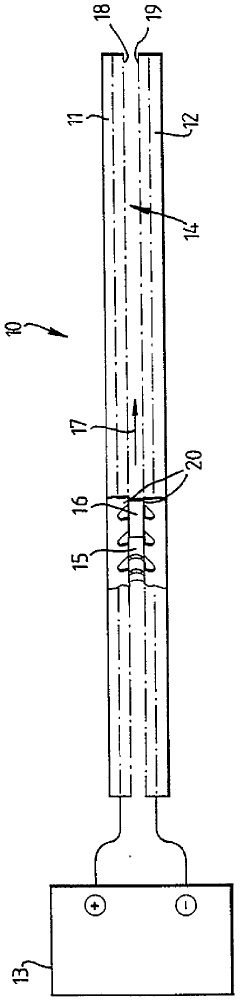
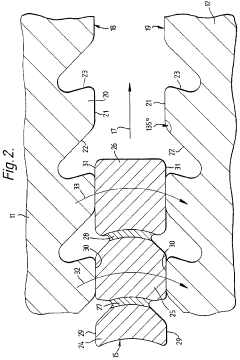
- The rail gun assembly features elongate co-extensive rail electrodes with regular toothed cross-sections and an armature composed of three electrically conductive portions, which makes and breaks contact with sequential pairs of tooth faces, distributing the current path and reducing overheating by ensuring each portion is only exposed to maximum current for a short period.
Materials Science Advancements for Rail Guns
The field of materials science has played a crucial role in advancing rail gun technology, particularly in addressing the challenges associated with electromagnetic potential variability. Recent advancements in materials have focused on improving the durability, conductivity, and thermal management of rail gun components, leading to enhanced performance and reliability.
One of the primary areas of focus has been the development of novel rail materials. Traditional copper rails, while highly conductive, suffer from rapid wear and erosion due to the extreme conditions during firing. Researchers have explored composite materials that combine the conductivity of copper with the strength and wear resistance of other metals or ceramics. For instance, copper-tungsten alloys have shown promise in maintaining conductivity while significantly improving wear resistance.
Another critical advancement has been in the field of insulation materials. The high voltages and currents involved in rail gun operation require exceptional insulation to prevent arcing and maintain electromagnetic integrity. New ceramic composites and advanced polymers have been developed that offer superior dielectric strength and thermal stability compared to traditional insulators. These materials help mitigate the risk of breakdown and contribute to more consistent electromagnetic potential distribution along the rails.
Thermal management has also seen significant improvements through materials science. The intense heat generated during rail gun operation can lead to thermal expansion and distortion, affecting the electromagnetic potential distribution. Advanced heat-resistant coatings and thermal barrier materials have been developed to protect critical components and maintain dimensional stability. Additionally, novel heat sink designs incorporating high thermal conductivity materials like graphene or carbon nanotubes have shown potential in rapidly dissipating heat from critical areas.
Surface engineering techniques have been employed to enhance the interface between the projectile and the rails. Nano-structured coatings and surface treatments have been developed to reduce friction and wear while maintaining optimal electrical contact. These advancements contribute to more consistent electromagnetic potential distribution and reduced variability in projectile acceleration.
Lastly, progress in superconducting materials has opened new possibilities for rail gun design. While still in the experimental stage, the use of high-temperature superconductors for rail construction could potentially revolutionize the field by dramatically reducing resistive losses and improving overall efficiency. This could lead to more stable and predictable electromagnetic potential distributions, addressing one of the key challenges in rail gun technology.
One of the primary areas of focus has been the development of novel rail materials. Traditional copper rails, while highly conductive, suffer from rapid wear and erosion due to the extreme conditions during firing. Researchers have explored composite materials that combine the conductivity of copper with the strength and wear resistance of other metals or ceramics. For instance, copper-tungsten alloys have shown promise in maintaining conductivity while significantly improving wear resistance.
Another critical advancement has been in the field of insulation materials. The high voltages and currents involved in rail gun operation require exceptional insulation to prevent arcing and maintain electromagnetic integrity. New ceramic composites and advanced polymers have been developed that offer superior dielectric strength and thermal stability compared to traditional insulators. These materials help mitigate the risk of breakdown and contribute to more consistent electromagnetic potential distribution along the rails.
Thermal management has also seen significant improvements through materials science. The intense heat generated during rail gun operation can lead to thermal expansion and distortion, affecting the electromagnetic potential distribution. Advanced heat-resistant coatings and thermal barrier materials have been developed to protect critical components and maintain dimensional stability. Additionally, novel heat sink designs incorporating high thermal conductivity materials like graphene or carbon nanotubes have shown potential in rapidly dissipating heat from critical areas.
Surface engineering techniques have been employed to enhance the interface between the projectile and the rails. Nano-structured coatings and surface treatments have been developed to reduce friction and wear while maintaining optimal electrical contact. These advancements contribute to more consistent electromagnetic potential distribution and reduced variability in projectile acceleration.
Lastly, progress in superconducting materials has opened new possibilities for rail gun design. While still in the experimental stage, the use of high-temperature superconductors for rail construction could potentially revolutionize the field by dramatically reducing resistive losses and improving overall efficiency. This could lead to more stable and predictable electromagnetic potential distributions, addressing one of the key challenges in rail gun technology.
Environmental Impact of Rail Gun Technology
The environmental impact of rail gun technology is a critical consideration as this advanced weaponry system continues to evolve. Rail guns, which use electromagnetic forces to launch projectiles at extremely high velocities, have the potential to significantly affect the surrounding environment in various ways.
One of the primary environmental concerns associated with rail gun technology is the intense electromagnetic fields generated during operation. These fields can potentially interfere with local ecosystems, affecting wildlife behavior and migration patterns. Additionally, the strong electromagnetic pulses may disrupt nearby electronic systems, potentially impacting civilian infrastructure and communication networks.
The high-velocity projectiles fired by rail guns also pose environmental risks. Upon impact, these projectiles can create substantial shock waves and generate significant amounts of heat and debris. This can lead to localized soil and air pollution, as well as potential damage to vegetation and wildlife habitats in the target area. Furthermore, the extreme velocities achieved by rail gun projectiles may contribute to increased atmospheric friction, potentially affecting local weather patterns and air quality.
Noise pollution is another significant environmental factor to consider. The operation of rail guns produces intense acoustic waves that can travel long distances, potentially disturbing both human populations and wildlife in surrounding areas. This noise pollution may have long-term effects on animal communication and breeding patterns, particularly in sensitive ecosystems.
The manufacturing and maintenance of rail gun systems also have environmental implications. The production of specialized materials and components required for rail guns may involve energy-intensive processes and the use of rare or potentially hazardous materials. Proper disposal and recycling of these components at the end of their lifecycle present additional environmental challenges.
However, it is important to note that rail gun technology may also offer some environmental benefits compared to traditional artillery systems. The absence of chemical propellants in rail guns reduces the release of harmful combustion byproducts into the atmosphere. Additionally, the increased accuracy and range of rail guns may lead to reduced collateral damage and fewer overall munitions used in military operations, potentially minimizing the environmental footprint of armed conflicts.
As research and development in rail gun technology progress, it is crucial to conduct comprehensive environmental impact assessments. These studies should focus on both short-term and long-term effects, considering factors such as electromagnetic radiation, acoustic disturbances, and potential habitat disruption. Mitigation strategies and environmental safeguards should be developed and implemented alongside technological advancements to ensure responsible deployment and operation of rail gun systems.
One of the primary environmental concerns associated with rail gun technology is the intense electromagnetic fields generated during operation. These fields can potentially interfere with local ecosystems, affecting wildlife behavior and migration patterns. Additionally, the strong electromagnetic pulses may disrupt nearby electronic systems, potentially impacting civilian infrastructure and communication networks.
The high-velocity projectiles fired by rail guns also pose environmental risks. Upon impact, these projectiles can create substantial shock waves and generate significant amounts of heat and debris. This can lead to localized soil and air pollution, as well as potential damage to vegetation and wildlife habitats in the target area. Furthermore, the extreme velocities achieved by rail gun projectiles may contribute to increased atmospheric friction, potentially affecting local weather patterns and air quality.
Noise pollution is another significant environmental factor to consider. The operation of rail guns produces intense acoustic waves that can travel long distances, potentially disturbing both human populations and wildlife in surrounding areas. This noise pollution may have long-term effects on animal communication and breeding patterns, particularly in sensitive ecosystems.
The manufacturing and maintenance of rail gun systems also have environmental implications. The production of specialized materials and components required for rail guns may involve energy-intensive processes and the use of rare or potentially hazardous materials. Proper disposal and recycling of these components at the end of their lifecycle present additional environmental challenges.
However, it is important to note that rail gun technology may also offer some environmental benefits compared to traditional artillery systems. The absence of chemical propellants in rail guns reduces the release of harmful combustion byproducts into the atmosphere. Additionally, the increased accuracy and range of rail guns may lead to reduced collateral damage and fewer overall munitions used in military operations, potentially minimizing the environmental footprint of armed conflicts.
As research and development in rail gun technology progress, it is crucial to conduct comprehensive environmental impact assessments. These studies should focus on both short-term and long-term effects, considering factors such as electromagnetic radiation, acoustic disturbances, and potential habitat disruption. Mitigation strategies and environmental safeguards should be developed and implemented alongside technological advancements to ensure responsible deployment and operation of rail gun systems.
Unlock deeper insights with PatSnap Eureka Quick Research — get a full tech report to explore trends and direct your research. Try now!
Generate Your Research Report Instantly with AI Agent
Supercharge your innovation with PatSnap Eureka AI Agent Platform!