

Scramjet Uplift Effects on Aerodynamic Performance Metrics
AUG 13, 20259 MIN READ
Generate Your Research Report Instantly with AI Agent
PatSnap Eureka helps you evaluate technical feasibility & market potential.
Scramjet Technology Evolution and Objectives
Scramjet technology has undergone significant evolution since its inception in the 1950s. Initially conceptualized as a means to achieve hypersonic flight, scramjets have progressed from theoretical designs to practical demonstrations. The primary objective of scramjet development has been to create an efficient propulsion system capable of operating at hypersonic speeds, typically above Mach 5.
Early research focused on understanding the fundamental principles of supersonic combustion and developing materials capable of withstanding extreme temperatures. The 1960s and 1970s saw increased interest in scramjet technology, with NASA and other aerospace agencies conducting ground-based experiments and computational studies. The 1980s marked a turning point with the first successful scramjet engine tests, albeit in short-duration wind tunnels.
The 1990s and early 2000s witnessed significant advancements in scramjet technology, including the development of more sophisticated computational fluid dynamics models and improved experimental techniques. Notable milestones include NASA's Hyper-X program, which culminated in the successful flight of the X-43A scramjet-powered vehicle in 2004, achieving a record-breaking speed of Mach 9.6.
Recent years have seen a renewed focus on scramjet technology, driven by both military and commercial interests. The objectives have expanded beyond achieving hypersonic flight to include enhancing fuel efficiency, improving engine durability, and developing practical applications for both aerospace and defense sectors.
Current research aims to address key challenges in scramjet technology, such as thermal management, fuel injection and mixing, and combustion stability at various flight conditions. There is also a growing emphasis on integrating scramjet propulsion with other systems to create more versatile and efficient vehicles.
The evolution of scramjet technology has led to the emergence of new objectives, including the development of reusable hypersonic vehicles, long-duration hypersonic cruise missiles, and even hypersonic passenger aircraft for rapid global transportation. Researchers are also exploring the potential of scramjets for space access, aiming to reduce the cost and complexity of reaching orbit.
As the field progresses, there is an increasing focus on understanding and optimizing the aerodynamic performance of scramjet-powered vehicles. This includes investigating the complex interactions between the vehicle's external aerodynamics and the internal flow of the scramjet engine. The study of uplift effects on aerodynamic performance metrics has become a crucial aspect of this research, as it directly impacts the overall efficiency and effectiveness of scramjet-powered systems.
Early research focused on understanding the fundamental principles of supersonic combustion and developing materials capable of withstanding extreme temperatures. The 1960s and 1970s saw increased interest in scramjet technology, with NASA and other aerospace agencies conducting ground-based experiments and computational studies. The 1980s marked a turning point with the first successful scramjet engine tests, albeit in short-duration wind tunnels.
The 1990s and early 2000s witnessed significant advancements in scramjet technology, including the development of more sophisticated computational fluid dynamics models and improved experimental techniques. Notable milestones include NASA's Hyper-X program, which culminated in the successful flight of the X-43A scramjet-powered vehicle in 2004, achieving a record-breaking speed of Mach 9.6.
Recent years have seen a renewed focus on scramjet technology, driven by both military and commercial interests. The objectives have expanded beyond achieving hypersonic flight to include enhancing fuel efficiency, improving engine durability, and developing practical applications for both aerospace and defense sectors.
Current research aims to address key challenges in scramjet technology, such as thermal management, fuel injection and mixing, and combustion stability at various flight conditions. There is also a growing emphasis on integrating scramjet propulsion with other systems to create more versatile and efficient vehicles.
The evolution of scramjet technology has led to the emergence of new objectives, including the development of reusable hypersonic vehicles, long-duration hypersonic cruise missiles, and even hypersonic passenger aircraft for rapid global transportation. Researchers are also exploring the potential of scramjets for space access, aiming to reduce the cost and complexity of reaching orbit.
As the field progresses, there is an increasing focus on understanding and optimizing the aerodynamic performance of scramjet-powered vehicles. This includes investigating the complex interactions between the vehicle's external aerodynamics and the internal flow of the scramjet engine. The study of uplift effects on aerodynamic performance metrics has become a crucial aspect of this research, as it directly impacts the overall efficiency and effectiveness of scramjet-powered systems.
Market Demand for Hypersonic Propulsion Systems
The market demand for hypersonic propulsion systems, particularly scramjet technology, has been steadily increasing in recent years. This growth is driven by both military and commercial interests in achieving faster and more efficient high-speed flight capabilities. In the defense sector, there is a growing emphasis on developing hypersonic weapons and aircraft to maintain strategic advantages. Major military powers, including the United States, Russia, and China, are investing heavily in hypersonic technology research and development.
Commercial applications for hypersonic propulsion systems are also emerging, with a focus on reducing long-distance travel times for passengers and cargo. Several aerospace companies and startups are exploring the potential of hypersonic transport aircraft that could dramatically cut intercontinental flight durations. This has sparked interest from airlines and logistics companies looking to gain a competitive edge in the global transportation market.
The space industry represents another significant market for hypersonic propulsion systems. As space exploration and commercial space activities expand, there is an increasing need for more efficient and cost-effective launch systems. Scramjet technology offers the potential for reusable launch vehicles and improved access to space, attracting attention from both government space agencies and private space companies.
Market analysts project substantial growth in the hypersonic propulsion systems market over the next decade. Factors contributing to this growth include ongoing technological advancements, increased government funding for hypersonic research, and the potential for dual-use applications in both military and civilian sectors. However, the market faces challenges such as high development costs, technical complexities, and regulatory hurdles.
The demand for scramjet technology specifically is driven by its potential to achieve sustained hypersonic flight within the atmosphere. This capability is crucial for developing long-range hypersonic missiles, high-speed reconnaissance aircraft, and future hypersonic passenger planes. Research into scramjet uplift effects on aerodynamic performance metrics is particularly valuable, as it directly impacts the efficiency and viability of these systems in real-world applications.
As the technology matures, industry experts anticipate a gradual shift from primarily government-funded research to increased private sector involvement. This transition is expected to accelerate commercialization efforts and broaden the potential applications of hypersonic propulsion systems across various industries.
Commercial applications for hypersonic propulsion systems are also emerging, with a focus on reducing long-distance travel times for passengers and cargo. Several aerospace companies and startups are exploring the potential of hypersonic transport aircraft that could dramatically cut intercontinental flight durations. This has sparked interest from airlines and logistics companies looking to gain a competitive edge in the global transportation market.
The space industry represents another significant market for hypersonic propulsion systems. As space exploration and commercial space activities expand, there is an increasing need for more efficient and cost-effective launch systems. Scramjet technology offers the potential for reusable launch vehicles and improved access to space, attracting attention from both government space agencies and private space companies.
Market analysts project substantial growth in the hypersonic propulsion systems market over the next decade. Factors contributing to this growth include ongoing technological advancements, increased government funding for hypersonic research, and the potential for dual-use applications in both military and civilian sectors. However, the market faces challenges such as high development costs, technical complexities, and regulatory hurdles.
The demand for scramjet technology specifically is driven by its potential to achieve sustained hypersonic flight within the atmosphere. This capability is crucial for developing long-range hypersonic missiles, high-speed reconnaissance aircraft, and future hypersonic passenger planes. Research into scramjet uplift effects on aerodynamic performance metrics is particularly valuable, as it directly impacts the efficiency and viability of these systems in real-world applications.
As the technology matures, industry experts anticipate a gradual shift from primarily government-funded research to increased private sector involvement. This transition is expected to accelerate commercialization efforts and broaden the potential applications of hypersonic propulsion systems across various industries.
Current Challenges in Scramjet Uplift Dynamics
Scramjet propulsion systems face several critical challenges in achieving optimal uplift dynamics, which significantly impact their overall aerodynamic performance. One of the primary obstacles is the complex interaction between the scramjet's airframe and the high-speed airflow, particularly at hypersonic velocities. This interaction creates intricate shock wave patterns and boundary layer phenomena that can dramatically affect the vehicle's lift-to-drag ratio and overall stability.
The management of thermal loads poses another substantial challenge. As scramjets operate at extreme speeds, the intense frictional heating can lead to structural integrity issues and affect the vehicle's aerodynamic properties. This thermal management problem is exacerbated by the need for lightweight materials that can withstand these extreme conditions while maintaining the desired aerodynamic shape.
Furthermore, the integration of the propulsion system with the airframe presents unique difficulties. Unlike traditional aircraft, scramjets rely on the forebody to compress incoming air, which then affects the uplift characteristics. Balancing this compression with the need for efficient lift generation remains a complex engineering task, often requiring sophisticated computational fluid dynamics (CFD) simulations and extensive wind tunnel testing.
Another significant challenge lies in controlling the scramjet vehicle across a wide range of Mach numbers. The uplift dynamics change dramatically as the vehicle accelerates from subsonic to hypersonic speeds, necessitating adaptive control systems that can adjust in real-time to maintain optimal performance and stability.
The unpredictable nature of hypersonic flow also contributes to the challenges in scramjet uplift dynamics. At these extreme speeds, even small perturbations in the flow can lead to significant changes in aerodynamic forces, making it difficult to predict and control the vehicle's behavior accurately.
Lastly, the limited availability of high-fidelity experimental data at true flight conditions hinders the development and validation of theoretical models for scramjet uplift effects. Most ground-based facilities cannot fully replicate the conditions experienced during actual hypersonic flight, leading to uncertainties in performance predictions and design optimizations.
Addressing these challenges requires a multidisciplinary approach, combining advanced computational methods, innovative materials science, and cutting-edge experimental techniques. As researchers continue to push the boundaries of hypersonic flight, overcoming these obstacles in scramjet uplift dynamics will be crucial for realizing the full potential of this revolutionary propulsion technology.
The management of thermal loads poses another substantial challenge. As scramjets operate at extreme speeds, the intense frictional heating can lead to structural integrity issues and affect the vehicle's aerodynamic properties. This thermal management problem is exacerbated by the need for lightweight materials that can withstand these extreme conditions while maintaining the desired aerodynamic shape.
Furthermore, the integration of the propulsion system with the airframe presents unique difficulties. Unlike traditional aircraft, scramjets rely on the forebody to compress incoming air, which then affects the uplift characteristics. Balancing this compression with the need for efficient lift generation remains a complex engineering task, often requiring sophisticated computational fluid dynamics (CFD) simulations and extensive wind tunnel testing.
Another significant challenge lies in controlling the scramjet vehicle across a wide range of Mach numbers. The uplift dynamics change dramatically as the vehicle accelerates from subsonic to hypersonic speeds, necessitating adaptive control systems that can adjust in real-time to maintain optimal performance and stability.
The unpredictable nature of hypersonic flow also contributes to the challenges in scramjet uplift dynamics. At these extreme speeds, even small perturbations in the flow can lead to significant changes in aerodynamic forces, making it difficult to predict and control the vehicle's behavior accurately.
Lastly, the limited availability of high-fidelity experimental data at true flight conditions hinders the development and validation of theoretical models for scramjet uplift effects. Most ground-based facilities cannot fully replicate the conditions experienced during actual hypersonic flight, leading to uncertainties in performance predictions and design optimizations.
Addressing these challenges requires a multidisciplinary approach, combining advanced computational methods, innovative materials science, and cutting-edge experimental techniques. As researchers continue to push the boundaries of hypersonic flight, overcoming these obstacles in scramjet uplift dynamics will be crucial for realizing the full potential of this revolutionary propulsion technology.
Existing Uplift Mitigation Strategies
01 Computational fluid dynamics for scramjet performance analysis
Advanced computational fluid dynamics (CFD) techniques are employed to simulate and analyze the complex aerodynamic behavior of scramjets. These simulations help in predicting performance metrics such as thrust, drag, and fuel efficiency under various operating conditions. The CFD models account for supersonic and hypersonic flow regimes, combustion dynamics, and heat transfer, providing valuable insights for optimizing scramjet design and performance.- Computational Fluid Dynamics (CFD) for Scramjet Analysis: CFD techniques are employed to simulate and analyze the complex aerodynamic performance of scramjets. These methods allow for detailed modeling of supersonic combustion, shock waves, and boundary layer interactions, providing crucial insights into scramjet efficiency and thrust generation.
- Performance Metrics and Optimization: Key performance metrics for scramjets include thrust-to-drag ratio, specific impulse, and combustion efficiency. Advanced optimization algorithms are used to fine-tune these parameters, considering factors such as inlet geometry, fuel injection, and nozzle design to maximize overall aerodynamic performance.
- Experimental Testing and Data Analysis: Wind tunnel testing and flight experiments are conducted to gather real-world data on scramjet aerodynamics. Sophisticated data analysis techniques, including machine learning algorithms, are applied to process and interpret the vast amounts of experimental data, enabling more accurate performance predictions and design improvements.
- Thermal Management and Materials: Effective thermal management is crucial for scramjet performance. Advanced materials and cooling systems are developed to withstand the extreme temperatures encountered during hypersonic flight. This includes the use of heat-resistant alloys and innovative cooling techniques to maintain structural integrity and optimize aerodynamic efficiency.
- Integration with Vehicle Systems: Scramjet performance is optimized through integration with other vehicle systems. This includes adaptive control systems, fuel management, and overall vehicle aerodynamics. Simulation and modeling techniques are used to analyze the interactions between the scramjet and other components, ensuring optimal performance across various flight conditions.
02 Experimental testing and measurement of scramjet aerodynamics
Experimental methods are crucial for validating theoretical models and assessing real-world scramjet performance. Wind tunnel testing, flight tests, and specialized instrumentation are used to measure key aerodynamic parameters such as pressure distribution, temperature profiles, and shock wave interactions. These experimental data are essential for refining performance metrics and improving the accuracy of predictive models.Expand Specific Solutions03 Integration of machine learning for performance optimization
Machine learning algorithms are increasingly applied to analyze large datasets from simulations and experiments, identifying patterns and optimizing scramjet performance metrics. These techniques can predict aerodynamic behavior under various conditions, assist in real-time flight control adjustments, and suggest design improvements to enhance overall efficiency and reliability of scramjet propulsion systems.Expand Specific Solutions04 Advanced materials and structures for improved aerodynamic performance
Development of novel materials and structural designs plays a crucial role in enhancing scramjet aerodynamic performance. High-temperature resistant materials, adaptive structures, and innovative cooling systems are employed to withstand extreme conditions while maintaining optimal aerodynamic properties. These advancements contribute to improved thrust-to-drag ratios, reduced heat loads, and extended operational envelopes for scramjet engines.Expand Specific Solutions05 Integration of scramjet performance metrics in flight management systems
Incorporating scramjet performance metrics into comprehensive flight management systems is essential for optimizing overall vehicle performance. This integration involves real-time monitoring and adjustment of engine parameters, fuel flow rates, and flight trajectories based on current aerodynamic conditions. Advanced algorithms process multiple performance indicators to ensure efficient operation across a wide range of flight regimes.Expand Specific Solutions
Key Players in Scramjet Development
The scramjet uplift effects on aerodynamic performance metrics represent a complex and evolving field within aerospace engineering. The industry is in a growth phase, with increasing interest from both commercial and military sectors. Market size is expanding as more countries invest in hypersonic technologies. Technologically, the field is still maturing, with ongoing research to optimize performance and efficiency. Key players like Boeing, Aerojet Rocketdyne, and Northrop Grumman are at the forefront, leveraging their extensive aerospace expertise. Academic institutions such as Georgia Tech and Beihang University are also contributing significantly to advancing the technology through research and development efforts.
The Boeing Co.
Technical Solution: Boeing has developed advanced computational fluid dynamics (CFD) models to analyze scramjet uplift effects on aerodynamic performance. Their approach combines high-fidelity simulations with wind tunnel testing to optimize scramjet integration. Boeing's X-51 Waverider program demonstrated sustained hypersonic flight using a scramjet engine, achieving speeds over Mach 5 for 210 seconds[1]. The company utilizes a multi-disciplinary optimization framework that considers thermal management, propulsion efficiency, and overall vehicle performance. Boeing's latest designs incorporate adaptive inlet geometries to enhance off-design performance across a wide Mach number range[2].
Strengths: Extensive experience in hypersonic vehicle design and testing. Access to advanced computational resources and proprietary CFD codes. Weaknesses: High development costs and long lead times for full-scale prototype testing.
Mitsubishi Heavy Industries, Ltd.
Technical Solution: Mitsubishi Heavy Industries (MHI) has focused on developing scramjet technologies for both space access and hypersonic transportation. Their approach emphasizes integrated vehicle design, considering the mutual interactions between the scramjet engine and airframe aerodynamics. MHI's research includes advanced numerical simulations and ground testing facilities capable of reproducing hypersonic flow conditions. They have investigated novel fuel injection strategies and combustor designs to optimize propulsion efficiency while minimizing adverse effects on vehicle aerodynamics[3]. MHI's latest efforts involve the development of a combined-cycle engine that transitions from turbojet to ramjet to scramjet modes, allowing for efficient operation from takeoff to hypersonic cruise[4].
Strengths: Strong integration of propulsion and aerodynamics expertise. Extensive ground testing capabilities. Weaknesses: Limited flight test experience compared to some competitors. Regulatory challenges for hypersonic vehicle deployment in Japan.
Innovative Aerodynamic Configurations
Energy-Deposition Systems, Equipment and Methods for Modifying and Controlling Shock Waves and Supersonic Flow
PatentActiveUS20150292532A1
Innovation
- The system employs conductive paths along surfaces with energy sources and sensors to assess and control energy discharge, allowing for the modification of shockwaves and fluid flows by depositing energy to start or restart inlets, mitigate blast effects, and manage heat transfer in wind tunnels.
Method for using variable supersonic Mach number air heater utilizing supersonic combustion
PatentInactiveUS7296396B1
Innovation
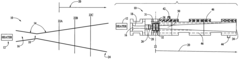
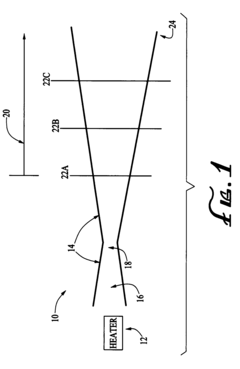
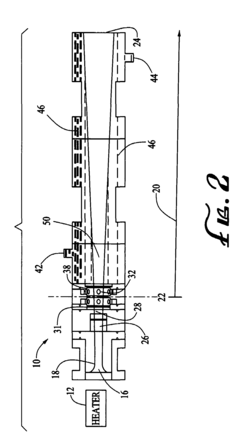
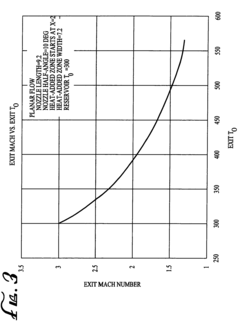
- A supersonic combustion heater apparatus that varies exit plane Mach numbers through strategic fuel injection and flame stabilization in a fixed geometry nozzle, enhancing high enthalpy flow and flame stability without using expensive film cooled nozzles, allowing for mode transition testing in air-breathing propulsion systems.
Materials Science Advancements for Scramjets
Materials science advancements have played a crucial role in the development and performance enhancement of scramjet engines. The extreme operating conditions of scramjets, characterized by high temperatures, pressures, and oxidizing environments, demand materials with exceptional properties. Recent progress in materials science has focused on addressing these challenges through innovative approaches and novel material systems.
One significant area of advancement is in high-temperature alloys and composites. Nickel-based superalloys, traditionally used in gas turbine engines, have been further optimized for scramjet applications. These alloys exhibit improved creep resistance and oxidation resistance at elevated temperatures, crucial for maintaining structural integrity in the combustion chamber and nozzle. Additionally, ceramic matrix composites (CMCs) have emerged as promising candidates for scramjet components. Silicon carbide (SiC) and carbon fiber-reinforced SiC composites offer excellent thermal shock resistance and low density, making them ideal for leading edges and thermal protection systems.
Thermal barrier coatings (TBCs) have also seen significant improvements. Advanced TBCs incorporating rare earth elements and complex oxide structures provide enhanced thermal insulation and durability. These coatings help protect underlying metal structures from extreme temperatures, extending component lifetimes and improving overall engine performance.
Nanomaterials and nanostructured coatings represent another frontier in scramjet materials science. Carbon nanotubes and graphene-based materials are being explored for their exceptional strength-to-weight ratios and thermal properties. When incorporated into composite structures or coatings, these nanomaterials can significantly enhance the mechanical and thermal performance of scramjet components.
Additive manufacturing techniques have revolutionized the fabrication of complex geometries for scramjet engines. 3D printing of high-temperature alloys and ceramics allows for the creation of intricate cooling channels and optimized flow paths, improving heat management and aerodynamic efficiency. This technology also enables rapid prototyping and iterative design improvements, accelerating the development cycle of scramjet engines.
Smart materials and self-healing systems are emerging areas of research with potential applications in scramjets. Shape memory alloys and piezoelectric materials could enable adaptive structures that respond to changing flight conditions. Self-healing materials, incorporating microencapsulated healing agents or vascular networks, offer the potential for in-situ repair of microcracks, extending component lifetimes in the harsh scramjet environment.
One significant area of advancement is in high-temperature alloys and composites. Nickel-based superalloys, traditionally used in gas turbine engines, have been further optimized for scramjet applications. These alloys exhibit improved creep resistance and oxidation resistance at elevated temperatures, crucial for maintaining structural integrity in the combustion chamber and nozzle. Additionally, ceramic matrix composites (CMCs) have emerged as promising candidates for scramjet components. Silicon carbide (SiC) and carbon fiber-reinforced SiC composites offer excellent thermal shock resistance and low density, making them ideal for leading edges and thermal protection systems.
Thermal barrier coatings (TBCs) have also seen significant improvements. Advanced TBCs incorporating rare earth elements and complex oxide structures provide enhanced thermal insulation and durability. These coatings help protect underlying metal structures from extreme temperatures, extending component lifetimes and improving overall engine performance.
Nanomaterials and nanostructured coatings represent another frontier in scramjet materials science. Carbon nanotubes and graphene-based materials are being explored for their exceptional strength-to-weight ratios and thermal properties. When incorporated into composite structures or coatings, these nanomaterials can significantly enhance the mechanical and thermal performance of scramjet components.
Additive manufacturing techniques have revolutionized the fabrication of complex geometries for scramjet engines. 3D printing of high-temperature alloys and ceramics allows for the creation of intricate cooling channels and optimized flow paths, improving heat management and aerodynamic efficiency. This technology also enables rapid prototyping and iterative design improvements, accelerating the development cycle of scramjet engines.
Smart materials and self-healing systems are emerging areas of research with potential applications in scramjets. Shape memory alloys and piezoelectric materials could enable adaptive structures that respond to changing flight conditions. Self-healing materials, incorporating microencapsulated healing agents or vascular networks, offer the potential for in-situ repair of microcracks, extending component lifetimes in the harsh scramjet environment.
Environmental Impact of Hypersonic Flight
The environmental impact of hypersonic flight, particularly in relation to scramjet uplift effects on aerodynamic performance metrics, is a critical consideration in the development and deployment of this advanced technology. Hypersonic flight, characterized by speeds exceeding Mach 5, introduces unique challenges to the Earth's atmosphere and ecosystem.
One of the primary environmental concerns associated with hypersonic flight is the potential for increased ozone depletion. The extreme temperatures generated during hypersonic travel can lead to the formation of nitrogen oxides (NOx) in the upper atmosphere. These compounds are known to catalyze ozone destruction, potentially exacerbating the depletion of the ozone layer, which plays a crucial role in protecting life on Earth from harmful ultraviolet radiation.
Furthermore, the intense heat generated by hypersonic vehicles can contribute to atmospheric heating. This localized heating effect may have implications for weather patterns and climate systems, although the extent of these impacts is still being studied. The high-altitude operation of hypersonic aircraft also raises questions about potential disturbances to the ionosphere, which could affect radio communications and satellite operations.
The sonic boom produced by hypersonic flight presents another environmental challenge. While traditional supersonic aircraft generate sonic booms that can be disruptive to communities on the ground, hypersonic vehicles may produce even more intense shock waves. These powerful sonic booms could have far-reaching effects on marine and terrestrial ecosystems, potentially disrupting wildlife behavior and habitats.
Emissions from hypersonic engines, particularly those using scramjet technology, are another area of environmental concern. While scramjets offer improved efficiency compared to traditional rocket engines, they still produce exhaust gases that can contribute to atmospheric pollution. The composition and quantity of these emissions, especially at high altitudes, require careful study to assess their long-term environmental impact.
Water vapor emissions from hypersonic vehicles operating in the stratosphere pose an additional environmental consideration. These emissions can lead to the formation of artificial clouds, potentially altering the Earth's radiation balance and contributing to climate change effects. The extent of this impact depends on factors such as flight frequency and atmospheric conditions.
As research into hypersonic flight continues, it is crucial to conduct comprehensive environmental impact assessments. These studies should consider not only the immediate effects of individual flights but also the cumulative impact of potential widespread adoption of hypersonic technology. Balancing the technological advancements and strategic advantages of hypersonic flight with environmental stewardship remains a key challenge for researchers and policymakers alike.
One of the primary environmental concerns associated with hypersonic flight is the potential for increased ozone depletion. The extreme temperatures generated during hypersonic travel can lead to the formation of nitrogen oxides (NOx) in the upper atmosphere. These compounds are known to catalyze ozone destruction, potentially exacerbating the depletion of the ozone layer, which plays a crucial role in protecting life on Earth from harmful ultraviolet radiation.
Furthermore, the intense heat generated by hypersonic vehicles can contribute to atmospheric heating. This localized heating effect may have implications for weather patterns and climate systems, although the extent of these impacts is still being studied. The high-altitude operation of hypersonic aircraft also raises questions about potential disturbances to the ionosphere, which could affect radio communications and satellite operations.
The sonic boom produced by hypersonic flight presents another environmental challenge. While traditional supersonic aircraft generate sonic booms that can be disruptive to communities on the ground, hypersonic vehicles may produce even more intense shock waves. These powerful sonic booms could have far-reaching effects on marine and terrestrial ecosystems, potentially disrupting wildlife behavior and habitats.
Emissions from hypersonic engines, particularly those using scramjet technology, are another area of environmental concern. While scramjets offer improved efficiency compared to traditional rocket engines, they still produce exhaust gases that can contribute to atmospheric pollution. The composition and quantity of these emissions, especially at high altitudes, require careful study to assess their long-term environmental impact.
Water vapor emissions from hypersonic vehicles operating in the stratosphere pose an additional environmental consideration. These emissions can lead to the formation of artificial clouds, potentially altering the Earth's radiation balance and contributing to climate change effects. The extent of this impact depends on factors such as flight frequency and atmospheric conditions.
As research into hypersonic flight continues, it is crucial to conduct comprehensive environmental impact assessments. These studies should consider not only the immediate effects of individual flights but also the cumulative impact of potential widespread adoption of hypersonic technology. Balancing the technological advancements and strategic advantages of hypersonic flight with environmental stewardship remains a key challenge for researchers and policymakers alike.
Unlock deeper insights with PatSnap Eureka Quick Research — get a full tech report to explore trends and direct your research. Try now!
Generate Your Research Report Instantly with AI Agent
Supercharge your innovation with PatSnap Eureka AI Agent Platform!