

Tech Development in Iron-Air Storage Systems
APR 27, 20269 MIN READ
Generate Your Research Report Instantly with AI Agent
PatSnap Eureka helps you evaluate technical feasibility & market potential.
Iron-Air Battery Technology Background and Development Goals
Iron-air battery technology represents a revolutionary approach to long-duration energy storage, emerging from decades of research into metal-air electrochemical systems. The fundamental concept leverages the abundant availability of iron and oxygen from ambient air to create a cost-effective, scalable energy storage solution. This technology traces its origins to early metal-air battery research in the 1960s, but has gained significant momentum in recent years due to the urgent need for grid-scale energy storage solutions to support renewable energy integration.
The historical development of iron-air systems has been marked by several key evolutionary phases. Initial research focused on understanding the basic electrochemical reactions between iron and oxygen, identifying the reversible oxidation and reduction processes that enable energy storage and release. Early prototypes faced significant challenges related to cycle life, efficiency, and practical implementation, leading to extensive materials science research and engineering optimization efforts.
Current technological objectives center on achieving commercially viable performance metrics that can compete with existing energy storage technologies. Primary goals include extending cycle life beyond 10,000 cycles while maintaining capacity retention above 80%, improving round-trip efficiency to exceed 60%, and reducing system costs to below $20 per kilowatt-hour. These targets are essential for establishing iron-air batteries as a dominant solution for long-duration energy storage applications.
The technology aims to address critical limitations of current energy storage systems, particularly the high costs and resource constraints associated with lithium-ion batteries for grid-scale applications. Iron-air systems offer the potential for multi-day energy storage capabilities, making them ideal for seasonal energy shifting and grid stabilization. The abundance of iron as a raw material provides significant advantages in terms of supply chain security and cost predictability.
Strategic development goals encompass both technical and commercial milestones. Technical objectives focus on optimizing electrode materials, electrolyte formulations, and system architecture to maximize performance and durability. Commercial goals emphasize manufacturing scalability, cost reduction through economies of scale, and integration with existing grid infrastructure. The ultimate vision involves deploying iron-air battery systems as backbone storage solutions for renewable energy grids, enabling the transition to sustainable energy systems while maintaining grid reliability and economic viability.
The historical development of iron-air systems has been marked by several key evolutionary phases. Initial research focused on understanding the basic electrochemical reactions between iron and oxygen, identifying the reversible oxidation and reduction processes that enable energy storage and release. Early prototypes faced significant challenges related to cycle life, efficiency, and practical implementation, leading to extensive materials science research and engineering optimization efforts.
Current technological objectives center on achieving commercially viable performance metrics that can compete with existing energy storage technologies. Primary goals include extending cycle life beyond 10,000 cycles while maintaining capacity retention above 80%, improving round-trip efficiency to exceed 60%, and reducing system costs to below $20 per kilowatt-hour. These targets are essential for establishing iron-air batteries as a dominant solution for long-duration energy storage applications.
The technology aims to address critical limitations of current energy storage systems, particularly the high costs and resource constraints associated with lithium-ion batteries for grid-scale applications. Iron-air systems offer the potential for multi-day energy storage capabilities, making them ideal for seasonal energy shifting and grid stabilization. The abundance of iron as a raw material provides significant advantages in terms of supply chain security and cost predictability.
Strategic development goals encompass both technical and commercial milestones. Technical objectives focus on optimizing electrode materials, electrolyte formulations, and system architecture to maximize performance and durability. Commercial goals emphasize manufacturing scalability, cost reduction through economies of scale, and integration with existing grid infrastructure. The ultimate vision involves deploying iron-air battery systems as backbone storage solutions for renewable energy grids, enabling the transition to sustainable energy systems while maintaining grid reliability and economic viability.
Market Demand Analysis for Long-Duration Energy Storage
The global energy storage market is experiencing unprecedented growth driven by the accelerating transition to renewable energy sources and the urgent need for grid stability solutions. Long-duration energy storage systems, particularly those capable of storing energy for 8-100 hours, represent a critical gap in current energy infrastructure that iron-air storage systems are uniquely positioned to address.
Traditional lithium-ion batteries, while effective for short-duration applications, become economically prohibitive for extended storage periods due to their high capital costs and limited cycle life. The market demand for cost-effective, long-duration storage solutions has intensified as renewable energy penetration increases globally, creating substantial opportunities for iron-air technology deployment.
Utility-scale applications constitute the primary market segment for iron-air storage systems, where grid operators require reliable backup power during extended periods of low renewable generation. These systems offer particular value in regions with high solar and wind capacity, where seasonal variations and multi-day weather patterns create extended periods of reduced renewable output.
Industrial and commercial sectors represent another significant demand driver, especially for facilities requiring uninterrupted power supply over extended periods. Manufacturing plants, data centers, and critical infrastructure facilities increasingly seek alternatives to diesel generators for backup power, creating substantial market opportunities for clean, long-duration storage technologies.
The economic advantages of iron-air systems become more pronounced in applications requiring storage durations exceeding 10 hours. Market analysis indicates strong demand from microgrid operators, remote communities, and developing regions where grid reliability remains challenging and cost-effective energy storage solutions are essential for economic development.
Regulatory frameworks and government incentives supporting renewable energy integration further amplify market demand. Carbon reduction commitments and renewable portfolio standards create additional pressure for utilities to invest in long-duration storage technologies that can facilitate higher renewable energy penetration while maintaining grid reliability and reducing dependence on fossil fuel peaking plants.
Traditional lithium-ion batteries, while effective for short-duration applications, become economically prohibitive for extended storage periods due to their high capital costs and limited cycle life. The market demand for cost-effective, long-duration storage solutions has intensified as renewable energy penetration increases globally, creating substantial opportunities for iron-air technology deployment.
Utility-scale applications constitute the primary market segment for iron-air storage systems, where grid operators require reliable backup power during extended periods of low renewable generation. These systems offer particular value in regions with high solar and wind capacity, where seasonal variations and multi-day weather patterns create extended periods of reduced renewable output.
Industrial and commercial sectors represent another significant demand driver, especially for facilities requiring uninterrupted power supply over extended periods. Manufacturing plants, data centers, and critical infrastructure facilities increasingly seek alternatives to diesel generators for backup power, creating substantial market opportunities for clean, long-duration storage technologies.
The economic advantages of iron-air systems become more pronounced in applications requiring storage durations exceeding 10 hours. Market analysis indicates strong demand from microgrid operators, remote communities, and developing regions where grid reliability remains challenging and cost-effective energy storage solutions are essential for economic development.
Regulatory frameworks and government incentives supporting renewable energy integration further amplify market demand. Carbon reduction commitments and renewable portfolio standards create additional pressure for utilities to invest in long-duration storage technologies that can facilitate higher renewable energy penetration while maintaining grid reliability and reducing dependence on fossil fuel peaking plants.
Current Status and Technical Challenges of Iron-Air Systems
Iron-air battery technology has emerged as a promising solution for long-duration energy storage, leveraging the abundance and low cost of iron as the primary active material. Current iron-air systems operate on the principle of reversible oxidation and reduction of iron, where iron is oxidized to iron oxide during discharge and reduced back to metallic iron during charging. The technology has gained significant momentum due to its potential for grid-scale applications, offering theoretical energy densities comparable to lithium-ion systems while utilizing earth-abundant materials.
The present state of iron-air battery development shows considerable progress in laboratory demonstrations, with several companies achieving multi-hour discharge capabilities and reasonable round-trip efficiencies. Leading developers have successfully demonstrated systems capable of 100-hour discharge durations, positioning iron-air technology as a viable candidate for seasonal energy storage applications. Current prototypes typically achieve energy densities ranging from 20-40 Wh/kg at the cell level, with system-level densities reaching 10-20 Wh/kg when accounting for auxiliary components.
Despite promising developments, iron-air systems face several critical technical challenges that limit their commercial viability. The primary obstacle lies in managing the complex electrochemical reactions at both electrodes, particularly the oxygen reduction reaction at the air cathode, which suffers from slow kinetics and requires expensive catalysts. The iron electrode presents its own set of challenges, including capacity fade due to iron particle agglomeration, passivation layer formation, and hydrogen evolution as a parasitic reaction during charging cycles.
Electrolyte management represents another significant hurdle, as iron-air batteries typically employ alkaline electrolytes that can lead to carbonation when exposed to atmospheric CO2, gradually degrading system performance. The bifunctional air electrode must efficiently catalyze both oxygen reduction during discharge and oxygen evolution during charge, requiring sophisticated catalyst materials that maintain stability over thousands of cycles.
System-level challenges include thermal management, as iron-air batteries generate substantial heat during operation, and the need for sophisticated air management systems to ensure consistent oxygen supply while preventing contamination. Cycle life remains a concern, with current systems demonstrating limited durability compared to established battery technologies, primarily due to structural changes in the iron electrode and catalyst degradation at the air cathode.
Manufacturing scalability poses additional challenges, particularly in producing consistent iron electrode morphologies and integrating complex air management systems into cost-effective battery designs. The technology requires further development in standardizing manufacturing processes and establishing supply chains for specialized components such as gas diffusion layers and bifunctional catalysts.
The present state of iron-air battery development shows considerable progress in laboratory demonstrations, with several companies achieving multi-hour discharge capabilities and reasonable round-trip efficiencies. Leading developers have successfully demonstrated systems capable of 100-hour discharge durations, positioning iron-air technology as a viable candidate for seasonal energy storage applications. Current prototypes typically achieve energy densities ranging from 20-40 Wh/kg at the cell level, with system-level densities reaching 10-20 Wh/kg when accounting for auxiliary components.
Despite promising developments, iron-air systems face several critical technical challenges that limit their commercial viability. The primary obstacle lies in managing the complex electrochemical reactions at both electrodes, particularly the oxygen reduction reaction at the air cathode, which suffers from slow kinetics and requires expensive catalysts. The iron electrode presents its own set of challenges, including capacity fade due to iron particle agglomeration, passivation layer formation, and hydrogen evolution as a parasitic reaction during charging cycles.
Electrolyte management represents another significant hurdle, as iron-air batteries typically employ alkaline electrolytes that can lead to carbonation when exposed to atmospheric CO2, gradually degrading system performance. The bifunctional air electrode must efficiently catalyze both oxygen reduction during discharge and oxygen evolution during charge, requiring sophisticated catalyst materials that maintain stability over thousands of cycles.
System-level challenges include thermal management, as iron-air batteries generate substantial heat during operation, and the need for sophisticated air management systems to ensure consistent oxygen supply while preventing contamination. Cycle life remains a concern, with current systems demonstrating limited durability compared to established battery technologies, primarily due to structural changes in the iron electrode and catalyst degradation at the air cathode.
Manufacturing scalability poses additional challenges, particularly in producing consistent iron electrode morphologies and integrating complex air management systems into cost-effective battery designs. The technology requires further development in standardizing manufacturing processes and establishing supply chains for specialized components such as gas diffusion layers and bifunctional catalysts.
Current Iron-Air Battery Technical Solutions
01 Iron-air battery cell design and construction
Iron-air storage systems utilize specialized cell designs that incorporate iron electrodes and air cathodes to enable efficient energy storage and discharge cycles. These systems feature unique cell architectures that optimize the electrochemical reactions between iron and oxygen from ambient air, allowing for scalable energy storage solutions with enhanced performance characteristics.- Iron-air battery cell design and construction: Iron-air storage systems utilize specialized cell designs that incorporate iron electrodes and air cathodes to enable efficient energy storage and discharge cycles. These systems feature unique cell architectures that optimize the electrochemical reactions between iron and oxygen from ambient air, allowing for scalable energy storage solutions with high energy density capabilities.
- Electrolyte formulations and compositions: The electrolyte systems in iron-air batteries require specific chemical compositions to facilitate proper ion transport and maintain stable electrochemical performance. These formulations are designed to prevent corrosion, enhance conductivity, and ensure long-term stability of the storage system while maintaining optimal pH levels for efficient iron oxidation and reduction reactions.
- Air management and oxygen supply systems: Iron-air storage systems incorporate sophisticated air management technologies to control oxygen flow and maintain optimal atmospheric conditions within the battery cells. These systems include air filtration, humidity control, and pressure regulation mechanisms that ensure consistent oxygen availability for the electrochemical reactions while preventing contamination and maintaining system efficiency.
- Iron electrode materials and processing: The iron electrodes in these storage systems utilize specially processed iron materials with enhanced surface properties and optimized particle sizes to maximize electrochemical activity. These electrodes are engineered to provide high capacity, improved cycling stability, and reduced degradation over extended charge-discharge cycles, incorporating various iron alloys and surface treatments.
- System integration and control mechanisms: Iron-air storage systems require sophisticated control and monitoring systems to manage charging and discharging cycles, temperature regulation, and overall system performance. These integration technologies include power management circuits, thermal control systems, and automated monitoring capabilities that ensure safe and efficient operation while maximizing system lifespan and energy output.
02 Electrolyte formulations and compositions
The electrolyte systems in iron-air batteries require specific chemical compositions to facilitate proper ion transport and maintain stable electrochemical performance. These formulations are designed to prevent corrosion, enhance conductivity, and ensure long-term stability of the storage system while maintaining optimal pH levels for efficient iron oxidation and reduction reactions.Expand Specific Solutions03 Air management and oxygen supply systems
Effective air management is crucial for iron-air storage systems, requiring sophisticated mechanisms to control oxygen flow, humidity, and air quality. These systems incorporate filtration, flow control, and atmospheric interface components that ensure consistent oxygen availability while preventing contamination and maintaining optimal operating conditions for the electrochemical processes.Expand Specific Solutions04 Iron electrode materials and processing
The iron electrodes in these storage systems require specific material compositions, surface treatments, and manufacturing processes to achieve optimal performance. These developments focus on enhancing the reversibility of iron oxidation-reduction reactions, improving electrode durability, and maximizing energy density through advanced material engineering and processing techniques.Expand Specific Solutions05 System integration and control mechanisms
Iron-air storage systems require sophisticated control and monitoring systems to manage charging and discharging cycles, temperature regulation, and overall system performance. These integration approaches include power management circuits, safety systems, and automated control mechanisms that optimize energy conversion efficiency and ensure reliable long-term operation of the storage infrastructure.Expand Specific Solutions
Major Players in Iron-Air Energy Storage Industry
The iron-air storage systems technology is in its early commercialization stage, representing an emerging segment within the broader energy storage market valued at approximately $120 billion globally. The competitive landscape features a mix of established energy giants and innovative startups, with technology maturity varying significantly across players. Form Energy leads as a specialized iron-air battery developer, while traditional energy companies like State Grid Corp. of China, China National Petroleum Corp., and China Petroleum & Chemical Corp. leverage their infrastructure expertise. Research institutions including Xi'an Jiaotong University and Global Energy Interconnection Research Institute contribute foundational R&D. Industrial players such as Air Liquide SA and Hitachi Ltd. provide complementary technologies and manufacturing capabilities. The technology remains in pilot and demonstration phases, with most companies still developing scalable commercial solutions, indicating significant growth potential but requiring substantial investment in manufacturing scale-up and cost reduction.
Form Energy, Inc.
Technical Solution: Form Energy has developed a revolutionary iron-air battery technology that uses iron pellets as the anode material and oxygen from ambient air as the cathode. Their system operates through a reversible rusting process where iron oxidizes during discharge and reduces back to metallic iron during charging. The technology offers multi-day energy storage capability with costs projected at less than $20/kWh, significantly lower than lithium-ion alternatives. Their batteries can provide 100+ hours of continuous discharge, making them ideal for seasonal energy storage and grid stabilization applications.
Strengths: Ultra-low cost, abundant raw materials, long duration storage capability, environmentally safe. Weaknesses: Lower round-trip efficiency compared to lithium-ion, slower response times, requires larger physical footprint.
Rondo Energy, Inc.
Technical Solution: Rondo Energy focuses on thermal energy storage systems that complement iron-air technologies for industrial applications. Their approach involves storing renewable energy as high-temperature heat in specialized materials, which can then be converted back to electricity or used directly for industrial processes. The system integrates with iron-air storage to provide comprehensive energy solutions for heavy industry, offering temperatures up to 1500°C for cement, steel, and chemical production. This hybrid approach maximizes the utilization of renewable energy in industrial settings where direct electrification is challenging.
Strengths: High-temperature capability, industrial process integration, cost-effective for large-scale applications. Weaknesses: Limited to specific industrial use cases, requires significant infrastructure investment, thermal losses over time.
Core Patent Analysis in Iron-Air Storage Innovation
Electrolyte for iron-air batteries and iron-air battery
PatentActiveUS10044082B2
Innovation
- An electrolyte solution containing discharge reaction promoters such as SCN−, S2O32−, or (CH3)2NCSS− anions, along with cations like Li+, K+, Na+, Rb+, Cs+, and Fr+, specifically Na2S2O3, is used to stabilize the discharge capacity without the need for precise concentration control, inhibiting re-passivation and promoting iron dissolution.
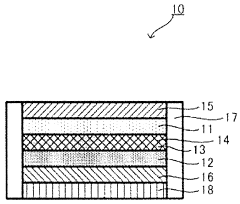
Electrode configurations for iron-air electrochemical systems
PatentWO2024081792A1
Innovation
- The design incorporates an iron electrode with a plurality of channels and an interdigitated oxygen evolution reaction electrode, where at least a portion of the oxygen evolution reaction electrode is disposed within the channels perpendicular to the oxygen reduction reaction electrode, optimizing ionic transport and electrical contact.


Grid Integration Standards for Iron-Air Storage
The integration of iron-air storage systems into existing electrical grids requires comprehensive standardization frameworks that address both technical specifications and operational protocols. Current grid integration standards are evolving to accommodate the unique characteristics of iron-air batteries, including their extended discharge duration capabilities and specific voltage regulation requirements. The IEEE 1547 series provides foundational guidelines for distributed energy resource interconnection, while emerging standards specifically target long-duration energy storage systems like iron-air technology.
Interconnection requirements for iron-air storage systems focus on power quality standards, including harmonic distortion limits, voltage regulation capabilities, and frequency response characteristics. These systems must comply with UL 9540 safety standards for energy storage installations and demonstrate adherence to grid codes that vary by regional transmission operators. The extended discharge capabilities of iron-air systems, typically ranging from 10 to 100 hours, necessitate specialized grid integration protocols that differ significantly from conventional lithium-ion battery standards.
Communication protocols represent a critical component of grid integration standards, with IEC 61850 serving as the primary framework for substation automation and smart grid communications. Iron-air storage systems require robust data exchange capabilities to coordinate with grid operators, enabling real-time monitoring of state-of-charge, power output, and system health parameters. Advanced metering infrastructure integration ensures accurate billing and grid services compensation for iron-air installations.
Safety and protection standards encompass fire suppression systems, electrical isolation requirements, and emergency shutdown procedures specific to iron-air chemistry. The non-flammable nature of iron-air systems simplifies certain safety requirements compared to lithium-ion alternatives, potentially reducing installation costs and regulatory complexity. Environmental compliance standards address the recyclable iron-based materials and minimal toxic waste generation associated with iron-air technology.
Grid services standardization enables iron-air systems to participate in ancillary service markets, including frequency regulation, voltage support, and capacity reserves. The predictable degradation characteristics and cycle life of iron-air batteries facilitate standardized performance guarantees and grid reliability calculations, supporting utility-scale deployment and investment decisions.
Interconnection requirements for iron-air storage systems focus on power quality standards, including harmonic distortion limits, voltage regulation capabilities, and frequency response characteristics. These systems must comply with UL 9540 safety standards for energy storage installations and demonstrate adherence to grid codes that vary by regional transmission operators. The extended discharge capabilities of iron-air systems, typically ranging from 10 to 100 hours, necessitate specialized grid integration protocols that differ significantly from conventional lithium-ion battery standards.
Communication protocols represent a critical component of grid integration standards, with IEC 61850 serving as the primary framework for substation automation and smart grid communications. Iron-air storage systems require robust data exchange capabilities to coordinate with grid operators, enabling real-time monitoring of state-of-charge, power output, and system health parameters. Advanced metering infrastructure integration ensures accurate billing and grid services compensation for iron-air installations.
Safety and protection standards encompass fire suppression systems, electrical isolation requirements, and emergency shutdown procedures specific to iron-air chemistry. The non-flammable nature of iron-air systems simplifies certain safety requirements compared to lithium-ion alternatives, potentially reducing installation costs and regulatory complexity. Environmental compliance standards address the recyclable iron-based materials and minimal toxic waste generation associated with iron-air technology.
Grid services standardization enables iron-air systems to participate in ancillary service markets, including frequency regulation, voltage support, and capacity reserves. The predictable degradation characteristics and cycle life of iron-air batteries facilitate standardized performance guarantees and grid reliability calculations, supporting utility-scale deployment and investment decisions.
Environmental Impact Assessment of Iron-Air Technologies
Iron-air battery technologies represent a significant advancement in sustainable energy storage, offering substantial environmental benefits compared to conventional battery systems. These technologies utilize abundant iron and oxygen from ambient air, eliminating the need for rare earth elements or toxic materials commonly found in lithium-ion batteries. The fundamental electrochemical processes involve iron oxidation and reduction cycles, producing only rust and water as byproducts, which are environmentally benign and pose minimal ecological risks.
Life cycle assessments of iron-air storage systems demonstrate remarkably low carbon footprints throughout their operational lifespan. The manufacturing process requires significantly less energy-intensive mining operations, as iron ore is widely available and easily extractable. Unlike lithium extraction, which often involves environmentally destructive brine evaporation or hard rock mining, iron sourcing presents minimal habitat disruption and water contamination risks.
The recyclability profile of iron-air batteries substantially exceeds that of traditional energy storage technologies. Iron components can be recycled indefinitely without performance degradation, while the air cathode materials are largely reusable. End-of-life disposal presents minimal environmental challenges, as iron naturally oxidizes and integrates harmlessly into soil systems. This contrasts sharply with lithium-ion batteries, which require specialized recycling facilities and generate hazardous waste streams.
Operational environmental impacts remain consistently low throughout the technology's lifespan. Iron-air systems produce no toxic emissions during charge-discharge cycles, eliminating concerns about air quality degradation or groundwater contamination. The absence of flammable electrolytes reduces fire risks and associated environmental damage potential. Additionally, these systems operate effectively across wider temperature ranges, reducing energy requirements for thermal management systems.
Regional environmental assessments indicate that iron-air battery deployment can significantly reduce local pollution levels, particularly in areas heavily dependent on fossil fuel-based grid storage. The technology's scalability enables large-scale renewable energy integration without introducing new environmental stressors, supporting broader decarbonization objectives while maintaining ecological integrity across diverse geographical regions.
Life cycle assessments of iron-air storage systems demonstrate remarkably low carbon footprints throughout their operational lifespan. The manufacturing process requires significantly less energy-intensive mining operations, as iron ore is widely available and easily extractable. Unlike lithium extraction, which often involves environmentally destructive brine evaporation or hard rock mining, iron sourcing presents minimal habitat disruption and water contamination risks.
The recyclability profile of iron-air batteries substantially exceeds that of traditional energy storage technologies. Iron components can be recycled indefinitely without performance degradation, while the air cathode materials are largely reusable. End-of-life disposal presents minimal environmental challenges, as iron naturally oxidizes and integrates harmlessly into soil systems. This contrasts sharply with lithium-ion batteries, which require specialized recycling facilities and generate hazardous waste streams.
Operational environmental impacts remain consistently low throughout the technology's lifespan. Iron-air systems produce no toxic emissions during charge-discharge cycles, eliminating concerns about air quality degradation or groundwater contamination. The absence of flammable electrolytes reduces fire risks and associated environmental damage potential. Additionally, these systems operate effectively across wider temperature ranges, reducing energy requirements for thermal management systems.
Regional environmental assessments indicate that iron-air battery deployment can significantly reduce local pollution levels, particularly in areas heavily dependent on fossil fuel-based grid storage. The technology's scalability enables large-scale renewable energy integration without introducing new environmental stressors, supporting broader decarbonization objectives while maintaining ecological integrity across diverse geographical regions.
Unlock deeper insights with PatSnap Eureka Quick Research — get a full tech report to explore trends and direct your research. Try now!
Generate Your Research Report Instantly with AI Agent
Supercharge your innovation with PatSnap Eureka AI Agent Platform!