
Underfill vs Conformal Coating: Impact on Electronic Reliability
APR 7, 20269 MIN READ
Generate Your Research Report Instantly with AI Agent
Patsnap Eureka helps you evaluate technical feasibility & market potential.
Underfill and Conformal Coating Technology Background and Goals
Electronic packaging technologies have evolved significantly over the past several decades, driven by the relentless miniaturization of electronic components and the increasing demand for higher performance in harsh operating environments. As semiconductor devices continue to shrink while simultaneously increasing in complexity and power density, the protection and reliability of these components have become paramount concerns for manufacturers across industries ranging from consumer electronics to aerospace applications.
The development of protective coating technologies emerged as a critical response to the challenges posed by environmental stressors, mechanical forces, and thermal cycling that can compromise electronic system integrity. Two primary approaches have dominated this field: underfill materials and conformal coatings, each representing distinct philosophical approaches to component protection with unique advantages and limitations.
Underfill technology originated in the 1990s as a solution to address the mechanical stress concentration issues inherent in flip-chip and ball grid array packaging. This approach involves dispensing liquid polymer materials beneath components to create a solid mechanical bond between the component and substrate, effectively redistributing stress across a larger area and preventing solder joint fatigue failures.
Conformal coating technology, conversely, focuses on creating a thin protective barrier over entire circuit assemblies. This approach provides environmental protection against moisture, chemicals, temperature extremes, and physical contaminants while maintaining electrical insulation properties. The coating conformally follows the contours of components and circuit traces, creating a uniform protective layer.
The primary technical objectives driving research in both technologies center on enhancing long-term reliability while maintaining manufacturing feasibility and cost-effectiveness. Key goals include improving thermal cycling performance, reducing moisture sensitivity, enhancing mechanical shock resistance, and extending operational lifespan under various environmental conditions.
Current industry trends indicate a growing need for hybrid approaches that combine the benefits of both technologies, particularly as electronic systems face increasingly demanding applications in automotive, medical, and industrial sectors. The challenge lies in optimizing material properties, application processes, and design methodologies to achieve maximum reliability benefits while minimizing manufacturing complexity and associated costs.
The development of protective coating technologies emerged as a critical response to the challenges posed by environmental stressors, mechanical forces, and thermal cycling that can compromise electronic system integrity. Two primary approaches have dominated this field: underfill materials and conformal coatings, each representing distinct philosophical approaches to component protection with unique advantages and limitations.
Underfill technology originated in the 1990s as a solution to address the mechanical stress concentration issues inherent in flip-chip and ball grid array packaging. This approach involves dispensing liquid polymer materials beneath components to create a solid mechanical bond between the component and substrate, effectively redistributing stress across a larger area and preventing solder joint fatigue failures.
Conformal coating technology, conversely, focuses on creating a thin protective barrier over entire circuit assemblies. This approach provides environmental protection against moisture, chemicals, temperature extremes, and physical contaminants while maintaining electrical insulation properties. The coating conformally follows the contours of components and circuit traces, creating a uniform protective layer.
The primary technical objectives driving research in both technologies center on enhancing long-term reliability while maintaining manufacturing feasibility and cost-effectiveness. Key goals include improving thermal cycling performance, reducing moisture sensitivity, enhancing mechanical shock resistance, and extending operational lifespan under various environmental conditions.
Current industry trends indicate a growing need for hybrid approaches that combine the benefits of both technologies, particularly as electronic systems face increasingly demanding applications in automotive, medical, and industrial sectors. The challenge lies in optimizing material properties, application processes, and design methodologies to achieve maximum reliability benefits while minimizing manufacturing complexity and associated costs.
Market Demand for Electronic Protection Solutions
The global electronics industry faces mounting pressure to enhance product reliability and longevity, driving substantial demand for advanced electronic protection solutions. As electronic devices become increasingly miniaturized and complex, manufacturers require sophisticated protection methods to safeguard critical components against environmental hazards, mechanical stress, and chemical degradation. This demand spans across multiple sectors including automotive electronics, consumer devices, aerospace systems, and industrial equipment.
Automotive electronics represents one of the fastest-growing segments for electronic protection solutions. Modern vehicles contain hundreds of electronic control units operating in harsh environments with extreme temperatures, vibrations, and moisture exposure. The transition toward electric vehicles and autonomous driving systems further intensifies the need for reliable protection methods, as component failures can have safety-critical implications. Manufacturers increasingly seek protection solutions that can withstand automotive qualification standards while maintaining long-term performance.
Consumer electronics markets drive demand for protection solutions that balance performance with cost-effectiveness. Smartphones, tablets, and wearable devices require protection methods that accommodate tight form factors while ensuring reliability throughout product lifecycles. The trend toward thinner devices and higher component density creates challenges that traditional protection methods struggle to address, spurring innovation in material formulations and application techniques.
Industrial and aerospace applications demand the highest levels of protection performance, often requiring solutions that can operate reliably for decades under extreme conditions. These markets prioritize long-term reliability over cost considerations, creating opportunities for premium protection solutions with enhanced performance characteristics. The growing adoption of Internet of Things devices in industrial settings expands the addressable market for electronic protection technologies.
The semiconductor packaging industry represents a critical demand driver, as advanced packaging technologies require increasingly sophisticated protection approaches. Flip-chip assemblies, system-in-package configurations, and three-dimensional integrated circuits present unique protection challenges that conventional methods cannot adequately address. This creates substantial market opportunities for innovative protection solutions that can accommodate complex geometries and thermal requirements.
Market demand increasingly favors protection solutions offering environmental sustainability benefits. Manufacturers seek alternatives to traditional materials that may contain hazardous substances or create disposal challenges. This trend drives development of bio-based formulations and recyclable protection materials, creating new market segments focused on sustainable electronics manufacturing practices.
Automotive electronics represents one of the fastest-growing segments for electronic protection solutions. Modern vehicles contain hundreds of electronic control units operating in harsh environments with extreme temperatures, vibrations, and moisture exposure. The transition toward electric vehicles and autonomous driving systems further intensifies the need for reliable protection methods, as component failures can have safety-critical implications. Manufacturers increasingly seek protection solutions that can withstand automotive qualification standards while maintaining long-term performance.
Consumer electronics markets drive demand for protection solutions that balance performance with cost-effectiveness. Smartphones, tablets, and wearable devices require protection methods that accommodate tight form factors while ensuring reliability throughout product lifecycles. The trend toward thinner devices and higher component density creates challenges that traditional protection methods struggle to address, spurring innovation in material formulations and application techniques.
Industrial and aerospace applications demand the highest levels of protection performance, often requiring solutions that can operate reliably for decades under extreme conditions. These markets prioritize long-term reliability over cost considerations, creating opportunities for premium protection solutions with enhanced performance characteristics. The growing adoption of Internet of Things devices in industrial settings expands the addressable market for electronic protection technologies.
The semiconductor packaging industry represents a critical demand driver, as advanced packaging technologies require increasingly sophisticated protection approaches. Flip-chip assemblies, system-in-package configurations, and three-dimensional integrated circuits present unique protection challenges that conventional methods cannot adequately address. This creates substantial market opportunities for innovative protection solutions that can accommodate complex geometries and thermal requirements.
Market demand increasingly favors protection solutions offering environmental sustainability benefits. Manufacturers seek alternatives to traditional materials that may contain hazardous substances or create disposal challenges. This trend drives development of bio-based formulations and recyclable protection materials, creating new market segments focused on sustainable electronics manufacturing practices.
Current State and Challenges in Electronic Reliability Protection
The electronic reliability protection landscape currently faces significant challenges as device miniaturization and performance demands continue to escalate. Modern electronic assemblies operate under increasingly harsh environmental conditions while requiring enhanced durability and longevity. Traditional protection methods are being pushed to their limits, necessitating more sophisticated approaches to safeguard critical components and interconnections.
Underfill technology has emerged as a dominant solution for flip-chip and ball grid array (BGA) applications, providing mechanical reinforcement and stress distribution. Current underfill materials primarily consist of epoxy-based formulations with silica fillers, offering coefficient of thermal expansion (CTE) matching between silicon dies and organic substrates. However, the technology faces processing challenges including long cure times, void formation, and limited reworkability. Flow characteristics and capillary action control remain critical issues, particularly in high-density packaging where narrow gaps impede proper material distribution.
Conformal coating represents an alternative approach, utilizing thin polymer films to provide environmental protection against moisture, chemicals, and contaminants. Existing coating technologies include acrylics, silicones, polyurethanes, and parylene variants, each offering distinct advantages in specific applications. Current challenges encompass achieving uniform thickness distribution, ensuring adequate coverage around complex geometries, and maintaining coating integrity under thermal cycling. Edge coverage and shadowing effects continue to limit effectiveness in three-dimensional assemblies.
The reliability protection sector struggles with material compatibility issues, as different protection methods may interact adversely with component materials or manufacturing processes. Thermal management considerations have become increasingly critical, as protection materials can impede heat dissipation while potentially creating thermal barriers. Process integration challenges arise when combining multiple protection strategies, requiring careful optimization of cure schedules, material selection, and application sequences.
Quality control and inspection methodologies lag behind technological advancement, with limited non-destructive testing capabilities for evaluating protection effectiveness. Current assessment techniques often rely on destructive testing or accelerated aging protocols that may not accurately predict long-term field performance. The industry faces growing pressure to develop real-time monitoring solutions and predictive reliability models.
Emerging applications in automotive electronics, 5G infrastructure, and Internet of Things devices demand protection solutions that can withstand extreme operating conditions while maintaining signal integrity. The challenge lies in balancing protection effectiveness with electrical performance, particularly in high-frequency applications where dielectric properties become critical factors in material selection and application strategies.
Underfill technology has emerged as a dominant solution for flip-chip and ball grid array (BGA) applications, providing mechanical reinforcement and stress distribution. Current underfill materials primarily consist of epoxy-based formulations with silica fillers, offering coefficient of thermal expansion (CTE) matching between silicon dies and organic substrates. However, the technology faces processing challenges including long cure times, void formation, and limited reworkability. Flow characteristics and capillary action control remain critical issues, particularly in high-density packaging where narrow gaps impede proper material distribution.
Conformal coating represents an alternative approach, utilizing thin polymer films to provide environmental protection against moisture, chemicals, and contaminants. Existing coating technologies include acrylics, silicones, polyurethanes, and parylene variants, each offering distinct advantages in specific applications. Current challenges encompass achieving uniform thickness distribution, ensuring adequate coverage around complex geometries, and maintaining coating integrity under thermal cycling. Edge coverage and shadowing effects continue to limit effectiveness in three-dimensional assemblies.
The reliability protection sector struggles with material compatibility issues, as different protection methods may interact adversely with component materials or manufacturing processes. Thermal management considerations have become increasingly critical, as protection materials can impede heat dissipation while potentially creating thermal barriers. Process integration challenges arise when combining multiple protection strategies, requiring careful optimization of cure schedules, material selection, and application sequences.
Quality control and inspection methodologies lag behind technological advancement, with limited non-destructive testing capabilities for evaluating protection effectiveness. Current assessment techniques often rely on destructive testing or accelerated aging protocols that may not accurately predict long-term field performance. The industry faces growing pressure to develop real-time monitoring solutions and predictive reliability models.
Emerging applications in automotive electronics, 5G infrastructure, and Internet of Things devices demand protection solutions that can withstand extreme operating conditions while maintaining signal integrity. The challenge lies in balancing protection effectiveness with electrical performance, particularly in high-frequency applications where dielectric properties become critical factors in material selection and application strategies.
Current Underfill vs Conformal Coating Solutions
01 Underfill materials and compositions for electronic packaging
Various underfill materials and compositions are developed to enhance the reliability of electronic packages. These materials are designed to fill the gap between semiconductor chips and substrates, providing mechanical support and protecting solder joints from thermal and mechanical stress. The compositions may include epoxy resins, fillers, and additives that improve adhesion, thermal conductivity, and coefficient of thermal expansion matching. Advanced formulations focus on low-temperature curing, reduced voiding, and improved flow characteristics to ensure complete filling of narrow gaps in flip-chip assemblies.- Underfill materials and compositions for electronic packaging: Underfill materials are designed to fill the gap between semiconductor chips and substrates to enhance mechanical strength and reliability. These compositions typically include epoxy resins, fillers, and curing agents that provide thermal stability, moisture resistance, and stress relief. The formulations are optimized to achieve proper flow characteristics, adhesion properties, and coefficient of thermal expansion matching to prevent delamination and cracking during thermal cycling.
- Conformal coating materials for circuit board protection: Conformal coatings are protective layers applied to electronic assemblies to shield components from environmental factors such as moisture, dust, chemicals, and temperature extremes. These coatings can be formulated from various materials including acrylics, silicones, urethanes, and parylene. The coatings provide dielectric insulation, prevent corrosion, and maintain electrical performance while allowing for thermal dissipation and maintaining flexibility to accommodate component movement.
- Application methods and processes for underfill and coating: Various application techniques are employed to deposit underfill and conformal coating materials onto electronic assemblies. These methods include capillary flow underfill, no-flow underfill processes, dispensing, spraying, dipping, and vapor deposition. Process parameters such as temperature, cure time, viscosity control, and application equipment are optimized to ensure complete coverage, void-free filling, and uniform coating thickness while maintaining manufacturing efficiency and component compatibility.
- Reliability testing and performance evaluation: Comprehensive testing methodologies are employed to assess the reliability and performance of underfilled and conformally coated electronic assemblies. These evaluations include thermal cycling tests, moisture resistance testing, mechanical stress analysis, electrical performance measurements, and accelerated aging studies. Testing protocols help validate the effectiveness of protection methods in preventing failures such as solder joint fatigue, delamination, corrosion, and electrical shorts under various environmental and operational conditions.
- Advanced formulations for enhanced reliability: Next-generation underfill and conformal coating formulations incorporate advanced materials and additives to address emerging reliability challenges in modern electronics. These innovations include nano-fillers for improved thermal conductivity, low-stress materials for flexible electronics, reworkable formulations for repair and maintenance, and environmentally friendly compositions that meet regulatory requirements. Enhanced formulations provide superior protection against harsh environments while supporting miniaturization trends and high-performance applications.
02 Conformal coating materials for circuit board protection
Conformal coatings are applied to electronic assemblies to provide environmental protection against moisture, dust, chemicals, and temperature extremes. These coatings conform to the contours of the circuit board and components, creating a protective barrier that enhances reliability and extends service life. Materials used include acrylics, silicones, urethanes, and parylene, each offering different properties such as flexibility, chemical resistance, and dielectric strength. The selection of coating material depends on the specific environmental challenges and performance requirements of the electronic device.Expand Specific Solutions03 Combined underfill and conformal coating processes
Integrated approaches combine underfill and conformal coating processes to provide comprehensive protection for electronic assemblies. These methods optimize manufacturing efficiency by reducing processing steps while ensuring both mechanical reinforcement of solder joints and environmental protection of the entire assembly. The combined processes may involve sequential application or the use of materials that serve dual purposes. Process parameters such as curing conditions, application methods, and material compatibility are carefully controlled to achieve optimal reliability without compromising component functionality or introducing defects.Expand Specific Solutions04 Reliability testing and failure analysis methods
Comprehensive testing methodologies are employed to evaluate the reliability of underfilled and conformally coated electronic assemblies. These methods include thermal cycling, humidity testing, mechanical shock, and vibration tests to simulate real-world operating conditions. Failure analysis techniques such as cross-sectioning, scanning electron microscopy, and acoustic microscopy are used to identify defects like delamination, cracking, and voiding. The testing protocols help establish quality standards and validate the effectiveness of protection methods in preventing common failure modes such as solder joint fatigue, corrosion, and moisture ingress.Expand Specific Solutions05 Advanced application techniques and equipment
Specialized application techniques and equipment are developed to ensure precise and consistent deposition of underfill and conformal coating materials. These include automated dispensing systems, jetting technologies, vacuum-assisted application, and selective coating methods that target specific areas while avoiding sensitive components. Process control features such as real-time monitoring, vision systems, and feedback mechanisms ensure uniform coverage and proper material placement. Advanced curing methods including UV curing, thermal curing, and moisture curing are optimized to achieve desired material properties while minimizing processing time and energy consumption.Expand Specific Solutions
Key Players in Electronic Protection Materials Industry
The underfill versus conformal coating technology landscape represents a mature market segment within the broader electronic reliability protection industry, currently valued at several billion dollars globally and experiencing steady growth driven by miniaturization trends and harsh environment applications. The industry has reached technological maturity with established players like Henkel, Namics, and Resonac dominating underfill materials, while companies such as HzO, Actnano, and Elantas PDG lead conformal coating innovations. Major semiconductor manufacturers including Intel, Infineon, and Sony Semiconductor Solutions drive demand through advanced packaging requirements, while aerospace giants like Boeing and Raytheon push performance boundaries for mission-critical applications. The competitive landscape shows clear segmentation between specialized material suppliers and end-user integrators, with emerging players from Asia-Pacific regions like Darbond Technology and Wuhan Sanxuan challenging established Western dominance through cost-effective solutions and localized manufacturing capabilities.
Intel Corp.
Technical Solution: Intel implements both underfill and conformal coating strategies in their semiconductor packaging to address reliability challenges in advanced node technologies. Their underfill approach focuses on low-stress materials with controlled flow properties to protect ultra-fine pitch interconnects in flip-chip packages. The company utilizes thermally conductive underfills with thermal conductivity values ranging from 0.8 to 2.5 W/mK to manage heat dissipation in high-performance processors. For conformal coating applications, Intel employs selective coating techniques using parylene and silicone materials to protect sensitive areas while maintaining signal integrity in high-frequency applications operating above 10 GHz.
Strengths: Advanced material characterization capabilities, integration with cutting-edge packaging technologies, excellent thermal management. Weaknesses: Solutions primarily optimized for high-end applications, limited cost-effectiveness for consumer products.
Huawei Technologies Co., Ltd.
Technical Solution: Huawei implements integrated protection strategies using both underfill and conformal coating technologies in their telecommunications and consumer electronics products. Their approach focuses on cost-effective solutions that balance protection performance with manufacturing efficiency. The company utilizes fast-curing underfill materials with cure times under 60 seconds at 150°C to support high-volume production requirements. For conformal coating, they employ selective application techniques using UV-curable acrylates and silicones that provide moisture protection while maintaining reworkability for field repairs. Their solutions are optimized for 5G infrastructure equipment operating in diverse environmental conditions with temperature ranges from -40°C to +85°C.
Strengths: Cost-effective manufacturing integration, fast processing times, optimized for high-volume production. Weaknesses: Limited performance in extreme environmental conditions, reduced material selection flexibility.
Core Technologies in Electronic Protection Material Innovation
Apparatus and method for conformal coating of integrated circuit packages
PatentActiveUS10356912B2
Innovation
- A method that combines conformal coating and underfilling using parylene as a conformal coating layer that also functions as a second underfill layer, along with a thermally reworkable underfill layer, and includes a release agent layer to facilitate rework, reducing costs and time-to-market by streamlining the assembly process.
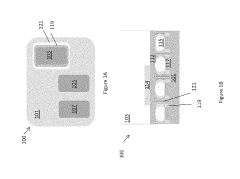
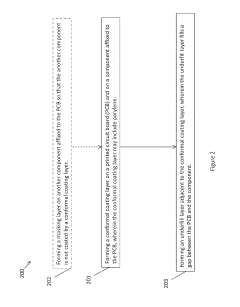
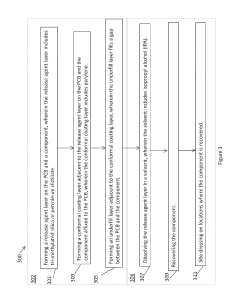
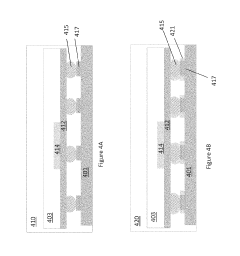
Composite component
PatentWO2023153240A1
Innovation
- The composite part design features a Si base layer with a rewiring layer and electronic components having through-Si vias, where the mounting surface is curved to guide voids outside, and an adhesive layer with a thickness gradient to facilitate void movement, reducing the likelihood of voids in the underfill layer.


Environmental Regulations for Electronic Protection Materials
The regulatory landscape for electronic protection materials has evolved significantly in response to growing environmental concerns and the need for sustainable manufacturing practices. Global environmental regulations now impose stringent requirements on the chemical composition, manufacturing processes, and end-of-life management of materials used in electronic protection applications, including underfill and conformal coating materials.
The European Union's RoHS (Restriction of Hazardous Substances) directive represents one of the most comprehensive regulatory frameworks affecting electronic protection materials. This regulation restricts the use of specific hazardous substances such as lead, mercury, cadmium, hexavalent chromium, and certain brominated flame retardants in electrical and electronic equipment. Both underfill and conformal coating formulations must comply with these restrictions, driving manufacturers to develop alternative chemistries that maintain performance while meeting environmental standards.
REACH (Registration, Evaluation, Authorization and Restriction of Chemicals) regulation further impacts the selection and use of electronic protection materials within the European market. This comprehensive chemical regulation requires manufacturers to register chemical substances, evaluate their safety, and obtain authorization for substances of very high concern. The regulation particularly affects the solvent systems, curing agents, and additives commonly used in conformal coatings and underfill materials.
In North America, the EPA's Toxic Substances Control Act (TSCA) and various state-level regulations, particularly California's Proposition 65, establish additional compliance requirements for electronic protection materials. These regulations focus on limiting exposure to carcinogenic and reproductive toxins, influencing the selection of raw materials and manufacturing processes for both underfill and conformal coating applications.
The waste electrical and electronic equipment (WEEE) directive establishes requirements for the collection, treatment, and recycling of electronic products at their end-of-life. This regulation indirectly influences the design of electronic protection materials, encouraging the development of removable or recyclable formulations that facilitate component recovery and material separation during the recycling process.
Emerging regulations addressing per- and polyfluoroalkyl substances (PFAS) are beginning to impact certain specialty conformal coating formulations that rely on fluorinated chemistries for enhanced performance characteristics. These evolving restrictions require manufacturers to evaluate alternative material systems while maintaining the critical protection properties required for electronic reliability applications.
The European Union's RoHS (Restriction of Hazardous Substances) directive represents one of the most comprehensive regulatory frameworks affecting electronic protection materials. This regulation restricts the use of specific hazardous substances such as lead, mercury, cadmium, hexavalent chromium, and certain brominated flame retardants in electrical and electronic equipment. Both underfill and conformal coating formulations must comply with these restrictions, driving manufacturers to develop alternative chemistries that maintain performance while meeting environmental standards.
REACH (Registration, Evaluation, Authorization and Restriction of Chemicals) regulation further impacts the selection and use of electronic protection materials within the European market. This comprehensive chemical regulation requires manufacturers to register chemical substances, evaluate their safety, and obtain authorization for substances of very high concern. The regulation particularly affects the solvent systems, curing agents, and additives commonly used in conformal coatings and underfill materials.
In North America, the EPA's Toxic Substances Control Act (TSCA) and various state-level regulations, particularly California's Proposition 65, establish additional compliance requirements for electronic protection materials. These regulations focus on limiting exposure to carcinogenic and reproductive toxins, influencing the selection of raw materials and manufacturing processes for both underfill and conformal coating applications.
The waste electrical and electronic equipment (WEEE) directive establishes requirements for the collection, treatment, and recycling of electronic products at their end-of-life. This regulation indirectly influences the design of electronic protection materials, encouraging the development of removable or recyclable formulations that facilitate component recovery and material separation during the recycling process.
Emerging regulations addressing per- and polyfluoroalkyl substances (PFAS) are beginning to impact certain specialty conformal coating formulations that rely on fluorinated chemistries for enhanced performance characteristics. These evolving restrictions require manufacturers to evaluate alternative material systems while maintaining the critical protection properties required for electronic reliability applications.
Cost-Benefit Analysis of Electronic Protection Strategies
The economic evaluation of electronic protection strategies requires a comprehensive assessment of both direct and indirect costs associated with underfill and conformal coating implementations. Initial material costs represent the most visible expense component, where underfill materials typically command higher unit prices due to their specialized formulations and thermal properties. However, conformal coatings often require multiple application layers and additional surface preparation, potentially offsetting their lower material costs.
Manufacturing process costs constitute a significant portion of the total economic impact. Underfill application demands precise dispensing equipment, controlled curing environments, and extended processing times, resulting in higher capital equipment investments and operational expenses. Conversely, conformal coating processes, while requiring specialized spray or dip coating equipment, generally offer faster throughput and lower energy consumption during application and curing phases.
Labor costs vary substantially between protection strategies. Underfill processes typically require skilled technicians for precise material placement and quality control, increasing direct labor expenses. Conformal coating applications, particularly automated spray systems, can achieve higher production volumes with reduced manual intervention, translating to lower per-unit labor costs in high-volume manufacturing scenarios.
Long-term reliability benefits present the most compelling economic argument for protection strategy selection. Underfill's superior mechanical reinforcement and thermal cycling performance can reduce warranty claims and field failures by 40-60% in harsh operating environments. This reliability improvement translates to substantial cost avoidance in terms of product returns, repair services, and brand reputation protection.
Maintenance and rework considerations significantly impact total cost of ownership. Conformal coatings offer advantages in field serviceability, allowing component replacement and repair without complete assembly replacement. Underfilled assemblies, while more robust, present challenges for component-level repairs, potentially requiring entire module replacement in failure scenarios.
Return on investment calculations demonstrate that while underfill strategies require higher upfront investments, they typically achieve break-even points within 18-24 months for applications experiencing moderate to severe environmental stresses. Conformal coating strategies show faster initial returns but may incur higher long-term costs in demanding applications due to increased failure rates and maintenance requirements.
Manufacturing process costs constitute a significant portion of the total economic impact. Underfill application demands precise dispensing equipment, controlled curing environments, and extended processing times, resulting in higher capital equipment investments and operational expenses. Conversely, conformal coating processes, while requiring specialized spray or dip coating equipment, generally offer faster throughput and lower energy consumption during application and curing phases.
Labor costs vary substantially between protection strategies. Underfill processes typically require skilled technicians for precise material placement and quality control, increasing direct labor expenses. Conformal coating applications, particularly automated spray systems, can achieve higher production volumes with reduced manual intervention, translating to lower per-unit labor costs in high-volume manufacturing scenarios.
Long-term reliability benefits present the most compelling economic argument for protection strategy selection. Underfill's superior mechanical reinforcement and thermal cycling performance can reduce warranty claims and field failures by 40-60% in harsh operating environments. This reliability improvement translates to substantial cost avoidance in terms of product returns, repair services, and brand reputation protection.
Maintenance and rework considerations significantly impact total cost of ownership. Conformal coatings offer advantages in field serviceability, allowing component replacement and repair without complete assembly replacement. Underfilled assemblies, while more robust, present challenges for component-level repairs, potentially requiring entire module replacement in failure scenarios.
Return on investment calculations demonstrate that while underfill strategies require higher upfront investments, they typically achieve break-even points within 18-24 months for applications experiencing moderate to severe environmental stresses. Conformal coating strategies show faster initial returns but may incur higher long-term costs in demanding applications due to increased failure rates and maintenance requirements.
Unlock deeper insights with Patsnap Eureka Quick Research — get a full tech report to explore trends and direct your research. Try now!
Generate Your Research Report Instantly with AI Agent
Supercharge your innovation with Patsnap Eureka AI Agent Platform!