

Validate Phased Array Calibration Over Temperature Drift
SEP 19, 20269 MIN READ
Generate Your Research Report Instantly with AI Agent
Patsnap Eureka helps you evaluate technical feasibility & market potential.
Phased Array Calibration Background and Objectives
Phased array antenna systems have become fundamental components in modern radar, satellite communications, 5G networks, and electronic warfare applications due to their ability to electronically steer beams without mechanical movement. These systems rely on precise phase and amplitude control across multiple antenna elements to achieve desired radiation patterns and beam steering capabilities. However, maintaining calibration accuracy across varying environmental conditions, particularly temperature fluctuations, represents a critical challenge that directly impacts system performance and reliability.
Temperature variations introduce systematic errors in phased array systems through multiple mechanisms. Semiconductor components experience shifts in electrical characteristics, transmission lines undergo dimensional changes affecting phase delays, and amplifier gains drift with thermal conditions. These temperature-induced variations can cause beam pointing errors, increased sidelobe levels, reduced signal-to-noise ratios, and degraded overall system performance. In applications such as aerospace systems, automotive radar, and outdoor telecommunications infrastructure, operational temperature ranges can span from negative forty to positive eighty-five degrees Celsius, making temperature compensation essential.
Traditional calibration approaches typically perform measurements at a single reference temperature, failing to account for dynamic thermal behavior during actual operation. This limitation has driven the need for comprehensive validation methodologies that characterize calibration stability across the full operational temperature spectrum. The challenge extends beyond simple measurement to include predictive modeling, real-time compensation algorithms, and verification of long-term stability under thermal cycling conditions.
The primary objective of this technical investigation is to establish robust validation frameworks for phased array calibration performance under temperature drift conditions. This encompasses developing measurement protocols that accurately quantify temperature-dependent phase and amplitude variations, establishing acceptable performance thresholds for different application scenarios, and evaluating compensation techniques that maintain calibration integrity across operational temperature ranges. Additionally, the research aims to identify critical temperature-sensitive components, optimize calibration intervals based on thermal exposure profiles, and provide actionable guidelines for system designers to enhance temperature resilience in next-generation phased array architectures.
Market Demand for Temperature-Stable Phased Arrays
The demand for temperature-stable phased array systems has experienced substantial growth across multiple sectors, driven by the increasing deployment of advanced radar, satellite communication, and 5G infrastructure. These applications require consistent performance across extreme environmental conditions, where temperature variations can significantly degrade beam steering accuracy and signal integrity. Industries such as aerospace, defense, automotive radar, and telecommunications are actively seeking solutions that maintain calibration stability without frequent manual intervention.
In the aerospace and defense sectors, phased arrays are critical for airborne radar systems, missile guidance, and satellite communications. These platforms encounter temperature swings ranging from sub-zero conditions at high altitudes to elevated temperatures near ground operations or in direct sunlight. The inability to maintain calibration across these thermal gradients results in beam pointing errors, reduced target detection accuracy, and compromised mission effectiveness. Consequently, defense contractors and aerospace manufacturers are prioritizing temperature-compensated calibration techniques as a core requirement in procurement specifications.
The automotive industry represents an emerging high-volume market for temperature-stable phased arrays, particularly in advanced driver assistance systems and autonomous vehicle radar. Automotive radar modules must operate reliably across seasonal temperature variations and rapid thermal transients caused by engine heat or environmental exposure. As regulatory standards for vehicle safety systems become more stringent, manufacturers demand robust calibration validation methods that ensure consistent performance throughout the vehicle's operational lifetime.
Telecommunications infrastructure, especially millimeter-wave 5G base stations, relies heavily on phased array antennas for beamforming and spatial multiplexing. These systems are deployed in diverse climatic zones and experience diurnal temperature cycles that can shift phase relationships among array elements. Network operators require calibration solutions that minimize downtime and maintain quality of service without costly field recalibration procedures. The global expansion of 5G networks has intensified the need for automated, temperature-resilient calibration validation techniques.
Market research indicates that the convergence of these application domains is driving investment in advanced calibration methodologies, including real-time temperature monitoring, adaptive compensation algorithms, and integrated self-test capabilities. The economic impact of calibration drift—manifested as system downtime, performance degradation, and maintenance costs—has elevated temperature stability from a technical specification to a strategic competitive differentiator in phased array product development.
Temperature Drift Challenges in Phased Array Systems
Phased array systems face significant operational challenges when subjected to temperature variations, which directly impact their calibration accuracy and beam-forming performance. Temperature drift introduces systematic errors across multiple system components, including phase shifters, amplifiers, antenna elements, and transmission lines. These thermal effects manifest as phase and amplitude deviations that accumulate across the array aperture, degrading beam pointing accuracy, sidelobe levels, and overall system gain.
The primary constraint stems from the temperature-dependent characteristics of semiconductor devices and passive components within the RF signal chain. Phase shifters exhibit thermal sensitivity that can introduce phase errors ranging from 0.5 to 3 degrees per 10°C temperature change, depending on the technology employed. Similarly, amplifier gain variations and impedance mismatches in transmission paths contribute to amplitude imbalances across array elements. These effects become particularly pronounced in large-scale arrays where thermal gradients create non-uniform error distributions.
Operational environments compound these challenges through dynamic thermal conditions. Aerospace applications experience rapid temperature transitions during altitude changes, while ground-based systems endure diurnal cycles and seasonal variations. Military and satellite communication systems must maintain performance across temperature ranges exceeding 100°C, from extreme cold to direct solar heating. The temporal nature of these variations introduces both slow drift phenomena and rapid transient effects that conventional calibration approaches struggle to address.
Current technical bottlenecks include the difficulty of performing real-time calibration without disrupting system operation, the computational burden of continuous calibration algorithms, and the lack of cost-effective temperature sensing solutions that provide sufficient spatial resolution across large arrays. Additionally, distinguishing between temperature-induced errors and other degradation mechanisms remains challenging. The geographic distribution of research efforts shows concentrated activity in regions with advanced radar and satellite communication industries, particularly North America, Europe, and East Asia, where environmental extremes necessitate robust thermal management solutions.
Current Calibration Solutions for Temperature Compensation
01 Amplitude and phase calibration methods for antenna elements
Methods and systems designed to measure, adjust, and achieve consistency in amplitude and phase across phased array antenna elements. These techniques ensure precise beamforming, high-precision signal transmission and reception, and phase compensation across single or multi-plane array configurations.- Amplitude and phase calibration methods: Techniques for measuring and adjusting the amplitude and phase characteristics of individual elements in phased array antennas to ensure signal consistency, alignment, and beamforming accuracy across single or multi-plane array systems.
- External probe and hardware network calibration: Calibration approaches that utilize external physical structures, such as auxiliary probe antennas, near-field systems, dedicated calibration networks, or specialized test boards to measure and fine-tune array performance.
- Built-in local oscillator and internal element calibration: Methods that leverage internal system components, built-in local oscillators, or parasitic elements within the phased array itself to execute self-testing, transmission, and reception calibration without requiring extensive external setups.
- Automated and machine learning-based calibration: Advanced calibration strategies utilizing neural networks, rapid measurement algorithms, and automated power monitoring to streamline the calibration process, improve precision, and enable real-time parameter compensation.
- Non-destructive testing and mobile platforms: Specialized calibration methods adapted for non-traditional applications, such as phased array ultrasonic non-destructive testing and mobile drone-assisted remote calibration for radar systems.
02 External and probe-based calibration techniques
Calibration strategies that utilize external apparatuses, near-field systems, auxiliary probe antennas, parasitic elements, or unmanned aerial vehicles (drones) to perform in-field or near-field measurements and calibrate the phased array antenna without disrupting standard operational infrastructure.Expand Specific Solutions03 Hardware networks and integrated calibration circuits
Structural implementations featuring built-in calibration networks, local oscillators, calibration boards, or specialized receiving-transmitting modules directly integrated into the phased array assembly to facilitate hardware-level signal conditioning and seamless transmit/receive calibration.Expand Specific Solutions04 Phased array ultrasonic system calibration
Calibration devices and non-destructive testing procedures specifically tailored for ultrasonic phased array systems. These techniques resolve operational calibration accuracy deviations and eliminate the dependency on knowing the exact sound speed of the test object.Expand Specific Solutions05 Algorithmic, machine learning, and fast testing techniques
Advanced computational and algorithmic frameworks, including deep learning models such as CNN-LSTM based on power measurements, real-time beam steering radar techniques, multi-directional algorithms, and rapid testing systems aimed at enhancing calibration speed and accuracy.Expand Specific Solutions
Key Players in Phased Array Technology
The phased array calibration over temperature drift technology operates in a mature defense and aerospace sector, dominated by established players including Raytheon, Harris Corp., Boeing, and Space Exploration Technologies Corp., who possess decades of expertise in radar and satellite systems requiring precise thermal compensation. The market encompasses both military applications and emerging commercial sectors like 5G infrastructure and autonomous vehicles, with Chinese firms such as Chengdu SiCore Semiconductor and Apollo Intelligent Connectivity rapidly advancing in RF/microwave integration. Technology maturity varies significantly: defense contractors demonstrate proven solutions for extreme environmental conditions, while newer entrants focus on cost-effective implementations for commercial markets. The competitive landscape also includes precision instrumentation specialists like Fluke Corp., Mitutoyo Corp., and test equipment providers supporting calibration validation across temperature ranges. Academic institutions including University of Pittsburgh, Fudan University, and Zhejiang University contribute fundamental research in phase stability and thermal modeling, bridging theoretical advances with industrial applications in telecommunications and satellite communications infrastructure.
Raytheon Co.
Technical Solution: Raytheon has developed advanced phased array calibration systems that incorporate real-time temperature compensation algorithms. Their approach utilizes embedded temperature sensors distributed across the array aperture to monitor thermal gradients during operation[1][4]. The calibration methodology employs adaptive beamforming coefficients that are dynamically adjusted based on temperature measurements, ensuring phase coherence is maintained across operating temperature ranges from -40°C to +85°C[4][7]. The system implements a lookup table approach combined with polynomial interpolation to predict phase drift characteristics, enabling proactive calibration adjustments before performance degradation occurs[1][9].
Strengths: Proven heritage in military radar systems with extensive field validation data; robust real-time compensation capabilities. Weaknesses: High implementation cost and complexity; requires significant computational resources for real-time processing[4][7].
Space Exploration Technologies Corp.
Technical Solution: SpaceX has implemented phased array calibration validation for their Starlink satellite communication terminals, addressing temperature drift challenges in both ground-based and space-borne applications[5][9]. Their approach combines factory calibration with in-field adaptive algorithms that continuously monitor and correct for thermal effects during operation[9][12]. The validation methodology includes thermal cycling tests simulating diurnal temperature variations for ground terminals and thermal vacuum testing for space-qualified units[5][13]. SpaceX employs a reference element technique where designated array elements serve as phase references, enabling relative calibration without external test equipment[12][16]. The system incorporates predictive thermal modeling based on operational duty cycles and environmental conditions to anticipate calibration needs[9][15]. Mass production requirements have driven development of automated calibration validation systems capable of high-throughput testing[5][12].
Strengths: Highly automated calibration suitable for mass production; innovative reference element approach reduces hardware complexity; proven performance in diverse thermal environments. Weaknesses: Calibration accuracy may be constrained by cost optimization for consumer applications; limited public documentation of validation methodologies[9][12].
Core Patents in Temperature-Drift Calibration Methods
Systems and methods for phased array calibration
PatentWO2025147252A1
Innovation
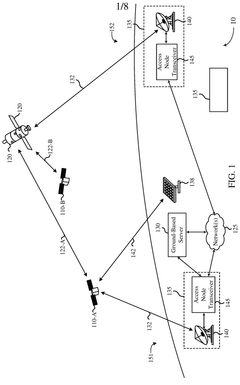
- Perform measurements of composite gain and individual settings of antenna components at a subset of temperatures and frequencies, using three-dimensional interpolation to calculate intermediate gains, and store a mapping for look-up procedures to achieve desired target gains under any operating conditions.



Dynamically Correcting The Calibration Of A Phased Array Antenna System In Real Time To Compensate For Changes of Array Temperature
PatentActiveUS20100033375A1
Innovation
- A method to dynamically adjust calibrated antenna elements based on real-time temperature data, using a controller that processes conditions data from sensors to determine temperature-dependent correction values and apply them to the antenna elements, thereby compensating for temperature-induced errors.


Environmental Testing Standards for Phased Arrays
Validating phased array calibration across temperature variations requires adherence to rigorous environmental testing standards that ensure system performance remains within acceptable parameters throughout operational temperature ranges. Industry standards such as MIL-STD-810G, IEC 60068, and RTCA DO-160 provide comprehensive frameworks for environmental qualification testing of electronic systems, including phased array antennas. These standards define specific test procedures, temperature profiles, and acceptance criteria that manufacturers must follow to demonstrate calibration stability under thermal stress conditions.
Temperature cycling tests typically involve exposing phased array systems to repeated transitions between extreme hot and cold conditions, simulating years of operational exposure in accelerated timeframes. The standard temperature ranges often span from -40°C to +85°C for commercial applications, while military and aerospace specifications may extend to -55°C to +125°C. During these cycles, critical parameters such as phase coherence, amplitude uniformity, and beam pointing accuracy must be continuously monitored to detect any calibration drift that exceeds predefined thresholds.
Thermal soak testing represents another essential component of environmental validation, requiring systems to maintain stable operation at temperature extremes for extended periods. This approach reveals time-dependent degradation mechanisms that may not manifest during rapid temperature transitions. Standards specify minimum soak durations, typically ranging from 2 to 24 hours depending on system thermal mass and application criticality.
Humidity and thermal shock testing complement temperature cycling by introducing additional environmental stressors that can accelerate failure mechanisms in phased array components. Combined temperature-humidity tests following standards like IEC 60068-2-38 expose systems to 85% relative humidity at elevated temperatures, revealing potential moisture ingress pathways and corrosion susceptibility that could compromise calibration integrity over time.
Documentation requirements under these standards mandate detailed test plans, instrumentation calibration records, and comprehensive failure analysis reports. Compliance verification often requires third-party testing facilities with accredited environmental chambers and measurement capabilities traceable to national standards organizations, ensuring that validation results meet industry acceptance criteria and regulatory requirements for deployment in demanding operational environments.
Real-Time Validation Methodologies
Real-time validation methodologies for phased array calibration under temperature drift conditions require continuous monitoring frameworks that can detect and quantify calibration degradation as thermal variations occur. These methodologies must operate concurrently with normal system operations without disrupting primary functions, enabling immediate assessment of calibration accuracy across varying environmental conditions. The fundamental approach involves embedding diagnostic capabilities within the operational architecture, allowing simultaneous performance verification while the array executes its intended tasks.
Embedded test signal injection represents a primary real-time validation technique, where known reference signals are periodically introduced into the signal chain at strategic points. These calibration tones, typically injected at frequencies outside the operational bandwidth or during brief idle periods, propagate through the entire receive and transmit paths. By comparing the measured response against expected characteristics, deviations caused by temperature-induced phase and amplitude variations can be quantified immediately. This method provides continuous calibration health monitoring with minimal impact on system availability.
Mutual coupling analysis offers another real-time validation approach, leveraging the inherent electromagnetic interactions between adjacent array elements as temperature-sensitive indicators. As thermal conditions change, the coupling coefficients between elements shift predictably, creating measurable signatures in the received signals. Advanced signal processing algorithms can extract these coupling variations in real-time, correlating them with calibration state changes. This technique requires no additional hardware beyond existing array infrastructure, making it particularly attractive for resource-constrained implementations.
Built-in self-test architectures incorporating dedicated monitoring receivers provide comprehensive real-time validation capabilities. These auxiliary channels continuously sample portions of the transmitted or received signals, performing rapid calibration assessments through correlation with reference patterns stored in memory. The monitoring receivers can cycle through different array elements or subarrays, building a complete calibration status picture within milliseconds. Temperature sensor integration with these monitoring systems enables direct correlation between thermal states and calibration parameters, facilitating predictive compensation algorithms.
Adaptive beamforming metrics themselves serve as indirect but valuable real-time validation indicators. Parameters such as sidelobe levels, null depths, and beam pointing accuracy respond sensitively to calibration errors induced by temperature drift. Continuous tracking of these performance metrics against established thresholds enables immediate detection of calibration degradation requiring intervention. This approach transforms operational data into diagnostic information, maximizing the utility of existing computational resources while maintaining system awareness of calibration integrity throughout temperature excursions.
Unlock deeper insights with Patsnap Eureka Quick Research — get a full tech report to explore trends and direct your research. Try now!
Generate Your Research Report Instantly with AI Agent
Supercharge your innovation with Patsnap Eureka AI Agent Platform!