Wireless Controllers vs Bluetooth: Signal Coverage
MAR 5, 20269 MIN READ
Generate Your Research Report Instantly with AI Agent
PatSnap Eureka helps you evaluate technical feasibility & market potential.
Wireless Controller Signal Coverage Background and Objectives
Wireless controller technology has undergone significant evolution since the early days of infrared-based gaming peripherals in the 1980s. The transition from wired to wireless solutions marked a pivotal shift in user experience, with radio frequency and Bluetooth technologies emerging as dominant communication protocols. This evolution has been driven by consumer demands for greater mobility, reduced cable clutter, and enhanced gaming experiences across multiple device ecosystems.
The development trajectory of wireless controllers demonstrates a clear progression from proprietary RF solutions to standardized Bluetooth implementations. Early wireless controllers suffered from limited range, high latency, and frequent connectivity issues. However, technological advancements in signal processing, antenna design, and power management have substantially improved performance metrics. Modern wireless controllers now achieve sub-millisecond latency and extended operational ranges, making them viable alternatives to traditional wired connections.
Current market dynamics reveal a growing emphasis on signal coverage optimization as a critical differentiator. Gaming console manufacturers, peripheral developers, and mobile device companies are investing heavily in enhancing wireless communication reliability. The proliferation of multi-room gaming setups and the rise of cloud gaming services have intensified the need for robust signal coverage solutions that maintain consistent performance across varying environmental conditions.
The primary technical objective centers on achieving optimal signal coverage while maintaining low latency and power efficiency. This involves addressing fundamental challenges in RF propagation, including signal attenuation through physical barriers, interference from competing wireless devices, and maintaining stable connections in electromagnetically noisy environments. The goal extends beyond mere range extension to encompass signal quality preservation across the entire coverage area.
Strategic objectives include developing adaptive signal management systems that can dynamically adjust transmission parameters based on environmental conditions. This encompasses implementing intelligent frequency hopping algorithms, optimizing antenna configurations, and integrating advanced error correction mechanisms. The ultimate aim is to establish wireless controller solutions that deliver consistent, reliable performance regardless of physical obstacles or competing wireless traffic.
Furthermore, the technical roadmap emphasizes backward compatibility while pushing forward with next-generation wireless standards. This dual approach ensures market adoption while positioning for future technological transitions, particularly as 5G and Wi-Fi 6E technologies create new opportunities for enhanced wireless controller implementations.
The development trajectory of wireless controllers demonstrates a clear progression from proprietary RF solutions to standardized Bluetooth implementations. Early wireless controllers suffered from limited range, high latency, and frequent connectivity issues. However, technological advancements in signal processing, antenna design, and power management have substantially improved performance metrics. Modern wireless controllers now achieve sub-millisecond latency and extended operational ranges, making them viable alternatives to traditional wired connections.
Current market dynamics reveal a growing emphasis on signal coverage optimization as a critical differentiator. Gaming console manufacturers, peripheral developers, and mobile device companies are investing heavily in enhancing wireless communication reliability. The proliferation of multi-room gaming setups and the rise of cloud gaming services have intensified the need for robust signal coverage solutions that maintain consistent performance across varying environmental conditions.
The primary technical objective centers on achieving optimal signal coverage while maintaining low latency and power efficiency. This involves addressing fundamental challenges in RF propagation, including signal attenuation through physical barriers, interference from competing wireless devices, and maintaining stable connections in electromagnetically noisy environments. The goal extends beyond mere range extension to encompass signal quality preservation across the entire coverage area.
Strategic objectives include developing adaptive signal management systems that can dynamically adjust transmission parameters based on environmental conditions. This encompasses implementing intelligent frequency hopping algorithms, optimizing antenna configurations, and integrating advanced error correction mechanisms. The ultimate aim is to establish wireless controller solutions that deliver consistent, reliable performance regardless of physical obstacles or competing wireless traffic.
Furthermore, the technical roadmap emphasizes backward compatibility while pushing forward with next-generation wireless standards. This dual approach ensures market adoption while positioning for future technological transitions, particularly as 5G and Wi-Fi 6E technologies create new opportunities for enhanced wireless controller implementations.
Market Demand for Extended Range Gaming Controllers
The gaming industry has witnessed unprecedented growth in wireless controller adoption, driven by the increasing demand for enhanced mobility and seamless gaming experiences across multiple platforms. Traditional Bluetooth controllers, while widely adopted, face significant limitations in signal coverage that directly impact user satisfaction and market penetration potential.
Consumer surveys consistently indicate that signal range represents one of the primary pain points for wireless gaming peripherals. Gamers frequently report connection drops, input lag, and reduced responsiveness when operating beyond standard Bluetooth ranges, particularly in competitive gaming scenarios where precision and reliability are paramount. This limitation has created substantial market opportunities for extended range gaming controllers that can maintain stable connections across larger distances.
The rise of living room gaming setups and multi-device gaming ecosystems has amplified demand for controllers capable of operating effectively at distances exceeding traditional Bluetooth specifications. Modern entertainment centers often require controllers to function reliably from distances of 10-15 meters, significantly beyond the optimal range of standard Bluetooth Low Energy implementations. This gap between user expectations and current technology capabilities represents a substantial market opportunity.
Professional esports and streaming communities have emerged as key demand drivers for extended range solutions. Content creators and professional gamers require controllers that maintain consistent performance across varied physical setups, including large streaming studios and tournament venues. The growing influence of these user segments has elevated extended range capabilities from a convenience feature to a competitive necessity.
Market research indicates strong willingness among premium gaming segments to invest in controllers offering superior signal coverage and reliability. The proliferation of cloud gaming services and cross-platform gaming has further intensified demand for controllers capable of seamless operation across diverse environments and distances. Gaming peripheral manufacturers are increasingly positioning extended range capabilities as premium differentiators, reflecting the substantial market value attributed to enhanced signal coverage performance.
The convergence of mobile gaming growth, smart TV gaming adoption, and the expansion of gaming into non-traditional spaces has created diverse use cases requiring robust wireless connectivity solutions beyond conventional Bluetooth limitations.
Consumer surveys consistently indicate that signal range represents one of the primary pain points for wireless gaming peripherals. Gamers frequently report connection drops, input lag, and reduced responsiveness when operating beyond standard Bluetooth ranges, particularly in competitive gaming scenarios where precision and reliability are paramount. This limitation has created substantial market opportunities for extended range gaming controllers that can maintain stable connections across larger distances.
The rise of living room gaming setups and multi-device gaming ecosystems has amplified demand for controllers capable of operating effectively at distances exceeding traditional Bluetooth specifications. Modern entertainment centers often require controllers to function reliably from distances of 10-15 meters, significantly beyond the optimal range of standard Bluetooth Low Energy implementations. This gap between user expectations and current technology capabilities represents a substantial market opportunity.
Professional esports and streaming communities have emerged as key demand drivers for extended range solutions. Content creators and professional gamers require controllers that maintain consistent performance across varied physical setups, including large streaming studios and tournament venues. The growing influence of these user segments has elevated extended range capabilities from a convenience feature to a competitive necessity.
Market research indicates strong willingness among premium gaming segments to invest in controllers offering superior signal coverage and reliability. The proliferation of cloud gaming services and cross-platform gaming has further intensified demand for controllers capable of seamless operation across diverse environments and distances. Gaming peripheral manufacturers are increasingly positioning extended range capabilities as premium differentiators, reflecting the substantial market value attributed to enhanced signal coverage performance.
The convergence of mobile gaming growth, smart TV gaming adoption, and the expansion of gaming into non-traditional spaces has created diverse use cases requiring robust wireless connectivity solutions beyond conventional Bluetooth limitations.
Current Bluetooth Signal Limitations and Coverage Challenges
Bluetooth technology faces several inherent limitations that significantly impact signal coverage and reliability in wireless controller applications. The fundamental constraint lies in Bluetooth's operating frequency of 2.4 GHz, which is shared with numerous other devices including Wi-Fi networks, microwave ovens, and various industrial equipment. This crowded spectrum creates substantial interference challenges that directly affect signal strength and stability.
The physical range limitations of Bluetooth represent another critical challenge. Standard Bluetooth Class 2 devices, commonly used in gaming controllers, typically achieve effective ranges of only 10 meters under optimal conditions. This range decreases dramatically when obstacles such as walls, furniture, or even the human body interfere with the signal path. The line-of-sight dependency becomes particularly problematic in gaming environments where users may move around or position themselves at various angles relative to the receiving device.
Signal attenuation through common household materials poses significant coverage challenges. Concrete walls can reduce Bluetooth signal strength by up to 25 dB, while metal objects and electronic devices create dead zones where connectivity becomes unreliable. Water-based materials, including the human body, absorb 2.4 GHz signals effectively, causing noticeable signal degradation when controllers are held in certain positions or when users move between the controller and receiver.
Latency issues compound the coverage challenges, particularly as signal strength weakens. Bluetooth's packet-based communication protocol introduces inherent delays that increase when the system compensates for poor signal quality through error correction and retransmission mechanisms. These delays become more pronounced at the edges of coverage areas, where signal-to-noise ratios deteriorate.
Power management constraints further limit effective coverage. Battery-powered controllers must balance transmission power with energy efficiency, often resulting in reduced signal strength to preserve battery life. This creates a fundamental trade-off between coverage range and operational duration that affects user experience.
Multi-device interference represents an increasingly significant challenge as smart home ecosystems expand. Bluetooth controllers must compete for spectrum space with smartphones, tablets, smart speakers, and IoT devices, all operating within the same frequency band. This congestion leads to connection drops, increased latency, and reduced effective range.
The adaptive frequency hopping mechanism, while designed to mitigate interference, introduces its own limitations. The system's ability to find clear channels becomes compromised in heavily congested environments, leading to degraded performance even within nominal coverage areas.
The physical range limitations of Bluetooth represent another critical challenge. Standard Bluetooth Class 2 devices, commonly used in gaming controllers, typically achieve effective ranges of only 10 meters under optimal conditions. This range decreases dramatically when obstacles such as walls, furniture, or even the human body interfere with the signal path. The line-of-sight dependency becomes particularly problematic in gaming environments where users may move around or position themselves at various angles relative to the receiving device.
Signal attenuation through common household materials poses significant coverage challenges. Concrete walls can reduce Bluetooth signal strength by up to 25 dB, while metal objects and electronic devices create dead zones where connectivity becomes unreliable. Water-based materials, including the human body, absorb 2.4 GHz signals effectively, causing noticeable signal degradation when controllers are held in certain positions or when users move between the controller and receiver.
Latency issues compound the coverage challenges, particularly as signal strength weakens. Bluetooth's packet-based communication protocol introduces inherent delays that increase when the system compensates for poor signal quality through error correction and retransmission mechanisms. These delays become more pronounced at the edges of coverage areas, where signal-to-noise ratios deteriorate.
Power management constraints further limit effective coverage. Battery-powered controllers must balance transmission power with energy efficiency, often resulting in reduced signal strength to preserve battery life. This creates a fundamental trade-off between coverage range and operational duration that affects user experience.
Multi-device interference represents an increasingly significant challenge as smart home ecosystems expand. Bluetooth controllers must compete for spectrum space with smartphones, tablets, smart speakers, and IoT devices, all operating within the same frequency band. This congestion leads to connection drops, increased latency, and reduced effective range.
The adaptive frequency hopping mechanism, while designed to mitigate interference, introduces its own limitations. The system's ability to find clear channels becomes compromised in heavily congested environments, leading to degraded performance even within nominal coverage areas.
Existing Solutions for Enhanced Signal Coverage
01 Antenna design and configuration for enhanced coverage
Wireless controllers can utilize optimized antenna designs and configurations to improve signal coverage. This includes the use of multiple antennas, directional antennas, or adaptive antenna arrays that can dynamically adjust to provide better signal strength and coverage area. Advanced antenna placement and orientation techniques help minimize dead zones and ensure consistent wireless communication across the intended coverage area.- Antenna design and configuration for enhanced coverage: Wireless controllers can utilize optimized antenna designs and configurations to improve signal coverage. This includes the use of multiple antennas, directional antennas, or adaptive antenna arrays that can dynamically adjust to provide better signal strength and coverage area. Advanced antenna placement and orientation techniques help minimize dead zones and ensure consistent wireless communication across the intended coverage area.
- Signal amplification and power management: Implementing signal amplification techniques and intelligent power management systems can significantly extend the coverage range of wireless controllers. These methods involve adjusting transmission power levels based on environmental conditions and distance requirements, using signal boosters or repeaters to extend range, and optimizing power consumption to maintain strong signal strength while preserving battery life in portable controllers.
- Multi-band and frequency hopping technologies: Wireless controllers can employ multi-band operation and frequency hopping techniques to improve signal coverage and reliability. By operating across multiple frequency bands or dynamically switching between frequencies, these systems can avoid interference, penetrate obstacles more effectively, and maintain stable connections in challenging environments. This approach helps ensure consistent coverage even in areas with high wireless traffic or physical obstructions.
- Mesh networking and relay systems: Implementing mesh networking architectures allows wireless controllers to extend coverage through relay nodes and peer-to-peer communication. In this approach, multiple devices can act as signal repeaters, creating a self-healing network that automatically routes signals through the most efficient path. This technology is particularly effective for covering large areas or complex environments where direct line-of-sight communication is not possible.
- Adaptive modulation and error correction: Advanced wireless controllers incorporate adaptive modulation schemes and robust error correction algorithms to maintain signal quality across varying coverage areas. These systems can automatically adjust data transmission rates, modulation techniques, and error correction levels based on signal strength and environmental conditions. This ensures reliable communication even at the edges of the coverage area where signal strength may be weaker.
02 Signal amplification and power management
Implementing signal amplification techniques and intelligent power management systems can significantly extend the coverage range of wireless controllers. These methods involve adjusting transmission power levels based on environmental conditions and distance requirements, utilizing signal boosters or repeaters, and employing power-efficient protocols to maintain strong signal strength while optimizing battery life and overall system performance.Expand Specific Solutions03 Frequency band selection and channel optimization
Selecting appropriate frequency bands and optimizing channel allocation can enhance wireless controller signal coverage. This involves utilizing multiple frequency bands, implementing frequency hopping techniques, and employing intelligent channel selection algorithms to avoid interference and maximize signal penetration through obstacles. Dynamic frequency management helps maintain reliable connections in various environmental conditions.Expand Specific Solutions04 Mesh networking and relay systems
Implementing mesh networking architectures and relay systems allows wireless controllers to extend coverage through interconnected nodes. Each device can act as a relay point, forwarding signals to create a self-healing network that expands the effective coverage area. This approach is particularly useful in large spaces or complex environments where direct line-of-sight communication may be limited.Expand Specific Solutions05 Adaptive modulation and error correction
Employing adaptive modulation schemes and advanced error correction techniques can improve signal reliability and effective coverage range. These methods dynamically adjust data transmission rates and encoding schemes based on signal quality, allowing wireless controllers to maintain stable connections even in challenging conditions with weak signals or high interference. Forward error correction and retransmission protocols ensure data integrity across extended distances.Expand Specific Solutions
Key Players in Wireless Controller and Bluetooth Industry
The wireless controller versus Bluetooth signal coverage landscape represents a mature technology sector experiencing steady growth driven by gaming, IoT, and smart device proliferation. The market demonstrates significant scale with established players like Intel Corp., Qualcomm Inc., and Samsung Electronics leading through comprehensive wireless communication portfolios spanning multiple protocols. Technology maturity varies across segments, with companies like MediaTek and Texas Instruments advancing low-power solutions, while Huawei Technologies and Motorola Solutions focus on enterprise-grade coverage optimization. The competitive dynamics show consolidation around key chipset manufacturers including Infineon Technologies, Cypress Semiconductor, and Murata Manufacturing, who provide foundational components enabling extended range capabilities. Market differentiation increasingly centers on power efficiency, latency reduction, and multi-protocol support, with emerging players like Honor Device and traditional automotive manufacturers like BMW integrating advanced wireless technologies into next-generation connected products and autonomous systems.
Intel Corp.
Technical Solution: Intel's wireless controller architecture focuses on Wi-Fi 6E and 7 technologies combined with Bluetooth LE for extended coverage scenarios. Their AX series controllers implement advanced spatial diversity techniques and intelligent channel selection algorithms to maximize signal penetration through obstacles. The company's solutions feature proprietary range extension protocols that can achieve coverage areas up to 300 meters in line-of-sight conditions. Intel's approach emphasizes low-latency communication through dedicated hardware acceleration and real-time signal processing capabilities, making their controllers particularly effective for gaming and industrial applications requiring reliable long-range connectivity.
Strengths: Strong Wi-Fi technology leadership, excellent latency performance, robust enterprise solutions. Weaknesses: Limited mobile market presence, higher cost structure, complex power management.
QUALCOMM, Inc.
Technical Solution: Qualcomm's wireless controller solutions leverage advanced RF technologies and proprietary algorithms to optimize signal coverage across multiple frequency bands. Their Snapdragon platforms integrate sophisticated antenna tuning capabilities and adaptive power management systems that dynamically adjust transmission power based on environmental conditions. The company's FastConnect technology provides enhanced range extension through beamforming and MIMO techniques, achieving up to 240 meters coverage in optimal conditions compared to standard Bluetooth's 10-meter range. Their solutions incorporate machine learning algorithms to predict and compensate for signal interference, maintaining stable connections even in challenging RF environments.
Strengths: Industry-leading RF expertise, comprehensive chipset integration, strong patent portfolio. Weaknesses: Higher power consumption, premium pricing, complex implementation requirements.
Core Patents in Wireless Signal Range Extension
Communication device and method of communicating transmissions
PatentActiveUS20110059768A1
Innovation
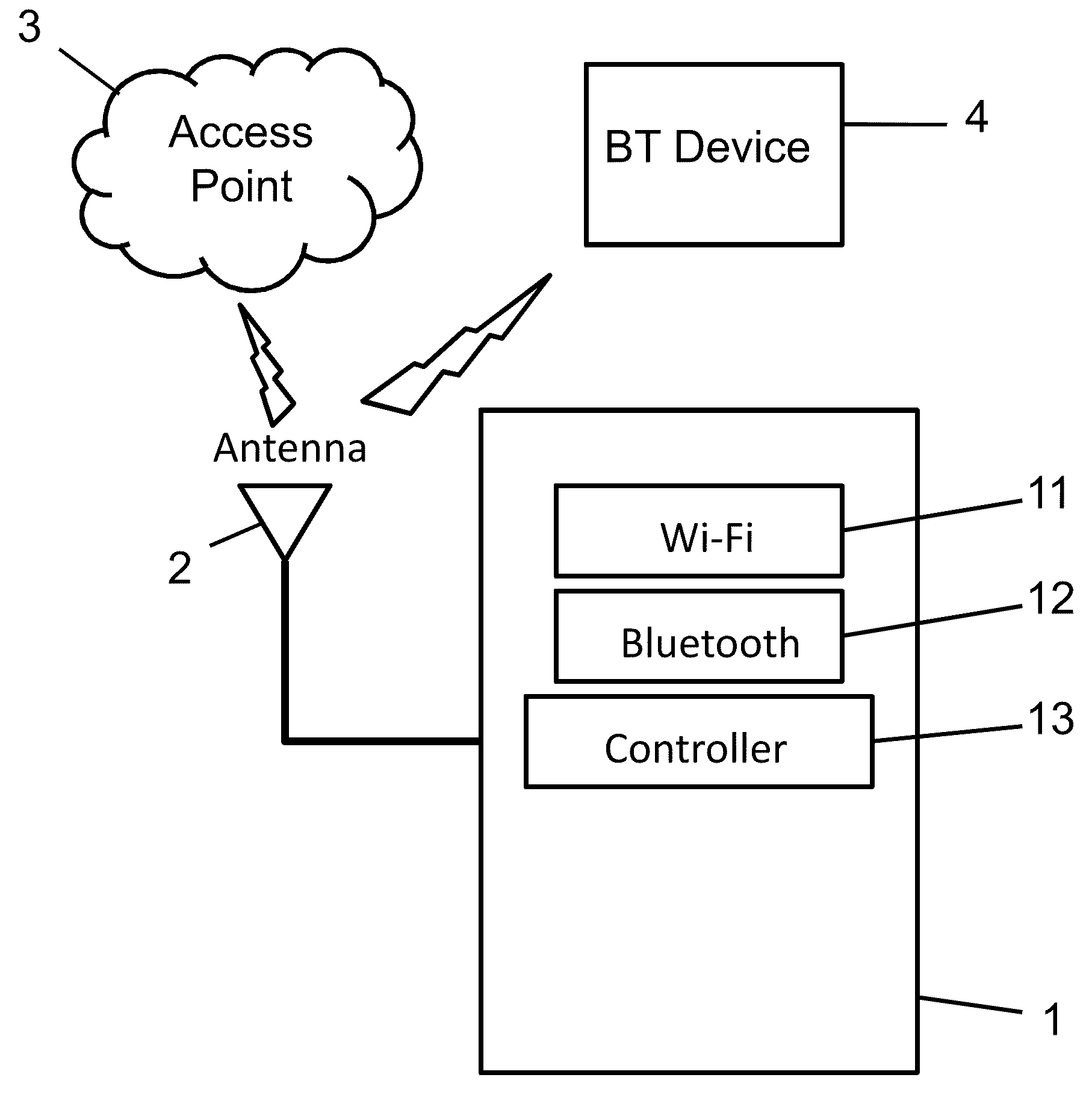
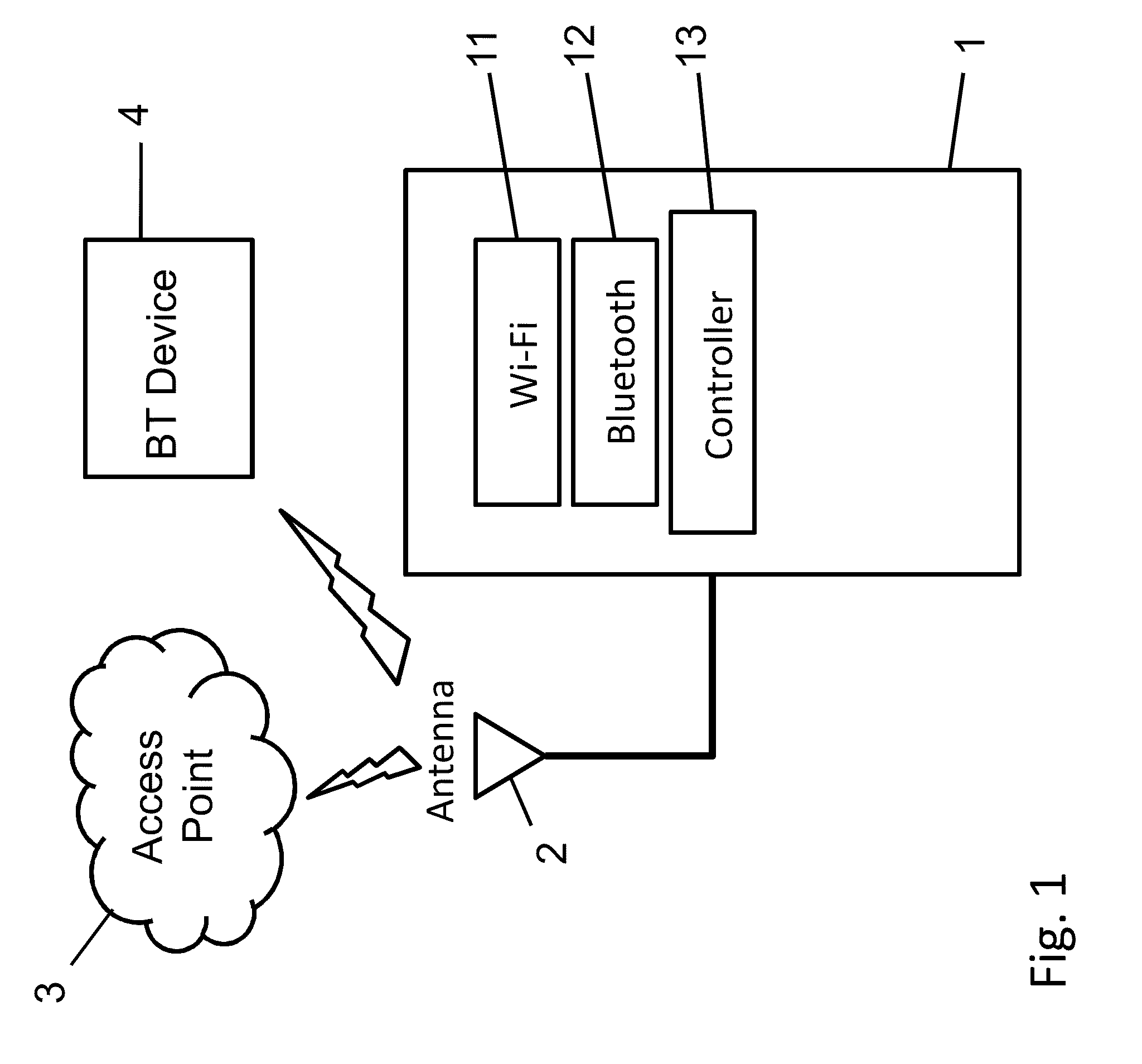
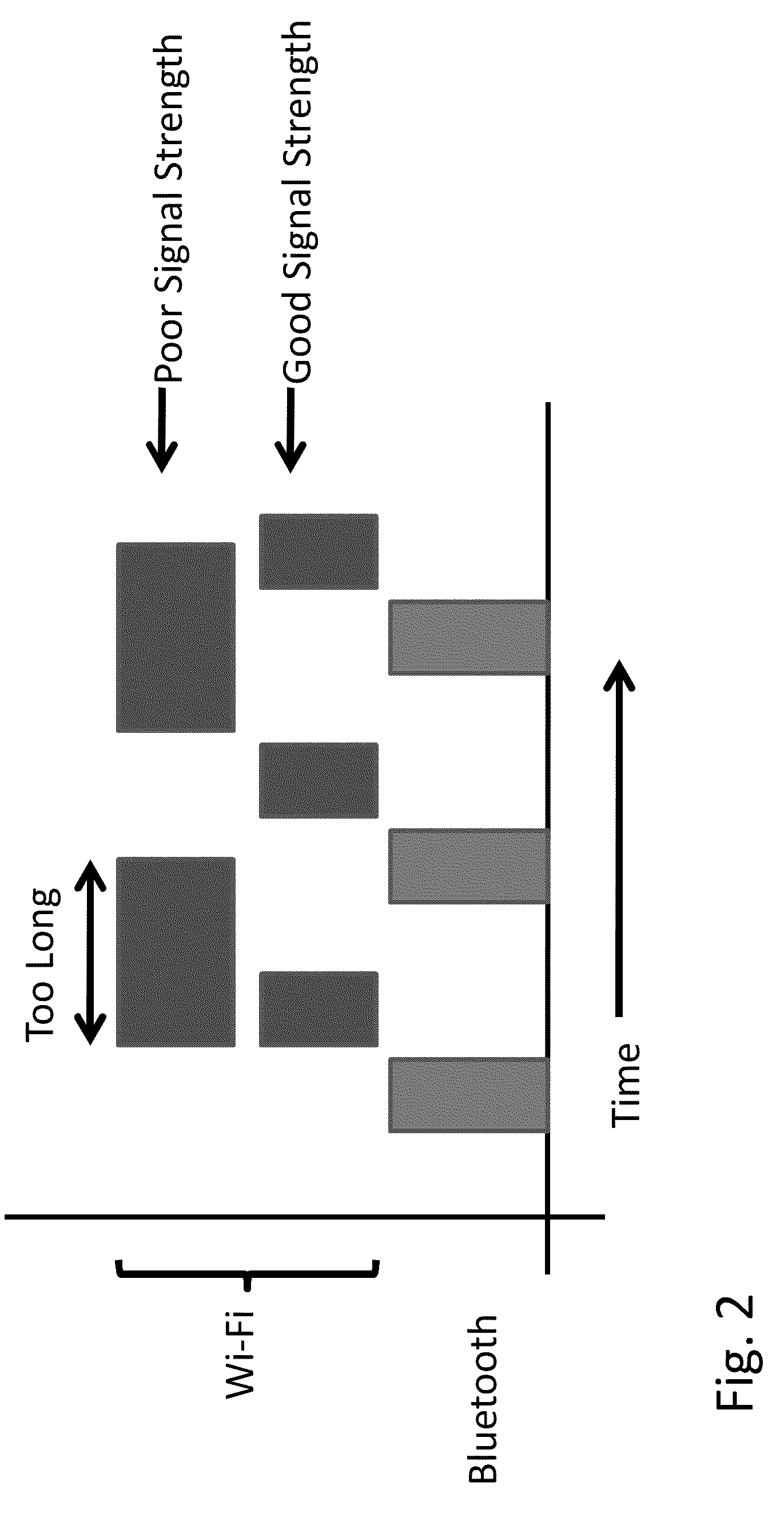
- A communication device with a controller that prioritizes transmissions based on signal strength, allowing higher prioritization for either Wi-Fi or Bluetooth transmissions depending on the signal strength, ensuring that critical Wi-Fi packets are maintained during low signal conditions to prevent link termination.

Transceivers with adjustable cell sizes
PatentPendingUS20240205848A1
Innovation
- A controller is used to adjust the cell size of WLAN and Bluetooth transceivers to minimize interference, allowing for optimized cell size adjustments by reducing transmit power, transmission rates, or duty cycles, enabling parallel operation while protecting Bluetooth transceivers from WLAN interference.


Interference Management in Wireless Gaming Environments
Interference management represents one of the most critical challenges in wireless gaming environments, where multiple devices compete for limited spectrum resources. The proliferation of wireless gaming peripherals, including controllers, headsets, keyboards, and mice, has created increasingly congested radio frequency environments that can significantly impact gaming performance and user experience.
The 2.4 GHz ISM band, commonly utilized by both proprietary wireless controllers and Bluetooth devices, experiences substantial interference from various sources. Wi-Fi networks operating on overlapping channels, microwave ovens, cordless phones, and other household electronics contribute to a complex interference landscape. This congestion is particularly problematic in dense urban environments and gaming tournaments where hundreds of devices may operate simultaneously within close proximity.
Proprietary wireless gaming controllers typically employ frequency-hopping spread spectrum techniques and adaptive channel selection algorithms to mitigate interference. These systems can dynamically switch between available channels when interference is detected, often within milliseconds. Advanced implementations utilize real-time spectrum analysis to identify clean frequency bands and maintain stable connections even in heavily congested environments.
Bluetooth technology faces unique interference challenges due to its standardized protocol constraints. While Bluetooth 5.0 and later versions incorporate improved coexistence mechanisms, including adaptive frequency hopping and interference detection algorithms, the protocol's inherent limitations can result in degraded performance when multiple Bluetooth devices operate concurrently. The master-slave architecture of Bluetooth piconets can create bottlenecks in multi-device gaming scenarios.
Modern interference mitigation strategies include temporal coordination between devices, spatial diversity through antenna design optimization, and power management techniques that reduce overall electromagnetic footprint. Machine learning algorithms are increasingly being deployed to predict interference patterns and proactively adjust transmission parameters, representing a significant advancement in wireless gaming technology resilience.
The 2.4 GHz ISM band, commonly utilized by both proprietary wireless controllers and Bluetooth devices, experiences substantial interference from various sources. Wi-Fi networks operating on overlapping channels, microwave ovens, cordless phones, and other household electronics contribute to a complex interference landscape. This congestion is particularly problematic in dense urban environments and gaming tournaments where hundreds of devices may operate simultaneously within close proximity.
Proprietary wireless gaming controllers typically employ frequency-hopping spread spectrum techniques and adaptive channel selection algorithms to mitigate interference. These systems can dynamically switch between available channels when interference is detected, often within milliseconds. Advanced implementations utilize real-time spectrum analysis to identify clean frequency bands and maintain stable connections even in heavily congested environments.
Bluetooth technology faces unique interference challenges due to its standardized protocol constraints. While Bluetooth 5.0 and later versions incorporate improved coexistence mechanisms, including adaptive frequency hopping and interference detection algorithms, the protocol's inherent limitations can result in degraded performance when multiple Bluetooth devices operate concurrently. The master-slave architecture of Bluetooth piconets can create bottlenecks in multi-device gaming scenarios.
Modern interference mitigation strategies include temporal coordination between devices, spatial diversity through antenna design optimization, and power management techniques that reduce overall electromagnetic footprint. Machine learning algorithms are increasingly being deployed to predict interference patterns and proactively adjust transmission parameters, representing a significant advancement in wireless gaming technology resilience.
Power Efficiency vs Signal Range Trade-offs
The fundamental trade-off between power efficiency and signal range represents one of the most critical engineering challenges in wireless controller design. Traditional wireless controllers operating on proprietary 2.4GHz protocols typically consume 15-25mW during active gaming sessions, while Bluetooth Low Energy (BLE) implementations can achieve power consumption as low as 1-5mW. However, this power reduction comes at the cost of reduced transmission power and consequently shorter effective range.
Wireless controllers employing proprietary protocols can achieve transmission ranges of 10-12 meters in optimal conditions by utilizing higher power amplifiers and more aggressive transmission schemes. These systems often operate at transmission powers ranging from 10-20dBm, enabling robust signal penetration through obstacles and maintaining stable connections even in electromagnetically noisy environments. The power budget allocation typically dedicates 60-70% of total consumption to RF transmission components.
Bluetooth controllers, particularly those implementing BLE 5.0 and later standards, face inherent limitations in transmission power due to protocol specifications and power class restrictions. Class 2 Bluetooth devices are limited to 4dBm transmission power, resulting in theoretical ranges of 6-8 meters under ideal conditions. Real-world performance often degrades to 3-5 meters in typical gaming environments with furniture and wall obstructions.
The power efficiency advantage of Bluetooth becomes apparent in battery life metrics. Bluetooth controllers can achieve 40-80 hours of continuous operation compared to 20-40 hours for proprietary wireless solutions. This efficiency stems from sophisticated power management protocols, including connection interval optimization, adaptive frequency hopping with reduced duty cycles, and intelligent sleep mode implementations that can reduce standby power to microamp levels.
Recent developments in adaptive power management present promising solutions to this traditional trade-off. Dynamic transmission power scaling allows controllers to automatically adjust output power based on real-time signal quality measurements and distance estimation algorithms. These systems can operate at reduced power levels for close-range gaming while boosting transmission power when extended range is detected as necessary.
Advanced antenna design and MIMO implementations are emerging as key differentiators in overcoming range limitations without proportional power increases. Beamforming techniques and diversity reception can improve effective range by 20-30% while maintaining power consumption within acceptable limits, though these solutions add complexity and cost to controller designs.
Wireless controllers employing proprietary protocols can achieve transmission ranges of 10-12 meters in optimal conditions by utilizing higher power amplifiers and more aggressive transmission schemes. These systems often operate at transmission powers ranging from 10-20dBm, enabling robust signal penetration through obstacles and maintaining stable connections even in electromagnetically noisy environments. The power budget allocation typically dedicates 60-70% of total consumption to RF transmission components.
Bluetooth controllers, particularly those implementing BLE 5.0 and later standards, face inherent limitations in transmission power due to protocol specifications and power class restrictions. Class 2 Bluetooth devices are limited to 4dBm transmission power, resulting in theoretical ranges of 6-8 meters under ideal conditions. Real-world performance often degrades to 3-5 meters in typical gaming environments with furniture and wall obstructions.
The power efficiency advantage of Bluetooth becomes apparent in battery life metrics. Bluetooth controllers can achieve 40-80 hours of continuous operation compared to 20-40 hours for proprietary wireless solutions. This efficiency stems from sophisticated power management protocols, including connection interval optimization, adaptive frequency hopping with reduced duty cycles, and intelligent sleep mode implementations that can reduce standby power to microamp levels.
Recent developments in adaptive power management present promising solutions to this traditional trade-off. Dynamic transmission power scaling allows controllers to automatically adjust output power based on real-time signal quality measurements and distance estimation algorithms. These systems can operate at reduced power levels for close-range gaming while boosting transmission power when extended range is detected as necessary.
Advanced antenna design and MIMO implementations are emerging as key differentiators in overcoming range limitations without proportional power increases. Beamforming techniques and diversity reception can improve effective range by 20-30% while maintaining power consumption within acceptable limits, though these solutions add complexity and cost to controller designs.
Unlock deeper insights with PatSnap Eureka Quick Research — get a full tech report to explore trends and direct your research. Try now!
Generate Your Research Report Instantly with AI Agent
Supercharge your innovation with PatSnap Eureka AI Agent Platform!