
Tone spell input method
A pinyin input and tone technology, applied in the input/output process of data processing, instruments, electrical digital data processing, etc.
Patent Information
- Authority / Receiving Office
- CN · China
- Patent Type
- Applications(China)
- Current Assignee / Owner
- Publication Date
- 2008-10-08
- Estimated Expiration
- Not applicable · inactive patent
Smart Images
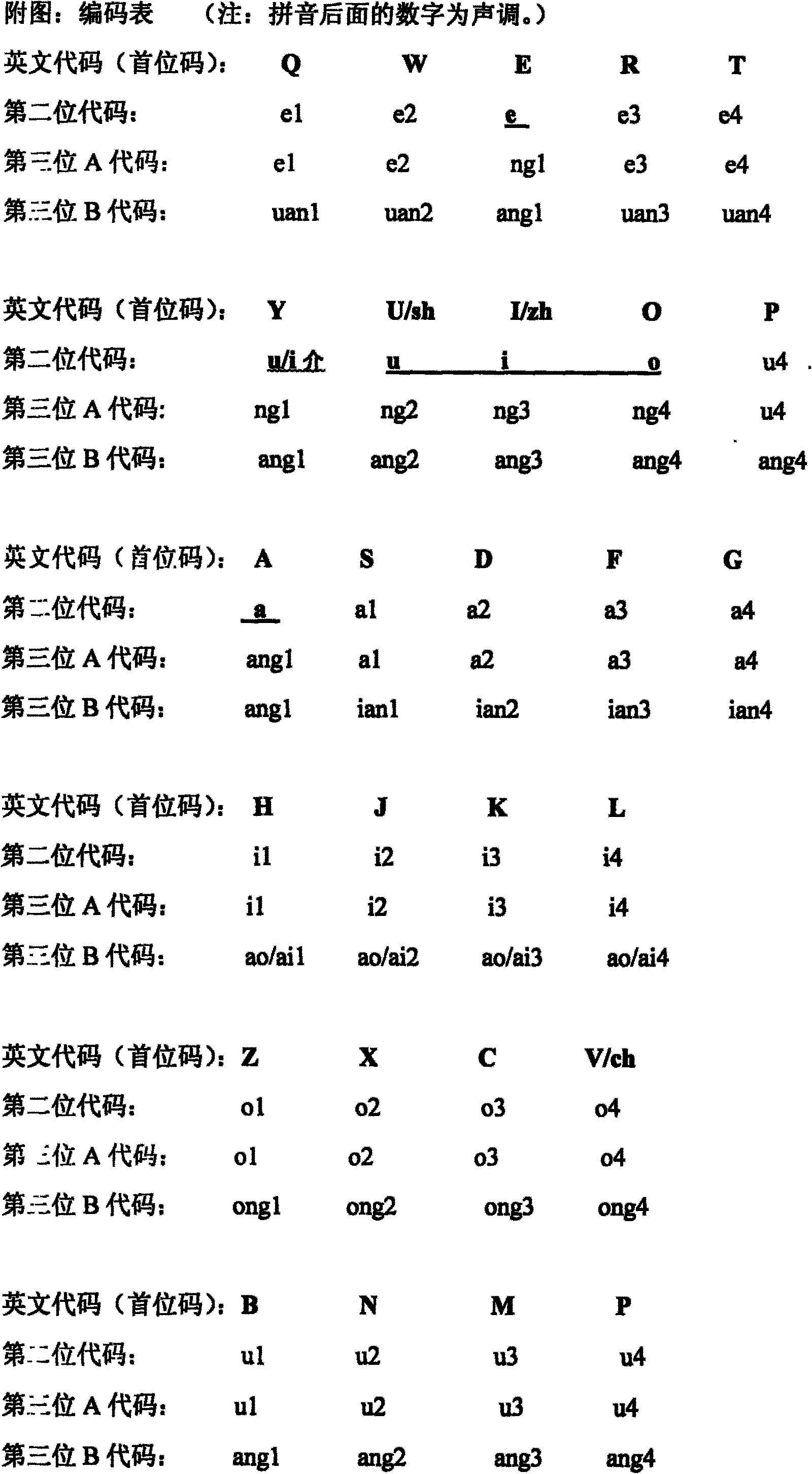
Figure 1
Abstract
Description
technical field
[0001] The invention relates to a computer pinyin input method, in particular to a pinyin input method which performs integrated encoding of pinyin and tones to realize synchronous input of pinyin and tones. Background technique
[0002] In the prior art, the commonly used pinyin input methods include Quanpin and Shuangpin. It is well known that the pinyin input methods developed on the basis of these two pinyin methods are high because they do not distinguish the tones. Repeat code rate. In several disclosed related band-tone pinyin input methods such as <rhythmic pinyin input method> etc., that is to say, to distinguish the tones by specifying a certain position vowel or using certain numbers, letters, key rows, etc., but all Focusing only on how to input the tones, it has not been able to fully optimize the tonal input of Pinyin, and has failed to achieve the purpose of wide use. Contents of the invention
[0003] In order to overcome the deficie...
Examples
Embodiment 1
[0080] Embodiment one is first coding and input setting: the first coding is the first input code of all pinyin, the present invention is that so initial consonant can only be a letter to the requirement of first input code, so double initial consonant ch / Sh / zh needs to be set as a one-digit code. The setting method is to use ch / sh / zh as h or use V / U / I to code. In addition, all other pinyins use the first letter as the first input code.
Embodiment 2
[0081] Embodiment two is the second encoding and input setting, and the second encoding all selects 26 letters as the code. Respectively set code five main finals a / e / i / o / u / respective four groups of tone codes, five main finals a / e / i / o / u / respective silent tone codes and medial finals u / i the code:
[0082] Set code positions of the four groups of tone codes of the five main finals a / e / i / o / u / respectively:
[0083] a a1=S a2=D a3=F a4=G
[0084] e e1=Q e2=W e3=R e4=T
[0085] i i1=H i2=J i3=K i4=L
[0086] o o1=Z o2=X o3=C o4=V
[0087] u u1=B u2=N u3=M u4=P
[0088] the silent tone code position of five main finals a / e / i / o / u / is set as the original position:
[0089] a=A e=E i=I o=O u=U
[0090] the code of intermediate vowel u / i is set to Y: u / i intermediary=Y
[0091] The input setting of the second digit is different according to different pinyin types. The general requirement is that the last digit is the code with tone, otherwise if the s...
Embodiment 3
[0113] Embodiment three is the coding of the 3rd and input setting: the 3rd code is the last tone code of B class phonetic, according to the different end modes of B1B2 two kinds of phonetics, two groups of different band tone codes are set, two Group codes all use 26 letters as codes, that is to say, no matter choosing any code for the 3rd position, it means that the band tone input of pinyin has been completed, and the next letter represents the input of the first letter of pinyin.
[0114] Coding and input setting of the third of B1 pinyin: B1 pinyin means that the second letter must be input with five main finals a / e / i / o / u / without tone codes After inputting the second letter, the only remaining letters are a / e / i / o / u / n / ng (n is regarded as the repetition of the previous letter) these six groups of letters, so only To complete the three-digit code input, set their respective four groups of third-digit code positions.
[0115] a a1=S a2=D a3=F a4=G
[0116] e e1=Q...