
Adjustable golf club
- Summary
- Abstract
- Description
- Claims
- Application Information
AI Technical Summary
Benefits of technology
Problems solved by technology
Method used
Image

Examples
Embodiment Construction
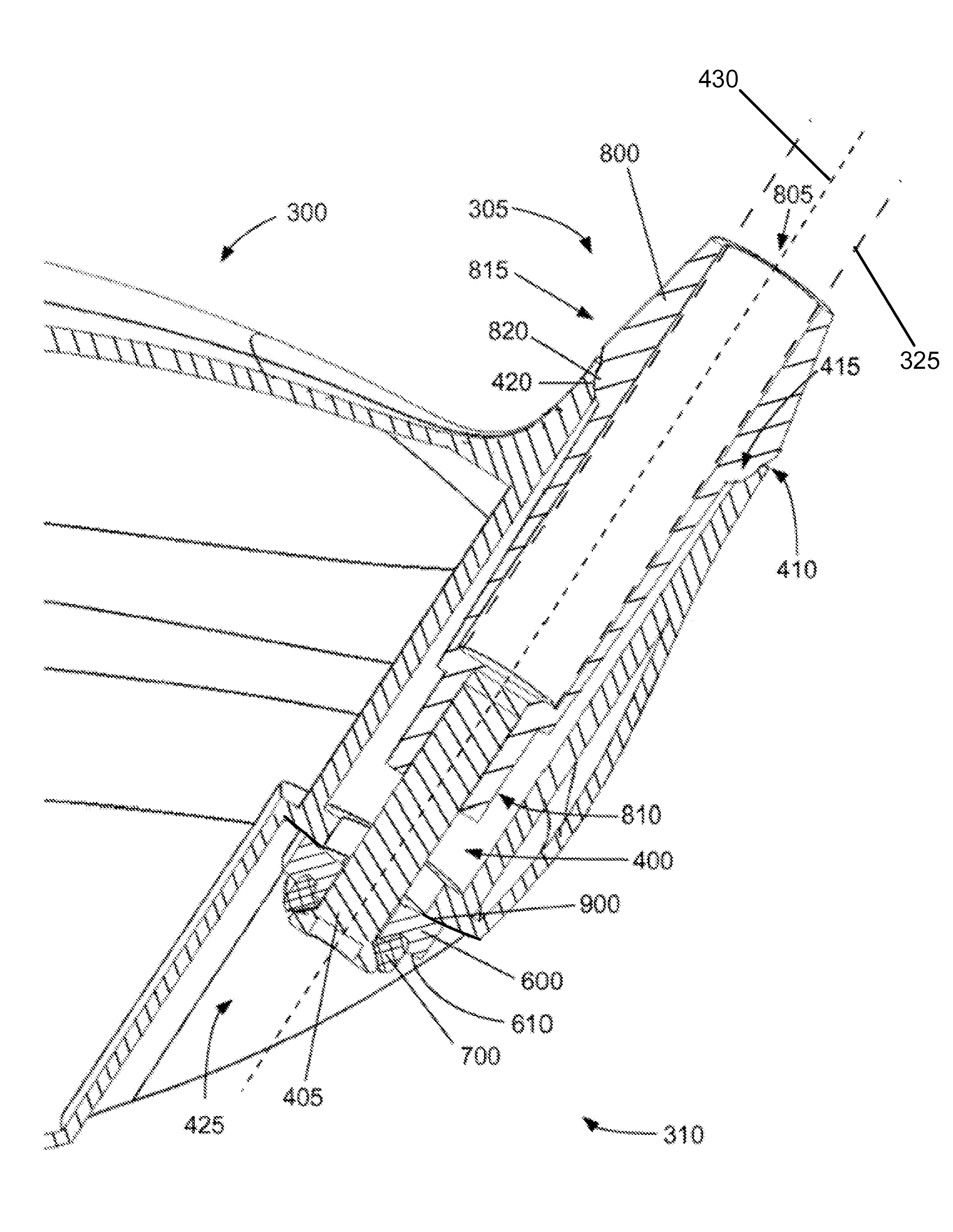
[0038]Embodiments of the present invention relate generally to golf clubs, and more particularly to adjustable golf clubs. In some embodiments, a golf club can be adjusted by moving sliders located proximate the heel of the club head. The sliders can be in communication with the shaft of the club, enabling the sliders to reposition the shaft with respect to the club head, which enables adjustment of the club. In some embodiments, a user can loosen a fastener, reposition the sliders, and tighten the fastener to rigidly lock the club in place. In this manner, the user can adjust the club.
[0039]Embodiments of the present invention can comprise a cavity with a substantially spherical surface on which the one or more sliders can slide. The spherical surface can have its origin at the center of rotation of the shaft, i.e., the point about which the shaft pivots when being adjusted. The spherical shape of the surface can enable the force applied by the sliders to be normal, or axial, to th...
PUM
 Login to View More
 Abstract
Description
Claims
Application Information
 Login to View More