

Resonator for a vibratory sensor of an angular parameter
a vibratory sensor and angular parameter technology, applied in the direction of generator/motor, acceleration measurement using interia forces, instruments, etc., can solve the problems of reducing the performance of the resonator, reducing the quality of the resonator, and reducing the mechanical damping and electrical damping.
Patent Information
- Authority / Receiving Office
- US · United States
- Patent Type
- Patents(United States)
- Current Assignee / Owner
- Publication Date
- 2013-07-23
Smart Images
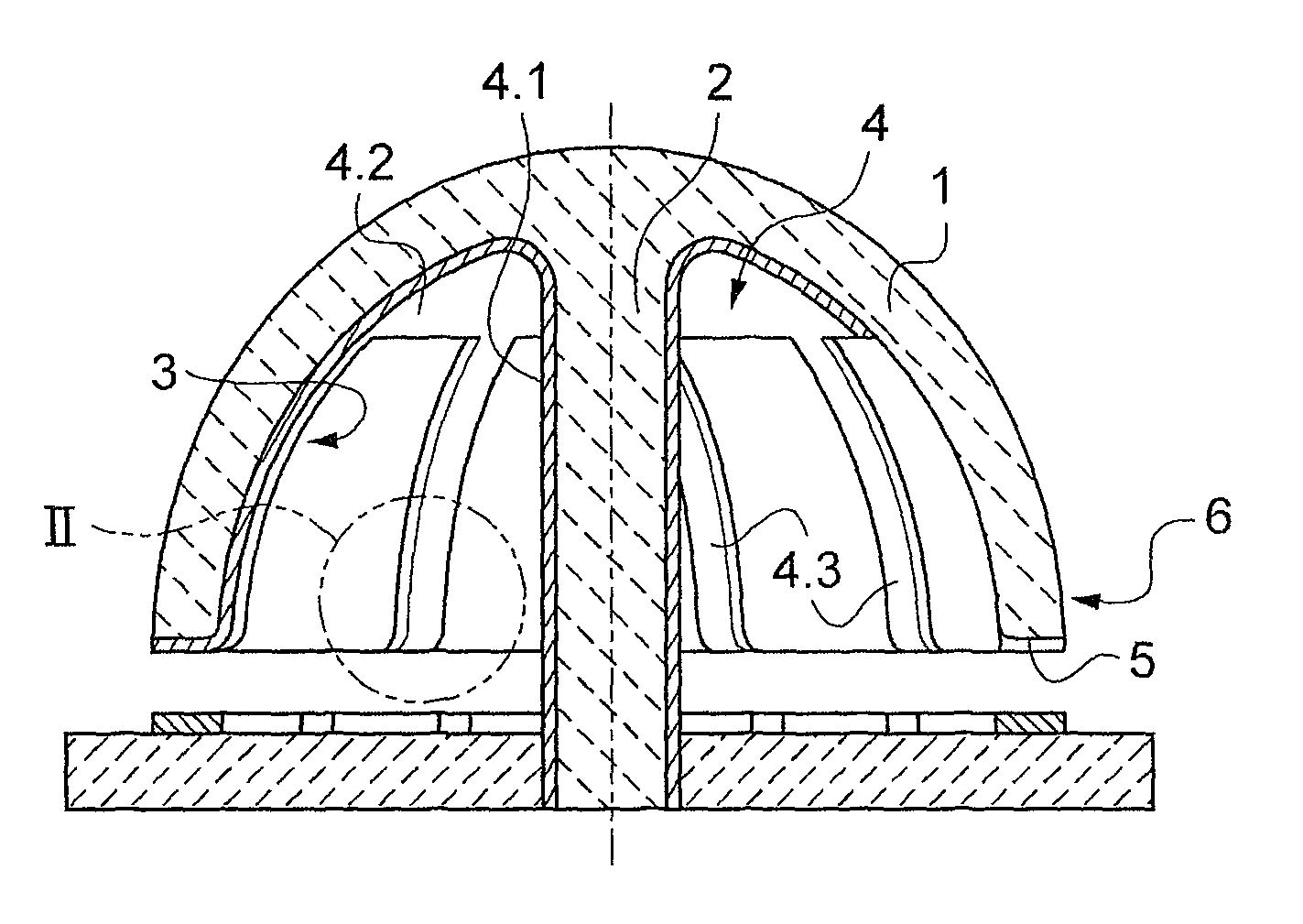
Figure 1 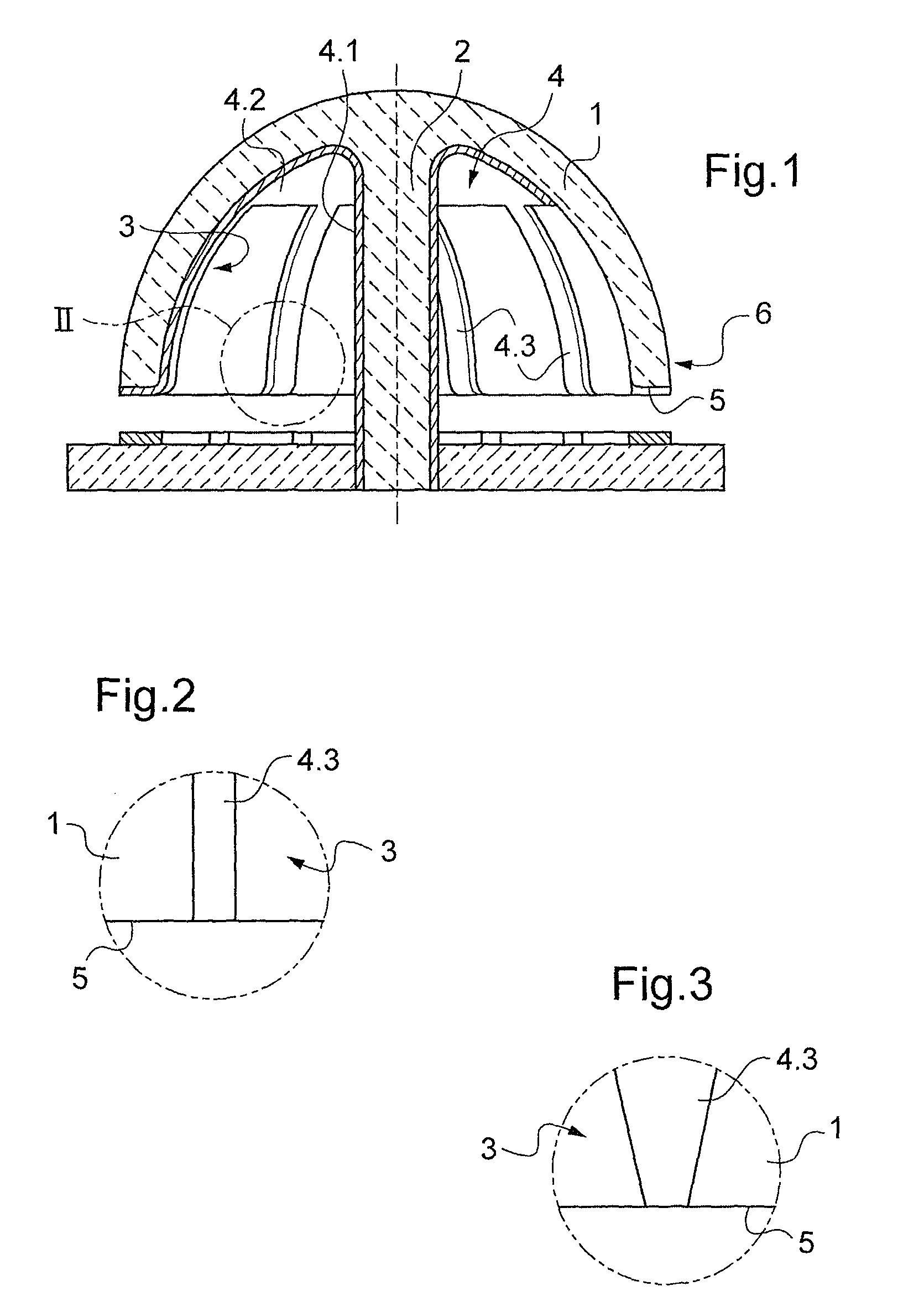
Figure 2
Abstract
Description
[0001] This Nonprovisional application claims priority of Provisional Application No. 61 / 172,480, filed on Apr. 24, 2009, under 35 U.S.C. 1.119(e), the entire contents of which are hereby incorporated by reference.
[0002] The present invention relates to a resonator for a vibratory sensor of an angular parameter, such as a rate gyro or a free gyro.BACKGROUND OF THE INVENTION
[0003] In general, a resonator for a rate gyro or a free gyro comprises a hemispherical bell provided with a central stem that is fastened to a bell support part. The bell is made of an electrically-insulating material and is uniformly coated in an electrically-conductive layer so as to define electrodes at a peripheral edge of the bell, which electrodes face electrodes on a support part. The electrodes are powered to cause the bell to be deformed into an ellipse and in order to detect the orientation of the ellipse. The material used for the bell is generally silica that guarantees accuracy for the sensor by virtue ...
Examples
Embodiment Construction
[0022]With reference to FIGS. 1 and 2, the resonator of the invention is intended for use in known manner in an angular parameter sensor such as a free gyro or a rate gyro, both of which are devices that are known in themselves and neither the structure nor the operation thereof is described herein.
[0023]The resonator in accordance with the invention comprises a bell 1 of hemispherical shape provided at its center with a stem 2 that projects from the inside surface 3 of the bell 1. The bell 1 and the stem 2 are made by machining silica.
[0024]The resonator comprises a conductive layer given overall reference 4 and comprising a portion 4.1 covering the stem 2, an annular central portion 4.2 extending the portion 4.1 around the base of the stem 2, and seven branches 4.3 extending from the portion 4.2 to the peripheral edge 5 of the bell 1. The branches 4.3 extend substantially along meridians of the bell 1 and in this example they have parallel longitudinal edges. The width of the bran...