

Lateral stress sensing system based on double-mode photon cystal coptical fibre and implementing method
A technology of photonic crystal fiber and transverse stress, which is applied in the direction of transmitting sensing components, clad optical fibers, optical waveguides and light guides with optical devices, and can solve the difficulty of transverse stress detection and the absence of photonic crystal fiber transverse stress sensing and Detection and other issues
Patent Information
- Authority / Receiving Office
- CN · China
- Patent Type
- Patents(China)
- Current Assignee / Owner
- Publication Date
- 2008-06-04
- Estimated Expiration
- Not applicable · inactive patent
Smart Images
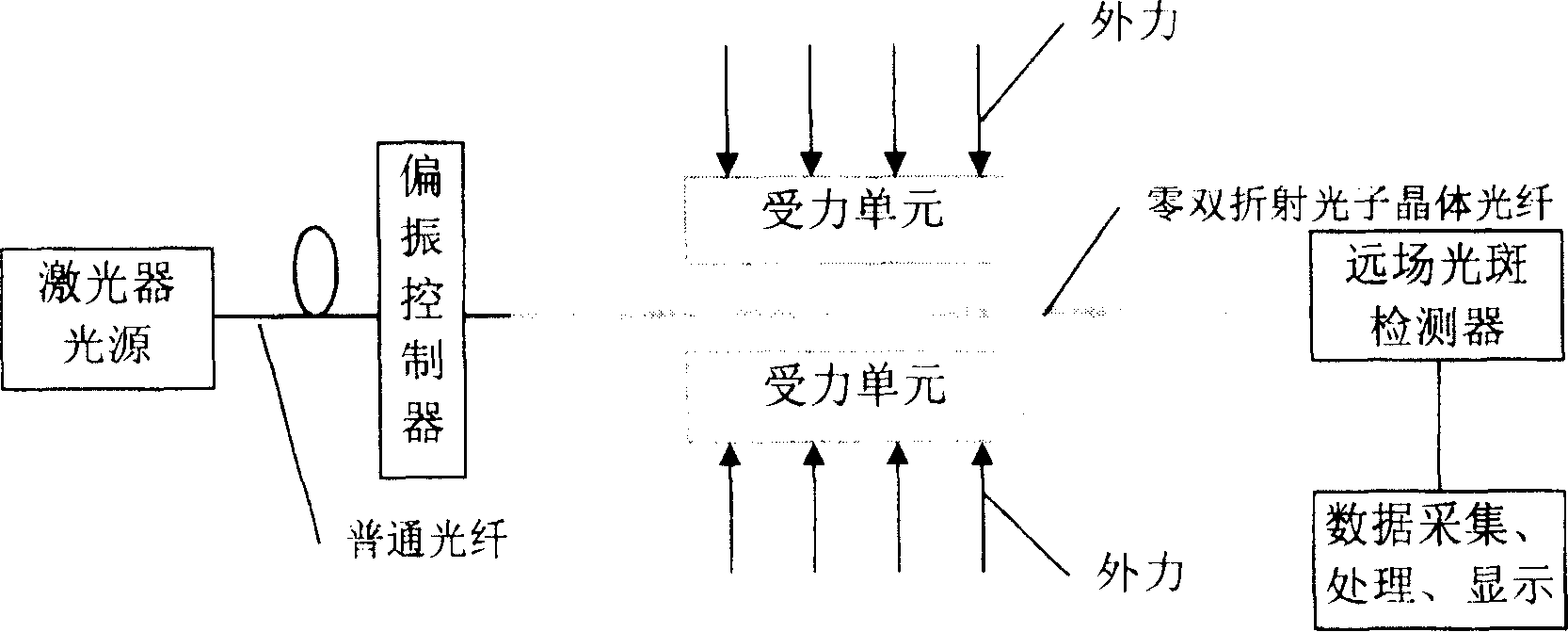
Figure 1 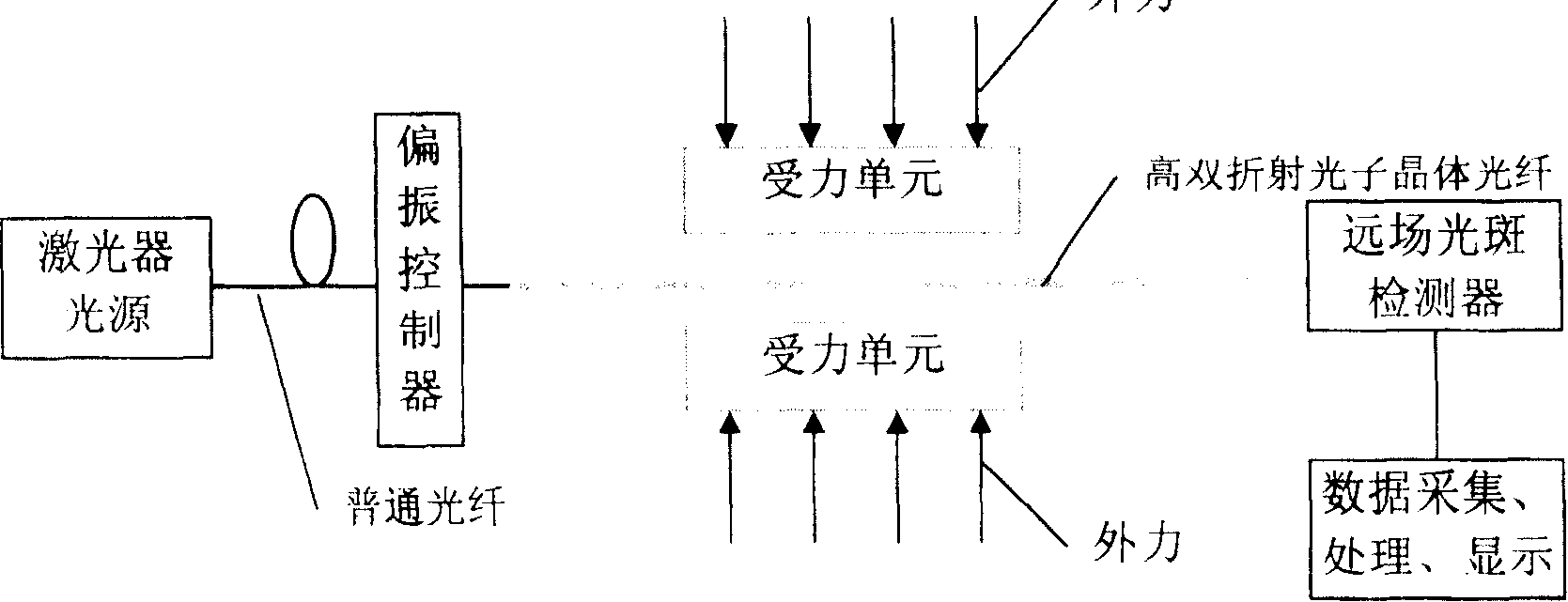
Figure 2 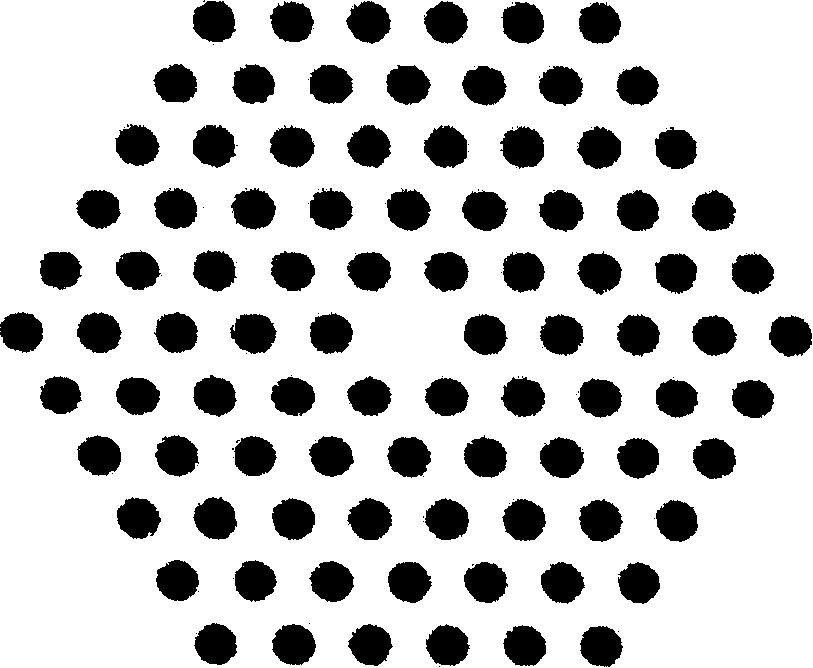
Figure 3
Abstract
Description
technical field
[0001] The present invention relates to an accurate and sensitive fiber optic sensing system to measure transverse stress or strain, especially transverse stress based on a dual-mode photonic crystal fiber based on a zero-birefringence dual-mode photonic crystal fiber or a high-birefringence dual-mode photonic crystal fiber (Strain) sensing system and implementation method. Background technique
[0002] The safety and quality monitoring of buildings is mainly to detect the stress and deformation under the action of external force. The general detection method is to install a large number of distributed strain gauges or other strain-sensing fibers in the building materials. Since the composite structure composed of fiber materials and building materials can properly improve the strength of building materials, the use of composite fiber materials for building loads Deformation detection is a relatively common method. Embed optical fibers in building materials...
Examples
Embodiment 1
[0064] Embodiment 1; Zero birefringence dual-mode photonic crystal fiber transverse stress (strain) sensing system;
[0065] attached figure 1As shown, the optical fiber in the figure is a zero-birefringence photonic crystal fiber, and the output light wavelength of the laser light source is 633nm. The optical fiber at this wavelength is in a dual-mode working state, supporting fundamental mode and second-order even mode; In the detection area, after the polarization controller, only the fundamental mode and the second-order even mode of polarization in the x direction remain; the dislocation is coupled into the photonic crystal fiber, and after the dislocation displacement is adjusted, the power of the fundamental mode and the second-order even mode are nearly equal; Under the action of transverse stress, it passes through the optical fiber and outputs it to the far-field spot detector (which can be a high-sensitivity CCD array), and converts the spatial light intensity dist...
Embodiment 2
[0066] Embodiment 2; High birefringence dual-mode photonic crystal fiber transverse stress (strain) sensing system;
[0067] attached figure 2 As shown, the optical fiber in the figure is a high birefringence photonic crystal fiber, and the output light wavelength of the laser light source is 1310nm. The optical fiber at this wavelength is in a dual-mode working state, supporting fundamental mode and second-order even mode; In the detection area, after the polarization controller, only the fundamental mode and the second-order even mode of polarization in the y direction remain; the dislocation is coupled into the photonic crystal fiber, and after the dislocation displacement is adjusted, the power of the fundamental mode and the second-order even mode are nearly equal; Under the action of transverse stress, it passes through the optical fiber and outputs it to the far-field spot detector (which can be a high-sensitivity CCD array), and converts the spatial light intensity di...
Embodiment 3
[0070] attached image 3 , 4 , 5 are three typical zero-birefringence dual-mode photonic crystal fibers, where the two polarization components of the fundamental mode (attached Figure 7 ) without birefringence, the second-order mode includes four approximately degenerate modes (attached Figure 8 ), the second-order mode transmitted in the actual fiber is composed of these four modes. Therefore, when transmitting in the fiber, the spot direction of the second-order mode rotates randomly. A polarization controller is added to the fiber input end to keep only light polarized in one direction transmitted in the fiber. In this way, only one component of the fundamental mode is transmitted, and only one polarization direction of light can be transmitted in the second-order mode, and the direction of the light spot is no longer rotated. A stable mode field can be formed.
[0071] The external force is applied to the transverse direction of the zero birefringence photonic crystal...