
sealing profile
A profile and elastic material technology, applied in the direction of engine seals, aircraft accessories, engine components, etc., to ensure the effect of impermeability
Patent Information
- Authority / Receiving Office
- CN · China
- Patent Type
- Applications(China)
- Current Assignee / Owner
- Publication Date
- 2011-12-28
- Estimated Expiration
- Not applicable · inactive patent
Smart Images
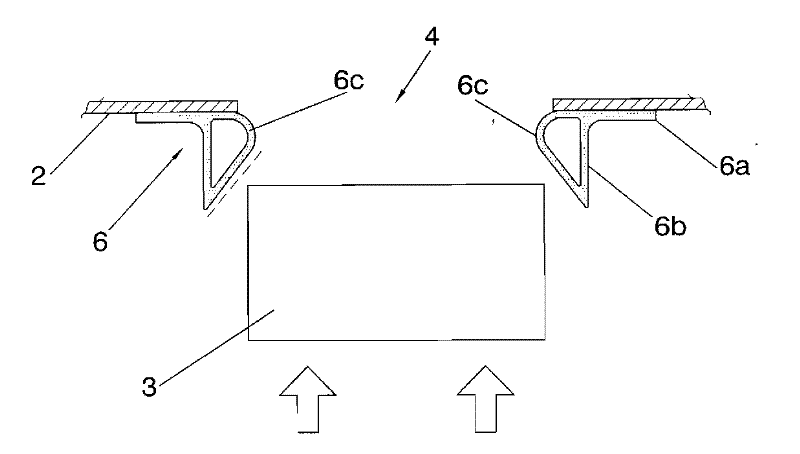
Figure 1 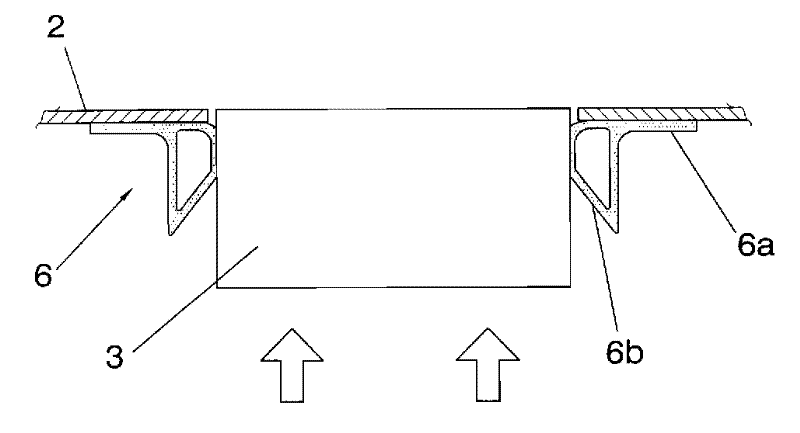
Figure 2 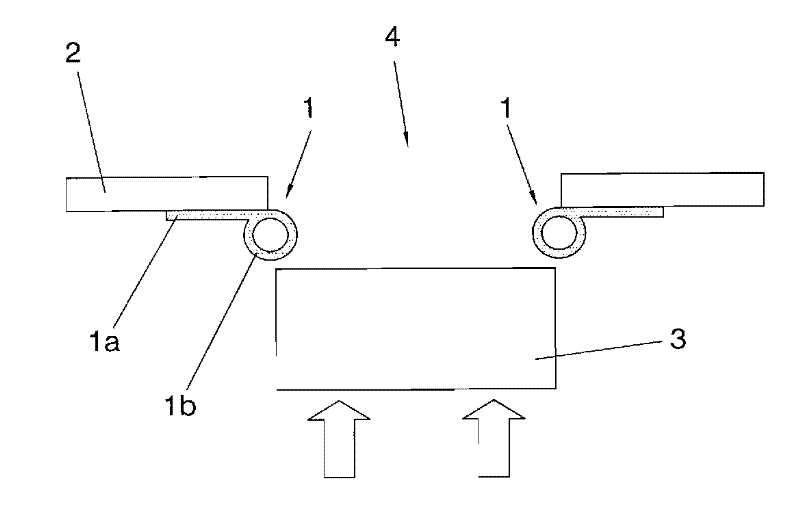
Figure 3
Abstract
Description
technical field
[0001] As stated in the title of this descriptive description, the present invention relates to a sealing profile for achieving fitting and sealing between two elements; and its purpose is to facilitate said fitting and sealing, all of which in a way that prevents any loss of impermeability.
[0002] In general, the invention can be applied to any sector of industry where it is necessary to achieve an assembled and impermeable connection between two elements, and in particular it can be applied to the aeronautical industry in order to achieve the formation of aerodynamic The connection and sealing between the various elements of the lining components. Background technique
[0003] In the field of aeronautical structural design, it is necessary to ensure the fit and seal between elements whose outer surfaces form aerodynamic surfaces. An example of such a coupling is that when the auxiliary power unit (APU, usually installed in the aircraft) is in operation ...
Examples
Embodiment Construction
[0020] The present invention is described below based on the drawings explained above.
[0021] pass figure 1 and 2 , first describe the sealing profile 1 conventionally used to connect the first element 2 and the second element 3, for example in the embodiment the first element 2 comprises an aerodynamic lining 2 equipped with openings 4, with which the sealing profile 1 consisting of the device 3 The second element 3 fits and seals in the opening.
[0022] Thus, the sealing profile is provided with a rectilinear portion, which is fixed on the aerodynamic lining 2 of the first element. The first section 1a terminates in a circular tubular section 1b protruding relative to the first element 2, the tubular section occupying part of the opening 4, as in figure 1 shown in .
[0023] For example, the device 3 may be a device, usually included in the aircraft, that ventilates the APU when the aircraft is stationary on the ground and the APU is activated. Thus, the ventilation ...