
Classification method based on feature library and projection
A classification method and feature library technology, which can be used in instruments, character and pattern recognition, computer parts, etc., and can solve problems such as high computational complexity and large amount of k-NN computation.
Patent Information
- Authority / Receiving Office
- CN · China
- Current Assignee / Owner
- Publication Date
- 2016-09-21
- Estimated Expiration
- Not applicable · inactive patent
Smart Images
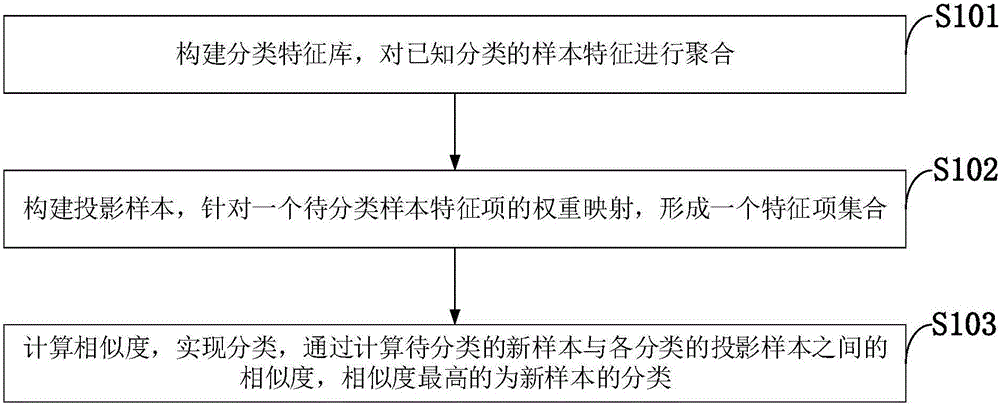
Figure 1 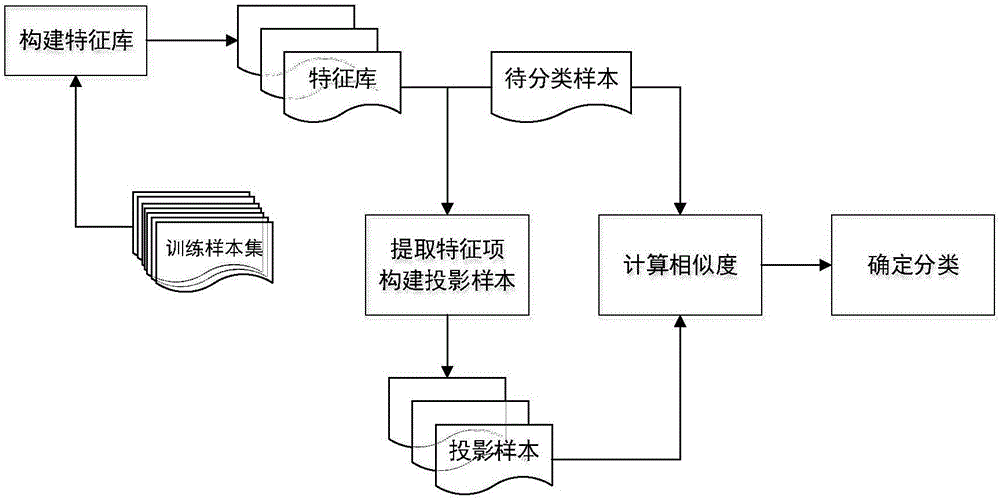
Figure 2 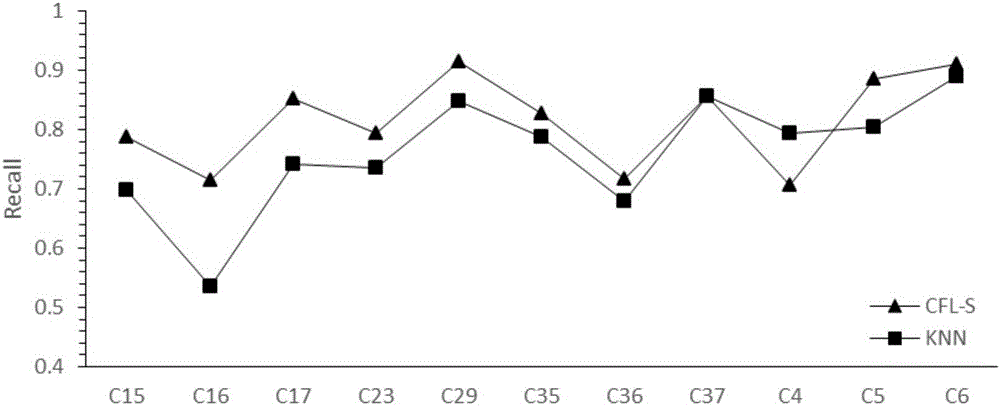
Figure 3
Abstract
Description
technical field
[0001] The invention belongs to the technical fields of data mining, machine learning and pattern recognition, and in particular relates to a classification method based on feature library-projection. Background technique
[0002] Classes are an important research area in data mining, machine learning, and pattern recognition. For example, in text management, classification technology can efficiently classify texts, which is convenient for people to manage and use. At present, the main classification techniques include Support Vector Algorithm (SVM), k-Nearest Neighbor Algorithm (k-NN) and so on. The SVM algorithm finds the support vector for dividing the hyperplane through training, and then completes the classification by calculating the relationship between the sample and the support vector; the k-NN algorithm requires almost no training, but finds the closest new sample to the unknown classification through calculation. There are k known classification ...
Examples
Embodiment Construction
[0039] In order to make the object, technical solution and advantages of the present invention more clear, the present invention will be further described in detail below in conjunction with the examples. It should be understood that the specific embodiments described here are only used to explain the present invention, not to limit the present invention.
[0040] The classification algorithm based on the feature library-projection (CFL-S) of the present invention is proposed to solve the problems that the computational complexity of SVM pre-training is relatively high and the calculation amount of k-NN is too large in the classification process. Based on the idea of statistics, CFL-S found that samples in the same category have a greater probability of having the same feature items than samples in other categories. These feature items are often the features of the category, so the characteristics are formed through the aggregation of samples. library (CFL), the weights of t...