
Three-vector model predictive control method for open-winding permanent magnet synchronous motor with hybrid power supply
A permanent magnet synchronous motor and hybrid power supply technology, which is applied in motor generator control, electronic commutation motor control, motor control, etc., can solve problems such as large torque ripple and increased algorithm complexity
Patent Information
- Authority / Receiving Office
- CN · China
- Patent Type
- Patents(China)
- Current Assignee / Owner
- Publication Date
- 2020-11-24
Smart Images
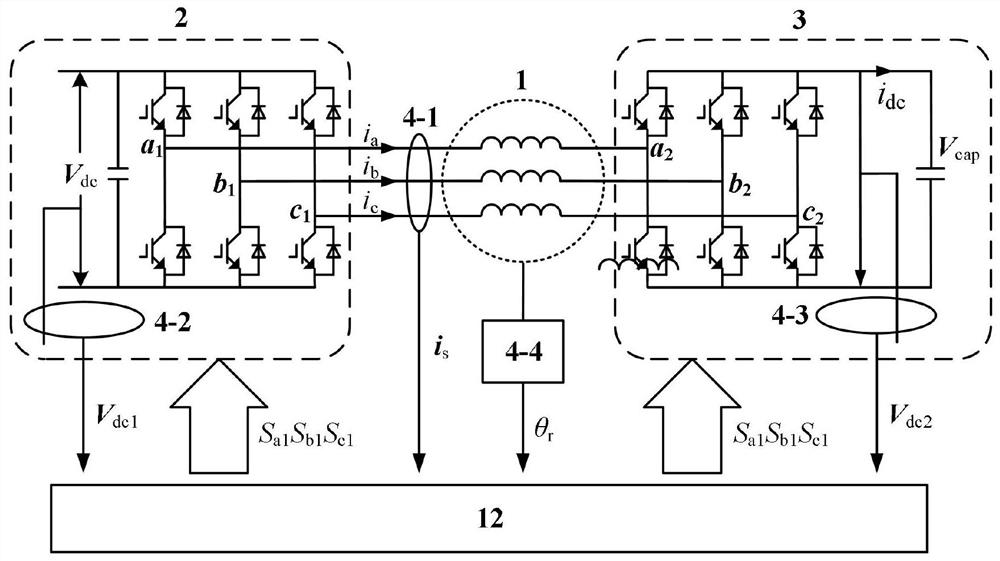
Figure 1 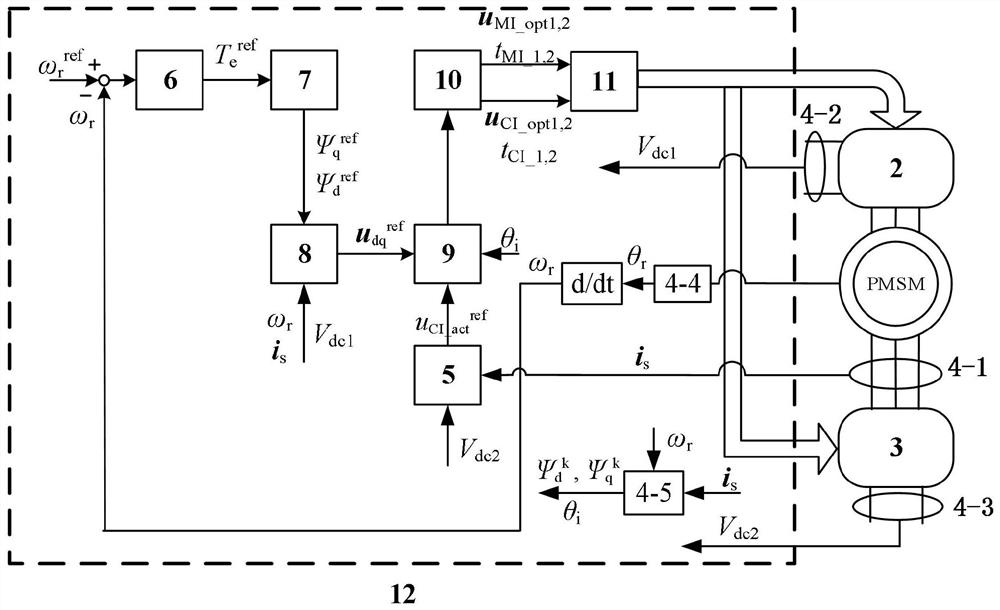
Figure 2 
Figure 3
Abstract
Description
technical field
[0001] The invention belongs to the technical field of motor control, and in particular relates to a fast three-vector model predictive control method based on a hybrid power supply type open-winding permanent magnet synchronous motor. Background technique
[0002] In recent years, due to the advantages of high power factor, simple structure, flexible control and reliable operation, permanent magnet synchronous motors have been widely used in military industry, aerospace, electric vehicles, national economy, industrial and agricultural production and other fields. However, as the power level of the above-mentioned applications continues to increase, a single power electronic converter drive system can no longer meet the performance requirements. For this reason, the open-winding permanent magnet synchronous motor system powered by a new type of double-inverter with double-terminal power supply has attracted extensive attention from scholars and industries at ...
Examples
Embodiment Construction
[0068] In order to describe the present invention more specifically, the technical solution of the present invention will be described in detail below in conjunction with the accompanying drawings and specific embodiments.
[0069] Such as figure 1 As shown, the hybrid power supply type open-winding permanent magnet synchronous motor system of the present invention includes: open-winding permanent magnet synchronous motor 1, main inverter 2, auxiliary inverter 3, three-phase stator current sensor 4-1, main inverter DC source voltage sensor 4-2, auxiliary inverter DC capacitor voltage sensor 4-3, rotor photoelectric encoder 4-4, state observer 4-5 and system control module 12. The system control module 12 takes the output voltage of the dual inverters as the control object, and unifies the three control constraints of the auxiliary inverter DC capacitor voltage balance control, open-winding permanent magnet synchronous motor 1 stator flux linkage amplitude and electromagnetic t...