
Precision die for chip shell
A technology for precision molds and chip casings, applied in the field of precision molds for chip casings, can solve problems such as unreasonable layout, uneven eccentric wall thickness, and insufficient core pulling, so as to solve the problem of large mold structure, good market application value, and use. handy effect
Patent Information
- Authority / Receiving Office
- CN · China
- Patent Type
- Applications(China)
- Current Assignee / Owner
- Publication Date
- 2021-04-02
Smart Images
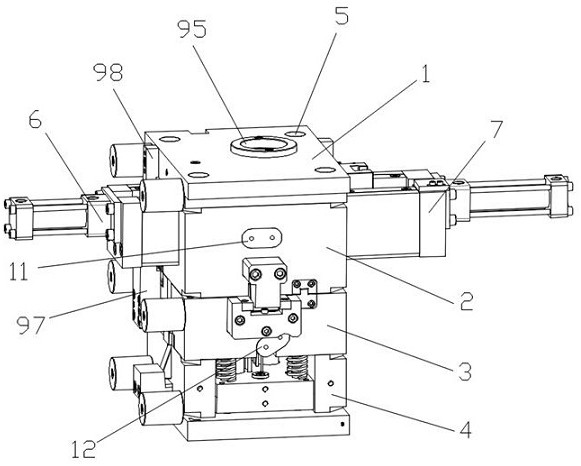
Figure 1 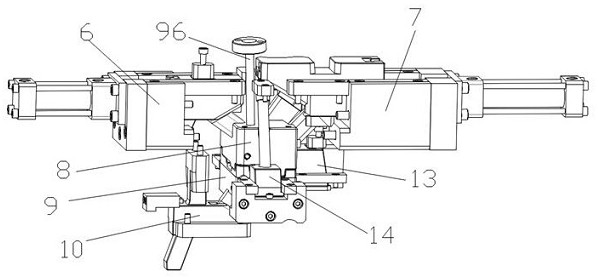
Figure 2 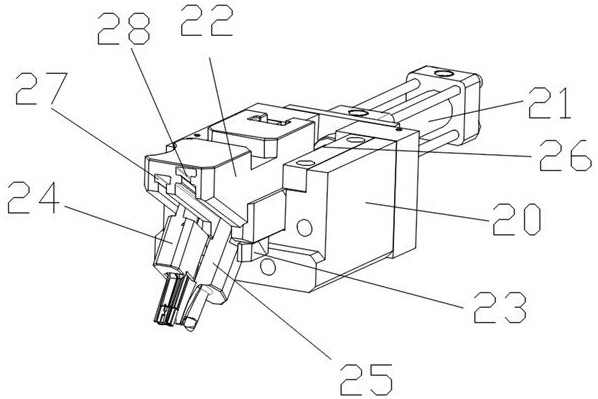
Figure 3
Abstract
Description
technical field
[0001] The invention relates to the field of molds, in particular to a precision mold used for chip shells. Background technique
[0002] Injection molds are commonly used molds in the field of existing product manufacturing, and their usual structures include two-plate molds, three-plate molds, I-shaped molds and straight body molds. In the production of injection molding products, the step of core pulling is often involved, and the core pulling methods vary widely, one of which is oblique hole core pulling. In the current market, the slanted holes of products continue to diversify. When injecting parts with multi-directional slanted holes, if there are buckles inside the workpiece, a backhoe is required, which will cause the entire mold structure to be huge, especially when processing small-sized workpieces. It is difficult to meet the structural needs; for a long time, the backhoe of the slider and the layout of the inclined guide pillars have interfered ...
Examples
Embodiment Construction
[0026] In order to facilitate the understanding of the present invention, the present invention will be described in more detail below in conjunction with the accompanying drawings and specific embodiments. Preferred embodiments of the invention are shown in the accompanying drawings. However, the present invention can be implemented in many different forms and is not limited to the embodiments described in this specification. On the contrary, these embodiments are provided to make the understanding of the disclosure of the present invention more thorough and comprehensive.
[0027] It should be noted that when an element is referred to as being “fixed” to another element, it can be directly on the other element or there can also be an intervening element. When an element is referred to as being "connected to" another element, it can be directly connected to the other element or intervening elements may also be present. The terms "vertical", "horizontal", "left", "right", "f...