

One-shot Face Recognition Method Based on Sparse Representation of Hybrid Extended Block Dictionary
A hybrid extension and sparse representation technology, which is applied in character and pattern recognition, unstructured text data retrieval, image enhancement, etc., can solve the problems of lack of discrimination, lack of consistency, poor face recognition effect, etc., to eliminate Redundant information between pixels, reducing the atomic dimension of the dictionary, and facilitating accurate recognition
Patent Information
- Authority / Receiving Office
- CN · China
- Patent Type
- Patents(China)
- Current Assignee / Owner
- Publication Date
- 2022-02-08
Smart Images
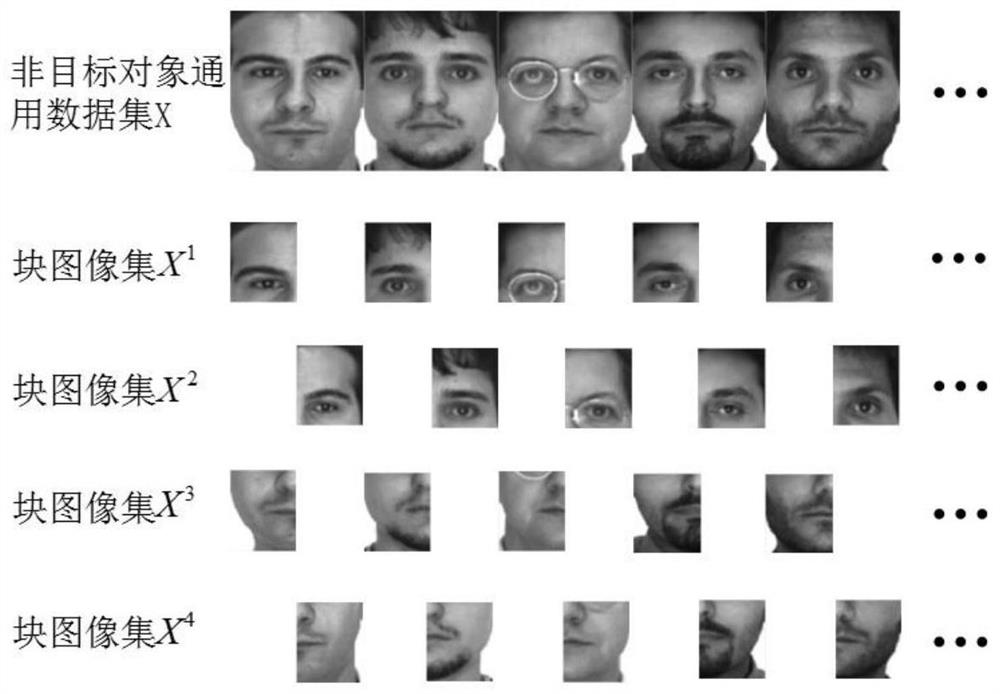
Figure 1 
Figure 2 
Figure 3
Abstract
Description
technical field
[0001] The invention relates to the technical field of single-sample face recognition in which only one or a small number of standard samples are identified in human-computer interaction, and in particular to a single-sample face recognition method based on the sparse representation of a hybrid extended block dictionary. Background technique
[0002] In recent years, due to the rapid development of technologies such as artificial intelligence, computer vision, and Internet of Things communications, face recognition technology has been widely used in real life, such as smart home appliances, smart retail, and smart monitoring. However, in some application scenarios, due to the limitation of storage space and personal privacy protection, some face recognition systems only include one or a small number of frontal standard images of each person (that is, those that are not disturbed by external factors such as illumination, expression, and occlusion). Frontal ima...
Examples
Embodiment 1
[0089] Embodiment 1: Experiment in CAS-PEAL database:
[0090] first as figure 1 The building blocks shown, figure 1 Take B=4:
[0091] The CAS-PEAL face database contains 1040 types of people, a total of 99594 face images (including 595 males and 445 females). All images are collected in a special collection environment, covering four main changing conditions of posture, expression, decoration and illumination. Some face images have changes in background, distance and time span. The present invention selects 9031 images among them for experiments, some sample images such as image 3 As shown, the image size is 120×100 pixels.
[0092] On the CAS-PEAL database, the standard dataset of target objects, the general dataset of non-target objects, the occlusion dataset and the intra-class change dataset are designed as follows:
[0093] (1) The general dataset of non-target objects includes 180 types of people with changing lighting and 80 types of people with changing express...
Embodiment 2
[0107] Example 2: Experiment on the AR database:
[0108] Same as embodiment 1 first as figure 1 The building blocks shown, figure 1 Take B=4:
[0109] The AR face database contains 126 types of people (56 females, 70 males), with a total of more than 4,000 frontally aligned faces. Each type of person was shot in two stages, with 13 images in each stage, including 4 images of illumination changes, 3 images of expression changes, 3 images of glasses occlusion, and 3 images of scarf occlusion. The present invention selects 100 types of people for experiments, and performs cropping and normalization processing on the images, and the size after cropping is 120×100 pixels.
[0110] On the AR database, the standard data set of target objects, the general data set of non-target objects, the occlusion data set and the intra-class change data set are designed as follows:
[0111] (1) The standard sample set of the target object consists of any 30 types of people in the AR database,...
Embodiment 3
[0121] Embodiment 3: experiment in LFW database:
[0122] Same as embodiment 1 first as figure 1 The building blocks shown, figure 1 Take B=4; LFW (Labeled Faces in the Wild database) database is a real face database collected from the Internet, with a total of 13,233 face images of 5,749 categories, including illumination, expression, posture, occlusion, age, race, etc. This kind of mixed interference is more challenging for accurate face recognition. The present invention selects people who contain more than 10 images for identification, and obtains 158 types of people. In order to facilitate the experiment, 10 images of each type of person are selected here, and 1580 samples are used for the experiment. Some samples such as Figure 6 As shown, the image size is 120×100 pixels.
[0123] Since the samples in the LFW database are collected from real environments with various mixed interferences, it is impossible to construct typical occlusion datasets and intra-class vari...