
A method for manufacturing a chip alloy foil resistor
A manufacturing method and alloy foil technology, applied in the field of alloy foil resistors, can solve the problems of uneven current density distribution of foil materials, affecting product reliability, product stability, etc., and achieving small distribution parameters, low noise, and tracking temperature coefficient. small effect
Patent Information
- Authority / Receiving Office
- CN · China
- Patent Type
- Patents(China)
- Current Assignee / Owner
- Publication Date
- 2022-03-11
Smart Images
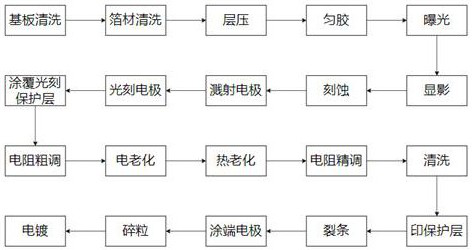
Figure 1
Abstract
Description
technical field
[0001] The invention belongs to the technical field of alloy foil resistors, and in particular relates to a manufacturing method of a chip-type alloy foil resistor. Background technique
[0002] The main material foil of chip alloy foil resistor is finished and rolled by nickel-chromium alloy according to a certain proportion, and its thickness is less than 5μm. Compared with metal film resistor, it has a relatively good and complete crystal structure, so chip alloy Foil resistors have the advantages of small temperature coefficient of resistance, small size, low current noise, high precision, good stability, and high reliability, and are widely used in high-precision instruments, military weapon systems, and aerospace equipment. However, there are the following two defects in the existing processing and production process. One is that during the etching process, if the photoresist adhesion is not good, part of the edge photoresist will fall off and cause foi...
Examples
Embodiment 1
[0033] like figure 1 As shown, the manufacturing method of the chip alloy foil resistor comprises the following steps:
[0034] 1. Substrate cleaning: Place the flower basket containing the substrate to be cleaned in deionized water with a frequency of 35KHz and a conductivity of less than 5μs / cm for 12 minutes, and then put it in absolute ethanol for 12 minutes. Dry in an oven at 98°C for 25 minutes;
[0035] 2. Foil cleaning: put the foil in 35kHz absolute ethanol for 12 minutes, and then clean it with medical gauze dipped in methyl ethyl ketone;
[0036] 3. Lamination: The foil and the ceramic substrate with a content of 98% aluminum oxide are passed through an epoxy adhesive at 180°C for 3h, 12kg / cm 2 glued together
[0037] 4. Coating: use a dropper to draw 1 ml of hexamethyldisilazane HMDS with a concentration of 30% and apply it on the substrate foil by spinning and spinning, dry and cool, and then spread the photoresist on it, evenly The speed time of the glue is 1...