
Digital Content Protection Method and Apparatus
a technology of digital content and protection method, applied in the field of digital content protection method and apparatus, can solve the problems of high risk, inferior quality and reliability of pirate services, and high distribution cost and customer acquisition cost, so as to minimize the probability that attackers will profit from attacks and improve system security , the effect of reducing the probability of attackers stealing
Patent Information
- Authority / Receiving Office
- US · United States
- Patent Type
- Applications(United States)
- Current Assignee / Owner
- Publication Date
- 2002-07-25
- Estimated Expiration
- Not applicable · inactive patent
Smart Images
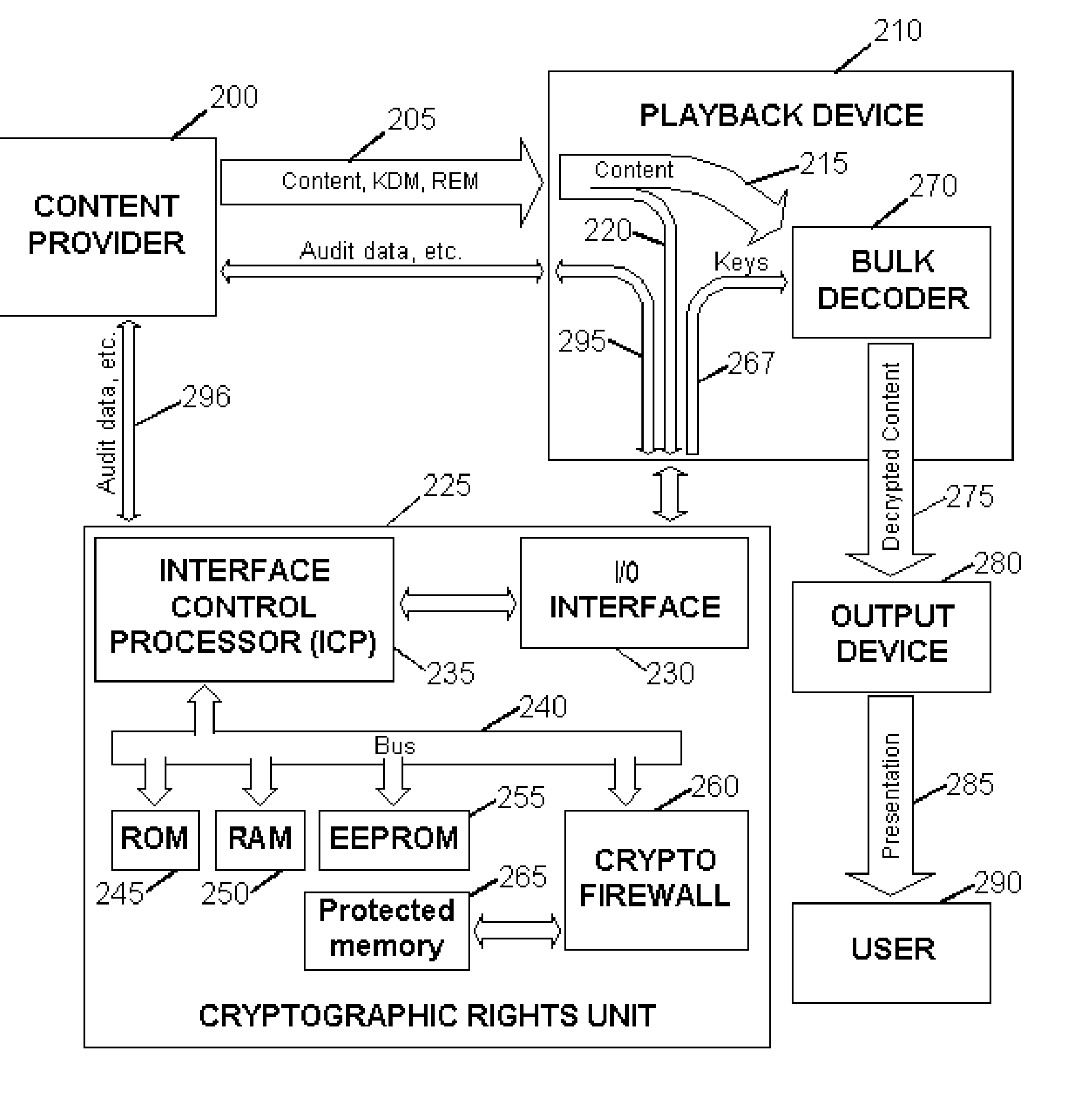
Figure 1 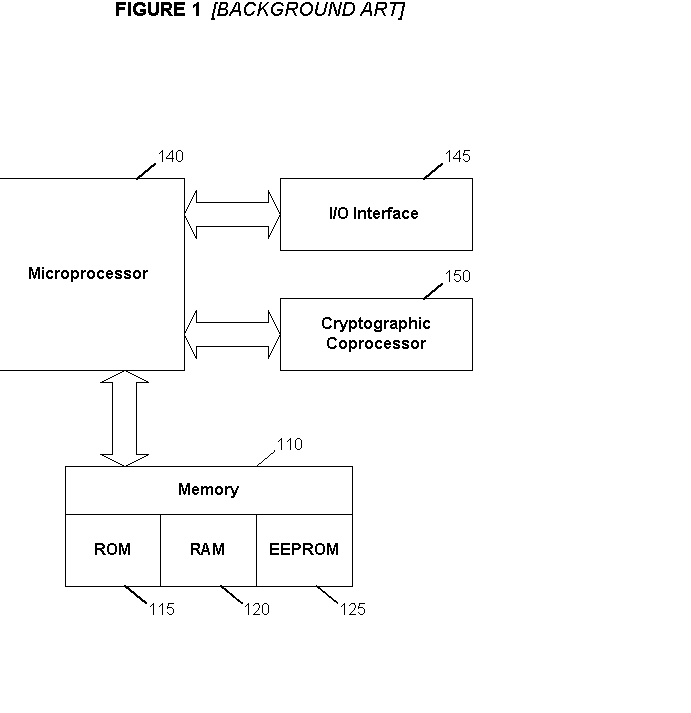
Figure 2 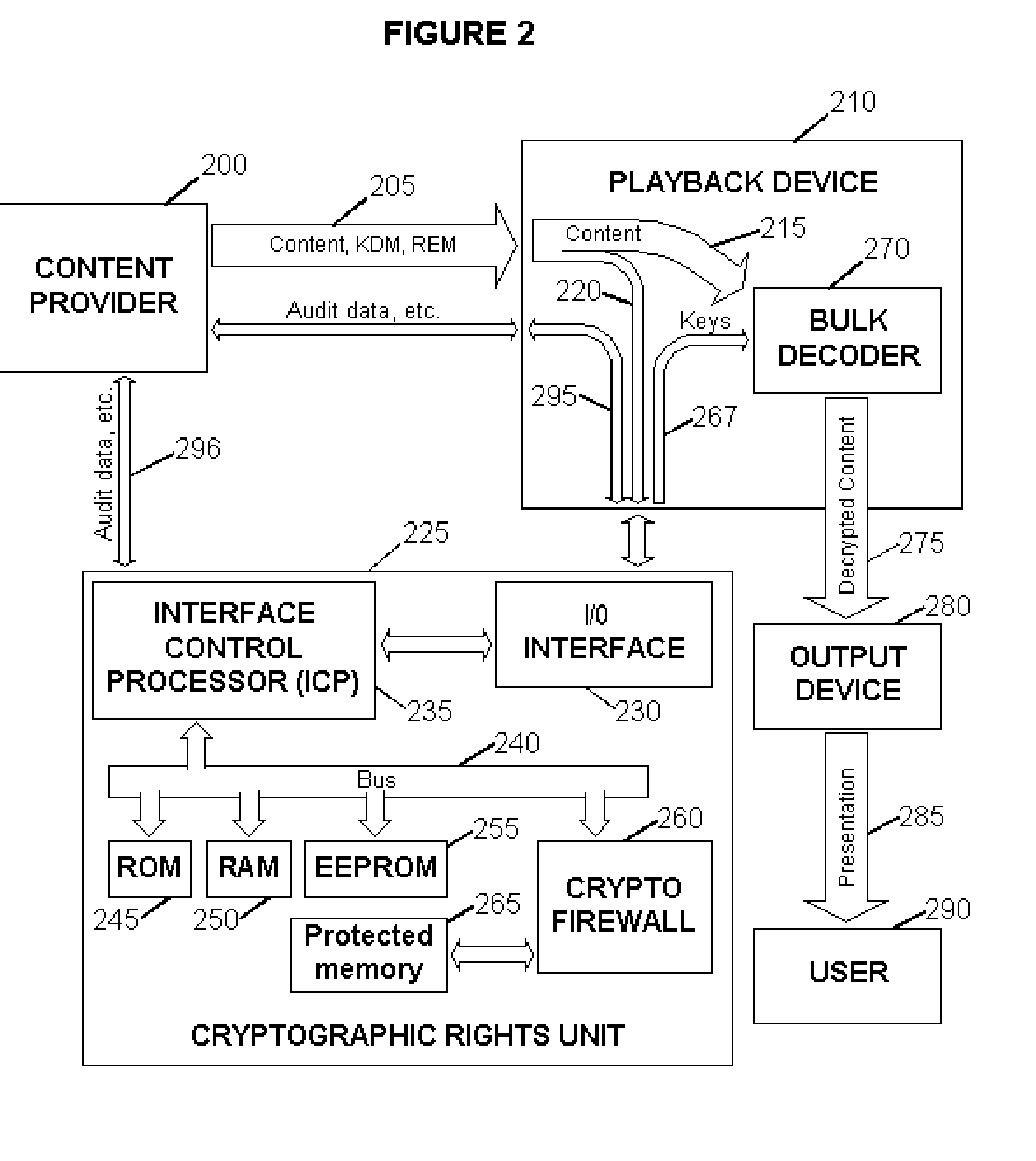
Figure 3
Abstract
Description
Cross Reference to Related Applications
[0001] This application is a continuation of U.S. Application No. 09 / 389,268, filed September 2, 1999, which is hereby incorporated by reference in its entirety.Background of InventionIntroduction
[0003] Systems that protect valuable content require effective security. For content distributed in physical form, such as film being transported to movie theaters, physical security measures can be sufficient. Unfortunately, traditional physical security techniques are slow, expensive, cumbersome, and cannot be used with non-physical content distribution models. As a result, content providers rely on cryptographic hardware to ensure that only authorized users can access their data.
[0004] To prevent misuse of decryption keys, cryptographic hardware used to manage content decryption keys must be tamper-resistant. Building effective tamper resistant hardware has proven extremely difficult, especially for systems that are the subject of determined attacks...
Examples
Embodiment Construction
[0050] The following description is presented to enable any person skilled in the art to make and use the invention, and is provided in the context of a partiapplication and its requirements. Various modifications to the disclosed embodiments will be readily apparent to those skilled in the art, and the genprinciples defined herein may be applied to other embodiments and applications without departing from the spirit and scope of the present invention.
Definitions
[0051] Asymmetric Function: An easy-to-compute function for which a complementary operation (such as its inverse) is computationally hard without a private key, but easy to compute with the private key. The RSA cryptosystem is thought to be asymmetric, since inverting the public key operation (i.e., performing the private key operation) is only easy with if the private key is known.
[0052] Content Decryption Key (CDK): A key required to decrypt some encrypted digital content.
[0053] Content Provider: An entity that manages the...