
Method and apparatus for election of group leaders in a distributed network
a distributed network and group leader technology, applied in the field of data communication, can solve the problems of large data transmission costs, and large data transmission costs, and achieve the effects of high scalable data transmission, avoiding unreliability, latency and inefficiencies of implementation, and efficient data transmission
Patent Information
- Authority / Receiving Office
- US · United States
- Patent Type
- Applications(United States)
- Current Assignee / Owner
- Publication Date
- 2005-09-08
- Estimated Expiration
- Not applicable · inactive patent
Smart Images
Figure 1 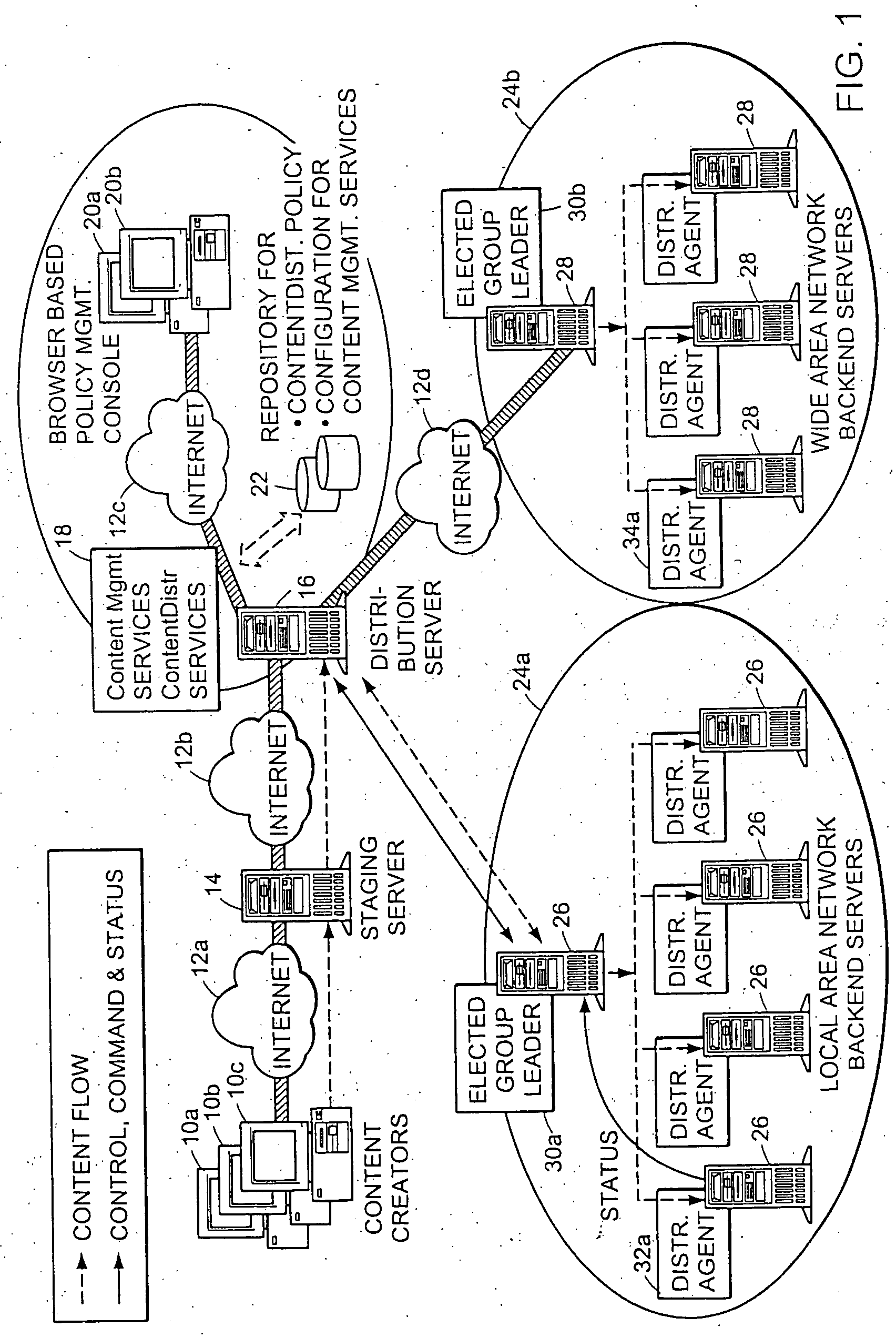
Figure 2 
Figure 3
Abstract
Description
FIELD OF THE INVENTION
[0001] This invention is directed towards data communication, and more particularly towards reliable and efficient distribution of data to large numbers of network locations. BACKGROUND OF THE INVENTION
[0002] Digital content creators are users who utilize workstations or other computers to create or digitize information in preparation for publication as “content.” When such content is to be shared with or published to a number of other computer users using a wide area network (WAN), such as the World Wide Web (“the Web”), reliability, latency, security, and efficiency become major issues. Reliability refers to the ability to ensure that the data was received without debilitating errors. Latency, the measure of how much time it takes to deliver data, suffers when finite resources become overloaded, whether in the respective processors, intermediate storage or a communications link. Inefficiency may arise because multiple copies of data have to be retransmitted...
Examples
Embodiment Construction
[0037] The architecture of the present invention, an illustrative embodiment of which is diagramed in FIG. 1, addresses the need for reliable and efficient distribution of digitized data from a single source to large numbers of dynamically networked recipients. Remote customers or content creators of the distribution method and apparatus use their computers 10 to submit their final content changes to a specified staging server 14. A distribution server 16, having content mover and management functions 18, interacts with servers 26, 28 constituting elected group leaders 30 for distributing content or content changes to distribution agents 32, 34 in each cluster 24. Once the content or change distribution is complete, users can begin to access the updated content from any of the servers 26, 28. User access to content on a given server can be efficiently managed, according to service level agreements, by a completely independent load-balancing method and apparatus, such as are known in...