
Antibodies to lymphotoxin-alpha
a lymphotoxin and antibody technology, applied in the field of antibodies, can solve the problems of increasing social and financial burden, ltr-ig disrupting the lymphogenesis of mice, and uneven distribution of variability in the variable domain, so as to reduce joint damage and maintain the effect of reducing joint damag
Patent Information
- Authority / Receiving Office
- US · United States
- Patent Type
- Applications(United States)
- Current Assignee / Owner
- Publication Date
- 2009-11-19
- Estimated Expiration
- Not applicable · inactive patent
Smart Images
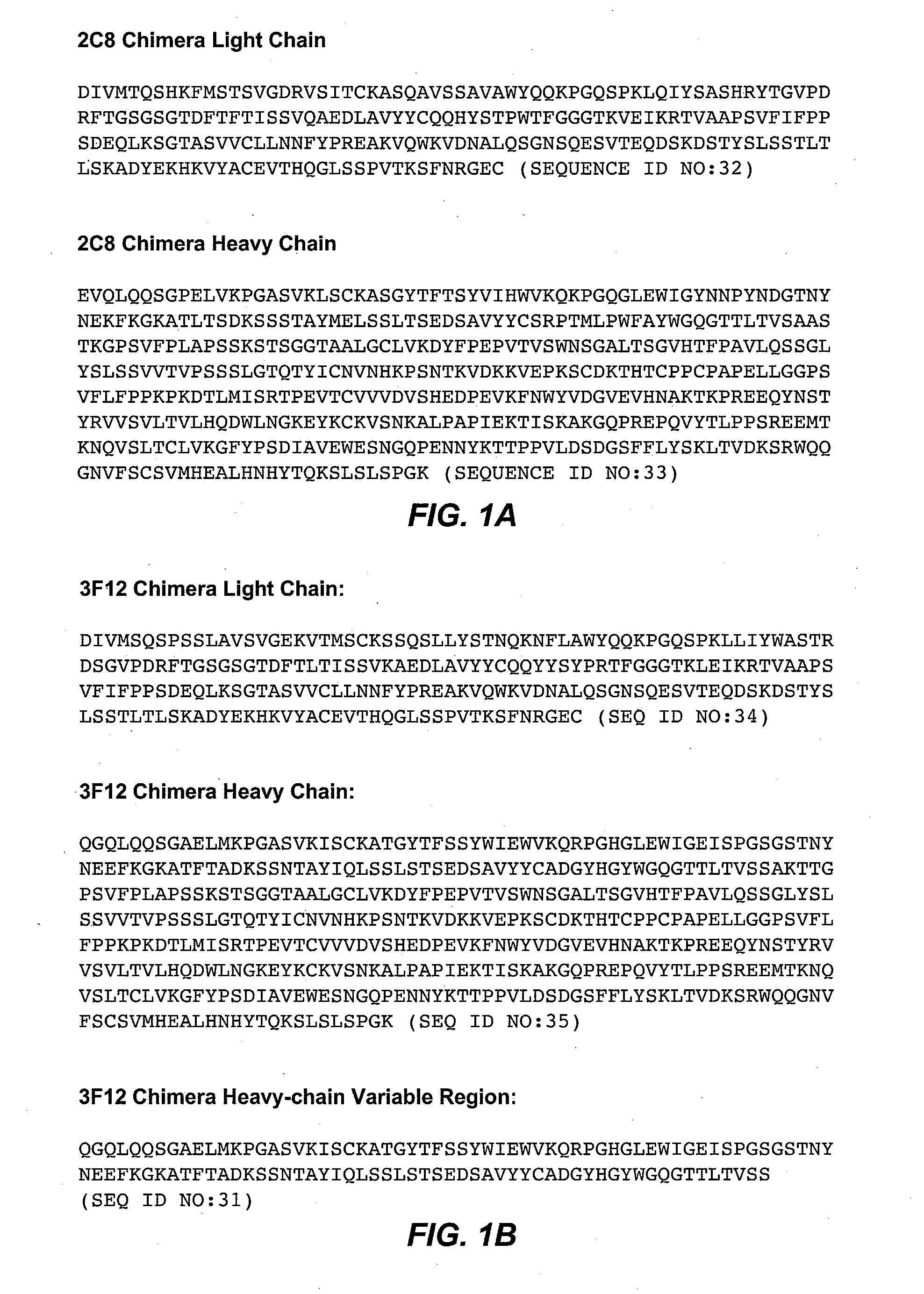
Figure 1 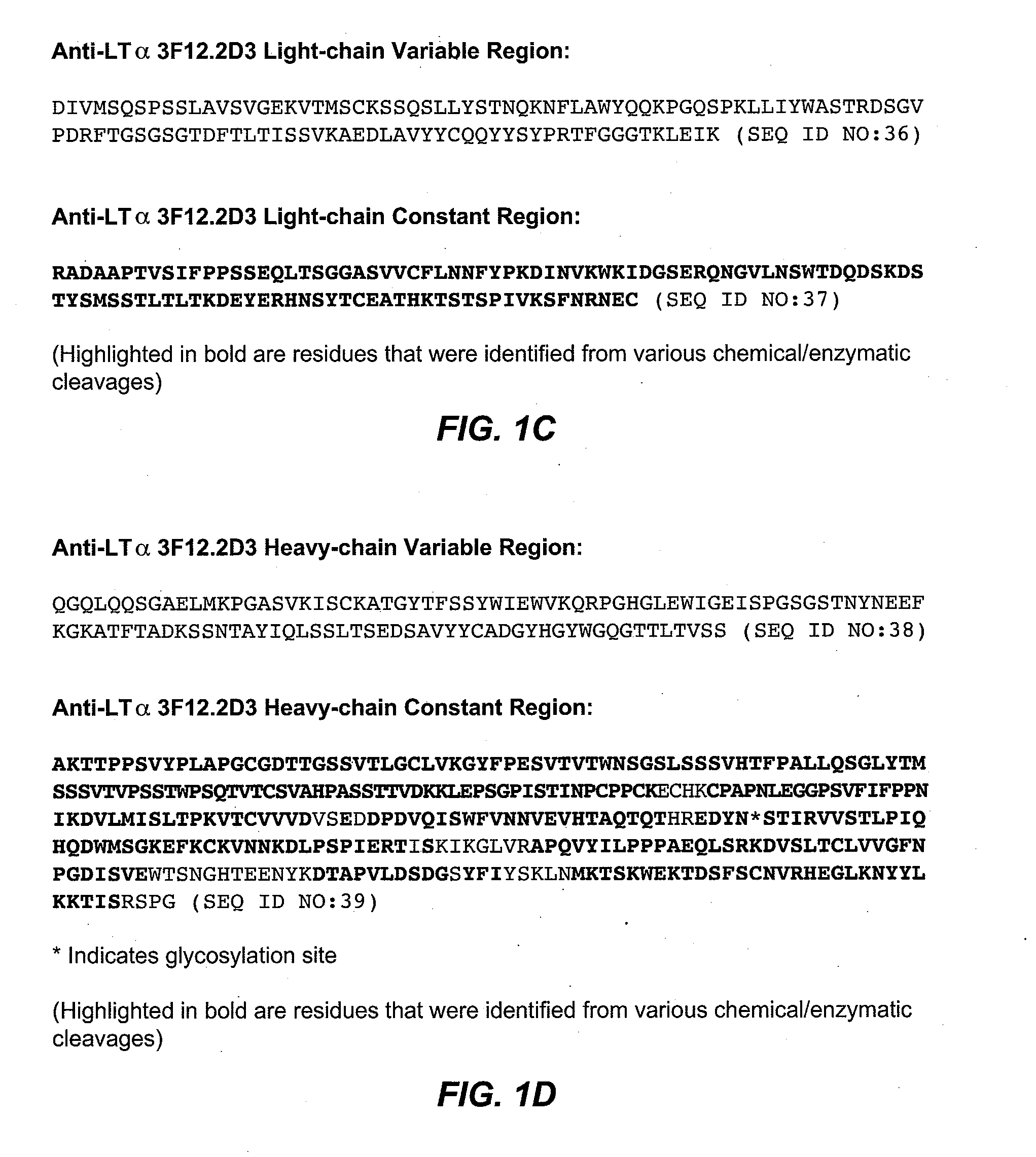
Figure 2 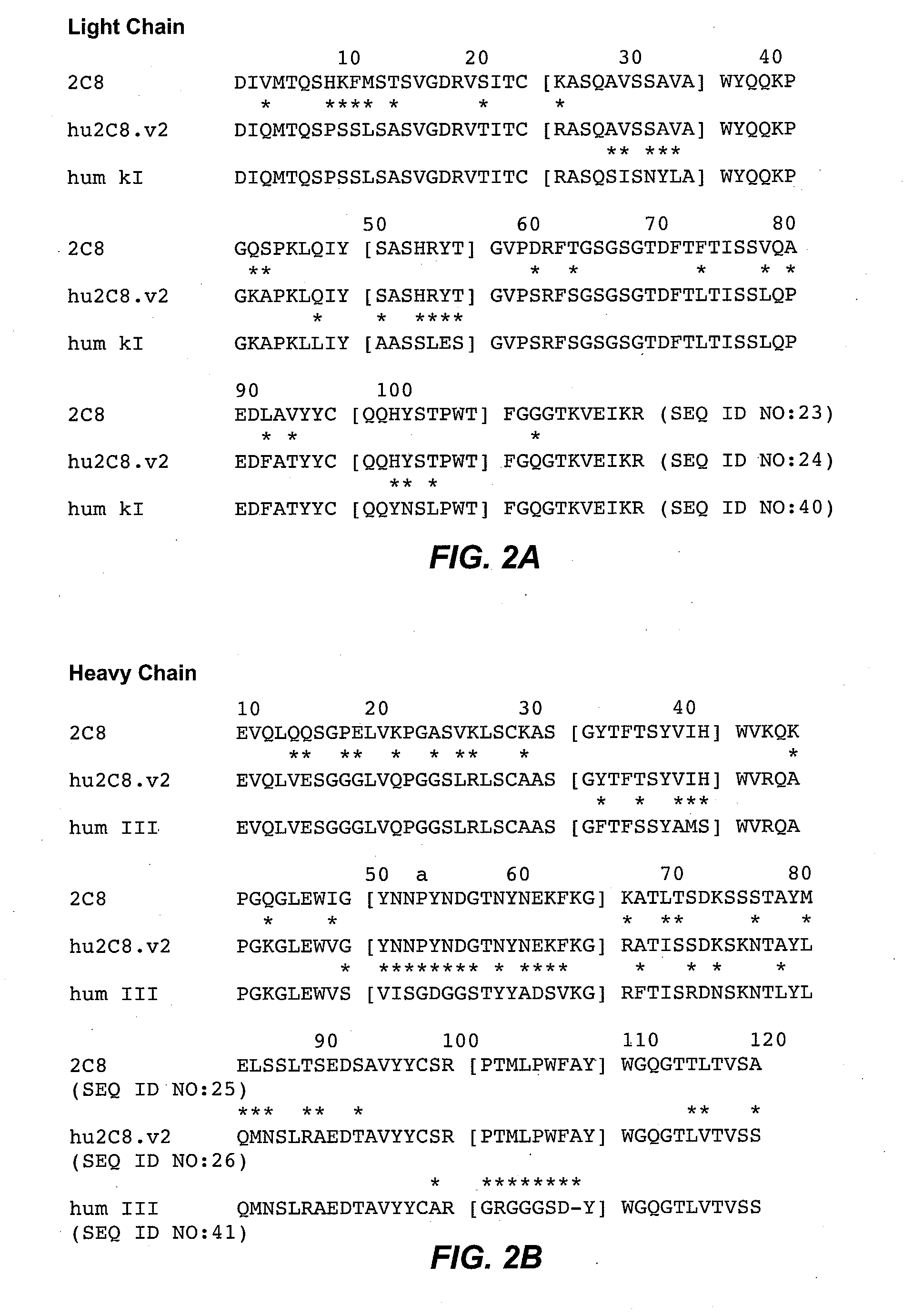
Figure 3
Abstract
Description
RELATED APPLICATIONS
[0001] This non-provisional application claims the benefit of priority of U.S. Provisional Application Ser. No. 60 / 829,257 filed on 12 Oct. 2006, and of U.S. Provisional Application Ser. No. 60 / 938,999 filed on 18 May 2007, which are incorporated by reference in their entirety.FIELD OF THE INVENTION
[0002] The present invention concerns antibodies and their uses to treat autoimmune disorders. More particularly, the present invention concerns antibodies that bind to lymphotoxin-α and may also block binding of the lymphotoxin-α ligand to one or more receptors.BACKGROUND OF THE INVENTIONTNF and LT
[0003] Autoimmune diseases remain clinically important diseases in humans. As the name implies, autoimmune diseases wreak their havoc through the body's own immune system. While the pathological mechanisms differ among individual types of autoimmune diseases, one general mechanism involves the binding of certain antibodies (referred to herein as self-reactive antibodies or auto...
Examples
example 1
Preparation of Anti-Human and Anti-Murine Ltα Monoclonal Antibodies and Hamster-Murine Chimeras
[0516]Anti-human LTα monoclonal antibodies 2C8 and 3F12 were generated as follows: BALB / c mice (Charles River Laboratories, Wilmington, Del.) were hyperimmunized by injection with 5 μg / dose of purified recombinant human LTα expressed in E. coli (Genentech, Inc., South San Francisco, Calif.; Genentech Lot# 8360-2B; see also Spriggs, “Tumor Necrosis Factor: Basic Principles and Preclinical Studies,”Biologic Therapy of Cancer, DeVita et al., eds., J.B. Lippincott Company (1991) Ch. 16, pp. 354-377; Ruddle, Current Opinion in Immunology, 4:327-332 (1992); Wong et al., “Tumor Necrosis Factor,”Human Monocytes, Academic Press (1989), pp. 195-215; Aggarwal et al., Cytokines and Lipocortins in Inflammation and Differentiation, Wiley-Liss, Inc. 1990, pp. 375-384; and Paul et al., Ann. Rev. Immunol., 6:407-438 (1988)) in DETOX™ adjuvant (RIBI ImmunoChem Research, Inc., Hamilton, Mo.). Specifically, 1...
example 2
Sequencing, Humanization, and Affinity Maturation of Anti-LTαAntibody 3F12
1. De Novo Sequencing of Anti-LTα 3F12 Using LTQ-FTMS-MS / MS Analysis and Edman Degradation
[0526]Because the hybridoma cell line 3F12.2D3 was lost from the frozen cell line bank, anti-LTα monoclonal antibody protein, purified from ascites 3F12.2D3, was submitted for sequencing at a concentration of about 3.0 mg / mL in PBS. The antibody (Ab) was separated on 4-20% TRIS™ HCl SDS-PAGE under reducing conditions and each resolved heavy chain (HC) and light chain (LC) was subjected to N-terminal sequencing (25-30 residues were sequenced) to establish monoclonality. The HC was found to be blocked with a pyroglutamyl group that made the N-terminal amino acid inaccessible to Edman sequencing. The blocking group was subsequently removed using the pyroglutamate aminopeptidase enzyme (PGAP) and the HC chain subjected to sequencing again. Both the HC and LC were confirmed to be monoclonal. The Ab was then treated with variou...
example 3
Preparation of Chimeric Antibody 2C8 and Humanization
1. Preparation of Chimeric Antibody
[0546]The variable regions of the heavy and light chains of the murine anti-LTα antibody 2C8 that bound and neutralized LTα3 and LTαβ were cloned and formatted as a murine / human chimeric antibody essentially as described above in Example 1 for the cloning of S5H3.
[0547]For RT-PCR, the primers used were as follows:
2C8 light chain:5′ primer:(SEQ ID NO: 79)GCC ATA GAT ATC GTR ATG CAN CAG TCT C3′ primer:(SEQ ID NO: 80)TTT KAT YTC CAG CTT GGT ACC2C8 heavy chain:5′ primer:(SEQ ID NO: 81)GAT CGA CGT ACG CTG AGG TYC AGC TSC AGC TSC AGCAGT CTG G3′ primer:(SEQ ID NO: 82)ACA GAT GGG CCC TTG GTG GAG GCT GMR GAG ACD GTGASH RDR GT.
wherein K=G or T, S=C or G, D=A or G or T, M=A or C, H=A or C or T, N is T, G, A, or C (any nucleic acid of these four), R=A or G, and Y=C or T.
[0548]The variable domain of the light chain was cloned into vector pRK.LPG3.HumanKappa containing the human kappa constant domain, while th...