
Restoration time in mesh networks
a mesh network and recovery time technology, applied in the field of communication networks, can solve the problems of restricting traffic re-engineering options, less cost-effective routing of grouped demands, etc., and achieve the effect of reducing the worst-case number of cross-connections and reducing the overall restoration tim
Patent Information
- Authority / Receiving Office
- US · United States
- Patent Type
- Patents(United States)
- Current Assignee / Owner
- Publication Date
- 2010-01-12
- Estimated Expiration
- Not applicable · inactive patent
Smart Images
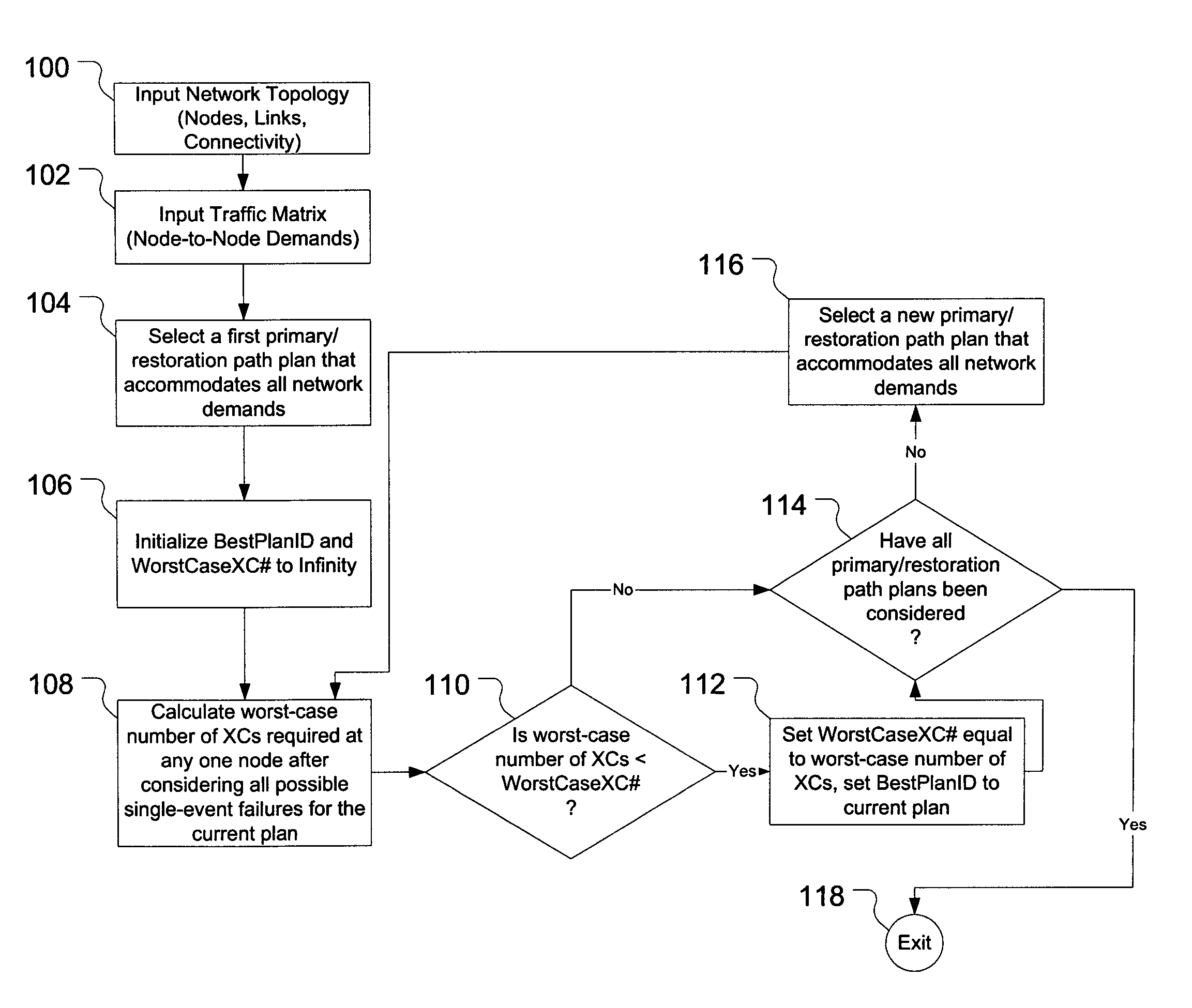
Figure 1 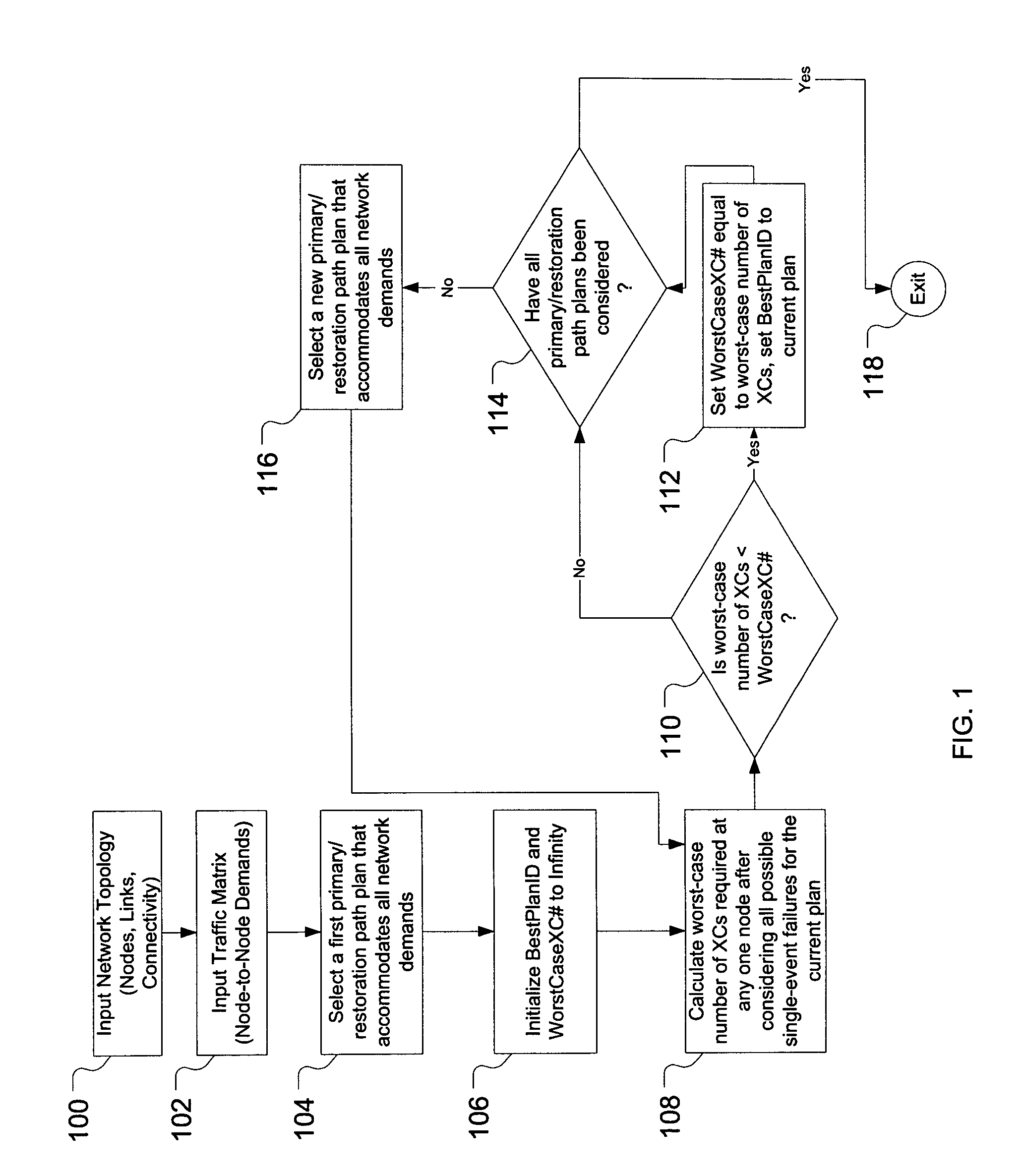
Figure 2 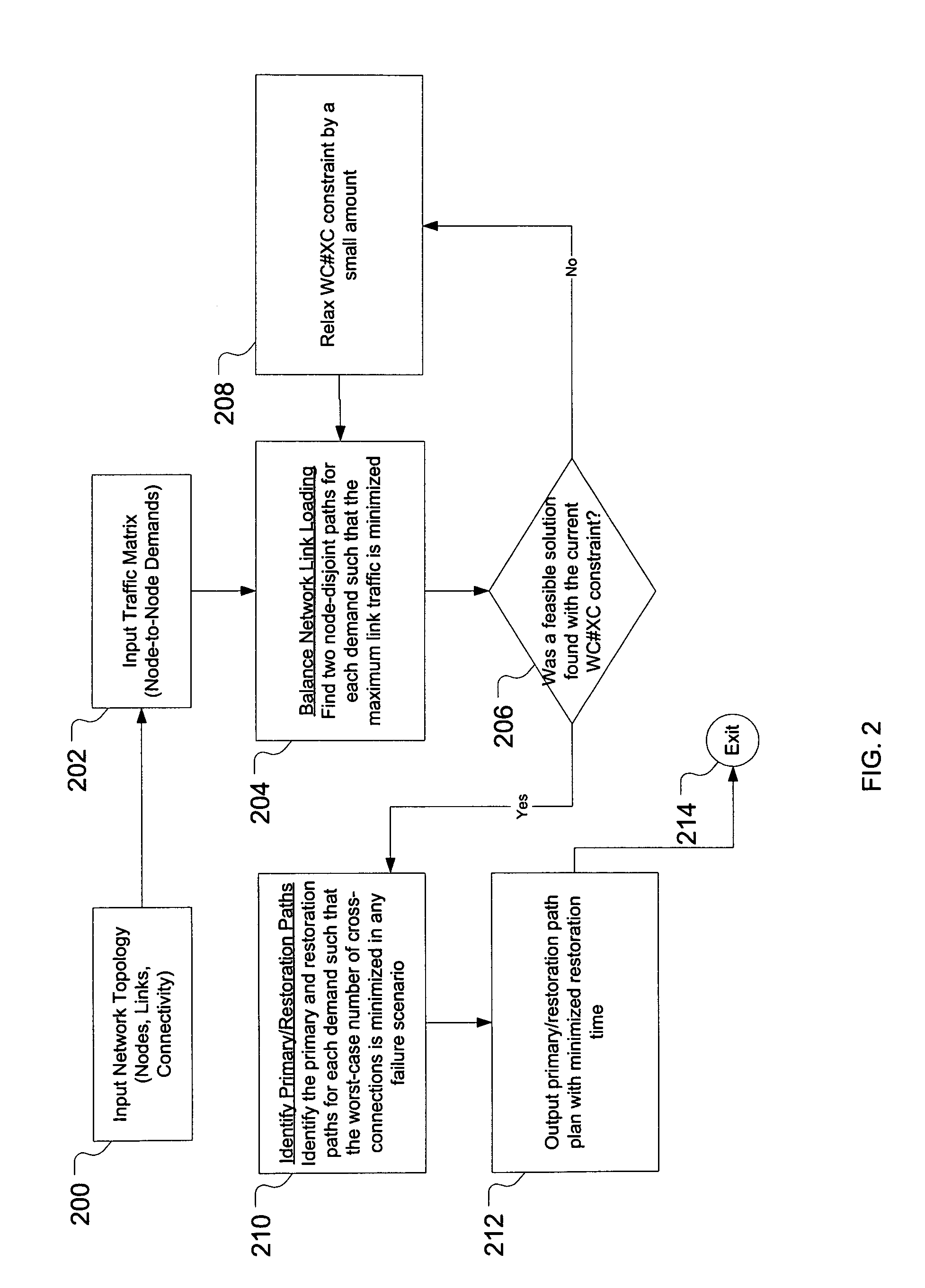
Figure 3
Abstract
Description
CROSS-REFERENCE TO RELATED APPLICATIONS
[0001] This application claims the benefit of the filing date of U.S. provisional application No. 60 / 459,163, filed on Mar. 31, 2003.BACKGROUND OF THE INVENTION
[0002] 1. Field of the Invention
[0003] The present invention relates to communications networks and, more specifically, to restoration time improvements in (e.g., optical) mesh networks.
[0004] 2. Description of the Related Art
[0005] In robust communications networks, it is typical to provide path redundancy for services. This is generally done by providing a primary path and a restoration path for each service. In the event of a failure along the primary path, the service traffic is switched over to the restoration path. Note that, in the art, the term “primary path” is often synonymous with the term “working path,” while the term “restoration path” is often synonymous with the terms “protection path” and “alternative path.”
[0006] For optical mesh transport networks, a challenge is to provide ...
Examples
Embodiment Construction
[0018]Reference herein to “one embodiment” or “an embodiment” means that a particular feature, structure, or characteristic described in connection with the embodiment can be included in at least one embodiment of the invention. The appearances of the phrase “in one embodiment” in various places in the specification are not necessarily all referring to the same embodiment, nor are separate or alternative embodiments mutually exclusive of other embodiments.
[0019]Introduction
[0020]Significant research has been done into various restoration and protection strategies for mesh networks at both the service and optical layers. Proposed architectures include centralized vs. distributed, pre-computed vs. computed on demand in real-time, and link-based vs. path-based. Characteristics that distinguish between these various restoration and protection strategies include recovery time, failure coverage, and required recovery capacity. A survey of relevant research as well as a specific distribute...