
Memory control circuit and microprocessor system for pre-fetching instructions
a microprocessor and memory control technology, applied in program control, computation using denominational number representation, instruments, etc., can solve the problems of pipeline stoppage, flow stoppage, processing performance reduction, etc., and achieve the effect of reducing branch penalty and small circuit siz
Patent Information
- Authority / Receiving Office
- US · United States
- Patent Type
- Patents(United States)
- Current Assignee / Owner
- Publication Date
- 2010-09-07
Smart Images
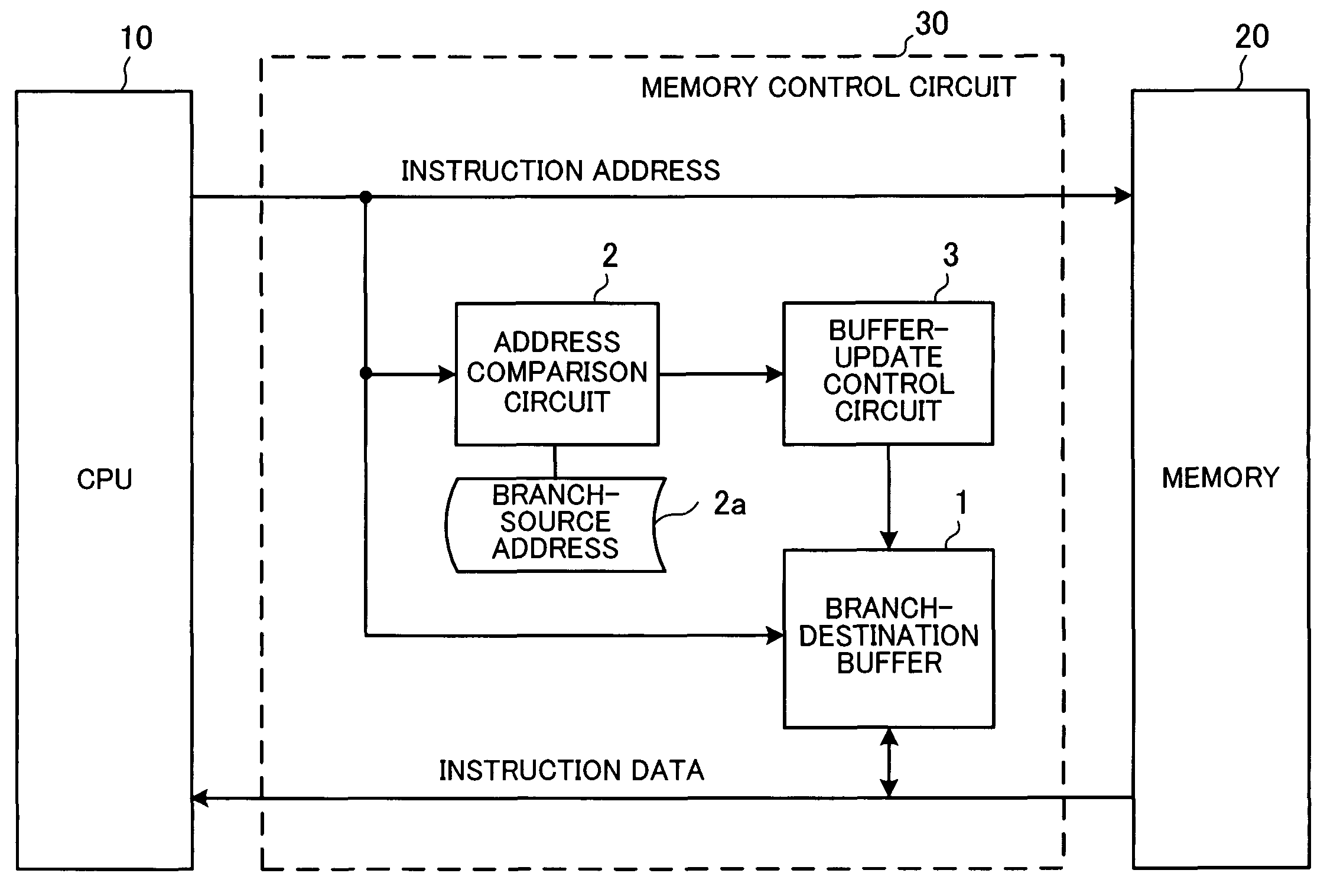
Figure 1 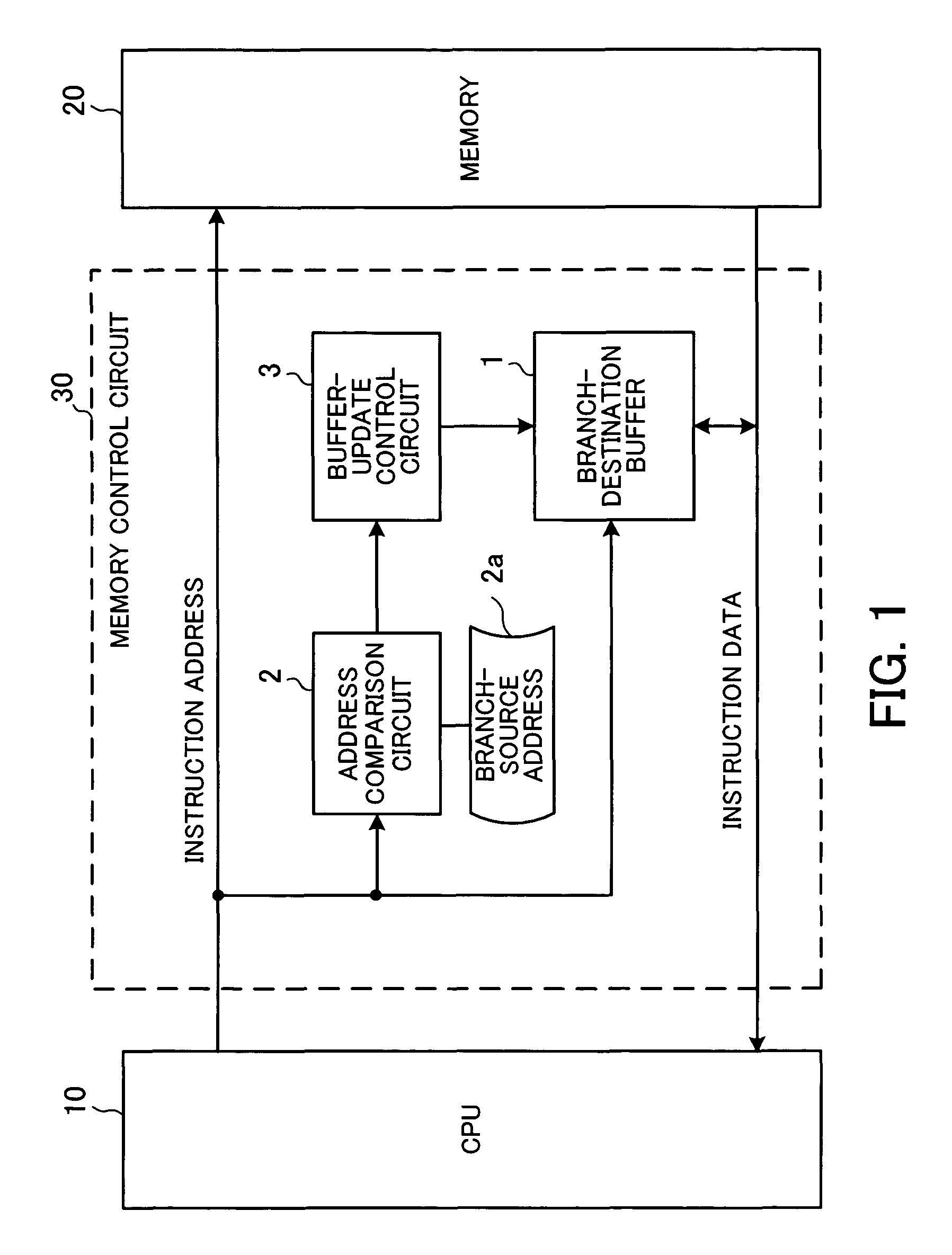
Figure 2 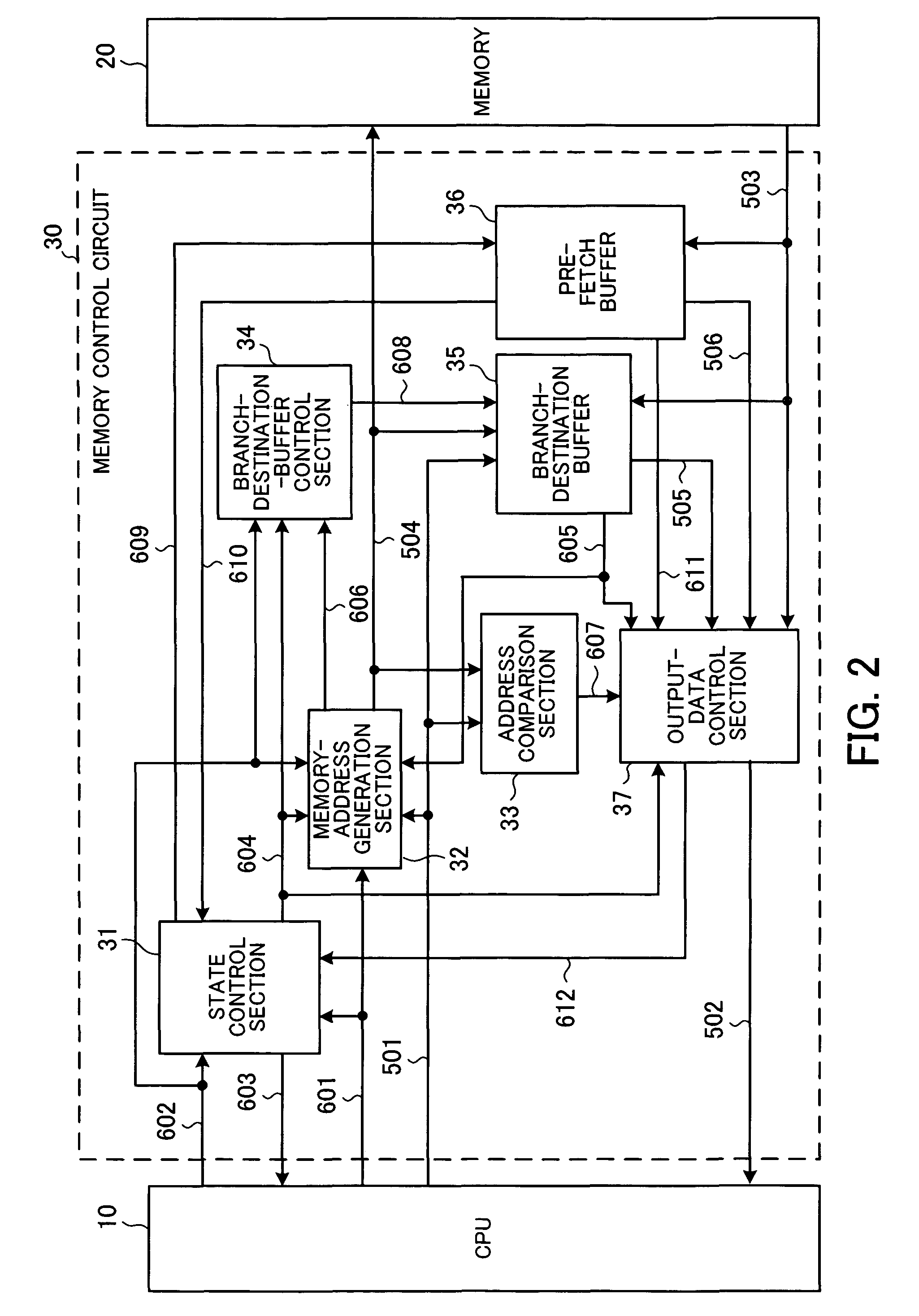
Figure 3
Abstract
Description
CROSS-REFERENCE TO RELATED APPLICATIONS
[0001] This application is based upon and claims the benefits of priority from the prior Japanese Patent Application No. 2004-258651, filed on Sep. 6, 2004, the entire contents of which are incorporated herein by reference.BACKGROUND OF THE INVENTION
[0002] 1. Field of the Invention
[0003] The present invention relates to memory control circuits provided with an instruction pre-fetch function, for controlling the reading of instructions to be fetched by the Central Processing Unit (CPU), from a memory and microprocessor systems that include the memory control circuits, and particularly to a memory control circuit and a microprocessor system both having a reduced penalty-cycle occurrence rate during the execution of branch instructions.
[0004] 2. Description of the Related Art
[0005] It has been conventionally known in microprocessor systems which use pipeline control that instruction data is read in advance from a main memory and buffered by an instruct...
Examples
first embodiment
[0042]FIG. 2 shows the structure of a main part of a microprocessor system according to a first embodiment of the present invention.
[0043]The microprocessor system shown in FIG. 2 is applied to a so-called single-chip microcontroller and others. In this system, an access to a memory 20 needs the period of two cycles of a CPU clock signal. The width of a bus used for the data access is set two times wider than that for instruction code and an instruction-data pre-fetch function is used, so that an instruction can be sent to a CPU 10 in one cycle. It is assumed here as an example case that buses for instruction addresses and instruction data are 32 bits wide, instruction data is 16 bits wide, the CPU 10 can fetch two instructions at the same time once in two cycles of the CPU clock signal, and an access cycle for the memory 20 corresponds to two cycles of the CPU clock signal.
[0044]In this microprocessor system, the CPU 10 outputs the instruction address 501 of an instruction to be fe...
second embodiment
[0083]When it is only determined whether a branch-destination-instruction address is smaller than the previous-instruction address, as in the first embodiment, if a subroutine or an interrupt process is included in a loop, for example, it is not possible to determine whether the branch is a branch to the top of the loop of the program, which is the target to detect, or the branch is a branch caused by a subroutine call instruction or return instruction.
[0084]FIG. 7 is a flowchart showing an example program in which a subroutine process is included in a loop.
[0085]In FIG. 7, it is assumed that process codes in steps S21 to S23 are stored in that order in a memory space consecutive viewed from the CPU 10 as in FIG. 4. Step 23 performs a subroutine process.
[0086]In this figure, a “branch E” from step S25 to step S23 and a “branch F” from step S23 to step S21 both change the instruction address 501 in the negative direction. Therefore, the branch-destination buffer 35 is updated when th...
third embodiment
[0095]FIG. 9 shows the structure of a microprocessor system according to a third embodiment. In FIG. 9, the same reference symbols as those used in FIG. 2 are assigned to the same sections as those shown in FIG. 2, and a description thereof is omitted.
[0096]In the second embodiment, the branch-destination-buffer control section 34 determines whether a subroutine branch has occurred. In the present embodiment, whether a subroutine branch has occurred is determined by a subroutine-branch report signal 613 sent from a CPU 10. When the CPU 10 decodes a subroutine call instruction or a subroutine return instruction, the CPU 10 asserts the subroutine-branch report signal 613 to report to a branch-destination-buffer control section 34 of a memory control circuit 30 that a subroutine branch has occurred.
[0097]FIG. 10 shows the internal structure of the branch-destination-buffer control section 34 according to a third embodiment. In FIG. 10, the same reference symbols as those used in FIG. 3...