
Method and device for locating a magnetic object
a magnetic object and method technology, applied in wave based measurement systems, instruments, reradiation, etc., can solve the problem that the removal of the closest magnetometer measurement does not modify, or even enhance, the accuracy of the location, so as to reduce the electrical consumption of the array of magnetometers.
Patent Information
- Authority / Receiving Office
- US · United States
- Patent Type
- Patents(United States)
- Current Assignee / Owner
- Publication Date
- 2017-10-03
Smart Images
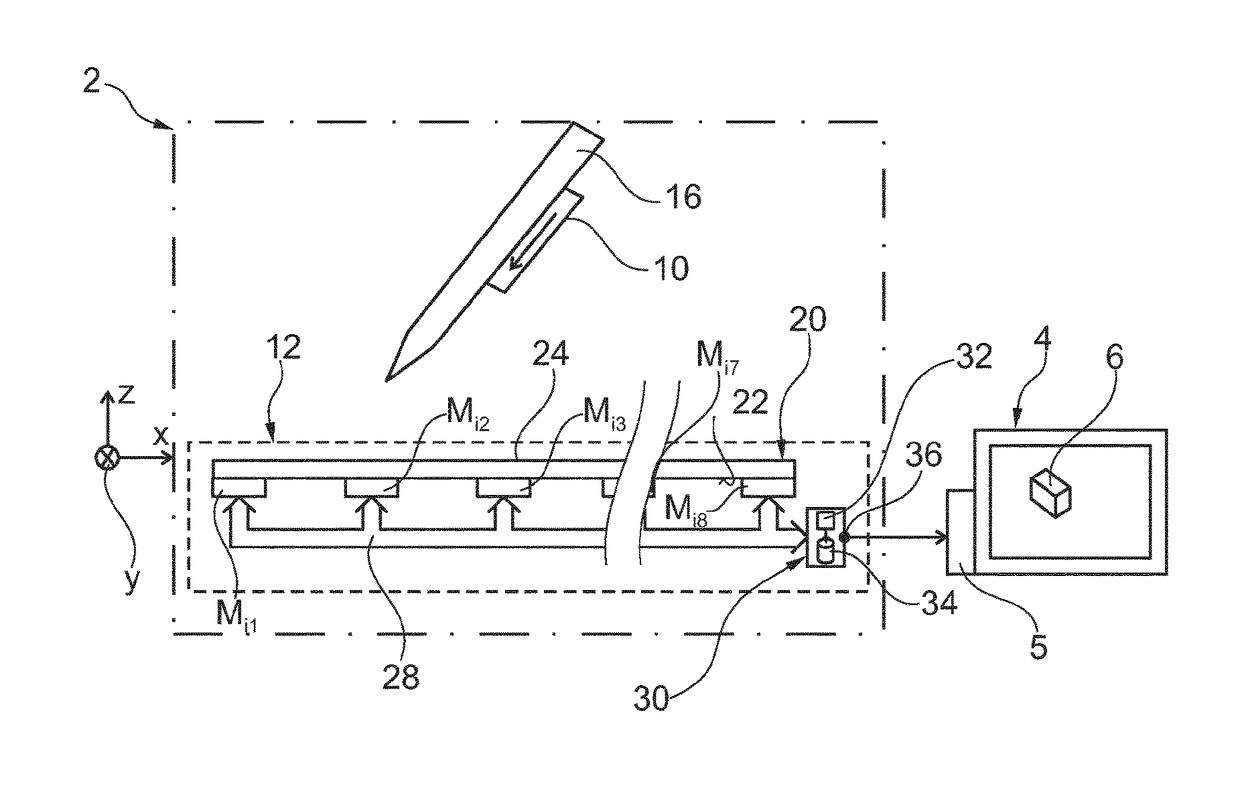
Figure 1 
Figure 2 
Figure 3
Abstract
Description
RELATED APPLICATIONS
[0001] This application is a U.S. National Stage of international application number PCT / EP2013 / 056814 filed Mar. 29, 2013, which claims the benefit of the priority date of French Patent Application FR 1252881, filed Mar. 29, 2012, the contents of which are herein incorporated by reference.FIELD OF INVENTION
[0002] The invention relates to a method and a device for locating a moving magnetic object. The invention relates also to a screen equipped with such a locating device.BACKGROUND
[0003] The known methods for locating a moving magnetic object comprise determining the position or the orientation of the magnetic object from measurements of an array of tri-axial magnetometers, this array comprising N tri-axial magnetometers mechanically linked to one another with no degree of freedom to retain a known distance between each of these magnetometers, where N is an integer number greater than 5.
[0004] A tri-axial magnetometer is a magnetometer suitable for measuring the pr...
Examples
Embodiment Construction
[0032]Hereinbelow in this description, the features and functions well known to those skilled in the art are not described in detail.
[0033]FIG. 1 represents a human / machine interface 2 making it possible to control an electronic apparatus 4. Here, the apparatus 4 is a screen connected to a control unit 5 capable of controlling the display of an image on this screen 4.
[0034]Here, the operation of the human / machine interface 2 is illustrated in the case where the unit 5 controls the position and the orientation of a cursor 6 on the screen 4. For example, the cursor has a three-dimensional form. In FIG. 1, the cursor 6 is a parallelepiped. However, the interface 2 can be used in numerous other applications as is described at the end of this description.
[0035]The interface 2 comprises a magnetic object 10 and a device 12 for locating this object 10. The object 10 can be freely moved within an orthogonal reference frame XYZ fixed with no degree of freedom to the device 12. Here, the dire...