
System for joining building boards
a technology of building boards and joints, applied in resiliently-mounted floors, walls, transportation and packaging, etc., can solve the problems of inability to thin floors, manufacturing costs, inconvenience, etc., and achieve the effect of small overall thickness
Patent Information
- Authority / Receiving Office
- US · United States
- Patent Type
- Patents(United States)
- Current Assignee / Owner
- Publication Date
- 2006-12-26
- Estimated Expiration
- Not applicable · inactive patent
Smart Images
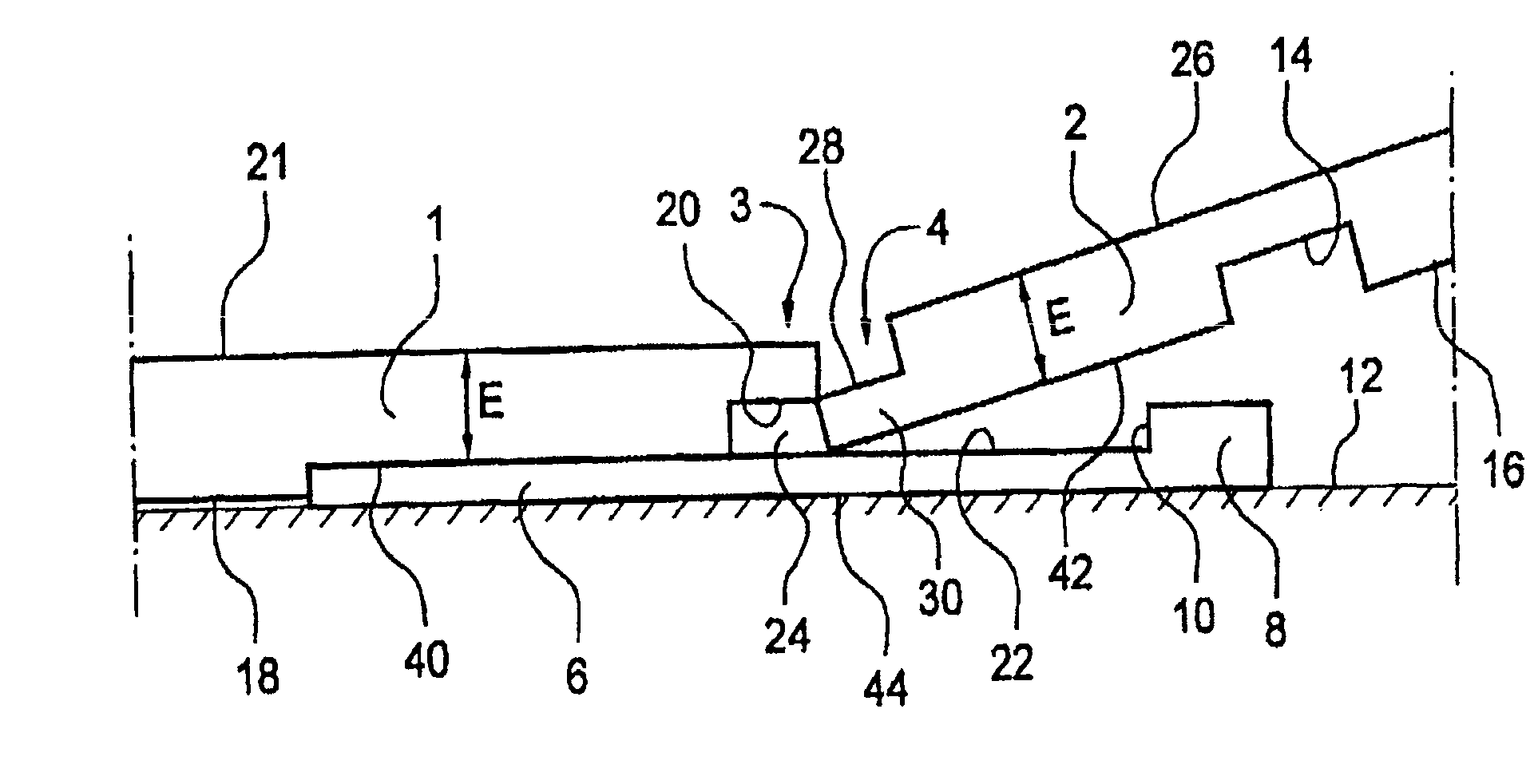
Figure 1 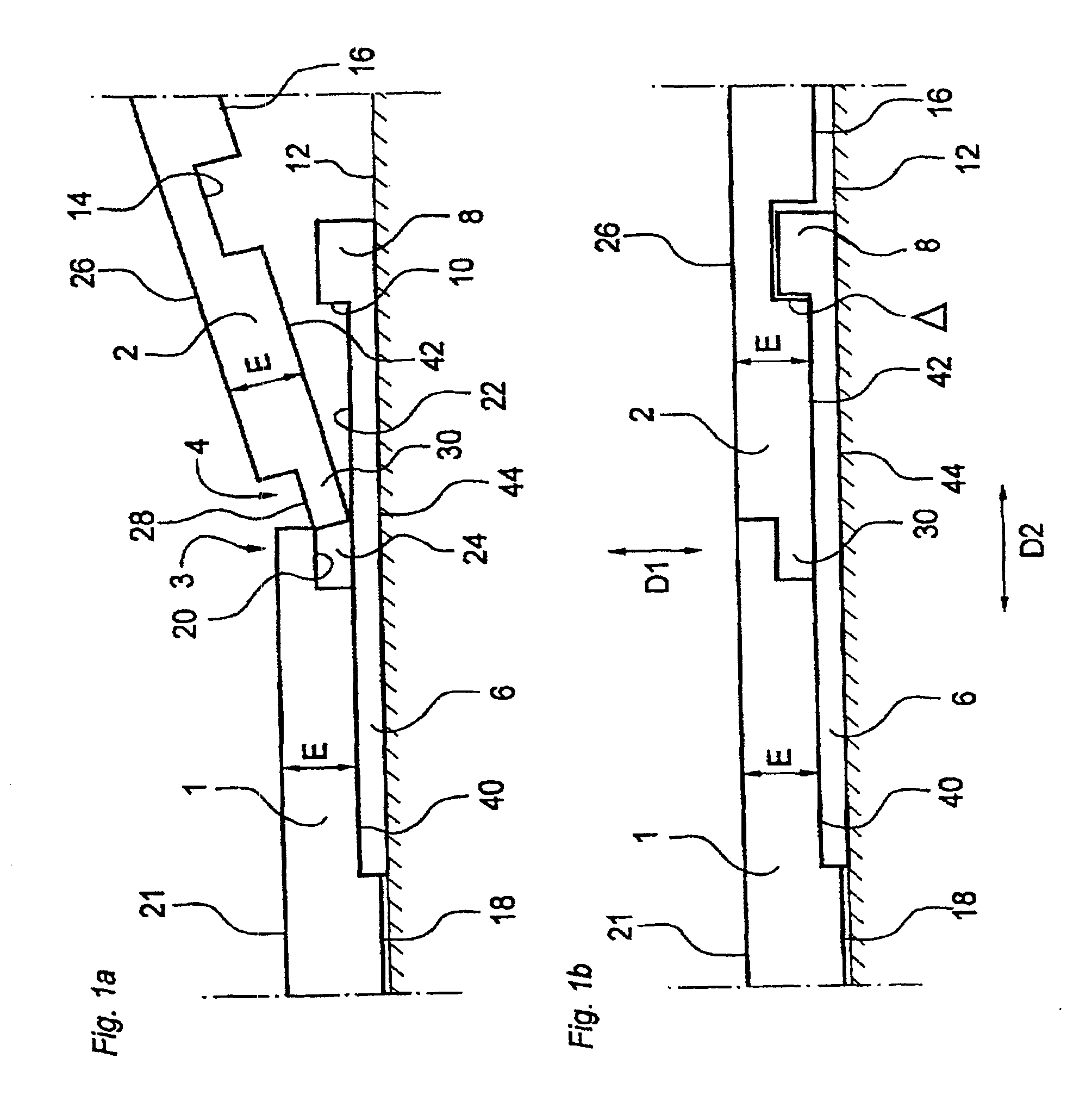
Figure 2 
Figure 3
Abstract
Description
TECHNICAL FIELD
[0001] The invention generally relates to a system for providing a joint along adjacent joint edges of two building panels, especially floor panels.
[0002] More specifically, the joint is of the type where the adjacent joint edges together form a first mechanical connection locking the joint edges to each other in a first direction at right angles to the principal plane of the panels, and where a locking device forms a second mechanical connection locking the panels to each other in a second direction parallel to the principal plane and at right angles to the joint edges, the locking device comprising a locking groove which extends parallel to and spaced from the joint edge of one of the panels, and said locking groove being open at the rear side of this one panel.
[0003] The invention is especially well suited for use in joining floor panels, especially thin laminated floors. Thus, the following description of the prior art and of the objects and features of the invention...
Examples
Embodiment Construction
[0062]FIGS. 1a and 1b, to which reference is now made, illustrate a first floor panel 1, hereinafter termed strip panel, and a second floor panel 2, hereinafter termed groove panel. The terms “strip panel” and “groove panel” are merely intended to facilitate the description of the invention, the panels 1, 2 normally being identical in practice. The panels 1 and 2 may be made from compact laminate and may have a thickness of about 3 mm with a thickness tolerance of about ±0.2 mm. Considering this thickness tolerance, the panels 1, 2 are illustrated with different Thicknesses (FIG. 1b), the strip panel 1 having a maximum thickness (3.2 mm) and the groove panel 2 having a minimum thickness (2.8 mm).
[0063]To enable mechanical joining of the panels 1, 2 at opposing joint edges, generally designated 3 and 4, respectively, the panels are provided with grooves and strips as described in the following.
[0064]Reference is now made primarily to FIGS. 1a and 1b, and secondly to FIGS. 4a and 4b s...