Adjusting Notch Filter Characteristics for Diverse Inputs
MAR 17, 20269 MIN READ
Generate Your Research Report Instantly with AI Agent
Patsnap Eureka helps you evaluate technical feasibility & market potential.
Notch Filter Technology Background and Adaptive Goals
Notch filters, also known as band-stop or band-reject filters, represent a fundamental class of signal processing components designed to attenuate specific frequency bands while preserving signals at other frequencies. These filters have evolved from simple passive LC circuits in early radio applications to sophisticated digital implementations capable of real-time adaptation. The core principle involves creating a sharp attenuation characteristic at predetermined frequencies, effectively "notching out" unwanted spectral components from input signals.
The historical development of notch filter technology traces back to the 1920s when engineers first employed twin-T networks and bridged-T configurations to eliminate power line interference in audio systems. The advent of operational amplifiers in the 1960s revolutionized active notch filter design, enabling higher Q-factors and improved performance characteristics. Digital signal processing emergence in the 1980s introduced infinite impulse response and finite impulse response notch filter implementations, providing unprecedented flexibility and precision.
Modern notch filter applications span diverse domains including biomedical signal processing, where 50/60 Hz power line interference removal is critical, audio engineering for feedback suppression, and communication systems for narrowband interference mitigation. The increasing complexity of electromagnetic environments and the proliferation of wireless devices have intensified the demand for adaptive notch filtering solutions capable of responding to dynamic interference scenarios.
Traditional fixed-parameter notch filters face significant limitations when confronting time-varying interference patterns or multiple simultaneous interference sources. The challenge of adjusting notch filter characteristics for diverse inputs encompasses several critical aspects: frequency tracking accuracy, bandwidth optimization, convergence speed, and stability maintenance across varying signal conditions.
Contemporary adaptive notch filtering objectives focus on developing intelligent systems capable of automatically detecting interference frequencies, dynamically adjusting filter parameters, and maintaining optimal performance across diverse input signal characteristics. These goals include achieving rapid convergence to unknown interference frequencies, minimizing distortion to desired signal components, and ensuring robust operation under varying noise conditions and signal-to-interference ratios.
The primary technical targets for next-generation adaptive notch filters include sub-millisecond adaptation times, multi-tone interference suppression capabilities, and integration with machine learning algorithms for predictive interference mitigation. These objectives drive current research toward developing hybrid analog-digital architectures and exploring novel adaptation algorithms that can simultaneously optimize multiple performance metrics while maintaining computational efficiency for real-time applications.
The historical development of notch filter technology traces back to the 1920s when engineers first employed twin-T networks and bridged-T configurations to eliminate power line interference in audio systems. The advent of operational amplifiers in the 1960s revolutionized active notch filter design, enabling higher Q-factors and improved performance characteristics. Digital signal processing emergence in the 1980s introduced infinite impulse response and finite impulse response notch filter implementations, providing unprecedented flexibility and precision.
Modern notch filter applications span diverse domains including biomedical signal processing, where 50/60 Hz power line interference removal is critical, audio engineering for feedback suppression, and communication systems for narrowband interference mitigation. The increasing complexity of electromagnetic environments and the proliferation of wireless devices have intensified the demand for adaptive notch filtering solutions capable of responding to dynamic interference scenarios.
Traditional fixed-parameter notch filters face significant limitations when confronting time-varying interference patterns or multiple simultaneous interference sources. The challenge of adjusting notch filter characteristics for diverse inputs encompasses several critical aspects: frequency tracking accuracy, bandwidth optimization, convergence speed, and stability maintenance across varying signal conditions.
Contemporary adaptive notch filtering objectives focus on developing intelligent systems capable of automatically detecting interference frequencies, dynamically adjusting filter parameters, and maintaining optimal performance across diverse input signal characteristics. These goals include achieving rapid convergence to unknown interference frequencies, minimizing distortion to desired signal components, and ensuring robust operation under varying noise conditions and signal-to-interference ratios.
The primary technical targets for next-generation adaptive notch filters include sub-millisecond adaptation times, multi-tone interference suppression capabilities, and integration with machine learning algorithms for predictive interference mitigation. These objectives drive current research toward developing hybrid analog-digital architectures and exploring novel adaptation algorithms that can simultaneously optimize multiple performance metrics while maintaining computational efficiency for real-time applications.
Market Demand for Adaptive Notch Filtering Solutions
The telecommunications industry represents the largest market segment for adaptive notch filtering solutions, driven by the exponential growth of wireless communication systems and the increasing complexity of signal environments. Modern cellular networks, including 5G infrastructure, require sophisticated interference mitigation capabilities to maintain signal quality across diverse frequency bands and varying environmental conditions. The proliferation of Internet of Things devices and smart city implementations has further intensified the demand for adaptive filtering technologies that can dynamically respond to changing interference patterns.
Industrial automation and manufacturing sectors demonstrate substantial market potential for adaptive notch filtering applications. Manufacturing environments present unique challenges with electromagnetic interference from heavy machinery, variable frequency drives, and power electronics systems. The growing adoption of Industry 4.0 technologies and precision control systems necessitates advanced filtering solutions capable of maintaining signal integrity in harsh industrial environments where interference characteristics change rapidly based on operational conditions.
The automotive industry emerges as a rapidly expanding market segment, particularly with the advancement of autonomous vehicles and electric vehicle technologies. Modern vehicles incorporate numerous electronic systems that generate complex interference patterns, requiring adaptive filtering solutions to ensure reliable operation of critical safety systems, navigation equipment, and communication modules. The transition toward electric powertrains introduces additional filtering challenges due to switching noise from power electronics and battery management systems.
Medical device manufacturers increasingly seek adaptive notch filtering solutions to address stringent regulatory requirements and ensure patient safety. Medical equipment operates in environments with diverse interference sources, from hospital electrical systems to other medical devices, requiring filtering solutions that can adapt to varying interference conditions while maintaining precise signal processing capabilities for diagnostic and therapeutic applications.
The aerospace and defense sector represents a high-value market segment with specific requirements for adaptive filtering technologies. Military communication systems, radar applications, and satellite communications demand robust filtering solutions capable of operating in contested electromagnetic environments where interference characteristics change dynamically. The increasing sophistication of electronic warfare systems drives continuous demand for advanced adaptive filtering capabilities.
Consumer electronics markets show growing interest in adaptive notch filtering solutions, particularly in high-end audio equipment, professional recording systems, and advanced communication devices. The proliferation of wireless devices in residential and commercial environments creates complex interference scenarios that benefit from adaptive filtering approaches to maintain optimal performance across diverse usage conditions.
Industrial automation and manufacturing sectors demonstrate substantial market potential for adaptive notch filtering applications. Manufacturing environments present unique challenges with electromagnetic interference from heavy machinery, variable frequency drives, and power electronics systems. The growing adoption of Industry 4.0 technologies and precision control systems necessitates advanced filtering solutions capable of maintaining signal integrity in harsh industrial environments where interference characteristics change rapidly based on operational conditions.
The automotive industry emerges as a rapidly expanding market segment, particularly with the advancement of autonomous vehicles and electric vehicle technologies. Modern vehicles incorporate numerous electronic systems that generate complex interference patterns, requiring adaptive filtering solutions to ensure reliable operation of critical safety systems, navigation equipment, and communication modules. The transition toward electric powertrains introduces additional filtering challenges due to switching noise from power electronics and battery management systems.
Medical device manufacturers increasingly seek adaptive notch filtering solutions to address stringent regulatory requirements and ensure patient safety. Medical equipment operates in environments with diverse interference sources, from hospital electrical systems to other medical devices, requiring filtering solutions that can adapt to varying interference conditions while maintaining precise signal processing capabilities for diagnostic and therapeutic applications.
The aerospace and defense sector represents a high-value market segment with specific requirements for adaptive filtering technologies. Military communication systems, radar applications, and satellite communications demand robust filtering solutions capable of operating in contested electromagnetic environments where interference characteristics change dynamically. The increasing sophistication of electronic warfare systems drives continuous demand for advanced adaptive filtering capabilities.
Consumer electronics markets show growing interest in adaptive notch filtering solutions, particularly in high-end audio equipment, professional recording systems, and advanced communication devices. The proliferation of wireless devices in residential and commercial environments creates complex interference scenarios that benefit from adaptive filtering approaches to maintain optimal performance across diverse usage conditions.
Current Limitations in Fixed Notch Filter Designs
Fixed notch filter designs face significant constraints in modern signal processing applications due to their inherent inflexibility in adapting to varying input characteristics. Traditional notch filters are designed with predetermined center frequencies, bandwidth parameters, and attenuation depths that remain constant throughout operation. This rigid architecture becomes problematic when dealing with dynamic signal environments where interference frequencies may shift, drift, or vary in intensity over time.
The primary limitation stems from the static nature of passive filter components, particularly in analog implementations using resistors, capacitors, and inductors. These components define fixed resonant frequencies and quality factors that cannot be modified during runtime. When interference signals deviate from the originally targeted frequency range, the filter's effectiveness diminishes substantially, leading to inadequate noise suppression or unwanted attenuation of desired signal components.
Digital fixed notch filters, while offering some advantages over analog counterparts, still suffer from predetermined coefficient sets that define their frequency response characteristics. Once implemented, these filters maintain constant notch depths and bandwidths regardless of input signal variations. This inflexibility becomes particularly problematic in applications such as audio processing, biomedical signal acquisition, and communication systems where interference patterns are inherently unpredictable and time-varying.
Another critical limitation involves the trade-off between selectivity and adaptability in fixed designs. Narrow-band notch filters provide excellent selectivity for specific interference frequencies but fail catastrophically when the interference shifts even slightly outside their operational bandwidth. Conversely, wider-band designs offer broader coverage but sacrifice precision and may inadvertently attenuate desired signal components adjacent to the interference.
The inability to adjust attenuation depth presents additional challenges in scenarios where interference intensity varies significantly. Fixed notch filters designed for maximum attenuation may introduce unnecessary signal distortion during periods of low interference, while designs optimized for minimal distortion may provide insufficient suppression during high-interference conditions. This limitation is particularly evident in real-time applications where interference characteristics change rapidly, requiring immediate filter response adjustments that fixed designs simply cannot accommodate.
The primary limitation stems from the static nature of passive filter components, particularly in analog implementations using resistors, capacitors, and inductors. These components define fixed resonant frequencies and quality factors that cannot be modified during runtime. When interference signals deviate from the originally targeted frequency range, the filter's effectiveness diminishes substantially, leading to inadequate noise suppression or unwanted attenuation of desired signal components.
Digital fixed notch filters, while offering some advantages over analog counterparts, still suffer from predetermined coefficient sets that define their frequency response characteristics. Once implemented, these filters maintain constant notch depths and bandwidths regardless of input signal variations. This inflexibility becomes particularly problematic in applications such as audio processing, biomedical signal acquisition, and communication systems where interference patterns are inherently unpredictable and time-varying.
Another critical limitation involves the trade-off between selectivity and adaptability in fixed designs. Narrow-band notch filters provide excellent selectivity for specific interference frequencies but fail catastrophically when the interference shifts even slightly outside their operational bandwidth. Conversely, wider-band designs offer broader coverage but sacrifice precision and may inadvertently attenuate desired signal components adjacent to the interference.
The inability to adjust attenuation depth presents additional challenges in scenarios where interference intensity varies significantly. Fixed notch filters designed for maximum attenuation may introduce unnecessary signal distortion during periods of low interference, while designs optimized for minimal distortion may provide insufficient suppression during high-interference conditions. This limitation is particularly evident in real-time applications where interference characteristics change rapidly, requiring immediate filter response adjustments that fixed designs simply cannot accommodate.
Existing Adaptive Notch Filter Implementation Methods
01 Notch filter circuit topology and design
Notch filters can be implemented using various circuit topologies including active filters with operational amplifiers, passive LC circuits, or digital filter structures. The design focuses on creating a sharp attenuation at a specific frequency while maintaining flat response in passband regions. Circuit configurations may include twin-T networks, bridged-T networks, or state-variable filter architectures that provide precise notch characteristics.- Notch filter circuit topology and design: Notch filters can be implemented using various circuit topologies including active filters with operational amplifiers, passive LC circuits, or digital filter structures. The design focuses on creating a sharp attenuation at a specific frequency while maintaining minimal impact on adjacent frequencies. Circuit configurations may include twin-T networks, bridged-T networks, or state-variable filter architectures that provide precise notch characteristics through careful component selection and arrangement.
- Tunable and adjustable notch filter characteristics: Tunable notch filters allow for dynamic adjustment of the center frequency, bandwidth, and depth of the notch. These filters employ variable components such as varactors, digitally controlled capacitor arrays, or software-defined parameters in digital implementations. The tunability enables adaptation to changing signal conditions and interference patterns, making them suitable for applications requiring flexible frequency rejection across a wide range.
- High Q-factor and narrow bandwidth notch filters: High Q-factor notch filters provide extremely narrow rejection bands with steep roll-off characteristics, enabling precise elimination of specific interference frequencies without affecting nearby signal components. These filters achieve their selectivity through cascaded filter stages, high-precision components, or advanced digital signal processing algorithms. The narrow bandwidth characteristic is critical for applications requiring surgical removal of interference while preserving signal integrity.
- Multi-notch and cascaded filter configurations: Multi-notch filter systems incorporate multiple notch frequencies within a single filter structure, allowing simultaneous rejection of several interference sources. Cascaded configurations combine multiple notch filter stages to achieve enhanced attenuation depth or to target multiple frequency bands. These architectures can be implemented through parallel filter banks, series-connected notch sections, or programmable filter arrays that provide comprehensive interference suppression across multiple frequencies.
- Notch filter frequency response and attenuation characteristics: The frequency response of notch filters is characterized by the depth of attenuation at the notch frequency, the sharpness of the transition bands, and the flatness of the passband regions. Key parameters include the notch depth measured in decibels, the 3dB bandwidth, and the rejection ratio. Advanced designs optimize these characteristics through mathematical modeling, simulation, and careful implementation to achieve specified performance metrics such as minimum insertion loss, maximum stopband attenuation, and controlled phase response.
02 Tunable and adjustable notch frequency characteristics
Notch filters with adjustable center frequency capabilities allow dynamic adaptation to varying signal conditions. These designs incorporate variable components such as voltage-controlled capacitors, digitally controlled capacitor arrays, or programmable resistance elements. The tuning mechanisms enable precise adjustment of the notch frequency while maintaining consistent bandwidth and attenuation depth across the tuning range.Expand Specific Solutions03 Bandwidth and quality factor control
The bandwidth and quality factor of notch filters determine the sharpness and selectivity of the frequency rejection. Design techniques focus on achieving high Q-factor for narrow bandwidth applications or adjustable bandwidth for versatile filtering requirements. Implementation methods include cascaded filter stages, feedback network optimization, and component value selection to achieve desired rejection characteristics while minimizing insertion loss in passband regions.Expand Specific Solutions04 Multi-notch and cascaded filter configurations
Multiple notch filters can be cascaded or combined to reject several discrete frequencies simultaneously. These configurations are useful for eliminating multiple interference sources or harmonics. Design considerations include minimizing interaction between stages, maintaining phase linearity, and optimizing overall filter response. Parallel or series arrangements of notch sections provide flexibility in achieving complex frequency rejection profiles.Expand Specific Solutions05 Digital and adaptive notch filtering techniques
Digital notch filters utilize signal processing algorithms to achieve precise frequency rejection with programmable characteristics. Adaptive notch filters automatically track and suppress time-varying interference frequencies using feedback mechanisms and frequency estimation algorithms. These implementations offer advantages in terms of stability, repeatability, and the ability to implement complex transfer functions that would be difficult to realize with analog components.Expand Specific Solutions
Key Players in Adaptive Signal Processing Industry
The adjusting notch filter characteristics technology operates in a mature market segment within the broader RF and signal processing industry, currently valued at approximately $25 billion globally and experiencing steady 6-8% annual growth. The competitive landscape is dominated by established semiconductor giants including Texas Instruments, Qualcomm, NXP Semiconductors, and Skyworks Solutions, who possess extensive patent portfolios and manufacturing capabilities. Technology maturity varies significantly across applications, with companies like Huawei and Boeing driving advanced implementations in telecommunications and aerospace, while emerging players such as Anhui Anuki Technologies focus on specialized integrated circuit solutions. The market shows consolidation around major players who can deliver comprehensive system-level solutions, though niche opportunities remain for specialized filter technologies in automotive, medical devices, and industrial applications where companies like Siemens and 3M Innovative Properties maintain strong positions through targeted innovation.
Huawei Technologies Co., Ltd.
Technical Solution: Huawei implements intelligent notch filtering technology in their telecommunications infrastructure and consumer electronics. Their solution features AI-driven parameter optimization that continuously monitors input signal characteristics and adjusts filter responses accordingly. The system incorporates adaptive algorithms that can handle multiple simultaneous interference sources while maintaining low latency performance. Their approach includes both analog and digital filtering stages with real-time coefficient updates based on signal quality metrics and environmental conditions. The technology is particularly optimized for 5G base stations and smartphone applications where diverse signal conditions require rapid filter adaptation.
Strengths: Strong AI integration capabilities and extensive deployment experience in telecommunications infrastructure. Weaknesses: Limited availability in global markets due to regulatory restrictions, potentially higher implementation costs.
Texas Instruments Incorporated
Technical Solution: Texas Instruments provides programmable analog and mixed-signal solutions for adaptive notch filtering applications. Their approach focuses on high-precision operational amplifiers and programmable gain stages that can be dynamically configured to create variable notch characteristics. The system utilizes digitally controlled analog components that offer fine-grained adjustment of filter parameters including center frequency, Q-factor, and depth. Their solutions are designed for industrial and automotive applications where robust performance across temperature variations and diverse input conditions is critical. The implementation includes built-in calibration routines and self-diagnostic capabilities.
Strengths: Excellent analog performance with high precision and reliability in harsh environments. Weaknesses: Limited digital signal processing capabilities compared to fully integrated solutions, requiring external control systems.
Core Algorithms for Dynamic Notch Adjustment
Automatically tunable notch filter and method for suppression of acoustical feedback
PatentInactiveUS4091236A
Innovation
- A single automatically tunable notch filter that monitors and compares successive periods in an audio signal to determine the presence and instantaneous dominant frequency of acoustical feedback, allowing for continuous and simultaneous survey of the entire audio frequency spectrum, using a control clock and logic circuitry to tune the filter to the dominant feedback frequency.


Realtime adaptive notch compensator
PatentInactiveUS6867642B1
Innovation
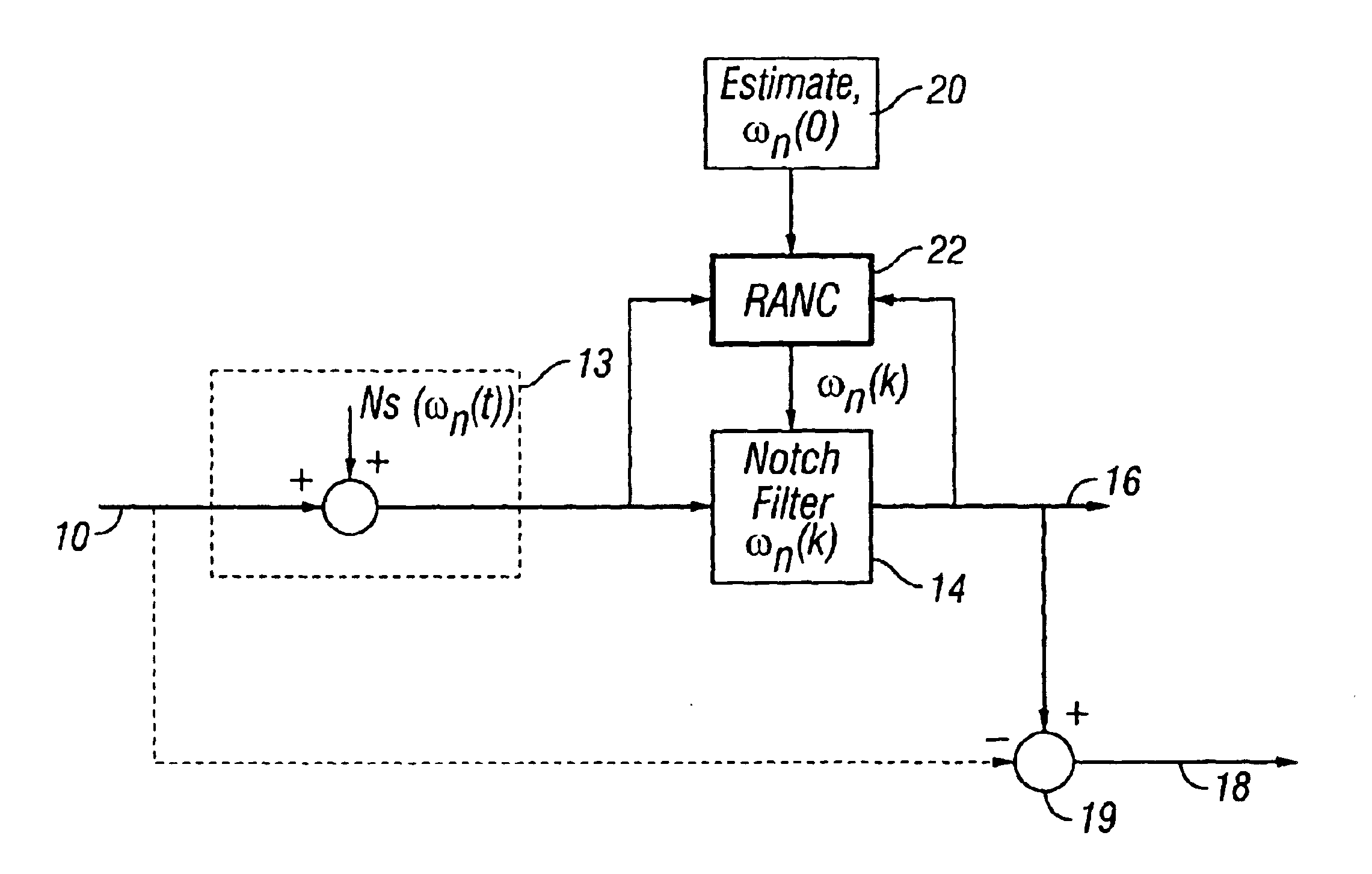
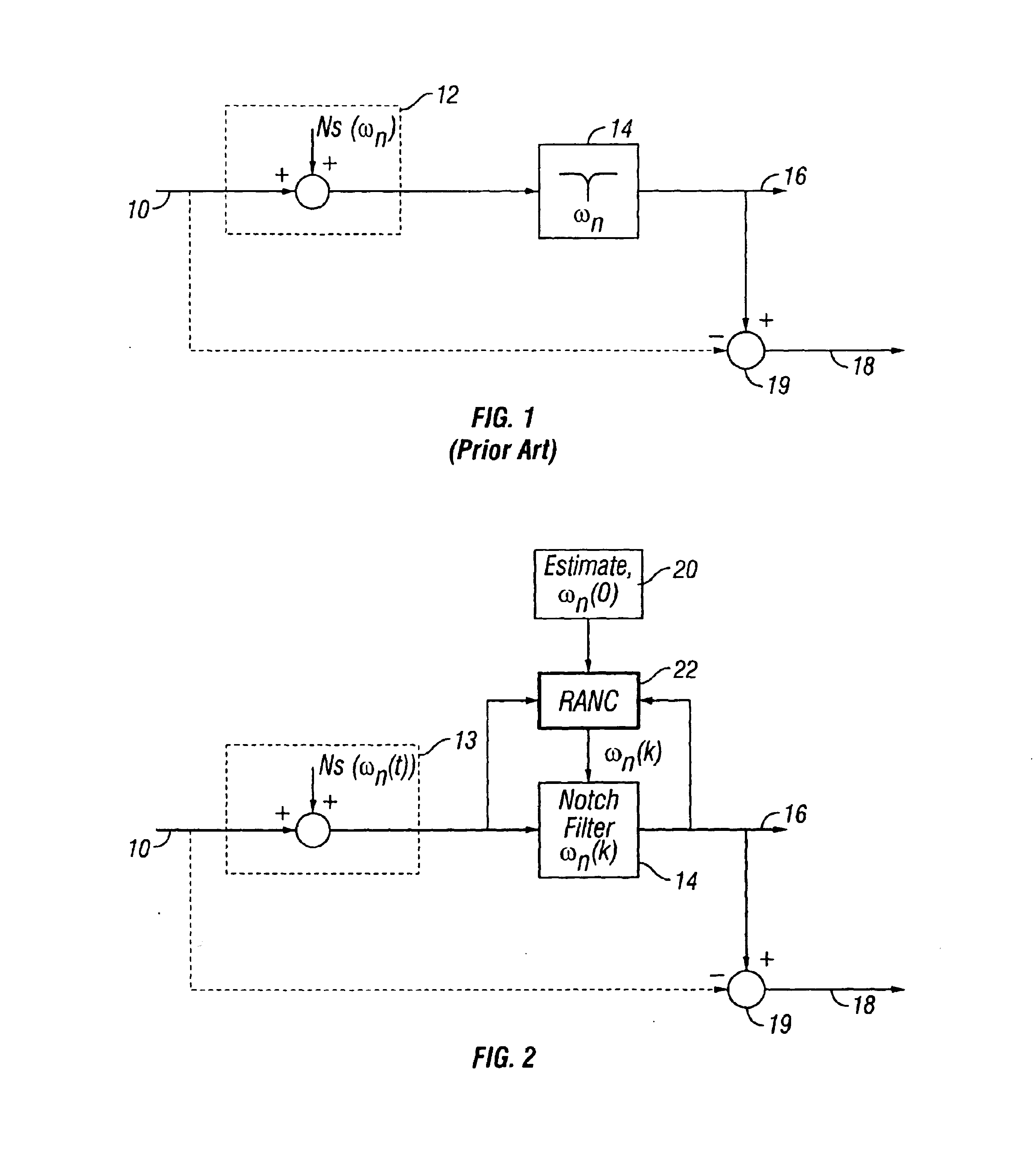
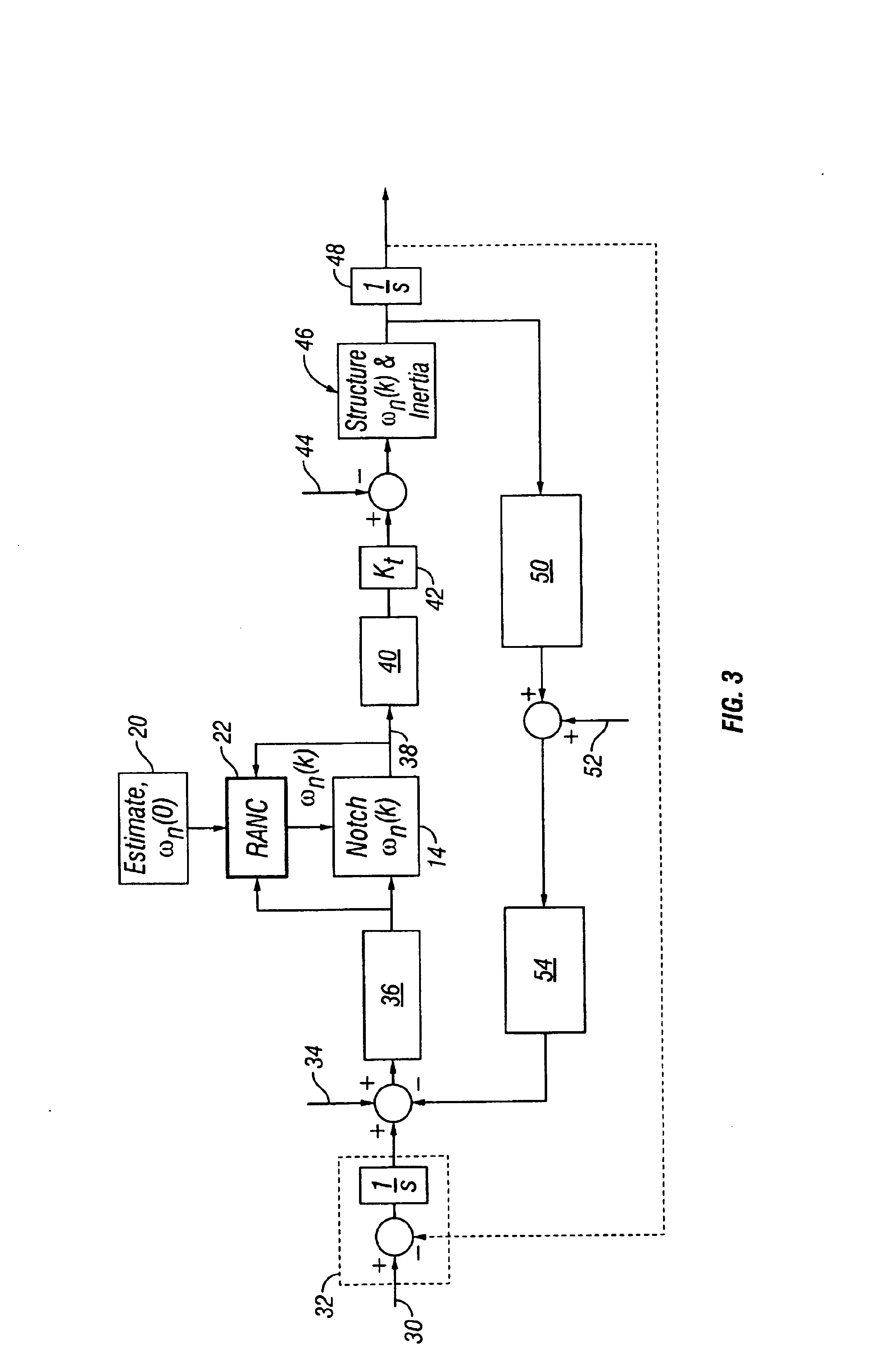
- The Realtime Adaptive Notch Compensator (RANC) dynamically calculates and updates the notch filter frequency to stabilize control loops by minimizing oscillations, using pre-filters, demodulation, and integral compensation to adapt to changing resonance frequencies and noise harmonics, allowing for narrower notches and reduced structural stiffness.

Real-time Processing Performance Requirements
Real-time processing performance requirements for adjusting notch filter characteristics across diverse inputs present significant computational challenges that directly impact system responsiveness and accuracy. The dynamic nature of input signals necessitates continuous parameter adjustments, requiring processing systems to maintain sub-millisecond response times while preserving signal integrity. Modern applications demand processing latencies below 100 microseconds for audio systems and even stricter requirements for high-frequency communication systems.
The computational complexity of adaptive notch filtering algorithms varies substantially based on the adaptation method employed. Least Mean Squares (LMS) algorithms typically require 50-200 multiply-accumulate operations per sample, while more sophisticated approaches like Recursive Least Squares (RLS) can demand 10-50 times more computational resources. These requirements scale linearly with the number of notch frequencies being simultaneously adjusted, creating exponential processing demands in multi-notch scenarios.
Memory bandwidth constraints significantly influence real-time performance, particularly when processing high-resolution audio or wideband signals. Systems must maintain sufficient buffer depths to accommodate algorithm convergence times while minimizing latency. Typical implementations require 512-2048 sample buffers, translating to 2-16KB memory allocation per channel at standard sampling rates.
Hardware acceleration becomes essential for meeting stringent real-time requirements. Digital Signal Processors (DSPs) and Field-Programmable Gate Arrays (FPGAs) offer parallel processing capabilities that can reduce computational latency by 80-95% compared to general-purpose processors. Modern DSP architectures provide dedicated multiply-accumulate units and circular buffering mechanisms specifically optimized for adaptive filtering operations.
Power consumption constraints in mobile and embedded applications further complicate performance requirements. Real-time notch filter implementations must balance computational accuracy with energy efficiency, often requiring dynamic scaling of processing precision based on input signal characteristics. Advanced power management techniques, including clock gating and voltage scaling, enable systems to maintain real-time performance while extending battery life in portable applications.
The computational complexity of adaptive notch filtering algorithms varies substantially based on the adaptation method employed. Least Mean Squares (LMS) algorithms typically require 50-200 multiply-accumulate operations per sample, while more sophisticated approaches like Recursive Least Squares (RLS) can demand 10-50 times more computational resources. These requirements scale linearly with the number of notch frequencies being simultaneously adjusted, creating exponential processing demands in multi-notch scenarios.
Memory bandwidth constraints significantly influence real-time performance, particularly when processing high-resolution audio or wideband signals. Systems must maintain sufficient buffer depths to accommodate algorithm convergence times while minimizing latency. Typical implementations require 512-2048 sample buffers, translating to 2-16KB memory allocation per channel at standard sampling rates.
Hardware acceleration becomes essential for meeting stringent real-time requirements. Digital Signal Processors (DSPs) and Field-Programmable Gate Arrays (FPGAs) offer parallel processing capabilities that can reduce computational latency by 80-95% compared to general-purpose processors. Modern DSP architectures provide dedicated multiply-accumulate units and circular buffering mechanisms specifically optimized for adaptive filtering operations.
Power consumption constraints in mobile and embedded applications further complicate performance requirements. Real-time notch filter implementations must balance computational accuracy with energy efficiency, often requiring dynamic scaling of processing precision based on input signal characteristics. Advanced power management techniques, including clock gating and voltage scaling, enable systems to maintain real-time performance while extending battery life in portable applications.
Multi-domain Application Scenarios Analysis
Adjustable notch filters demonstrate remarkable versatility across multiple engineering domains, each presenting unique requirements for input signal characteristics and filtering precision. The telecommunications sector represents one of the most demanding applications, where notch filters must dynamically adapt to eliminate interference from adjacent frequency bands while preserving signal integrity across varying data rates and modulation schemes. Modern 5G networks particularly benefit from adaptive notch filtering capabilities that can respond to real-time spectrum conditions and diverse user equipment configurations.
In audio processing applications, adjustable notch filters serve critical roles in professional sound engineering and consumer electronics. Recording studios utilize these filters to eliminate specific frequency artifacts such as power line hum, air conditioning noise, or feedback loops, with each scenario requiring different notch depths and bandwidths. Consumer audio devices implement adaptive notch filtering to enhance listening experiences across various content types, from speech-heavy podcasts requiring narrow notch characteristics to music playback demanding broader frequency response adjustments.
Medical instrumentation presents another significant application domain where notch filter adaptability proves essential. Electrocardiogram and electroencephalogram systems must filter out power line interference while accommodating patient-specific physiological variations. The filter characteristics must adjust based on patient demographics, electrode placement variations, and environmental electromagnetic conditions, ensuring accurate diagnostic readings across diverse clinical scenarios.
Industrial automation and control systems leverage adjustable notch filters to maintain signal quality in harsh electromagnetic environments. Manufacturing facilities with variable motor loads, welding operations, and switching power supplies create dynamic interference patterns requiring real-time filter adaptation. These systems must accommodate input signals ranging from low-frequency sensor data to high-speed communication protocols.
Radar and defense applications demand notch filters capable of suppressing jamming signals while maintaining target detection capabilities across diverse operational environments. The filters must adapt to different threat scenarios, geographic locations, and mission-specific requirements, demonstrating the critical importance of flexible notch characteristics in maintaining system effectiveness across varied operational contexts.
In audio processing applications, adjustable notch filters serve critical roles in professional sound engineering and consumer electronics. Recording studios utilize these filters to eliminate specific frequency artifacts such as power line hum, air conditioning noise, or feedback loops, with each scenario requiring different notch depths and bandwidths. Consumer audio devices implement adaptive notch filtering to enhance listening experiences across various content types, from speech-heavy podcasts requiring narrow notch characteristics to music playback demanding broader frequency response adjustments.
Medical instrumentation presents another significant application domain where notch filter adaptability proves essential. Electrocardiogram and electroencephalogram systems must filter out power line interference while accommodating patient-specific physiological variations. The filter characteristics must adjust based on patient demographics, electrode placement variations, and environmental electromagnetic conditions, ensuring accurate diagnostic readings across diverse clinical scenarios.
Industrial automation and control systems leverage adjustable notch filters to maintain signal quality in harsh electromagnetic environments. Manufacturing facilities with variable motor loads, welding operations, and switching power supplies create dynamic interference patterns requiring real-time filter adaptation. These systems must accommodate input signals ranging from low-frequency sensor data to high-speed communication protocols.
Radar and defense applications demand notch filters capable of suppressing jamming signals while maintaining target detection capabilities across diverse operational environments. The filters must adapt to different threat scenarios, geographic locations, and mission-specific requirements, demonstrating the critical importance of flexible notch characteristics in maintaining system effectiveness across varied operational contexts.
Unlock deeper insights with Patsnap Eureka Quick Research — get a full tech report to explore trends and direct your research. Try now!
Generate Your Research Report Instantly with AI Agent
Supercharge your innovation with Patsnap Eureka AI Agent Platform!