

Amide Reaction Innovations: Enhanced Eco-Friendly Protocols
FEB 28, 20269 MIN READ
Generate Your Research Report Instantly with AI Agent
PatSnap Eureka helps you evaluate technical feasibility & market potential.
Amide Synthesis Background and Green Chemistry Goals
Amide bonds represent one of the most fundamental linkages in organic chemistry, serving as the backbone of proteins and forming the structural foundation of countless pharmaceuticals, polymers, and advanced materials. The formation of these C-N bonds has been a cornerstone of synthetic chemistry for over a century, with traditional methods relying heavily on coupling reagents, harsh reaction conditions, and stoichiometric activating agents that generate substantial chemical waste.
The historical development of amide synthesis began with simple condensation reactions between carboxylic acids and amines, but the inherently unfavorable thermodynamics of direct amidation necessitated the development of activation strategies. Classical approaches emerged through the use of acid chlorides, anhydrides, and later, sophisticated coupling reagents such as carbodiimides, phosphonium salts, and uranium-based activators. While these methods achieved high efficiency and broad substrate scope, they introduced significant environmental concerns through the generation of stoichiometric byproducts and reliance on toxic or expensive reagents.
The evolution toward more sustainable amide synthesis has been driven by mounting environmental pressures and regulatory requirements across pharmaceutical and chemical industries. Traditional amide formation processes typically generate 1-3 equivalents of waste per bond formed, contributing to substantial environmental footprints in large-scale manufacturing. Additionally, many conventional coupling reagents pose safety hazards, require specialized handling, and create disposal challenges that increase operational costs and regulatory compliance burdens.
Contemporary green chemistry initiatives in amide synthesis focus on several key objectives that align with the twelve principles of green chemistry. Primary goals include the elimination or dramatic reduction of stoichiometric waste through catalytic processes, the replacement of hazardous solvents with benign alternatives or solvent-free conditions, and the development of atom-economical transformations that maximize the incorporation of starting materials into final products.
Energy efficiency represents another critical target, with researchers pursuing mild reaction conditions that operate at ambient temperature and pressure while maintaining high selectivity and yield. The integration of renewable feedstocks and the design of inherently safer processes that minimize the potential for accidents or environmental releases constitute additional focal points for sustainable amide synthesis development.
The convergence of these environmental imperatives with advances in catalysis, process intensification, and reaction engineering has created unprecedented opportunities for breakthrough innovations in amide formation. Modern approaches increasingly emphasize the development of catalytic systems that can activate readily available starting materials under mild conditions, the exploitation of alternative energy sources such as photochemical and electrochemical activation, and the implementation of continuous flow processes that enhance safety and efficiency while reducing waste generation.
The historical development of amide synthesis began with simple condensation reactions between carboxylic acids and amines, but the inherently unfavorable thermodynamics of direct amidation necessitated the development of activation strategies. Classical approaches emerged through the use of acid chlorides, anhydrides, and later, sophisticated coupling reagents such as carbodiimides, phosphonium salts, and uranium-based activators. While these methods achieved high efficiency and broad substrate scope, they introduced significant environmental concerns through the generation of stoichiometric byproducts and reliance on toxic or expensive reagents.
The evolution toward more sustainable amide synthesis has been driven by mounting environmental pressures and regulatory requirements across pharmaceutical and chemical industries. Traditional amide formation processes typically generate 1-3 equivalents of waste per bond formed, contributing to substantial environmental footprints in large-scale manufacturing. Additionally, many conventional coupling reagents pose safety hazards, require specialized handling, and create disposal challenges that increase operational costs and regulatory compliance burdens.
Contemporary green chemistry initiatives in amide synthesis focus on several key objectives that align with the twelve principles of green chemistry. Primary goals include the elimination or dramatic reduction of stoichiometric waste through catalytic processes, the replacement of hazardous solvents with benign alternatives or solvent-free conditions, and the development of atom-economical transformations that maximize the incorporation of starting materials into final products.
Energy efficiency represents another critical target, with researchers pursuing mild reaction conditions that operate at ambient temperature and pressure while maintaining high selectivity and yield. The integration of renewable feedstocks and the design of inherently safer processes that minimize the potential for accidents or environmental releases constitute additional focal points for sustainable amide synthesis development.
The convergence of these environmental imperatives with advances in catalysis, process intensification, and reaction engineering has created unprecedented opportunities for breakthrough innovations in amide formation. Modern approaches increasingly emphasize the development of catalytic systems that can activate readily available starting materials under mild conditions, the exploitation of alternative energy sources such as photochemical and electrochemical activation, and the implementation of continuous flow processes that enhance safety and efficiency while reducing waste generation.
Market Demand for Sustainable Amide Formation Methods
The pharmaceutical industry represents the largest consumer segment for sustainable amide formation methods, driven by stringent regulatory requirements and increasing environmental consciousness. Major pharmaceutical companies are actively seeking greener alternatives to traditional amide coupling reactions, which often rely on toxic reagents and generate substantial waste streams. The industry's commitment to reducing environmental impact has created substantial demand for eco-friendly protocols that maintain high yields and selectivity while minimizing hazardous byproducts.
Chemical manufacturing sectors, particularly those producing agrochemicals and specialty chemicals, demonstrate growing interest in sustainable amide synthesis. These industries face mounting pressure from environmental regulations and sustainability mandates, creating market pull for innovative green chemistry solutions. The demand is particularly pronounced in regions with strict environmental compliance requirements, where companies seek to avoid costly waste treatment and disposal processes associated with conventional amide formation methods.
Academic and research institutions constitute an emerging market segment, increasingly prioritizing sustainable synthetic methodologies in their research programs. Government funding agencies and research councils are directing resources toward green chemistry initiatives, creating institutional demand for eco-friendly amide formation protocols. This academic interest translates into long-term market development as trained researchers enter industrial positions with expertise in sustainable synthetic approaches.
The fine chemicals and materials science sectors show accelerating adoption of sustainable amide formation methods, particularly for high-value applications where environmental credentials provide competitive advantages. Companies producing advanced materials, electronic chemicals, and performance additives recognize that sustainable manufacturing processes enhance product marketability and align with customer sustainability requirements.
Market demand is further amplified by supply chain considerations, as downstream customers increasingly evaluate suppliers based on environmental performance metrics. This creates cascading demand throughout chemical value chains, where companies adopt sustainable amide formation methods to maintain competitive positioning and meet customer expectations for environmentally responsible sourcing.
Regulatory trends across major markets continue strengthening environmental requirements, creating sustained demand drivers for eco-friendly synthetic protocols. The convergence of regulatory pressure, customer expectations, and corporate sustainability commitments establishes a robust foundation for continued market growth in sustainable amide formation technologies.
Chemical manufacturing sectors, particularly those producing agrochemicals and specialty chemicals, demonstrate growing interest in sustainable amide synthesis. These industries face mounting pressure from environmental regulations and sustainability mandates, creating market pull for innovative green chemistry solutions. The demand is particularly pronounced in regions with strict environmental compliance requirements, where companies seek to avoid costly waste treatment and disposal processes associated with conventional amide formation methods.
Academic and research institutions constitute an emerging market segment, increasingly prioritizing sustainable synthetic methodologies in their research programs. Government funding agencies and research councils are directing resources toward green chemistry initiatives, creating institutional demand for eco-friendly amide formation protocols. This academic interest translates into long-term market development as trained researchers enter industrial positions with expertise in sustainable synthetic approaches.
The fine chemicals and materials science sectors show accelerating adoption of sustainable amide formation methods, particularly for high-value applications where environmental credentials provide competitive advantages. Companies producing advanced materials, electronic chemicals, and performance additives recognize that sustainable manufacturing processes enhance product marketability and align with customer sustainability requirements.
Market demand is further amplified by supply chain considerations, as downstream customers increasingly evaluate suppliers based on environmental performance metrics. This creates cascading demand throughout chemical value chains, where companies adopt sustainable amide formation methods to maintain competitive positioning and meet customer expectations for environmentally responsible sourcing.
Regulatory trends across major markets continue strengthening environmental requirements, creating sustained demand drivers for eco-friendly synthetic protocols. The convergence of regulatory pressure, customer expectations, and corporate sustainability commitments establishes a robust foundation for continued market growth in sustainable amide formation technologies.
Current Amide Reaction Challenges and Environmental Impact
Traditional amide bond formation represents one of the most fundamental yet challenging reactions in organic chemistry, with significant implications for pharmaceutical manufacturing, materials science, and chemical industry at large. Despite decades of research and development, current methodologies continue to face substantial technical and environmental obstacles that limit their widespread application and sustainability.
The primary technical challenge lies in the inherent thermodynamic stability of carboxylic acids and amines, which necessitates the use of highly reactive coupling reagents to facilitate bond formation. Conventional approaches rely heavily on stoichiometric activating agents such as carbodiimides, phosphonium salts, and uronium-based reagents, which generate substantial quantities of chemical waste and often require harsh reaction conditions including elevated temperatures and extended reaction times.
Energy efficiency remains a critical concern, as most established protocols demand significant thermal input to overcome activation barriers. This energy-intensive nature not only increases operational costs but also contributes to substantial carbon footprint, particularly in large-scale industrial applications where amide formation constitutes a major synthetic step.
The environmental impact of current amide synthesis methods extends far beyond energy consumption. Traditional coupling reagents generate toxic byproducts that pose serious disposal challenges and environmental risks. Many commonly used activating agents produce urea derivatives, phosphine oxides, and other persistent organic compounds that require specialized waste treatment protocols and contribute to long-term environmental contamination.
Solvent usage presents another significant environmental burden, as most conventional amide formation reactions require large volumes of organic solvents, including dichloromethane, dimethylformamide, and acetonitrile. These solvents not only pose health and safety risks but also contribute to volatile organic compound emissions and require energy-intensive purification and recycling processes.
Selectivity issues further compound these challenges, particularly in complex molecular environments where multiple reactive sites may compete for coupling reagents. Poor selectivity leads to increased purification requirements, higher material consumption, and greater waste generation, ultimately undermining both economic viability and environmental sustainability.
The cumulative effect of these challenges has created an urgent need for innovative approaches that can maintain synthetic efficiency while dramatically reducing environmental impact through improved atom economy, reduced waste generation, and enhanced energy efficiency.
The primary technical challenge lies in the inherent thermodynamic stability of carboxylic acids and amines, which necessitates the use of highly reactive coupling reagents to facilitate bond formation. Conventional approaches rely heavily on stoichiometric activating agents such as carbodiimides, phosphonium salts, and uronium-based reagents, which generate substantial quantities of chemical waste and often require harsh reaction conditions including elevated temperatures and extended reaction times.
Energy efficiency remains a critical concern, as most established protocols demand significant thermal input to overcome activation barriers. This energy-intensive nature not only increases operational costs but also contributes to substantial carbon footprint, particularly in large-scale industrial applications where amide formation constitutes a major synthetic step.
The environmental impact of current amide synthesis methods extends far beyond energy consumption. Traditional coupling reagents generate toxic byproducts that pose serious disposal challenges and environmental risks. Many commonly used activating agents produce urea derivatives, phosphine oxides, and other persistent organic compounds that require specialized waste treatment protocols and contribute to long-term environmental contamination.
Solvent usage presents another significant environmental burden, as most conventional amide formation reactions require large volumes of organic solvents, including dichloromethane, dimethylformamide, and acetonitrile. These solvents not only pose health and safety risks but also contribute to volatile organic compound emissions and require energy-intensive purification and recycling processes.
Selectivity issues further compound these challenges, particularly in complex molecular environments where multiple reactive sites may compete for coupling reagents. Poor selectivity leads to increased purification requirements, higher material consumption, and greater waste generation, ultimately undermining both economic viability and environmental sustainability.
The cumulative effect of these challenges has created an urgent need for innovative approaches that can maintain synthetic efficiency while dramatically reducing environmental impact through improved atom economy, reduced waste generation, and enhanced energy efficiency.
Existing Eco-Friendly Amide Formation Solutions
01 Use of green solvents in amide synthesis
Eco-friendly amide reactions can be achieved by utilizing green solvents such as water, ionic liquids, or bio-based solvents instead of traditional organic solvents. These alternative solvents reduce environmental impact, minimize waste generation, and improve the sustainability of the amide formation process. The use of such solvents can maintain or even enhance reaction efficiency while significantly reducing toxicity and environmental footprint.- Use of green solvents in amide synthesis: Eco-friendly amide reactions can be achieved by utilizing green solvents such as water, ionic liquids, or bio-based solvents instead of traditional organic solvents. These alternative solvents reduce environmental impact, minimize waste generation, and improve the sustainability of the amide formation process. The use of such solvents can maintain or even enhance reaction efficiency while significantly reducing toxicity and environmental footprint.
- Catalyst-based eco-friendly amide formation: The development of environmentally benign catalysts for amide bond formation represents a significant advancement in green chemistry. These catalysts, including metal-free organocatalysts, biocatalysts, or recyclable metal catalysts, enable amide synthesis under mild conditions with reduced energy consumption. Such catalytic systems minimize the need for harsh reagents and allow for catalyst recovery and reuse, thereby reducing waste and improving the overall sustainability of the process.
- Solvent-free amide synthesis methods: Solvent-free approaches to amide synthesis eliminate the need for organic solvents entirely, representing one of the most environmentally friendly methods. These techniques may involve mechanochemical synthesis, microwave-assisted reactions, or solid-state reactions that proceed efficiently without liquid media. By removing solvents from the process, these methods reduce waste, lower costs, and minimize environmental pollution while maintaining high yields and selectivity.
- Renewable feedstock utilization for amide production: The use of renewable and bio-based starting materials for amide synthesis contributes to the sustainability of the process. This approach involves utilizing naturally derived carboxylic acids, amines, or their derivatives obtained from biomass, agricultural waste, or other renewable sources. By replacing petroleum-based feedstocks with renewable alternatives, the carbon footprint of amide production is reduced, and the process becomes more aligned with circular economy principles.
- Energy-efficient amide coupling procedures: Energy-efficient methods for amide bond formation focus on reducing the energy requirements of the reaction through optimized conditions, such as room temperature reactions, photocatalytic processes, or electrochemical synthesis. These approaches minimize the need for high temperatures and pressures, thereby reducing energy consumption and associated carbon emissions. Such methods often incorporate innovative activation strategies that enable efficient amide formation under mild conditions while maintaining high atom economy.
02 Catalyst-based eco-friendly amide formation
The development of environmentally benign catalysts, including biocatalysts, metal-free catalysts, and recyclable catalytic systems, enables more sustainable amide synthesis. These catalytic approaches reduce the need for stoichiometric reagents, lower energy consumption, and minimize by-product formation. The catalysts can be recovered and reused, further enhancing the environmental profile of the amide reaction process.Expand Specific Solutions03 Energy-efficient amide synthesis methods
Eco-friendly amide reactions can be accomplished through energy-efficient methods such as microwave-assisted synthesis, ultrasound-promoted reactions, or room temperature processes. These approaches reduce energy consumption compared to conventional heating methods, shorten reaction times, and improve overall process efficiency. The reduced energy requirements contribute to lower carbon footprint and enhanced sustainability of amide production.Expand Specific Solutions04 Waste minimization and atom economy in amide reactions
Sustainable amide synthesis focuses on maximizing atom economy and minimizing waste generation through direct coupling methods, elimination of protecting groups, and one-pot multi-step reactions. These strategies reduce the number of synthetic steps, decrease the use of auxiliary reagents, and improve the overall yield of desired products. The approach aligns with green chemistry principles by reducing material consumption and waste disposal requirements.Expand Specific Solutions05 Bio-based and renewable feedstocks for amide production
The utilization of bio-based starting materials and renewable feedstocks represents an eco-friendly approach to amide synthesis. This includes the use of amino acids, peptides, or other biomass-derived compounds as substrates for amide formation. Such approaches reduce dependence on petroleum-based chemicals, lower the carbon footprint of the synthesis process, and contribute to circular economy principles in chemical manufacturing.Expand Specific Solutions
Key Players in Sustainable Chemical Manufacturing
The amide reaction innovations sector is experiencing significant growth driven by increasing environmental regulations and sustainability demands across pharmaceutical and chemical industries. The market demonstrates substantial expansion potential as companies seek eco-friendly alternatives to traditional synthetic protocols. Technology maturity varies considerably among key players, with established chemical giants like DuPont de Nemours, Mitsui Chemicals, and Evonik Operations leading in commercial-scale green chemistry applications. Academic institutions including Nanjing Tech University, Central South University, and Indian Institute of Technology Roorkee are advancing fundamental research in catalytic methodologies. Pharmaceutical companies such as Ono Pharmaceutical and Zydus Lifesciences are implementing these innovations in drug synthesis, while specialty chemical manufacturers like Kingfa Sci. & Tech. and Transfar companies are scaling sustainable amide formation processes for industrial applications.
Ono Pharmaceutical Co., Ltd.
Technical Solution: Ono Pharmaceutical has focused on developing biocatalytic amide synthesis methods specifically for pharmaceutical applications. Their approach utilizes engineered amidases and lipases that catalyze amide bond formation under physiological conditions with exceptional stereoselectivity. The company has created immobilized enzyme systems that can be easily separated and reused, reducing overall process costs by 30%. Their technology incorporates deep eutectic solvents as green reaction media, which enhance enzyme stability and substrate solubility while being biodegradable. Ono's protocols have been successfully applied to synthesize complex drug molecules with improved environmental profiles and reduced regulatory compliance requirements for pharmaceutical manufacturing.
Strengths: High stereoselectivity, pharmaceutical-grade quality, regulatory compliance advantages. Weaknesses: Limited to specific pharmaceutical applications, enzyme production costs.
Evonik Operations GmbH
Technical Solution: Evonik has developed a comprehensive green chemistry platform for amide synthesis utilizing their proprietary ionic liquid catalysts. The system operates through a continuous flow process that enables precise temperature and residence time control, resulting in improved selectivity and reduced by-product formation. Their technology incorporates real-time monitoring systems that optimize reaction conditions automatically, achieving energy savings of up to 50%. The process uses recyclable ionic liquids that can be regenerated through simple distillation, maintaining catalyst activity over 100+ cycles. Evonik's approach eliminates the need for traditional coupling agents and reduces overall process complexity while maintaining pharmaceutical-grade product quality.
Strengths: Continuous flow technology, excellent catalyst recyclability, automated process control. Weaknesses: High ionic liquid costs, complex process setup requirements.
Core Patents in Green Amide Coupling Technologies
Method for preparation of amides from alcohols and amines by extrusion of hydrogen
PatentInactiveUS20110319636A1
Innovation
- A ruthenium N-heterocyclic carbene (NHC) complex is used in situ to catalyze the direct coupling of alcohols and amines, producing amides with hydrogen as the only by-product, avoiding the need for additional reagents and promoting a more efficient, environmentally friendly synthesis.
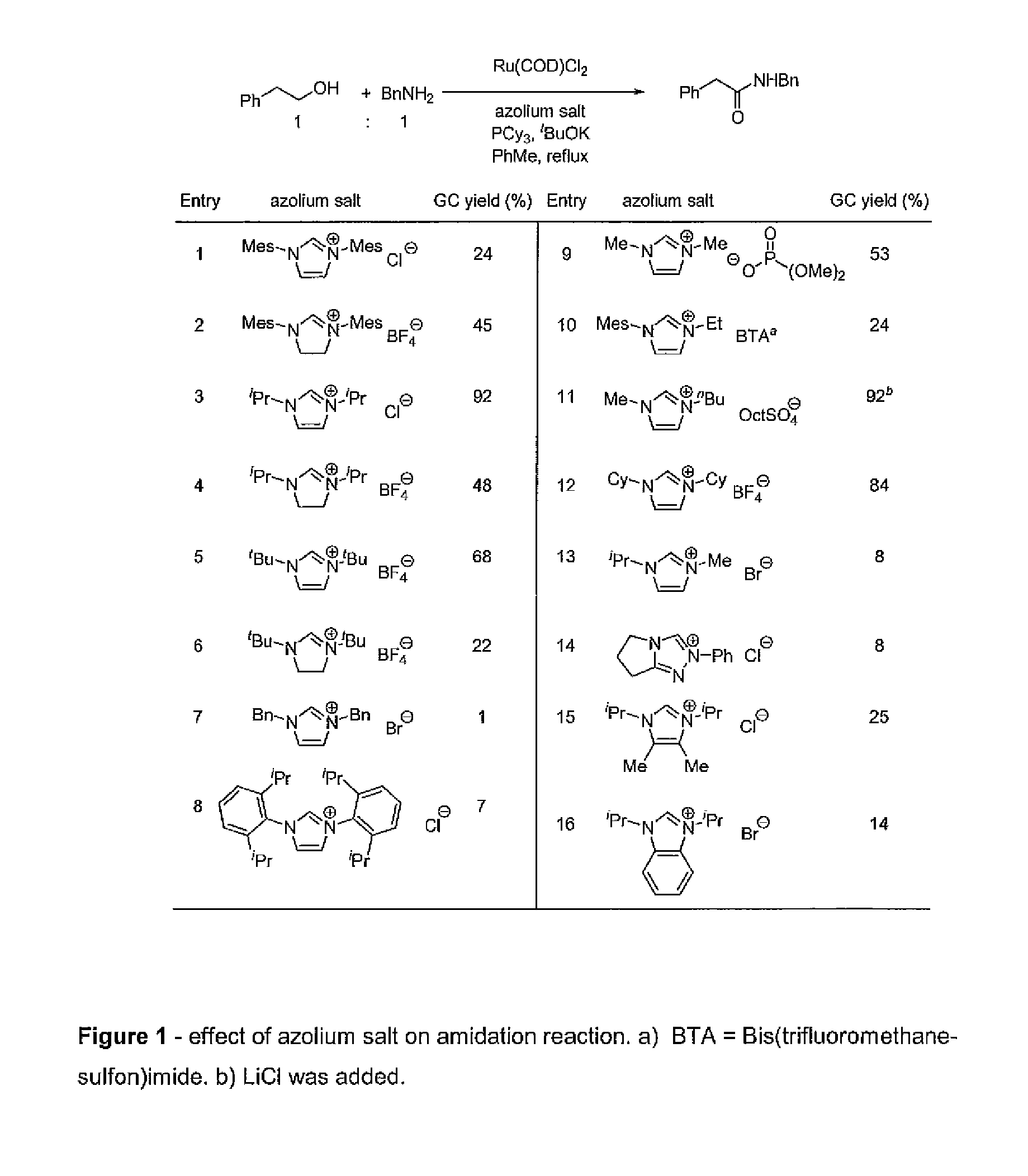
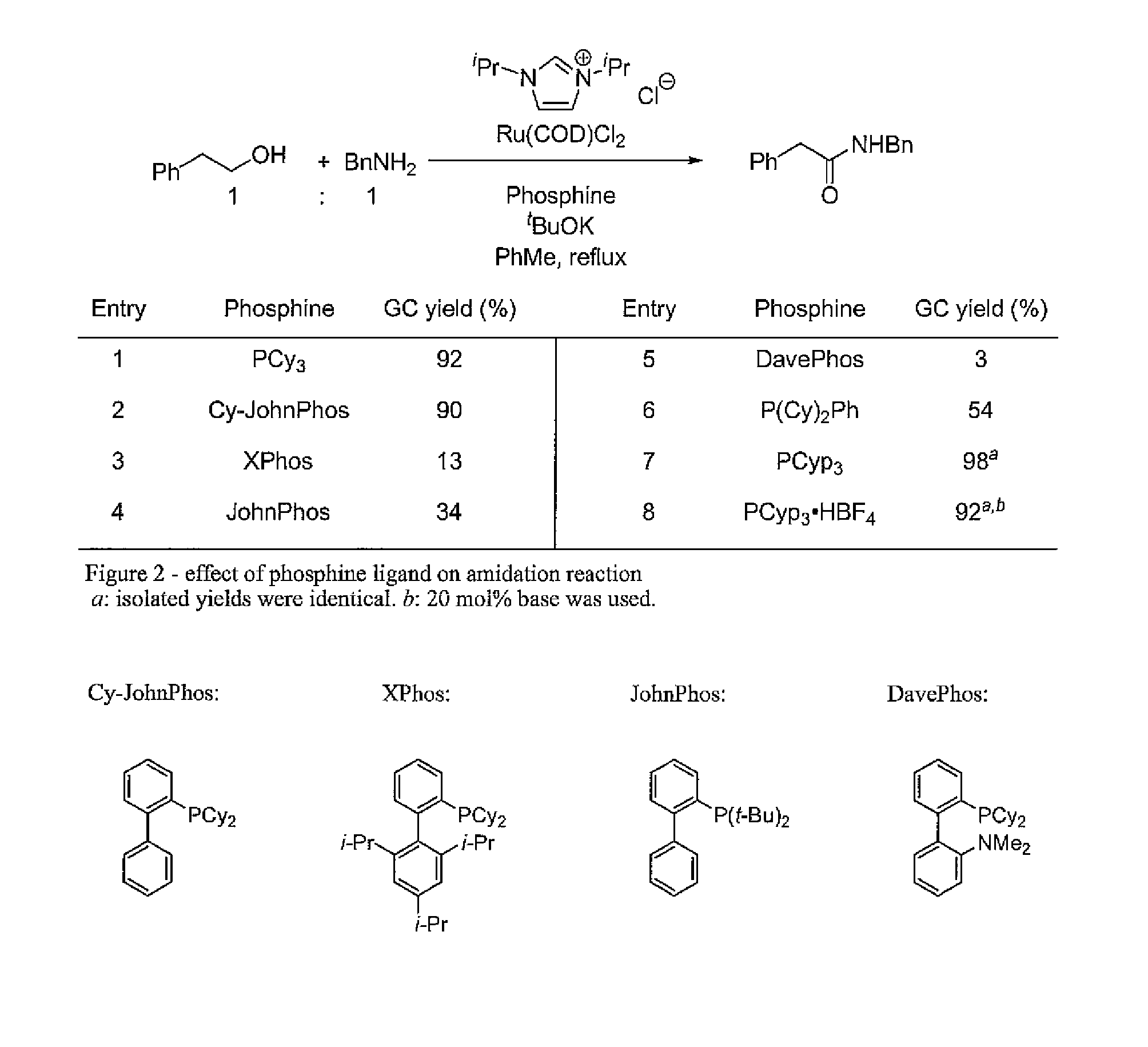
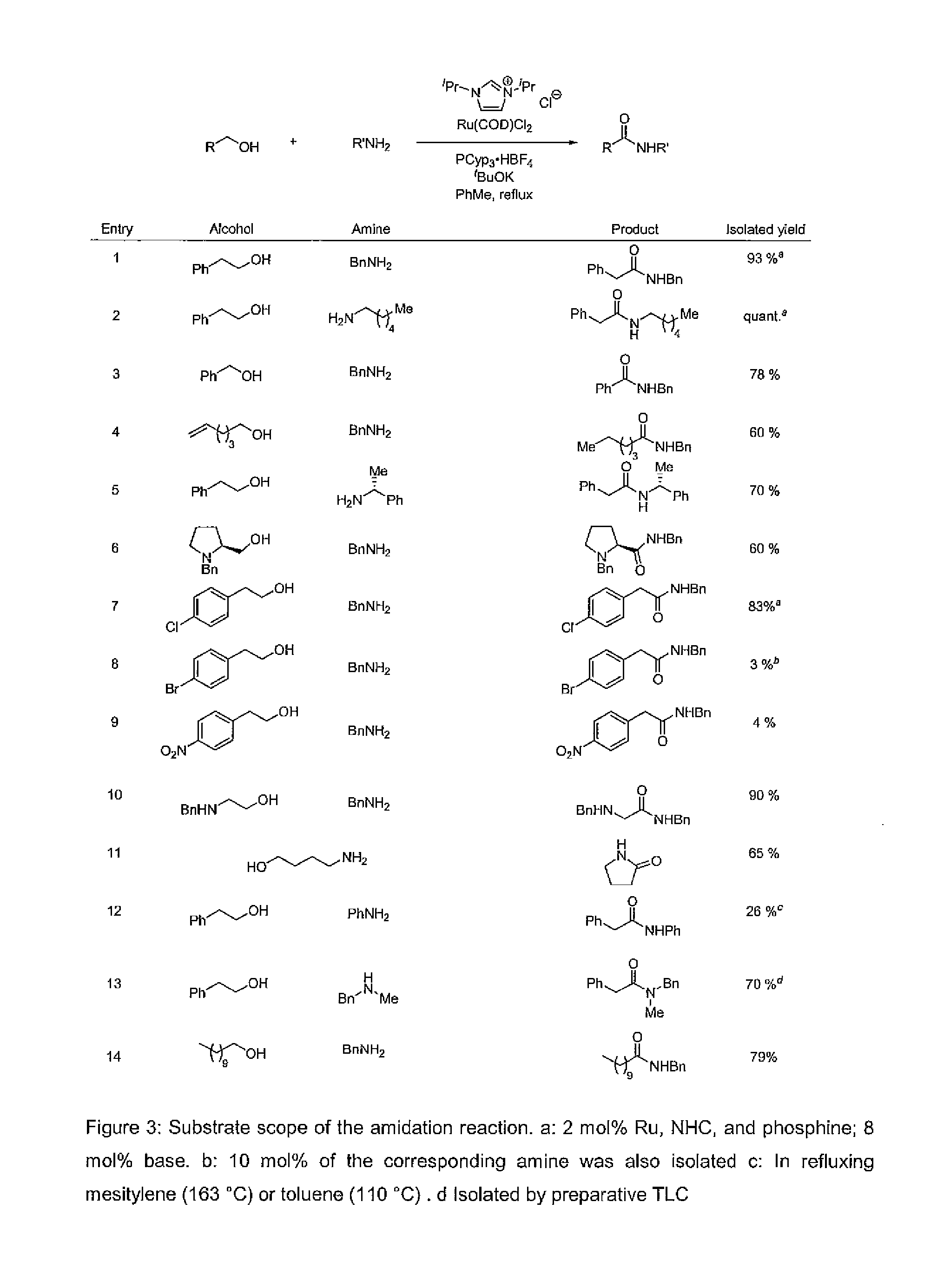

Reaction agent for amide reaction and method for producing amide compound using same
PatentInactiveUS20240209020A1
Innovation
- A silane compound with a specific structure is used as a reaction agent, either alone or in combination with a Lewis acid catalyst and/or a phosphorus compound, to facilitate amidation reactions between carboxyl and amino groups, enabling the production of amide compounds with high stereoselectivity and efficiency.


Environmental Regulations for Chemical Processes
The regulatory landscape governing chemical processes has undergone significant transformation in recent decades, with environmental protection agencies worldwide implementing increasingly stringent standards for chemical manufacturing operations. These regulations directly impact amide synthesis protocols, as traditional methods often involve hazardous solvents, generate substantial waste streams, and consume excessive energy resources.
The European Union's REACH regulation represents one of the most comprehensive frameworks affecting amide production, requiring extensive safety and environmental impact assessments for chemical substances. This regulation mandates the registration, evaluation, and authorization of chemicals, compelling manufacturers to demonstrate the safety of their processes and identify safer alternatives where possible. Similarly, the U.S. Environmental Protection Agency's Toxic Substances Control Act has been strengthened to require more rigorous evaluation of new chemical processes and existing manufacturing methods.
Green chemistry principles have been increasingly codified into regulatory frameworks, establishing twelve fundamental principles that guide environmentally responsible chemical synthesis. These principles emphasize waste prevention, atom economy, safer chemical synthesis, and the use of renewable feedstocks. For amide formation reactions, these regulations particularly focus on eliminating or reducing the use of coupling reagents that generate stoichiometric waste and promoting catalytic processes that minimize byproduct formation.
International standards such as ISO 14001 environmental management systems have created additional compliance requirements for chemical manufacturers. These standards mandate continuous improvement in environmental performance, requiring companies to establish measurable objectives for reducing their environmental footprint. The implementation of these standards has accelerated the adoption of cleaner amide synthesis technologies and encouraged investment in process optimization.
Recent regulatory developments have also introduced carbon footprint considerations into chemical process evaluation. The European Green Deal and similar initiatives worldwide are establishing carbon neutrality targets that directly influence manufacturing decisions. These policies create economic incentives for adopting energy-efficient amide synthesis methods and renewable energy integration in chemical production facilities.
Regulatory compliance costs associated with traditional amide synthesis methods have become a significant economic driver for innovation. The combination of waste disposal fees, environmental monitoring requirements, and potential liability for environmental damage has made eco-friendly protocols increasingly attractive from both regulatory and economic perspectives, fundamentally reshaping the competitive landscape in chemical manufacturing.
The European Union's REACH regulation represents one of the most comprehensive frameworks affecting amide production, requiring extensive safety and environmental impact assessments for chemical substances. This regulation mandates the registration, evaluation, and authorization of chemicals, compelling manufacturers to demonstrate the safety of their processes and identify safer alternatives where possible. Similarly, the U.S. Environmental Protection Agency's Toxic Substances Control Act has been strengthened to require more rigorous evaluation of new chemical processes and existing manufacturing methods.
Green chemistry principles have been increasingly codified into regulatory frameworks, establishing twelve fundamental principles that guide environmentally responsible chemical synthesis. These principles emphasize waste prevention, atom economy, safer chemical synthesis, and the use of renewable feedstocks. For amide formation reactions, these regulations particularly focus on eliminating or reducing the use of coupling reagents that generate stoichiometric waste and promoting catalytic processes that minimize byproduct formation.
International standards such as ISO 14001 environmental management systems have created additional compliance requirements for chemical manufacturers. These standards mandate continuous improvement in environmental performance, requiring companies to establish measurable objectives for reducing their environmental footprint. The implementation of these standards has accelerated the adoption of cleaner amide synthesis technologies and encouraged investment in process optimization.
Recent regulatory developments have also introduced carbon footprint considerations into chemical process evaluation. The European Green Deal and similar initiatives worldwide are establishing carbon neutrality targets that directly influence manufacturing decisions. These policies create economic incentives for adopting energy-efficient amide synthesis methods and renewable energy integration in chemical production facilities.
Regulatory compliance costs associated with traditional amide synthesis methods have become a significant economic driver for innovation. The combination of waste disposal fees, environmental monitoring requirements, and potential liability for environmental damage has made eco-friendly protocols increasingly attractive from both regulatory and economic perspectives, fundamentally reshaping the competitive landscape in chemical manufacturing.
Catalyst Recovery and Waste Minimization Strategies
Catalyst recovery represents a critical component in developing sustainable amide synthesis protocols, as it directly addresses both economic viability and environmental impact concerns. Traditional homogeneous catalysts, while often highly active and selective, present significant challenges in separation and reuse. The implementation of heterogeneous catalysts has emerged as a primary strategy, utilizing solid supports such as silica, alumina, or polymer matrices to immobilize active metal centers. These systems enable straightforward separation through filtration or magnetic recovery when using magnetic nanoparticles as supports.
Advanced recovery techniques have evolved beyond simple filtration methods. Biphasic catalysis systems employ ionic liquids or fluorous phases to facilitate catalyst separation while maintaining high reaction efficiency. Temperature-responsive polymers offer another innovative approach, where catalyst solubility can be controlled through thermal cycling, allowing for homogeneous reaction conditions followed by heterogeneous separation. Membrane-based separation technologies have also gained traction, particularly for molecular catalyst recovery in continuous flow systems.
Waste minimization strategies in amide synthesis focus on atom economy principles and byproduct valorization. The shift from traditional coupling reagents like EDC/HOBt to more efficient alternatives such as COMU or PyBOP reduces the formation of urea-based waste products. Direct amidation methods utilizing carboxylic acids and amines without additional coupling agents represent the ultimate goal in waste reduction, though these approaches often require elevated temperatures or specialized catalysts.
Solvent recovery and recycling constitute another crucial aspect of waste minimization. Deep eutectic solvents and bio-based solvents offer inherent advantages in terms of recyclability and environmental compatibility. Distillation, membrane separation, and crystallization techniques enable solvent purification and reuse across multiple reaction cycles. The development of solvent-free or minimal solvent protocols further reduces waste generation while maintaining synthetic efficiency.
Process intensification through continuous flow chemistry provides additional opportunities for waste reduction. These systems enable precise control over reaction parameters, reducing side product formation and improving overall atom economy. Integration of in-line purification and catalyst recovery systems creates closed-loop processes that minimize waste generation throughout the entire synthetic sequence.
Advanced recovery techniques have evolved beyond simple filtration methods. Biphasic catalysis systems employ ionic liquids or fluorous phases to facilitate catalyst separation while maintaining high reaction efficiency. Temperature-responsive polymers offer another innovative approach, where catalyst solubility can be controlled through thermal cycling, allowing for homogeneous reaction conditions followed by heterogeneous separation. Membrane-based separation technologies have also gained traction, particularly for molecular catalyst recovery in continuous flow systems.
Waste minimization strategies in amide synthesis focus on atom economy principles and byproduct valorization. The shift from traditional coupling reagents like EDC/HOBt to more efficient alternatives such as COMU or PyBOP reduces the formation of urea-based waste products. Direct amidation methods utilizing carboxylic acids and amines without additional coupling agents represent the ultimate goal in waste reduction, though these approaches often require elevated temperatures or specialized catalysts.
Solvent recovery and recycling constitute another crucial aspect of waste minimization. Deep eutectic solvents and bio-based solvents offer inherent advantages in terms of recyclability and environmental compatibility. Distillation, membrane separation, and crystallization techniques enable solvent purification and reuse across multiple reaction cycles. The development of solvent-free or minimal solvent protocols further reduces waste generation while maintaining synthetic efficiency.
Process intensification through continuous flow chemistry provides additional opportunities for waste reduction. These systems enable precise control over reaction parameters, reducing side product formation and improving overall atom economy. Integration of in-line purification and catalyst recovery systems creates closed-loop processes that minimize waste generation throughout the entire synthetic sequence.
Unlock deeper insights with PatSnap Eureka Quick Research — get a full tech report to explore trends and direct your research. Try now!
Generate Your Research Report Instantly with AI Agent
Supercharge your innovation with PatSnap Eureka AI Agent Platform!