Automating Scramjet Engine Testing: Tools and Challenges
AUG 13, 20259 MIN READ
Generate Your Research Report Instantly with AI Agent
Patsnap Eureka helps you evaluate technical feasibility & market potential.
Scramjet Testing Evolution
The evolution of scramjet engine testing has been a critical journey in the advancement of hypersonic propulsion technology. Initially, ground-based facilities were the primary means of testing, with early experiments conducted in shock tunnels and arc-heated wind tunnels. These facilities provided valuable data on combustion efficiency and flow characteristics but were limited in their ability to replicate actual flight conditions.
As the demand for more accurate and comprehensive testing grew, researchers developed more sophisticated ground test facilities. Pulse facilities, such as shock tubes and expansion tubes, emerged as valuable tools for simulating high-enthalpy flow conditions. These advancements allowed for more realistic testing of scramjet components and subsystems, providing insights into ignition processes and flame stability.
The introduction of continuous-flow test facilities marked a significant milestone in scramjet testing evolution. These facilities, including vitiated air heaters and arc-heated wind tunnels with longer test durations, enabled researchers to study steady-state scramjet operation and thermal management issues. This development was crucial for understanding the sustained performance of scramjet engines under prolonged exposure to hypersonic conditions.
Flight testing became an essential component of scramjet development programs in the late 20th and early 21st centuries. Notable projects such as NASA's Hyper-X program and the U.S. Air Force's X-51 Waverider demonstrated the feasibility of scramjet propulsion in actual flight conditions. These tests provided invaluable data on engine performance, vehicle integration, and real-world challenges that could not be fully replicated in ground facilities.
The integration of computational fluid dynamics (CFD) and advanced simulation tools has revolutionized scramjet testing methodologies. High-fidelity numerical simulations now complement physical testing, allowing researchers to explore a wider range of operating conditions and design variations. This computational approach has significantly reduced the time and cost associated with experimental testing while providing detailed insights into complex flow phenomena.
Recent advancements in instrumentation and diagnostics have further enhanced the capabilities of scramjet testing facilities. Non-intrusive measurement techniques, such as laser-based diagnostics and high-speed imaging, now provide unprecedented levels of detail in flow visualization and combustion analysis. These tools have been instrumental in validating computational models and refining engine designs.
The trend towards automation in scramjet testing has gained momentum in recent years. Automated control systems, data acquisition, and analysis tools are being developed to streamline testing procedures and improve the consistency and reliability of results. This shift towards automation addresses the challenges of managing complex test conditions and processing vast amounts of data generated during scramjet experiments.
As the demand for more accurate and comprehensive testing grew, researchers developed more sophisticated ground test facilities. Pulse facilities, such as shock tubes and expansion tubes, emerged as valuable tools for simulating high-enthalpy flow conditions. These advancements allowed for more realistic testing of scramjet components and subsystems, providing insights into ignition processes and flame stability.
The introduction of continuous-flow test facilities marked a significant milestone in scramjet testing evolution. These facilities, including vitiated air heaters and arc-heated wind tunnels with longer test durations, enabled researchers to study steady-state scramjet operation and thermal management issues. This development was crucial for understanding the sustained performance of scramjet engines under prolonged exposure to hypersonic conditions.
Flight testing became an essential component of scramjet development programs in the late 20th and early 21st centuries. Notable projects such as NASA's Hyper-X program and the U.S. Air Force's X-51 Waverider demonstrated the feasibility of scramjet propulsion in actual flight conditions. These tests provided invaluable data on engine performance, vehicle integration, and real-world challenges that could not be fully replicated in ground facilities.
The integration of computational fluid dynamics (CFD) and advanced simulation tools has revolutionized scramjet testing methodologies. High-fidelity numerical simulations now complement physical testing, allowing researchers to explore a wider range of operating conditions and design variations. This computational approach has significantly reduced the time and cost associated with experimental testing while providing detailed insights into complex flow phenomena.
Recent advancements in instrumentation and diagnostics have further enhanced the capabilities of scramjet testing facilities. Non-intrusive measurement techniques, such as laser-based diagnostics and high-speed imaging, now provide unprecedented levels of detail in flow visualization and combustion analysis. These tools have been instrumental in validating computational models and refining engine designs.
The trend towards automation in scramjet testing has gained momentum in recent years. Automated control systems, data acquisition, and analysis tools are being developed to streamline testing procedures and improve the consistency and reliability of results. This shift towards automation addresses the challenges of managing complex test conditions and processing vast amounts of data generated during scramjet experiments.
Hypersonic Market Analysis
The hypersonic market is experiencing rapid growth and transformation, driven by advancements in scramjet engine technology and increasing demand for high-speed transportation and defense systems. This market segment encompasses a wide range of applications, including military aircraft, missiles, and potential commercial transportation solutions.
In the defense sector, hypersonic weapons and aircraft are becoming increasingly important for strategic deterrence and rapid response capabilities. Major military powers are investing heavily in hypersonic technology development, recognizing its potential to revolutionize warfare and maintain technological superiority. This has led to a surge in research and development funding, with governments allocating substantial resources to hypersonic programs.
The commercial sector is also showing interest in hypersonic technology, particularly for long-distance travel. Several aerospace companies are exploring the feasibility of hypersonic passenger aircraft that could dramatically reduce intercontinental travel times. While still in the early stages, these initiatives are attracting significant attention and investment from both established aerospace firms and innovative startups.
Market analysts project substantial growth in the hypersonic market over the next decade. Key factors driving this growth include increasing defense budgets, technological advancements in materials science and propulsion systems, and growing interest in high-speed transportation solutions. However, the market faces challenges such as high development costs, technical complexities, and regulatory hurdles.
The scramjet engine, a critical component of hypersonic systems, is at the forefront of this market's development. Automating scramjet engine testing is crucial for accelerating innovation and reducing costs in this field. Improved testing tools and methodologies can help overcome technical challenges, enhance reliability, and streamline the development process for hypersonic vehicles.
As the market evolves, collaborations between government agencies, research institutions, and private companies are becoming more prevalent. These partnerships aim to pool resources, share expertise, and accelerate the development of hypersonic technologies. Such collaborations are essential for addressing the complex challenges associated with hypersonic flight and propulsion systems.
The global nature of the hypersonic market is evident, with several countries actively pursuing hypersonic capabilities. This international competition is driving innovation and investment, but also raising concerns about arms races and strategic stability. As a result, the market is influenced not only by technological advancements but also by geopolitical factors and international relations.
In the defense sector, hypersonic weapons and aircraft are becoming increasingly important for strategic deterrence and rapid response capabilities. Major military powers are investing heavily in hypersonic technology development, recognizing its potential to revolutionize warfare and maintain technological superiority. This has led to a surge in research and development funding, with governments allocating substantial resources to hypersonic programs.
The commercial sector is also showing interest in hypersonic technology, particularly for long-distance travel. Several aerospace companies are exploring the feasibility of hypersonic passenger aircraft that could dramatically reduce intercontinental travel times. While still in the early stages, these initiatives are attracting significant attention and investment from both established aerospace firms and innovative startups.
Market analysts project substantial growth in the hypersonic market over the next decade. Key factors driving this growth include increasing defense budgets, technological advancements in materials science and propulsion systems, and growing interest in high-speed transportation solutions. However, the market faces challenges such as high development costs, technical complexities, and regulatory hurdles.
The scramjet engine, a critical component of hypersonic systems, is at the forefront of this market's development. Automating scramjet engine testing is crucial for accelerating innovation and reducing costs in this field. Improved testing tools and methodologies can help overcome technical challenges, enhance reliability, and streamline the development process for hypersonic vehicles.
As the market evolves, collaborations between government agencies, research institutions, and private companies are becoming more prevalent. These partnerships aim to pool resources, share expertise, and accelerate the development of hypersonic technologies. Such collaborations are essential for addressing the complex challenges associated with hypersonic flight and propulsion systems.
The global nature of the hypersonic market is evident, with several countries actively pursuing hypersonic capabilities. This international competition is driving innovation and investment, but also raising concerns about arms races and strategic stability. As a result, the market is influenced not only by technological advancements but also by geopolitical factors and international relations.
Automation Challenges
Automating scramjet engine testing presents several significant challenges due to the complex nature of hypersonic propulsion systems and the extreme conditions under which they operate. One of the primary obstacles is the development of robust sensors capable of withstanding the intense heat and pressure generated during scramjet operation. Traditional sensing technologies often fail or provide inaccurate data in such harsh environments, necessitating the creation of advanced, high-temperature resistant sensors.
Another major challenge lies in the real-time data processing and control systems required for automated testing. The extremely short time scales involved in scramjet combustion processes demand ultra-fast data acquisition and analysis capabilities. Developing algorithms that can interpret and respond to this data in milliseconds is crucial for effective automation. Additionally, the integration of these systems with existing test infrastructure poses significant technical hurdles.
The unpredictable nature of scramjet combustion adds another layer of complexity to automation efforts. Combustion instabilities and flame-outs can occur rapidly and unexpectedly, requiring automated systems to have sophisticated prediction and response mechanisms. This necessitates the development of advanced machine learning algorithms capable of recognizing patterns and anomalies in real-time sensor data.
Ensuring the safety and reliability of automated testing systems is paramount. The high-energy nature of scramjet testing means that any malfunction or error in the automation process could have catastrophic consequences. Developing fail-safe mechanisms and redundant systems that can handle unexpected scenarios without compromising safety is a significant challenge.
The need for precise control of test conditions presents another automation hurdle. Scramjet performance is highly sensitive to inlet conditions, fuel injection timing, and combustor geometry. Automating the adjustment of these parameters to maintain optimal test conditions requires the development of complex control systems capable of making rapid, precise adjustments based on real-time data.
Lastly, the challenge of scalability in automated testing systems cannot be overlooked. As scramjet technology advances, test requirements will evolve, necessitating flexible automation solutions that can adapt to new test parameters, sensor types, and control strategies. Developing modular, upgradable automation architectures that can accommodate future advancements in scramjet technology is a significant engineering challenge.
Another major challenge lies in the real-time data processing and control systems required for automated testing. The extremely short time scales involved in scramjet combustion processes demand ultra-fast data acquisition and analysis capabilities. Developing algorithms that can interpret and respond to this data in milliseconds is crucial for effective automation. Additionally, the integration of these systems with existing test infrastructure poses significant technical hurdles.
The unpredictable nature of scramjet combustion adds another layer of complexity to automation efforts. Combustion instabilities and flame-outs can occur rapidly and unexpectedly, requiring automated systems to have sophisticated prediction and response mechanisms. This necessitates the development of advanced machine learning algorithms capable of recognizing patterns and anomalies in real-time sensor data.
Ensuring the safety and reliability of automated testing systems is paramount. The high-energy nature of scramjet testing means that any malfunction or error in the automation process could have catastrophic consequences. Developing fail-safe mechanisms and redundant systems that can handle unexpected scenarios without compromising safety is a significant challenge.
The need for precise control of test conditions presents another automation hurdle. Scramjet performance is highly sensitive to inlet conditions, fuel injection timing, and combustor geometry. Automating the adjustment of these parameters to maintain optimal test conditions requires the development of complex control systems capable of making rapid, precise adjustments based on real-time data.
Lastly, the challenge of scalability in automated testing systems cannot be overlooked. As scramjet technology advances, test requirements will evolve, necessitating flexible automation solutions that can adapt to new test parameters, sensor types, and control strategies. Developing modular, upgradable automation architectures that can accommodate future advancements in scramjet technology is a significant engineering challenge.
Current Automation Tools
01 Automated control systems for scramjet engine testing
Advanced control systems are developed to automate various aspects of scramjet engine testing. These systems can manage fuel injection, airflow, and other critical parameters during test runs. Automation helps improve test consistency, reduces human error, and allows for more precise data collection and analysis.- Automated test systems for scramjet engines: Development of automated test systems specifically designed for scramjet engines. These systems incorporate sensors, data acquisition equipment, and control software to streamline the testing process, improve accuracy, and reduce human intervention. Automation allows for more efficient and repeatable testing of scramjet engine performance, combustion characteristics, and overall system integration.
- Simulation and modeling for scramjet testing: Utilization of advanced simulation and modeling techniques to enhance scramjet engine testing. This includes computational fluid dynamics (CFD) simulations, virtual testing environments, and digital twins. These tools allow for preliminary testing and optimization of scramjet designs before physical prototypes are built, reducing development time and costs.
- Automated fuel injection and mixing systems: Development of automated fuel injection and mixing systems for scramjet engines. These systems precisely control fuel flow rates, injection timing, and mixing patterns to optimize combustion efficiency and engine performance. Automation of these critical components allows for rapid adjustments during testing and more accurate data collection.
- Robotic systems for scramjet engine assembly and testing: Integration of robotic systems in scramjet engine assembly and testing processes. These robotic systems can perform precise measurements, component installations, and adjustments with high repeatability. Automation in assembly and testing reduces human error, increases safety, and allows for continuous operation in harsh testing environments.
- Automated data analysis and performance optimization: Implementation of automated data analysis systems for scramjet engine testing. These systems use machine learning algorithms and artificial intelligence to process large volumes of test data, identify performance trends, and suggest optimizations. Automation in data analysis accelerates the iterative design process and helps engineers make data-driven decisions for engine improvements.
02 Simulation and modeling techniques for scramjet testing
Sophisticated simulation and modeling tools are employed to predict scramjet engine performance and optimize test parameters. These computational methods can simulate various flight conditions and engine configurations, reducing the need for physical testing and accelerating the development process.Expand Specific Solutions03 Instrumentation and data acquisition systems
Advanced sensors and data acquisition systems are utilized to capture real-time performance data during scramjet engine tests. These systems can measure parameters such as temperature, pressure, and thrust with high precision. Automated data processing and analysis tools help researchers quickly interpret test results and make informed decisions.Expand Specific Solutions04 Test facility automation and integration
Scramjet test facilities are being automated and integrated to streamline the testing process. This includes automated fuel delivery systems, wind tunnel controls, and test article positioning. Integrated systems allow for coordinated control of multiple test components, improving efficiency and reducing setup time between tests.Expand Specific Solutions05 Automated safety systems and test monitoring
Automated safety systems are implemented to monitor test conditions and respond to potential hazards during scramjet engine testing. These systems can automatically shut down tests if predefined safety thresholds are exceeded. Real-time monitoring and automated alerts help ensure the safety of personnel and equipment during high-risk test operations.Expand Specific Solutions
Key Industry Players
The scramjet engine testing automation market is in its early growth stage, characterized by increasing demand for more efficient and cost-effective testing solutions. The market size is expanding as aerospace companies and research institutions invest in advanced propulsion technologies. While the technology is still evolving, companies like Aerojet Rocketdyne and Mitsubishi Heavy Industries are at the forefront of developing automated testing tools for scramjet engines. The competitive landscape is diverse, with aerospace giants, specialized propulsion companies, and research institutions contributing to technological advancements. As the field matures, we can expect increased collaboration between industry players and academic institutions to overcome the challenges associated with high-speed propulsion testing automation.
Siemens AG
Technical Solution: Siemens has applied its expertise in industrial automation to develop a sophisticated automated testing system for scramjet engines. Their solution leverages the company's Digital Twin technology to create highly accurate virtual models of scramjet engines and test environments. This approach allows for extensive pre-testing simulations, reducing the need for costly physical tests. Siemens' system incorporates advanced sensor networks and real-time data processing capabilities, enabling precise control and monitoring of test parameters[5]. The company has also developed specialized software for automated test sequence generation and execution, which can adapt to unexpected results during testing, enhancing both efficiency and safety[6].
Strengths: Extensive experience in industrial automation, advanced digital twin technology, and robust data management capabilities. Weaknesses: Less specific experience in aerospace propulsion compared to specialized rocket companies.
Mitsubishi Heavy Industries, Ltd.
Technical Solution: Mitsubishi Heavy Industries has developed an integrated approach to automating scramjet engine testing, combining advanced robotics with sophisticated control systems. Their testing facilities feature automated fuel handling and injection systems that can precisely control and vary fuel composition during tests. MHI's approach includes the use of adaptive control algorithms that can adjust test parameters in real-time based on engine performance data. The company has also implemented advanced materials testing capabilities within their scramjet test facilities, allowing for simultaneous evaluation of engine performance and material durability under hypersonic conditions[7]. Their automated data acquisition and analysis systems can process vast amounts of test data in near real-time, enabling rapid iteration and optimization of engine designs[8].
Strengths: Comprehensive integration of robotics and control systems, advanced materials testing capabilities. Weaknesses: Potential challenges in scaling up to full-size scramjet engine testing.
Innovative Test Methods
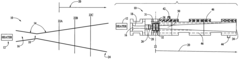
Method for using variable supersonic Mach number air heater utilizing supersonic combustion
PatentInactiveUS7296396B1
Innovation
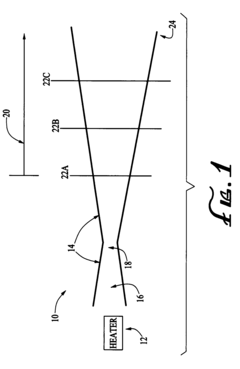
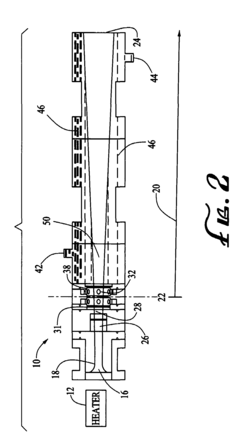
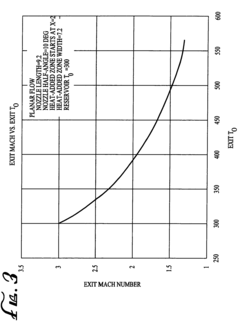
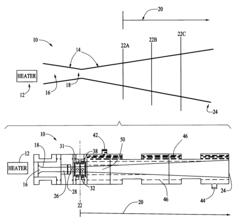
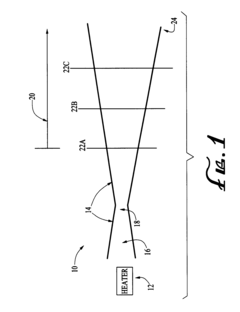
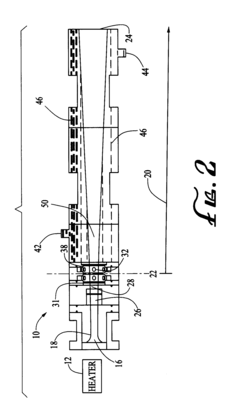
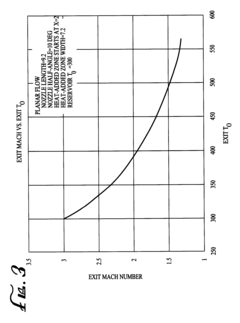
- A supersonic combustion heater apparatus that varies exit plane Mach numbers through strategic fuel injection and flame stabilization in a fixed geometry nozzle, enhancing high enthalpy flow and flame stability without using expensive film cooled nozzles, allowing for mode transition testing in air-breathing propulsion systems.
Variable supersonic mach number air heater utilizing supersonic combustion
PatentInactiveUS8087229B2
Innovation
- A supersonic combustion heater with strategically positioned fuel injection means and flame stabilization techniques that vary Mach numbers at the exit plane by heat addition in the diverging area, enhancing enthalpy flow, flame stability, and mixing without the need for expensive film-cooled nozzles, using a fixed geometric nozzle with converging and diverging areas and incorporating oxygen injection for stability.
Safety Considerations
Safety considerations are paramount in the automation of scramjet engine testing. The high-speed, high-temperature, and highly reactive nature of scramjet operations necessitates rigorous safety protocols and advanced protective measures. One primary concern is the management of extreme temperatures and pressures generated during testing. Automated systems must incorporate robust thermal management solutions, including advanced cooling systems and heat-resistant materials, to prevent structural failures and protect sensitive equipment.
Fuel handling and storage present another critical safety challenge. Scramjet engines often utilize highly volatile fuels, such as hydrogen or hydrocarbons, which require specialized containment and delivery systems. Automated testing facilities must implement sophisticated leak detection mechanisms, emergency shutdown procedures, and fire suppression systems to mitigate the risks associated with fuel-related incidents.
The potential for uncontrolled combustion or detonation during testing poses a significant threat to personnel and equipment. Automated systems should incorporate multiple layers of safeguards, including real-time monitoring of combustion parameters, rapid response mechanisms to detect and address anomalies, and fail-safe shutdown procedures. Additionally, the integration of blast-resistant structures and containment measures is essential to minimize the impact of potential explosions or fragmentation events.
Electromagnetic interference (EMI) and radiation exposure are often overlooked safety concerns in scramjet testing environments. The high-power systems and intense electromagnetic fields generated during testing can interfere with control systems and pose health risks to personnel. Automated testing facilities must implement comprehensive EMI shielding and radiation protection measures to ensure the reliability of control systems and safeguard human operators.
The automation of test procedures introduces new cybersecurity considerations. As control systems become increasingly interconnected and reliant on digital interfaces, the risk of unauthorized access or malicious interference grows. Robust cybersecurity protocols, including encrypted communications, secure access controls, and regular vulnerability assessments, are essential to protect both the integrity of test data and the safety of physical systems.
Human factors remain a critical aspect of safety, even in highly automated environments. Clear emergency protocols, comprehensive training programs, and intuitive human-machine interfaces are necessary to ensure that operators can effectively monitor automated systems and intervene when necessary. The design of automated test facilities should prioritize ergonomics and situational awareness to minimize the potential for human error in critical situations.
Fuel handling and storage present another critical safety challenge. Scramjet engines often utilize highly volatile fuels, such as hydrogen or hydrocarbons, which require specialized containment and delivery systems. Automated testing facilities must implement sophisticated leak detection mechanisms, emergency shutdown procedures, and fire suppression systems to mitigate the risks associated with fuel-related incidents.
The potential for uncontrolled combustion or detonation during testing poses a significant threat to personnel and equipment. Automated systems should incorporate multiple layers of safeguards, including real-time monitoring of combustion parameters, rapid response mechanisms to detect and address anomalies, and fail-safe shutdown procedures. Additionally, the integration of blast-resistant structures and containment measures is essential to minimize the impact of potential explosions or fragmentation events.
Electromagnetic interference (EMI) and radiation exposure are often overlooked safety concerns in scramjet testing environments. The high-power systems and intense electromagnetic fields generated during testing can interfere with control systems and pose health risks to personnel. Automated testing facilities must implement comprehensive EMI shielding and radiation protection measures to ensure the reliability of control systems and safeguard human operators.
The automation of test procedures introduces new cybersecurity considerations. As control systems become increasingly interconnected and reliant on digital interfaces, the risk of unauthorized access or malicious interference grows. Robust cybersecurity protocols, including encrypted communications, secure access controls, and regular vulnerability assessments, are essential to protect both the integrity of test data and the safety of physical systems.
Human factors remain a critical aspect of safety, even in highly automated environments. Clear emergency protocols, comprehensive training programs, and intuitive human-machine interfaces are necessary to ensure that operators can effectively monitor automated systems and intervene when necessary. The design of automated test facilities should prioritize ergonomics and situational awareness to minimize the potential for human error in critical situations.
Environmental Impact
The environmental impact of automating scramjet engine testing is a critical consideration in the development and implementation of this technology. As testing procedures become more automated, there is potential for both positive and negative effects on the environment.
One of the primary environmental benefits of automated scramjet engine testing is the reduction in fuel consumption during the testing phase. Traditional manual testing often requires multiple engine runs, resulting in significant fuel usage and emissions. Automated systems can optimize test sequences, reducing the number of engine firings and overall fuel consumption. This not only conserves resources but also minimizes the release of combustion byproducts into the atmosphere.
However, the increased reliance on automated testing systems may lead to higher energy consumption in other areas. The sophisticated sensors, data processing equipment, and control systems required for automation can have substantial power requirements. This shift in energy usage from direct fuel consumption to electrical power may impact the overall carbon footprint of the testing process, depending on the source of electricity used to power the automated systems.
Noise pollution is another environmental factor affected by automated scramjet engine testing. While automation can potentially reduce the frequency of engine firings, it may also enable more consistent and prolonged testing periods. This could lead to changes in noise patterns and durations, potentially affecting local ecosystems and communities near testing facilities.
The materials used in automated testing equipment also have environmental implications. Advanced sensors and control systems often contain rare earth elements and other materials that can have significant environmental impacts during their extraction and processing. As automation technology evolves, there may be opportunities to develop more environmentally friendly components and recycling processes for these materials.
Automated testing may also contribute to improved engine efficiency and performance, indirectly benefiting the environment. By enabling more precise and comprehensive testing, automation can lead to the development of scramjet engines with reduced emissions and improved fuel efficiency. This long-term benefit could offset some of the environmental costs associated with the testing process itself.
Water usage and potential contamination are additional environmental concerns in scramjet engine testing. Automated systems may offer more precise control over cooling and other processes that use water, potentially reducing overall water consumption. However, the complexity of automated systems may also introduce new risks for leaks or contamination if not properly managed.
In conclusion, the environmental impact of automating scramjet engine testing is multifaceted, with potential benefits in resource conservation and long-term engine efficiency improvements, balanced against increased energy consumption and material use in automated systems. Careful consideration of these factors is essential for minimizing negative environmental impacts while maximizing the benefits of automation in this critical aerospace technology.
One of the primary environmental benefits of automated scramjet engine testing is the reduction in fuel consumption during the testing phase. Traditional manual testing often requires multiple engine runs, resulting in significant fuel usage and emissions. Automated systems can optimize test sequences, reducing the number of engine firings and overall fuel consumption. This not only conserves resources but also minimizes the release of combustion byproducts into the atmosphere.
However, the increased reliance on automated testing systems may lead to higher energy consumption in other areas. The sophisticated sensors, data processing equipment, and control systems required for automation can have substantial power requirements. This shift in energy usage from direct fuel consumption to electrical power may impact the overall carbon footprint of the testing process, depending on the source of electricity used to power the automated systems.
Noise pollution is another environmental factor affected by automated scramjet engine testing. While automation can potentially reduce the frequency of engine firings, it may also enable more consistent and prolonged testing periods. This could lead to changes in noise patterns and durations, potentially affecting local ecosystems and communities near testing facilities.
The materials used in automated testing equipment also have environmental implications. Advanced sensors and control systems often contain rare earth elements and other materials that can have significant environmental impacts during their extraction and processing. As automation technology evolves, there may be opportunities to develop more environmentally friendly components and recycling processes for these materials.
Automated testing may also contribute to improved engine efficiency and performance, indirectly benefiting the environment. By enabling more precise and comprehensive testing, automation can lead to the development of scramjet engines with reduced emissions and improved fuel efficiency. This long-term benefit could offset some of the environmental costs associated with the testing process itself.
Water usage and potential contamination are additional environmental concerns in scramjet engine testing. Automated systems may offer more precise control over cooling and other processes that use water, potentially reducing overall water consumption. However, the complexity of automated systems may also introduce new risks for leaks or contamination if not properly managed.
In conclusion, the environmental impact of automating scramjet engine testing is multifaceted, with potential benefits in resource conservation and long-term engine efficiency improvements, balanced against increased energy consumption and material use in automated systems. Careful consideration of these factors is essential for minimizing negative environmental impacts while maximizing the benefits of automation in this critical aerospace technology.
Unlock deeper insights with Patsnap Eureka Quick Research — get a full tech report to explore trends and direct your research. Try now!
Generate Your Research Report Instantly with AI Agent
Supercharge your innovation with Patsnap Eureka AI Agent Platform!