Band Pass Filter vs Notch Filter: Performance Comparison
MAR 25, 20269 MIN READ
Generate Your Research Report Instantly with AI Agent
Patsnap Eureka helps you evaluate technical feasibility & market potential.
Band Pass vs Notch Filter Technology Background and Goals
Band pass filters and notch filters represent two fundamental yet contrasting approaches to frequency-selective signal processing, each serving distinct roles in modern electronic systems. The evolution of these filtering technologies has been driven by the increasing demand for precise frequency control in applications ranging from telecommunications to audio processing and instrumentation systems.
Band pass filters are designed to allow signals within a specific frequency range to pass through while attenuating frequencies outside this desired band. This selective transmission capability makes them essential components in radio frequency systems, where signal isolation and channel separation are critical. The technology has evolved from simple LC circuits to sophisticated digital implementations, enabling precise control over bandwidth and center frequency characteristics.
Conversely, notch filters, also known as band-stop or band-reject filters, perform the inverse function by blocking a narrow range of frequencies while allowing all other frequencies to pass relatively unimpeded. These filters excel at eliminating specific interference signals, such as power line harmonics or unwanted carrier frequencies, without significantly affecting the desired signal content across the broader frequency spectrum.
The historical development of both filter types has been closely tied to advances in circuit design methodologies and component technologies. Early implementations relied heavily on passive components, with performance limitations imposed by component tolerances and parasitic effects. The introduction of active filter designs using operational amplifiers expanded the achievable performance parameters, while digital signal processing techniques have enabled unprecedented precision and flexibility in filter characteristics.
Current technological objectives focus on achieving optimal performance metrics including insertion loss minimization, improved selectivity, enhanced temperature stability, and reduced manufacturing costs. The integration of these filters into system-on-chip solutions has become increasingly important as electronic devices demand smaller form factors while maintaining superior performance standards.
The comparative analysis of band pass versus notch filter performance encompasses multiple dimensions including frequency response accuracy, phase linearity, dynamic range, and implementation complexity. Understanding these performance trade-offs is crucial for selecting the appropriate filtering approach for specific applications, particularly in systems where both signal preservation and interference rejection are simultaneously required.
Band pass filters are designed to allow signals within a specific frequency range to pass through while attenuating frequencies outside this desired band. This selective transmission capability makes them essential components in radio frequency systems, where signal isolation and channel separation are critical. The technology has evolved from simple LC circuits to sophisticated digital implementations, enabling precise control over bandwidth and center frequency characteristics.
Conversely, notch filters, also known as band-stop or band-reject filters, perform the inverse function by blocking a narrow range of frequencies while allowing all other frequencies to pass relatively unimpeded. These filters excel at eliminating specific interference signals, such as power line harmonics or unwanted carrier frequencies, without significantly affecting the desired signal content across the broader frequency spectrum.
The historical development of both filter types has been closely tied to advances in circuit design methodologies and component technologies. Early implementations relied heavily on passive components, with performance limitations imposed by component tolerances and parasitic effects. The introduction of active filter designs using operational amplifiers expanded the achievable performance parameters, while digital signal processing techniques have enabled unprecedented precision and flexibility in filter characteristics.
Current technological objectives focus on achieving optimal performance metrics including insertion loss minimization, improved selectivity, enhanced temperature stability, and reduced manufacturing costs. The integration of these filters into system-on-chip solutions has become increasingly important as electronic devices demand smaller form factors while maintaining superior performance standards.
The comparative analysis of band pass versus notch filter performance encompasses multiple dimensions including frequency response accuracy, phase linearity, dynamic range, and implementation complexity. Understanding these performance trade-offs is crucial for selecting the appropriate filtering approach for specific applications, particularly in systems where both signal preservation and interference rejection are simultaneously required.
Market Demand Analysis for Frequency Selective Filtering Solutions
The global market for frequency selective filtering solutions demonstrates robust growth driven by expanding applications across telecommunications, consumer electronics, automotive, and industrial sectors. Band pass filters and notch filters represent critical components in this ecosystem, each serving distinct market segments with specific performance requirements.
Telecommunications infrastructure modernization creates substantial demand for both filter types. The deployment of 5G networks requires sophisticated band pass filters to isolate specific frequency bands while maintaining signal integrity across multiple carrier frequencies. Simultaneously, notch filters address interference suppression needs in dense urban environments where multiple wireless services operate in proximity.
Consumer electronics markets exhibit differentiated demand patterns for these filtering technologies. Smartphones and tablets primarily utilize band pass filters for RF front-end modules, enabling multi-band operation and carrier aggregation capabilities. Audio equipment manufacturers increasingly adopt notch filters to eliminate specific interference frequencies, particularly in professional recording and broadcast applications.
Automotive sector demand reflects the industry's transition toward connected and autonomous vehicles. Advanced driver assistance systems require precise frequency filtering to ensure reliable radar and lidar operation. Band pass filters enable selective reception of navigation signals, while notch filters mitigate interference from engine control units and other electronic systems.
Industrial automation and Internet of Things applications drive demand for cost-effective filtering solutions. Manufacturing environments with high electromagnetic interference levels require robust notch filtering capabilities to maintain communication reliability. Process control systems utilize band pass filters for sensor signal conditioning and data acquisition accuracy.
Medical device markets present specialized requirements for both filter architectures. Diagnostic equipment demands high-precision band pass filters for signal isolation, while therapeutic devices often require notch filters to eliminate power line interference and ensure patient safety compliance.
Market segmentation analysis reveals distinct price sensitivity patterns across applications. High-performance telecommunications and aerospace applications justify premium pricing for superior filter performance, while consumer electronics markets emphasize cost optimization and miniaturization. This segmentation influences technology development priorities and competitive positioning strategies for filter manufacturers.
Regional demand variations reflect local industry concentrations and regulatory environments. Asia-Pacific markets demonstrate strong growth in consumer electronics applications, while North American and European markets show increased demand for automotive and industrial filtering solutions.
Telecommunications infrastructure modernization creates substantial demand for both filter types. The deployment of 5G networks requires sophisticated band pass filters to isolate specific frequency bands while maintaining signal integrity across multiple carrier frequencies. Simultaneously, notch filters address interference suppression needs in dense urban environments where multiple wireless services operate in proximity.
Consumer electronics markets exhibit differentiated demand patterns for these filtering technologies. Smartphones and tablets primarily utilize band pass filters for RF front-end modules, enabling multi-band operation and carrier aggregation capabilities. Audio equipment manufacturers increasingly adopt notch filters to eliminate specific interference frequencies, particularly in professional recording and broadcast applications.
Automotive sector demand reflects the industry's transition toward connected and autonomous vehicles. Advanced driver assistance systems require precise frequency filtering to ensure reliable radar and lidar operation. Band pass filters enable selective reception of navigation signals, while notch filters mitigate interference from engine control units and other electronic systems.
Industrial automation and Internet of Things applications drive demand for cost-effective filtering solutions. Manufacturing environments with high electromagnetic interference levels require robust notch filtering capabilities to maintain communication reliability. Process control systems utilize band pass filters for sensor signal conditioning and data acquisition accuracy.
Medical device markets present specialized requirements for both filter architectures. Diagnostic equipment demands high-precision band pass filters for signal isolation, while therapeutic devices often require notch filters to eliminate power line interference and ensure patient safety compliance.
Market segmentation analysis reveals distinct price sensitivity patterns across applications. High-performance telecommunications and aerospace applications justify premium pricing for superior filter performance, while consumer electronics markets emphasize cost optimization and miniaturization. This segmentation influences technology development priorities and competitive positioning strategies for filter manufacturers.
Regional demand variations reflect local industry concentrations and regulatory environments. Asia-Pacific markets demonstrate strong growth in consumer electronics applications, while North American and European markets show increased demand for automotive and industrial filtering solutions.
Current State and Challenges in Filter Design Technologies
The current landscape of filter design technologies presents a complex array of achievements and persistent challenges, particularly in the realm of band pass and notch filter implementations. Modern filter design has reached remarkable sophistication through decades of theoretical advancement and practical refinement, yet several fundamental limitations continue to constrain optimal performance across diverse applications.
Contemporary filter design methodologies encompass multiple implementation approaches, including passive LC circuits, active operational amplifier configurations, digital signal processing algorithms, and emerging microelectromechanical systems (MEMS) technologies. Each approach demonstrates distinct advantages and inherent limitations that directly impact the performance comparison between band pass and notch filter architectures.
The primary technical challenges facing current filter design technologies center around the fundamental trade-offs between selectivity, insertion loss, and bandwidth control. Achieving steep roll-off characteristics while maintaining low insertion loss remains particularly problematic in passive implementations, where component tolerances and parasitic effects significantly influence performance consistency. Active filter designs offer enhanced control over transfer function characteristics but introduce noise, power consumption, and stability concerns that become critical in precision applications.
Manufacturing variability represents another significant challenge affecting both band pass and notch filter performance. Component tolerance accumulation, temperature coefficient variations, and aging effects create substantial deviations from theoretical design parameters. These variations are particularly pronounced in high-Q applications where small parameter changes result in dramatic performance shifts, making reliable comparison between filter types increasingly complex.
Digital filter implementations have addressed many traditional analog limitations but introduce quantization noise, processing delays, and computational complexity constraints. The sampling rate requirements for maintaining adequate performance often exceed practical system limitations, particularly in wideband applications where both band pass and notch filters must operate across extended frequency ranges.
Emerging challenges include electromagnetic interference susceptibility, miniaturization demands, and the need for adaptive filtering capabilities in dynamic environments. Modern communication systems require filters that can dynamically adjust their characteristics while maintaining consistent performance metrics, presenting unprecedented design complexity that affects both band pass and notch filter architectures equally.
The integration of filter technologies into system-on-chip architectures introduces additional constraints related to substrate coupling, power supply noise, and thermal management. These factors significantly impact the practical performance comparison between different filter topologies, often overshadowing theoretical advantages in real-world implementations.
Contemporary filter design methodologies encompass multiple implementation approaches, including passive LC circuits, active operational amplifier configurations, digital signal processing algorithms, and emerging microelectromechanical systems (MEMS) technologies. Each approach demonstrates distinct advantages and inherent limitations that directly impact the performance comparison between band pass and notch filter architectures.
The primary technical challenges facing current filter design technologies center around the fundamental trade-offs between selectivity, insertion loss, and bandwidth control. Achieving steep roll-off characteristics while maintaining low insertion loss remains particularly problematic in passive implementations, where component tolerances and parasitic effects significantly influence performance consistency. Active filter designs offer enhanced control over transfer function characteristics but introduce noise, power consumption, and stability concerns that become critical in precision applications.
Manufacturing variability represents another significant challenge affecting both band pass and notch filter performance. Component tolerance accumulation, temperature coefficient variations, and aging effects create substantial deviations from theoretical design parameters. These variations are particularly pronounced in high-Q applications where small parameter changes result in dramatic performance shifts, making reliable comparison between filter types increasingly complex.
Digital filter implementations have addressed many traditional analog limitations but introduce quantization noise, processing delays, and computational complexity constraints. The sampling rate requirements for maintaining adequate performance often exceed practical system limitations, particularly in wideband applications where both band pass and notch filters must operate across extended frequency ranges.
Emerging challenges include electromagnetic interference susceptibility, miniaturization demands, and the need for adaptive filtering capabilities in dynamic environments. Modern communication systems require filters that can dynamically adjust their characteristics while maintaining consistent performance metrics, presenting unprecedented design complexity that affects both band pass and notch filter architectures equally.
The integration of filter technologies into system-on-chip architectures introduces additional constraints related to substrate coupling, power supply noise, and thermal management. These factors significantly impact the practical performance comparison between different filter topologies, often overshadowing theoretical advantages in real-world implementations.
Current Filter Implementation Solutions and Approaches
01 Active filter circuits for band pass and notch filtering
Active filter circuits utilize operational amplifiers and active components to achieve band pass and notch filter characteristics. These circuits provide adjustable center frequency, bandwidth control, and high Q-factor performance. The active configuration allows for signal amplification while filtering, making them suitable for applications requiring precise frequency selection and rejection. The design typically incorporates feedback networks and tunable components to optimize filter performance across different frequency ranges.- Active filter circuits for band pass and notch filtering: Active filter circuits utilize operational amplifiers and other active components to achieve band pass and notch filtering characteristics. These circuits can provide adjustable center frequencies, quality factors, and gain control. The active configuration allows for better impedance matching and signal amplification while filtering. These designs are particularly useful in applications requiring precise frequency selection and rejection with minimal signal loss.
- Tunable and adjustable filter performance optimization: Tunable filter designs enable dynamic adjustment of filter parameters such as center frequency, bandwidth, and notch depth. These implementations use variable components or digital control methods to modify filter characteristics in real-time. The adjustability allows for adaptation to changing signal conditions and interference patterns. Such filters are essential in communication systems where frequency bands need to be reconfigured based on operational requirements.
- Multi-stage cascaded filter architectures: Cascaded filter configurations combine multiple filter stages to achieve enhanced selectivity and steeper roll-off characteristics. These architectures can integrate both band pass and notch filtering functions in series to provide comprehensive frequency response shaping. The multi-stage approach allows for independent optimization of each stage while achieving overall superior performance. This design methodology is effective for applications requiring high rejection ratios and narrow transition bands.
- Digital signal processing based filter implementations: Digital filter implementations utilize computational algorithms to achieve band pass and notch filtering in the digital domain. These methods offer precise control over filter coefficients and enable complex frequency response characteristics. Digital approaches provide flexibility in modifying filter parameters through software updates without hardware changes. The implementations can achieve linear phase response and adaptive filtering capabilities that are difficult to realize with analog circuits.
- Integrated filter circuits with impedance matching: Integrated filter designs incorporate impedance matching networks to optimize power transfer and minimize signal reflections. These circuits combine filtering functions with input and output matching stages to ensure compatibility with system components. The integration reduces component count and improves overall system performance by addressing both filtering and impedance requirements simultaneously. Such designs are critical in RF and high-frequency applications where impedance mismatches can significantly degrade filter performance.
02 Digital signal processing based filter implementation
Digital implementation of band pass and notch filters using signal processing algorithms and digital circuits provides flexible and programmable filtering solutions. These systems employ digital filtering techniques including finite impulse response and infinite impulse response structures to achieve desired frequency response characteristics. The digital approach enables precise control over filter parameters, adaptive filtering capabilities, and integration with modern communication systems. This method offers advantages in terms of stability, reproducibility, and ease of parameter adjustment.Expand Specific Solutions03 Tunable and reconfigurable filter architectures
Tunable filter designs allow dynamic adjustment of center frequency and bandwidth to accommodate varying signal conditions and application requirements. These architectures incorporate variable capacitors, switchable components, or digitally controlled elements to modify filter characteristics in real-time. The reconfigurable nature enables a single filter structure to serve multiple filtering functions, including both band pass and notch operations. This flexibility is particularly valuable in multi-band communication systems and adaptive signal processing applications.Expand Specific Solutions04 High-frequency and wideband filter designs
Specialized filter configurations optimized for high-frequency operation and wideband applications address challenges in modern wireless and communication systems. These designs employ advanced circuit topologies, transmission line structures, and impedance matching techniques to maintain performance across extended frequency ranges. The implementations focus on minimizing insertion loss, achieving steep roll-off characteristics, and maintaining stable operation at elevated frequencies. Such filters are essential for applications in radio frequency systems, radar, and broadband communication equipment.Expand Specific Solutions05 Integrated filter systems with noise suppression
Integrated filter solutions combine band pass and notch filtering capabilities with additional noise suppression and interference rejection features. These systems incorporate multiple filtering stages, harmonic rejection circuits, and electromagnetic interference mitigation techniques to enhance overall signal quality. The integrated approach provides comprehensive frequency management in a compact form factor, suitable for applications requiring high signal integrity. Design considerations include minimizing crosstalk, optimizing power consumption, and ensuring compatibility with surrounding circuit components.Expand Specific Solutions
Major Players in Filter Technology and IC Design Industry
The band pass filter versus notch filter performance comparison represents a mature segment within the broader RF and signal processing industry, currently in a consolidation phase with established market leaders driving innovation. The market demonstrates substantial scale, supported by growing demand across telecommunications, consumer electronics, and automotive applications. Technology maturity varies significantly among key players, with companies like Murata Manufacturing, Intel Corp., and Texas Instruments leading in advanced filter design and manufacturing capabilities. MediaTek and NXP Semiconductors excel in integrated solutions, while specialized firms such as Tai-Saw Technology and KMW focus on RF component optimization. Qorvo, pSemi Corp., and RF360 Singapore represent the cutting-edge of filter technology development, particularly in 5G and IoT applications. The competitive landscape shows clear differentiation between volume manufacturers like Sony Group and Mitsubishi Electric, and precision specialists such as CTS Corp. and Alps Alpine, indicating a mature ecosystem with established technological hierarchies and market positioning.
Intel Corp.
Technical Solution: Intel develops integrated filtering solutions primarily for wireless communication and computing applications. Their band pass filters are implemented using on-chip LC networks and external SAW components, achieving insertion loss around 2-3dB with moderate selectivity suitable for broadband applications. The notch filters utilize active RC circuits and digital signal processing techniques providing programmable rejection characteristics with depths up to 40dB. Their solutions focus on integration with system-on-chip (SoC) designs supporting frequencies up to 6GHz with emphasis on power efficiency and cost optimization.
Strengths: High integration capability, programmable characteristics, cost-effective for high-volume applications. Weaknesses: Lower performance compared to dedicated filter manufacturers, limited standalone filter offerings.
Murata Manufacturing Co. Ltd.
Technical Solution: Murata offers comprehensive filtering solutions including ceramic band pass filters and LC notch filters for various applications. Their band pass filters utilize multilayer ceramic technology achieving quality factors (Q) exceeding 200 with compact form factors down to 1005 size packages. The notch filters employ LC circuit designs providing rejection ratios up to 60dB with precise frequency control within ±1% tolerance. Their product portfolio covers frequencies from 100MHz to 6GHz with power handling capabilities up to 2W for mobile and IoT applications.
Strengths: Cost-effective ceramic technology, compact packaging, high volume manufacturing capability. Weaknesses: Limited high-frequency performance compared to acoustic wave solutions, lower Q-factor than SAW/BAW alternatives.
Core Filter Design Patents and Technical Innovations
Band pass filter having parallel connected notch filter circuits
PatentActiveUS10848126B2
Innovation
- A band pass filter device comprising a first and second filter circuit connected in parallel, where the first circuit includes a notch filter and the second circuit includes a notch filter and a phase shifter, providing steep roll-offs at the lower and upper cutoff frequencies to prevent interference, with low insertion loss within the passband and high insertion loss in adjacent stopbands.


Band pass filter
PatentInactiveUS7081788B2
Innovation
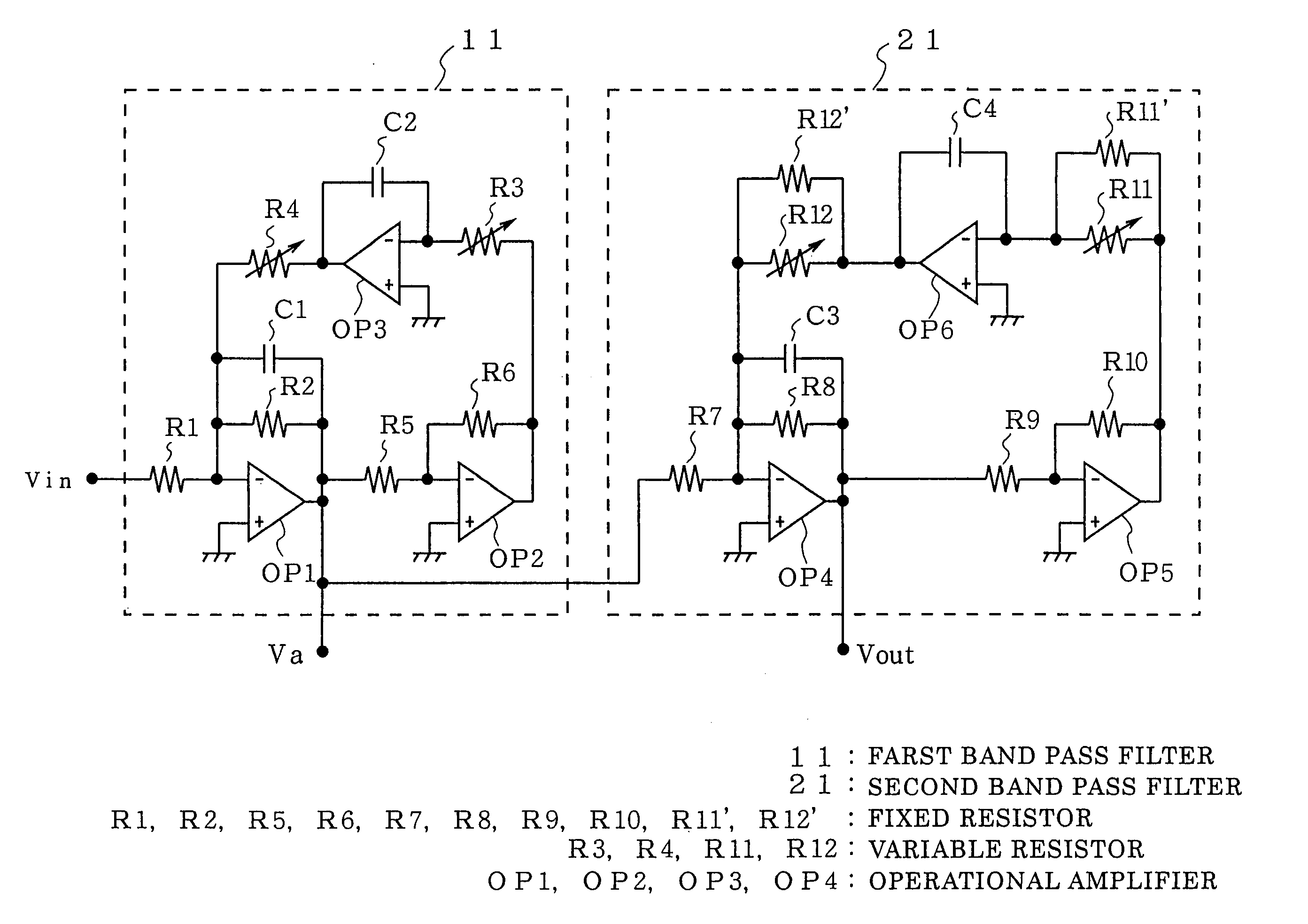
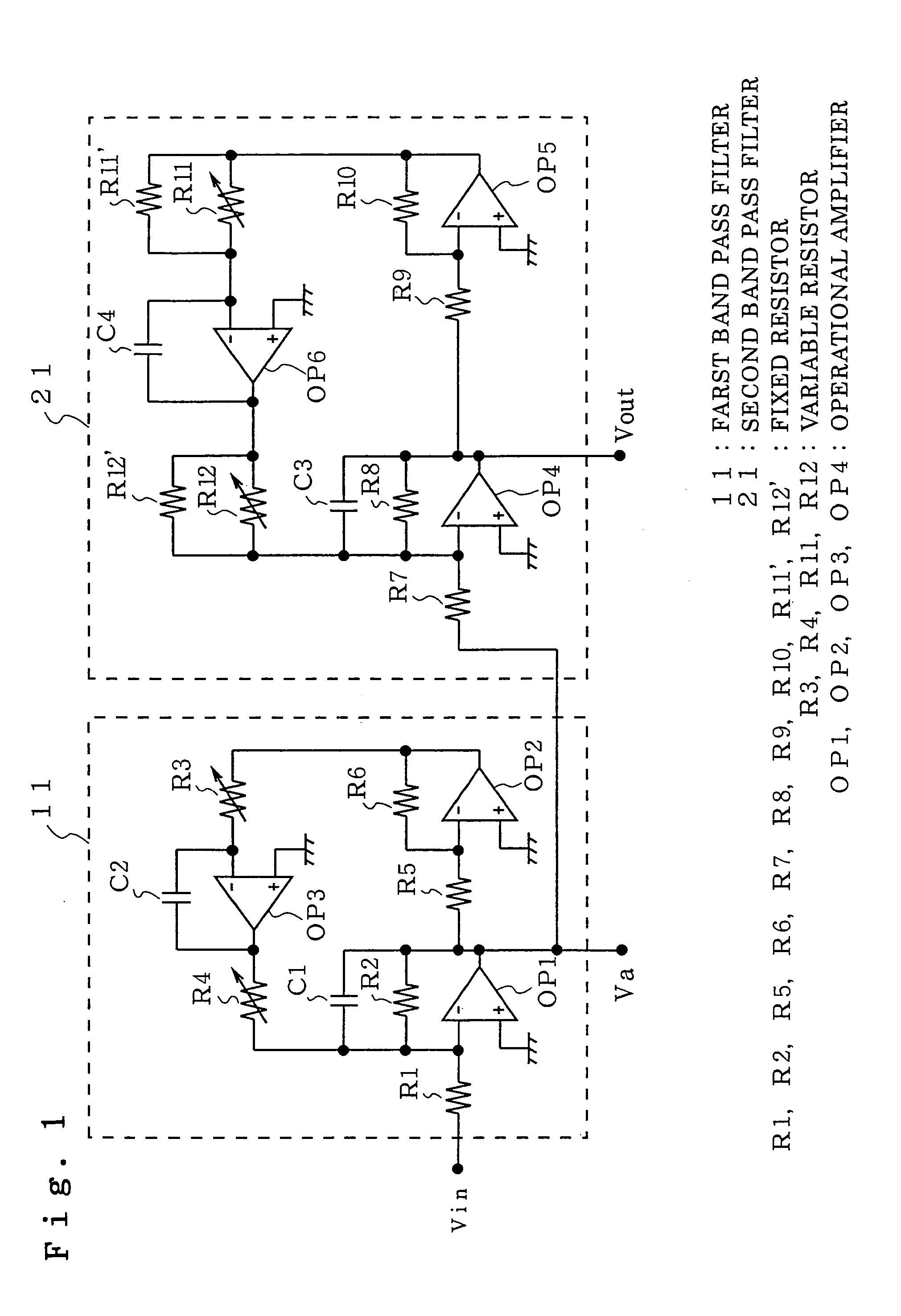
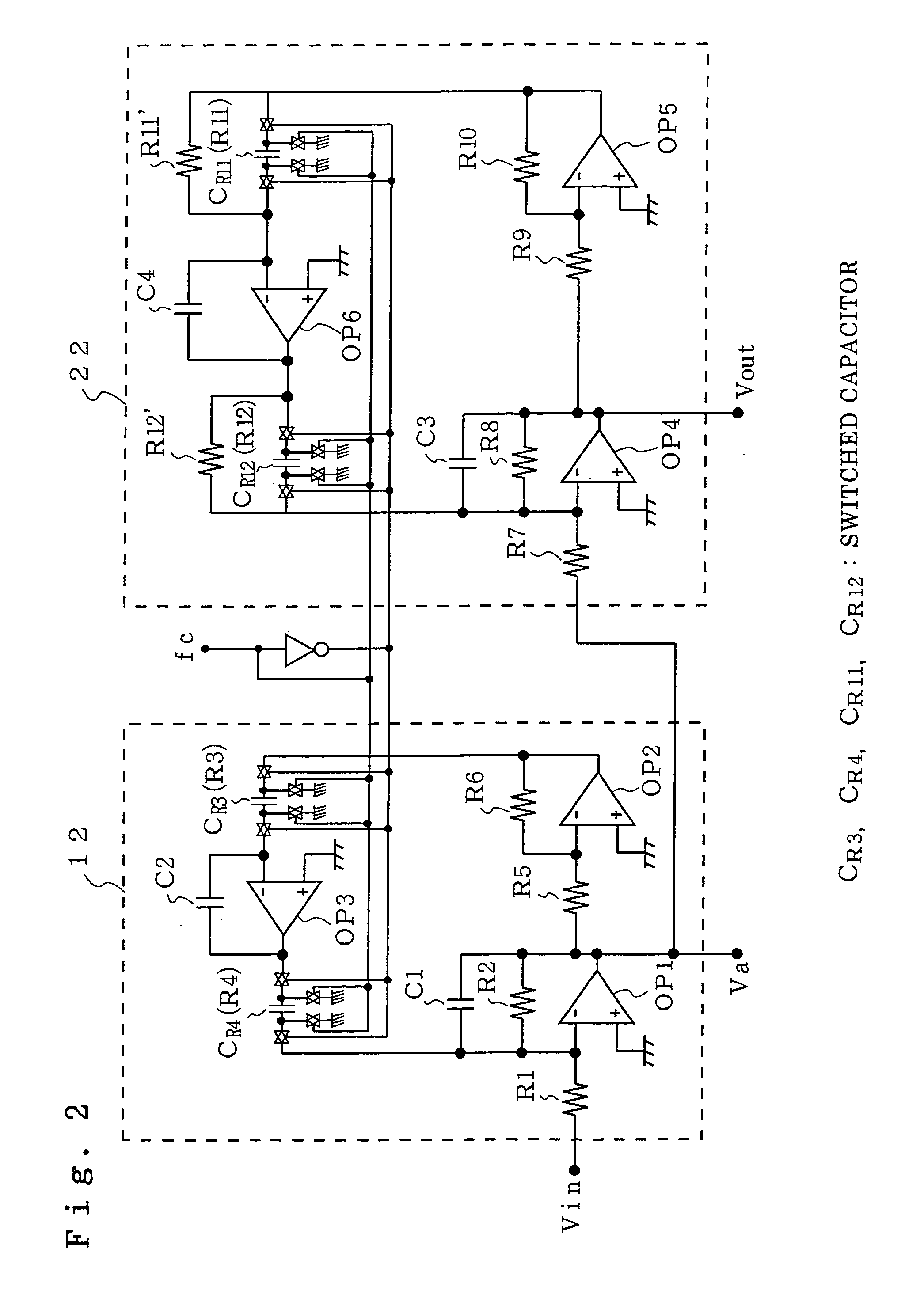
- A band pass filter design that includes a first and second biquad circuit-based band pass filter with center frequency and maximum gain adjusting variable resistors, where a fixed resistor is connected in parallel to the center frequency adjusting variable resistor, allowing for variable center frequency and maximum gain adjustments using switched capacitors or resistors, while keeping the band width fixed.

Signal Processing Standards and Compliance Requirements
Signal processing applications involving band pass filters and notch filters must adhere to stringent industry standards and regulatory compliance requirements across various sectors. The IEEE 802.11 wireless communication standards mandate specific spectral mask requirements that directly influence filter design parameters, particularly for band pass filters used in RF front-end architectures. These standards define acceptable out-of-band emission levels and adjacent channel rejection ratios that filter implementations must achieve.
In medical device applications, both filter types must comply with IEC 60601 series standards, which establish electromagnetic compatibility requirements and safety protocols. The FDA's guidance documents for medical signal processing devices specify performance criteria for filters used in diagnostic equipment, including ECG monitors and imaging systems. These regulations emphasize the importance of maintaining signal integrity while suppressing unwanted frequency components, making the choice between band pass and notch filter configurations critical for compliance.
Automotive industry standards, particularly ISO 26262 for functional safety, impose strict requirements on signal processing components used in advanced driver assistance systems. The standard mandates specific performance metrics for filters processing sensor data, including phase linearity requirements and group delay specifications that can significantly impact the comparative performance of band pass versus notch filter implementations.
Military and aerospace applications must conform to MIL-STD-461 electromagnetic interference standards, which define conducted and radiated emission limits. These requirements often favor notch filter implementations for interference suppression while maintaining broad-spectrum signal integrity. The standard's CS114 and RE102 test procedures specifically evaluate filter performance under various electromagnetic environments.
Telecommunications infrastructure must comply with ITU-T recommendations and regional regulatory frameworks such as FCC Part 15 in the United States and ETSI standards in Europe. These regulations establish spurious emission limits and spectral purity requirements that directly influence filter topology selection and performance optimization strategies for both band pass and notch filter configurations.
In medical device applications, both filter types must comply with IEC 60601 series standards, which establish electromagnetic compatibility requirements and safety protocols. The FDA's guidance documents for medical signal processing devices specify performance criteria for filters used in diagnostic equipment, including ECG monitors and imaging systems. These regulations emphasize the importance of maintaining signal integrity while suppressing unwanted frequency components, making the choice between band pass and notch filter configurations critical for compliance.
Automotive industry standards, particularly ISO 26262 for functional safety, impose strict requirements on signal processing components used in advanced driver assistance systems. The standard mandates specific performance metrics for filters processing sensor data, including phase linearity requirements and group delay specifications that can significantly impact the comparative performance of band pass versus notch filter implementations.
Military and aerospace applications must conform to MIL-STD-461 electromagnetic interference standards, which define conducted and radiated emission limits. These requirements often favor notch filter implementations for interference suppression while maintaining broad-spectrum signal integrity. The standard's CS114 and RE102 test procedures specifically evaluate filter performance under various electromagnetic environments.
Telecommunications infrastructure must comply with ITU-T recommendations and regional regulatory frameworks such as FCC Part 15 in the United States and ETSI standards in Europe. These regulations establish spurious emission limits and spectral purity requirements that directly influence filter topology selection and performance optimization strategies for both band pass and notch filter configurations.
Filter Performance Optimization Methodologies and Metrics
Filter performance optimization requires systematic methodologies that address both design parameters and evaluation metrics to achieve desired frequency response characteristics. The optimization process typically involves multi-objective approaches that balance competing requirements such as selectivity, insertion loss, group delay variation, and implementation complexity.
Mathematical optimization techniques form the foundation of modern filter design methodologies. Gradient-based algorithms, including steepest descent and Newton-Raphson methods, enable precise parameter tuning for both band pass and notch filter configurations. These approaches utilize sensitivity analysis to identify critical design variables and their impact on overall performance metrics.
Evolutionary algorithms have emerged as powerful tools for filter optimization, particularly when dealing with non-linear design constraints and discrete component values. Genetic algorithms, particle swarm optimization, and differential evolution techniques demonstrate superior performance in exploring complex design spaces where traditional analytical methods may converge to local optima.
Performance metrics evaluation encompasses multiple frequency and time domain parameters that collectively define filter quality. Primary frequency domain metrics include insertion loss, return loss, selectivity factor, and out-of-band rejection levels. Time domain characteristics such as group delay ripple, phase linearity, and transient response behavior provide complementary performance insights essential for system-level integration.
Advanced optimization frameworks incorporate statistical design methodologies to address manufacturing tolerances and component variations. Monte Carlo analysis and worst-case design approaches ensure robust performance across production variations, while yield optimization techniques maximize manufacturing success rates within specified performance boundaries.
Multi-physics simulation environments enable comprehensive performance assessment by incorporating parasitic effects, thermal variations, and electromagnetic coupling phenomena. These sophisticated modeling approaches reveal performance limitations not apparent in idealized circuit analysis, leading to more accurate optimization outcomes.
Measurement-based optimization methodologies utilize vector network analyzer data and automated tuning systems to achieve real-time performance enhancement. Adaptive algorithms can compensate for manufacturing variations and environmental changes, maintaining optimal performance throughout operational lifetime while providing valuable feedback for future design iterations.
Mathematical optimization techniques form the foundation of modern filter design methodologies. Gradient-based algorithms, including steepest descent and Newton-Raphson methods, enable precise parameter tuning for both band pass and notch filter configurations. These approaches utilize sensitivity analysis to identify critical design variables and their impact on overall performance metrics.
Evolutionary algorithms have emerged as powerful tools for filter optimization, particularly when dealing with non-linear design constraints and discrete component values. Genetic algorithms, particle swarm optimization, and differential evolution techniques demonstrate superior performance in exploring complex design spaces where traditional analytical methods may converge to local optima.
Performance metrics evaluation encompasses multiple frequency and time domain parameters that collectively define filter quality. Primary frequency domain metrics include insertion loss, return loss, selectivity factor, and out-of-band rejection levels. Time domain characteristics such as group delay ripple, phase linearity, and transient response behavior provide complementary performance insights essential for system-level integration.
Advanced optimization frameworks incorporate statistical design methodologies to address manufacturing tolerances and component variations. Monte Carlo analysis and worst-case design approaches ensure robust performance across production variations, while yield optimization techniques maximize manufacturing success rates within specified performance boundaries.
Multi-physics simulation environments enable comprehensive performance assessment by incorporating parasitic effects, thermal variations, and electromagnetic coupling phenomena. These sophisticated modeling approaches reveal performance limitations not apparent in idealized circuit analysis, leading to more accurate optimization outcomes.
Measurement-based optimization methodologies utilize vector network analyzer data and automated tuning systems to achieve real-time performance enhancement. Adaptive algorithms can compensate for manufacturing variations and environmental changes, maintaining optimal performance throughout operational lifetime while providing valuable feedback for future design iterations.
Unlock deeper insights with Patsnap Eureka Quick Research — get a full tech report to explore trends and direct your research. Try now!
Generate Your Research Report Instantly with AI Agent
Supercharge your innovation with Patsnap Eureka AI Agent Platform!