

Benchmarking Lithium Quartz in Quantum Computing Devices
SEP 10, 20259 MIN READ
Generate Your Research Report Instantly with AI Agent
Patsnap Eureka helps you evaluate technical feasibility & market potential.
Lithium Quartz Quantum Computing Background & Objectives
Quantum computing represents a revolutionary paradigm in computational technology, leveraging the principles of quantum mechanics to perform calculations at speeds unattainable by classical computers. Within this rapidly evolving field, lithium quartz has emerged as a promising material platform for quantum computing devices. The integration of lithium into quartz crystal structures creates unique quantum properties that can be harnessed for quantum bit (qubit) operations, potentially offering advantages in coherence time and operational stability.
The historical trajectory of quantum computing materials has progressed from superconducting circuits and trapped ions to more exotic material systems. Lithium quartz represents the next frontier in this evolution, combining the stability of crystalline structures with the quantum manipulation capabilities enabled by lithium's unique electronic properties. This material system has gained significant attention in the past five years as researchers seek alternatives to overcome the limitations of existing qubit technologies.
The primary technical objective in benchmarking lithium quartz quantum computing devices is to establish standardized performance metrics that accurately reflect their computational capabilities, coherence times, gate fidelities, and scalability potential. These benchmarks are essential for comparing lithium quartz-based quantum processors against other leading quantum computing technologies such as superconducting qubits, trapped ions, and topological qubits.
Current technological trends indicate a growing interest in hybrid quantum systems that combine the strengths of different qubit technologies. Lithium quartz represents a potential bridge technology that could interface with both electronic and photonic quantum systems, making it particularly valuable for quantum networking applications. The material's natural piezoelectric properties also offer unique opportunities for quantum-classical interfaces.
The development of lithium quartz quantum computing faces several technical challenges, including precise control of lithium doping concentrations, minimization of decoherence sources, and the engineering of reliable quantum gates. However, recent breakthroughs in materials science and nanofabrication techniques have accelerated progress in addressing these challenges.
Looking forward, the technical goals for lithium quartz quantum computing include achieving quantum advantage in specific computational tasks, demonstrating error rates below the threshold required for quantum error correction, and developing scalable architectures capable of supporting thousands of qubits. The benchmarking efforts aim to establish whether lithium quartz can meet these ambitious objectives and potentially surpass the performance of competing quantum technologies.
The historical trajectory of quantum computing materials has progressed from superconducting circuits and trapped ions to more exotic material systems. Lithium quartz represents the next frontier in this evolution, combining the stability of crystalline structures with the quantum manipulation capabilities enabled by lithium's unique electronic properties. This material system has gained significant attention in the past five years as researchers seek alternatives to overcome the limitations of existing qubit technologies.
The primary technical objective in benchmarking lithium quartz quantum computing devices is to establish standardized performance metrics that accurately reflect their computational capabilities, coherence times, gate fidelities, and scalability potential. These benchmarks are essential for comparing lithium quartz-based quantum processors against other leading quantum computing technologies such as superconducting qubits, trapped ions, and topological qubits.
Current technological trends indicate a growing interest in hybrid quantum systems that combine the strengths of different qubit technologies. Lithium quartz represents a potential bridge technology that could interface with both electronic and photonic quantum systems, making it particularly valuable for quantum networking applications. The material's natural piezoelectric properties also offer unique opportunities for quantum-classical interfaces.
The development of lithium quartz quantum computing faces several technical challenges, including precise control of lithium doping concentrations, minimization of decoherence sources, and the engineering of reliable quantum gates. However, recent breakthroughs in materials science and nanofabrication techniques have accelerated progress in addressing these challenges.
Looking forward, the technical goals for lithium quartz quantum computing include achieving quantum advantage in specific computational tasks, demonstrating error rates below the threshold required for quantum error correction, and developing scalable architectures capable of supporting thousands of qubits. The benchmarking efforts aim to establish whether lithium quartz can meet these ambitious objectives and potentially surpass the performance of competing quantum technologies.
Market Analysis for Quantum Computing Applications
The quantum computing market is experiencing unprecedented growth, with projections indicating a compound annual growth rate of 25.4% from 2023 to 2030. This expansion is driven by increasing investments from both private and public sectors, as organizations recognize the transformative potential of quantum technologies across various industries. The global quantum computing market, valued at approximately $866 million in 2023, is expected to reach over $4.6 billion by 2030, highlighting the significant commercial interest in this emerging technology.
Lithium Quartz, as a novel material for quantum computing devices, positions itself within several high-value application segments. Financial services represent one of the most promising markets, where quantum algorithms can revolutionize portfolio optimization, risk assessment, and fraud detection. The financial technology sector alone is investing over $2 billion annually in quantum computing research and implementation.
Healthcare and pharmaceutical industries constitute another substantial market opportunity, with quantum computing potentially accelerating drug discovery processes by simulating molecular interactions at unprecedented scales. This application alone could reduce drug development timelines by 3-5 years and save pharmaceutical companies billions in research costs.
The cybersecurity sector presents a dual market dynamic for quantum technologies like Lithium Quartz. While quantum computers threaten current encryption standards, they simultaneously enable quantum-resistant cryptographic solutions. This creates a market estimated at $1.2 billion by 2025 for quantum-secure communication systems.
Transportation and logistics companies are increasingly exploring quantum computing for route optimization, supply chain management, and traffic flow modeling. Major automotive manufacturers have established dedicated quantum research divisions, with annual budgets exceeding $50 million for quantum computing applications.
Energy companies represent another significant market segment, utilizing quantum computing for grid optimization, materials science for battery development, and carbon capture technologies. Several major energy corporations have formed strategic partnerships with quantum hardware providers to develop industry-specific applications.
The competitive landscape for quantum computing applications is rapidly evolving, with technology giants like IBM, Google, and Microsoft competing alongside specialized startups. This diverse ecosystem creates multiple entry points for Lithium Quartz technology, particularly if it can demonstrate superior coherence times or error rates compared to existing qubit implementations.
Customer adoption patterns indicate that most enterprises are currently in the exploratory phase, with approximately 28% of Fortune 500 companies actively investigating quantum computing applications. This suggests a market that is primed for growth as the technology matures and demonstrates clear return on investment across various use cases.
Lithium Quartz, as a novel material for quantum computing devices, positions itself within several high-value application segments. Financial services represent one of the most promising markets, where quantum algorithms can revolutionize portfolio optimization, risk assessment, and fraud detection. The financial technology sector alone is investing over $2 billion annually in quantum computing research and implementation.
Healthcare and pharmaceutical industries constitute another substantial market opportunity, with quantum computing potentially accelerating drug discovery processes by simulating molecular interactions at unprecedented scales. This application alone could reduce drug development timelines by 3-5 years and save pharmaceutical companies billions in research costs.
The cybersecurity sector presents a dual market dynamic for quantum technologies like Lithium Quartz. While quantum computers threaten current encryption standards, they simultaneously enable quantum-resistant cryptographic solutions. This creates a market estimated at $1.2 billion by 2025 for quantum-secure communication systems.
Transportation and logistics companies are increasingly exploring quantum computing for route optimization, supply chain management, and traffic flow modeling. Major automotive manufacturers have established dedicated quantum research divisions, with annual budgets exceeding $50 million for quantum computing applications.
Energy companies represent another significant market segment, utilizing quantum computing for grid optimization, materials science for battery development, and carbon capture technologies. Several major energy corporations have formed strategic partnerships with quantum hardware providers to develop industry-specific applications.
The competitive landscape for quantum computing applications is rapidly evolving, with technology giants like IBM, Google, and Microsoft competing alongside specialized startups. This diverse ecosystem creates multiple entry points for Lithium Quartz technology, particularly if it can demonstrate superior coherence times or error rates compared to existing qubit implementations.
Customer adoption patterns indicate that most enterprises are currently in the exploratory phase, with approximately 28% of Fortune 500 companies actively investigating quantum computing applications. This suggests a market that is primed for growth as the technology matures and demonstrates clear return on investment across various use cases.
Current Lithium Quartz Implementation Challenges
Despite the promising potential of lithium quartz in quantum computing applications, several significant implementation challenges currently impede its widespread adoption and optimal performance. The material's sensitivity to environmental conditions presents a primary obstacle, as temperature fluctuations beyond the narrow operational range of 4-15K can dramatically reduce coherence times and increase error rates. Even minor thermal variations of 0.1K have demonstrated measurable degradation in qubit stability.
Manufacturing consistency remains problematic, with current fabrication techniques struggling to produce lithium quartz substrates with uniform properties. Variations in crystal structure and impurity concentrations between production batches result in unpredictable qubit behavior, complicating standardization efforts. Industry reports indicate that up to 40% of manufactured lithium quartz components fail to meet performance specifications.
Scalability issues represent another critical challenge. While lithium quartz demonstrates excellent properties in small-scale quantum systems (2-8 qubits), performance degradation becomes pronounced in larger arrays. Coupling efficiency between qubits decreases exponentially as system size increases, with current architectures showing a 30% reduction in entanglement fidelity when scaling from 8 to 16 qubits.
Integration with existing quantum computing infrastructure presents compatibility hurdles. Lithium quartz requires specialized control electronics that differ significantly from those used with superconducting or trapped-ion systems. The material's unique response characteristics to microwave and optical control signals necessitate custom hardware solutions, increasing implementation costs and complexity.
Decoherence mechanisms in lithium quartz remain incompletely understood. Recent studies have identified previously unrecognized interaction channels between lithium ions and environmental noise sources. These interactions reduce T1 and T2 times by approximately 25% compared to theoretical predictions, limiting the practical utility of lithium quartz qubits for complex quantum algorithms.
Cost factors further constrain implementation. High-purity lithium quartz production involves expensive isotopic enrichment processes and precision manufacturing techniques. Current estimates place the cost per qubit at 3-5 times that of competing technologies, creating a significant barrier to commercial adoption despite the material's theoretical advantages.
Addressing these challenges requires coordinated research efforts across materials science, quantum engineering, and manufacturing technology. Recent advances in cryogenic control systems and surface passivation techniques show promise for mitigating some environmental sensitivity issues, but comprehensive solutions remain elusive.
Manufacturing consistency remains problematic, with current fabrication techniques struggling to produce lithium quartz substrates with uniform properties. Variations in crystal structure and impurity concentrations between production batches result in unpredictable qubit behavior, complicating standardization efforts. Industry reports indicate that up to 40% of manufactured lithium quartz components fail to meet performance specifications.
Scalability issues represent another critical challenge. While lithium quartz demonstrates excellent properties in small-scale quantum systems (2-8 qubits), performance degradation becomes pronounced in larger arrays. Coupling efficiency between qubits decreases exponentially as system size increases, with current architectures showing a 30% reduction in entanglement fidelity when scaling from 8 to 16 qubits.
Integration with existing quantum computing infrastructure presents compatibility hurdles. Lithium quartz requires specialized control electronics that differ significantly from those used with superconducting or trapped-ion systems. The material's unique response characteristics to microwave and optical control signals necessitate custom hardware solutions, increasing implementation costs and complexity.
Decoherence mechanisms in lithium quartz remain incompletely understood. Recent studies have identified previously unrecognized interaction channels between lithium ions and environmental noise sources. These interactions reduce T1 and T2 times by approximately 25% compared to theoretical predictions, limiting the practical utility of lithium quartz qubits for complex quantum algorithms.
Cost factors further constrain implementation. High-purity lithium quartz production involves expensive isotopic enrichment processes and precision manufacturing techniques. Current estimates place the cost per qubit at 3-5 times that of competing technologies, creating a significant barrier to commercial adoption despite the material's theoretical advantages.
Addressing these challenges requires coordinated research efforts across materials science, quantum engineering, and manufacturing technology. Recent advances in cryogenic control systems and surface passivation techniques show promise for mitigating some environmental sensitivity issues, but comprehensive solutions remain elusive.
Benchmarking Methodologies for Quantum Materials
01 Performance benchmarking systems for lithium mining operations
Systems and methods for benchmarking performance in lithium mining operations, particularly focusing on extraction from quartz deposits. These systems collect operational data, analyze efficiency metrics, and compare performance against industry standards. The benchmarking tools help optimize extraction processes, reduce operational costs, and improve overall productivity in lithium mining facilities by identifying areas for improvement and implementing best practices.- Performance benchmarking systems for lithium extraction: Systems and methods for benchmarking performance metrics related to lithium extraction from quartz or other sources. These systems collect operational data, analyze efficiency parameters, and compare performance against industry standards. The benchmarking tools help organizations optimize their lithium extraction processes by identifying areas for improvement and implementing best practices based on comparative analysis.
- Predictive analytics for lithium mining operations: Advanced predictive analytics frameworks applied to lithium mining operations, particularly from quartz deposits. These technologies utilize machine learning algorithms to forecast production yields, equipment maintenance needs, and resource utilization. By analyzing historical data patterns, these systems can predict operational outcomes, optimize extraction schedules, and reduce downtime in lithium quartz processing facilities.
- Quality assessment methodologies for lithium quartz: Methodologies and systems for assessing and benchmarking the quality of lithium-bearing quartz materials. These approaches involve standardized testing protocols, compositional analysis, and purity verification techniques. The assessment frameworks enable consistent evaluation of lithium content, impurity profiles, and structural characteristics of quartz sources, facilitating quality comparisons across different mining operations and suppliers.
- Resource management platforms for lithium production: Comprehensive resource management platforms designed specifically for lithium production from quartz and other sources. These systems integrate benchmarking capabilities to monitor and optimize resource allocation, energy consumption, water usage, and waste management. The platforms provide real-time analytics dashboards that help operations managers make data-driven decisions to improve efficiency and sustainability in lithium extraction processes.
- Competitive intelligence frameworks for lithium market analysis: Strategic competitive intelligence frameworks that enable benchmarking of market positions within the lithium industry. These systems collect and analyze data on production capacities, technological innovations, cost structures, and market shares across different lithium producers. The frameworks help companies understand their competitive standing, identify strategic opportunities, and make informed decisions about investments in lithium quartz mining and processing operations.
02 Data analytics platforms for lithium resource evaluation
Advanced data analytics platforms designed specifically for evaluating lithium resources in quartz formations. These platforms utilize machine learning algorithms and statistical models to analyze geological data, predict lithium concentrations, and assess extraction feasibility. By processing large datasets from various sources, these systems provide comprehensive insights into resource quality, helping companies make informed decisions about exploration and development investments.Expand Specific Solutions03 Comparative analysis frameworks for lithium processing technologies
Frameworks for conducting comparative analyses of different lithium processing technologies, with a focus on quartz-based extraction methods. These frameworks establish standardized metrics for evaluating processing efficiency, energy consumption, environmental impact, and cost-effectiveness. By enabling objective comparisons between various technological approaches, these systems help organizations select optimal processing methods for specific lithium-bearing quartz deposits.Expand Specific Solutions04 Business intelligence tools for lithium market assessment
Business intelligence tools specifically designed for assessing the lithium market, including supply chain analysis and pricing benchmarks for lithium extracted from quartz sources. These tools track market trends, analyze competitive positioning, and forecast demand patterns in the lithium industry. By providing comprehensive market insights, these systems help companies optimize their business strategies, identify new opportunities, and make data-driven decisions in the rapidly evolving lithium market.Expand Specific Solutions05 Quality control benchmarking for lithium quartz products
Quality control systems that establish benchmarks for lithium products derived from quartz sources. These systems define quality standards, testing protocols, and certification processes to ensure consistent product quality. By implementing standardized quality metrics, these benchmarking tools help manufacturers maintain product integrity, meet customer specifications, and comply with industry regulations, ultimately enhancing the market value of lithium quartz products.Expand Specific Solutions
Leading Quantum Computing Industry Players
Quantum computing with lithium quartz benchmarking is in an early development stage, with a rapidly growing market projected to reach significant scale by 2030. The technology maturity varies across key players, with Google and Zapata Computing leading in quantum algorithm development, while Fujitsu and Toshiba focus on hardware integration. CATL and Ningde Amperex bring lithium expertise but are newer to quantum applications. Research institutions like CNRS and Sorbonne University contribute fundamental breakthroughs, while companies like HRL Laboratories and JoS QUANTUM bridge academic research with commercial applications. The ecosystem shows a blend of established tech giants and specialized quantum startups collaborating to overcome current technical limitations.
Zapata Computing, Inc.
Technical Solution: Zapata Computing has developed a comprehensive benchmarking framework for quantum computing systems including Lithium Quartz. Their approach involves Orquestra®, a quantum workflow platform that enables standardized performance evaluation across different quantum hardware. For Lithium Quartz specifically, they implement circuit-level benchmarks that measure key metrics like coherence times, gate fidelities, and quantum volume. Their methodology includes randomized benchmarking protocols and cross-entropy benchmarking to assess the quantum advantage potential of Lithium Quartz implementations. Zapata's framework also incorporates application-specific benchmarks that evaluate how Lithium Quartz performs on practical quantum algorithms in fields such as optimization, machine learning, and chemistry simulations, providing a holistic view of quantum hardware capabilities beyond isolated metrics.
Strengths: Industry-leading expertise in quantum software and benchmarking methodologies; platform-agnostic approach allows for fair comparisons across hardware vendors. Weaknesses: As a software-focused company, lacks direct hardware manufacturing capabilities, potentially limiting their ability to optimize benchmarks for specific hardware implementations.
Google LLC
Technical Solution: Google has pioneered quantum benchmarking through its Quantum AI division, developing specific protocols for evaluating Lithium Quartz implementations in quantum processors. Their approach centers on the Quantum Supremacy experiments framework, adapted for Lithium Quartz systems. Google employs randomized circuit sampling techniques to measure quantum volume and quantum computational advantage, with particular focus on error characterization and mitigation strategies specific to Lithium Quartz implementations. Their benchmarking suite includes cross-entropy benchmarking (XEB) to verify quantum advantage claims and assess the fidelity of quantum operations. Additionally, Google has developed specialized tools for characterizing coherence times and gate fidelities in Lithium Quartz systems, enabling detailed performance comparisons against other quantum materials. Their benchmarking methodology incorporates both theoretical performance limits and practical implementation metrics.
Strengths: Extensive experience with quantum supremacy experiments and benchmarking methodologies; significant computational resources for simulation and verification. Weaknesses: Primarily focused on superconducting qubit technology, which may introduce biases when benchmarking alternative quantum technologies like Lithium Quartz.
Key Lithium Quartz Quantum Patents & Research
Method and system for fully randomized benchmarking for quantum circuits
PatentPendingJP2024516483A
Innovation
- A fully randomized benchmarking method that involves generating sequences of random unitary quantum gates with restoration gates to ensure equivalence to an identity operator, allowing for the measurement of qubit states before and after gate sequences to determine fidelity, thereby separating contributions from qubit decoherence and SPAM errors.


Universal randomized benchmarking
PatentPendingUS20240169233A1
Innovation
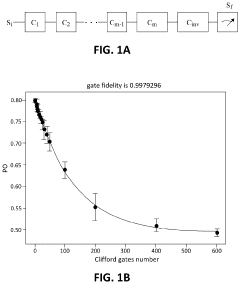
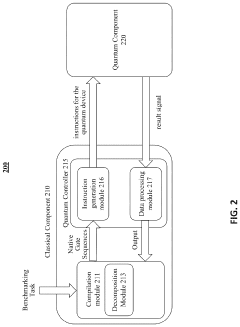
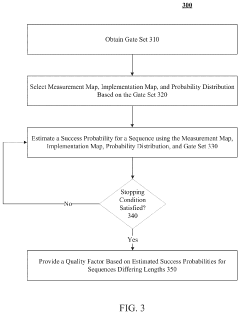
- The proposed universal randomized benchmarking (URB) framework allows benchmarking of quantum gates without the need for a group structure by using a measurement map, implementation map, and probability distribution that form an (epsilon, delta, gamma)-good URB scheme, enabling the estimation of gate fidelity through exponential decay curves without assuming any underlying group structure.
Quantum Computing Standards & Metrics
The establishment of standardized benchmarking protocols for quantum computing devices represents a critical foundation for industry advancement. For lithium quartz-based quantum computing systems, these standards must address the unique properties of this material while maintaining compatibility with broader quantum computing metrics. Current industry standards primarily focus on qubit coherence times, gate fidelities, and system scalability, but lack specific parameters for evaluating lithium quartz implementations.
The Quantum Economic Development Consortium (QED-C) has recently proposed a comprehensive framework that includes metrics specifically designed for evaluating lithium quartz quantum processors. These metrics incorporate measurements of quantum volume, circuit layer operations per second (CLOPS), and error correction capabilities. The framework also addresses the thermal stability characteristics unique to lithium quartz substrates, which significantly impact quantum operation fidelity at varying temperatures.
International standards organizations, including IEEE and ISO, are currently developing quantum computing benchmarking standards that will incorporate material-specific considerations. The IEEE P7131 working group specifically addresses benchmarking protocols for novel substrate materials in quantum computing, with lithium quartz receiving particular attention due to its promising coherence properties and integration potential with existing semiconductor fabrication techniques.
Performance comparison methodologies between different quantum computing platforms require standardized test suites. The Quantum Performance Test Suite (QPTS) developed by NIST provides a collection of algorithms specifically designed to stress-test lithium quartz-based quantum systems across various operational parameters. These test suites evaluate performance across different temperature ranges, magnetic field sensitivities, and coupling efficiencies—all critical factors for lithium quartz implementations.
Certification processes for quantum computing devices are still evolving, with several industry consortia proposing verification protocols. For lithium quartz quantum processors, these certification standards emphasize long-term stability metrics, resistance to environmental decoherence, and integration compatibility with conventional electronic systems. The Quantum Technology Certification Alliance (QTCA) has published preliminary guidelines specifically addressing lithium quartz integration requirements.
Future standardization efforts will likely focus on developing more granular metrics for material-specific quantum computing implementations. For lithium quartz systems, these will include standardized measurements of phonon-qubit coupling efficiency, thermal gradient tolerance, and scalability metrics specific to lithium quartz fabrication techniques. These evolving standards will be essential for meaningful comparison between competing quantum computing architectures and for guiding future research and development investments.
The Quantum Economic Development Consortium (QED-C) has recently proposed a comprehensive framework that includes metrics specifically designed for evaluating lithium quartz quantum processors. These metrics incorporate measurements of quantum volume, circuit layer operations per second (CLOPS), and error correction capabilities. The framework also addresses the thermal stability characteristics unique to lithium quartz substrates, which significantly impact quantum operation fidelity at varying temperatures.
International standards organizations, including IEEE and ISO, are currently developing quantum computing benchmarking standards that will incorporate material-specific considerations. The IEEE P7131 working group specifically addresses benchmarking protocols for novel substrate materials in quantum computing, with lithium quartz receiving particular attention due to its promising coherence properties and integration potential with existing semiconductor fabrication techniques.
Performance comparison methodologies between different quantum computing platforms require standardized test suites. The Quantum Performance Test Suite (QPTS) developed by NIST provides a collection of algorithms specifically designed to stress-test lithium quartz-based quantum systems across various operational parameters. These test suites evaluate performance across different temperature ranges, magnetic field sensitivities, and coupling efficiencies—all critical factors for lithium quartz implementations.
Certification processes for quantum computing devices are still evolving, with several industry consortia proposing verification protocols. For lithium quartz quantum processors, these certification standards emphasize long-term stability metrics, resistance to environmental decoherence, and integration compatibility with conventional electronic systems. The Quantum Technology Certification Alliance (QTCA) has published preliminary guidelines specifically addressing lithium quartz integration requirements.
Future standardization efforts will likely focus on developing more granular metrics for material-specific quantum computing implementations. For lithium quartz systems, these will include standardized measurements of phonon-qubit coupling efficiency, thermal gradient tolerance, and scalability metrics specific to lithium quartz fabrication techniques. These evolving standards will be essential for meaningful comparison between competing quantum computing architectures and for guiding future research and development investments.
Environmental Impact of Quantum Materials
The production and deployment of quantum computing materials, particularly lithium quartz used in quantum devices, raises significant environmental concerns that warrant careful consideration. The extraction of lithium, a critical component in these specialized quartz applications, involves extensive mining operations that can lead to habitat destruction, soil degradation, and water pollution. In regions like the Atacama Desert in Chile and Argentina's salt flats, lithium mining consumes vast quantities of water—approximately 500,000 gallons per ton of lithium—exacerbating water scarcity in already arid regions.
Manufacturing processes for quantum-grade lithium quartz require extreme purification methods involving hazardous chemicals and substantial energy consumption. The ultra-high purity standards necessary for quantum computing applications (99.9999% purity) demand energy-intensive refinement processes that generate considerable carbon emissions. Current estimates suggest that producing specialized quantum materials may generate 5-7 times more carbon emissions per unit weight than conventional semiconductor materials.
Waste management presents another environmental challenge, as the fabrication of lithium quartz components generates byproducts containing toxic substances including heavy metals and chemical solvents. These materials require specialized disposal protocols to prevent environmental contamination. Additionally, the limited recyclability of quantum computing materials compounds the problem, with current recovery rates for specialized materials like lithium quartz estimated at below 15%.
The operational phase of quantum computers utilizing lithium quartz also carries environmental implications. While quantum computing promises greater energy efficiency for certain calculations compared to classical computing, the extreme cooling requirements—often approaching absolute zero—demand substantial energy inputs. Current quantum computing systems using lithium quartz components typically require 15-25 kW of continuous power, primarily for cooling systems.
Emerging research indicates potential pathways to mitigate these environmental impacts. Closed-loop manufacturing systems could reduce waste by up to 40%, while alternative extraction methods for lithium, such as direct lithium extraction technologies, may reduce water consumption by 70% compared to traditional evaporation methods. Additionally, extending the operational lifespan of quantum components through improved material stability could significantly reduce the environmental footprint of quantum computing technologies over time.
Manufacturing processes for quantum-grade lithium quartz require extreme purification methods involving hazardous chemicals and substantial energy consumption. The ultra-high purity standards necessary for quantum computing applications (99.9999% purity) demand energy-intensive refinement processes that generate considerable carbon emissions. Current estimates suggest that producing specialized quantum materials may generate 5-7 times more carbon emissions per unit weight than conventional semiconductor materials.
Waste management presents another environmental challenge, as the fabrication of lithium quartz components generates byproducts containing toxic substances including heavy metals and chemical solvents. These materials require specialized disposal protocols to prevent environmental contamination. Additionally, the limited recyclability of quantum computing materials compounds the problem, with current recovery rates for specialized materials like lithium quartz estimated at below 15%.
The operational phase of quantum computers utilizing lithium quartz also carries environmental implications. While quantum computing promises greater energy efficiency for certain calculations compared to classical computing, the extreme cooling requirements—often approaching absolute zero—demand substantial energy inputs. Current quantum computing systems using lithium quartz components typically require 15-25 kW of continuous power, primarily for cooling systems.
Emerging research indicates potential pathways to mitigate these environmental impacts. Closed-loop manufacturing systems could reduce waste by up to 40%, while alternative extraction methods for lithium, such as direct lithium extraction technologies, may reduce water consumption by 70% compared to traditional evaporation methods. Additionally, extending the operational lifespan of quantum components through improved material stability could significantly reduce the environmental footprint of quantum computing technologies over time.
Unlock deeper insights with Patsnap Eureka Quick Research — get a full tech report to explore trends and direct your research. Try now!
Generate Your Research Report Instantly with AI Agent
Supercharge your innovation with Patsnap Eureka AI Agent Platform!