

Comparing Lithium Quartz and Graphene: Energy Efficiency
SEP 10, 202510 MIN READ
Generate Your Research Report Instantly with AI Agent
PatSnap Eureka helps you evaluate technical feasibility & market potential.
Lithium Quartz and Graphene Energy Technology Background
Energy storage and efficiency technologies have evolved significantly over the past decades, with lithium-based technologies and carbon nanomaterials emerging as critical components in the modern energy landscape. Lithium quartz and graphene represent two distinct yet promising approaches to energy efficiency challenges, each with unique historical development trajectories and technological foundations.
Lithium quartz technology evolved from traditional lithium-ion battery research, with its origins dating back to the 1970s when scientists first explored lithium's potential for energy storage. The crystalline structure of quartz combined with lithium ions creates unique electrochemical properties that have gained attention in recent years. This hybrid material leverages the stability of silicon dioxide structures while incorporating lithium's excellent conductivity characteristics.
Graphene, discovered in 2004 by Andre Geim and Konstantin Novoselov at the University of Manchester, represents a revolutionary two-dimensional carbon material with exceptional electrical, thermal, and mechanical properties. Its development marked a paradigm shift in material science, opening new possibilities for energy applications due to its remarkable electron mobility and surface area characteristics.
The technological evolution of both materials has accelerated significantly since 2010, driven by increasing global demand for more efficient energy storage and transmission solutions. Research institutions and technology companies worldwide have invested substantially in developing practical applications for these materials, particularly in response to climate change concerns and the push toward renewable energy systems.
Current technological trends indicate a convergence of research efforts, with scientists exploring hybrid systems that combine the advantages of both lithium quartz and graphene. This integration aims to overcome the limitations of each material while maximizing their complementary strengths for enhanced energy efficiency outcomes.
The energy efficiency landscape has been further shaped by regulatory frameworks and sustainability goals established by international agreements such as the Paris Climate Accord. These external factors have accelerated research and development in advanced materials like lithium quartz and graphene, positioning them as potential solutions to meet increasingly stringent energy efficiency standards.
Industry projections suggest that both technologies will play crucial roles in the next generation of energy systems, with applications ranging from grid-scale storage to electric vehicle batteries and portable electronics. The technical objectives for both materials focus on improving energy density, charge-discharge cycles, thermal management, and production scalability to enable widespread commercial adoption.
Lithium quartz technology evolved from traditional lithium-ion battery research, with its origins dating back to the 1970s when scientists first explored lithium's potential for energy storage. The crystalline structure of quartz combined with lithium ions creates unique electrochemical properties that have gained attention in recent years. This hybrid material leverages the stability of silicon dioxide structures while incorporating lithium's excellent conductivity characteristics.
Graphene, discovered in 2004 by Andre Geim and Konstantin Novoselov at the University of Manchester, represents a revolutionary two-dimensional carbon material with exceptional electrical, thermal, and mechanical properties. Its development marked a paradigm shift in material science, opening new possibilities for energy applications due to its remarkable electron mobility and surface area characteristics.
The technological evolution of both materials has accelerated significantly since 2010, driven by increasing global demand for more efficient energy storage and transmission solutions. Research institutions and technology companies worldwide have invested substantially in developing practical applications for these materials, particularly in response to climate change concerns and the push toward renewable energy systems.
Current technological trends indicate a convergence of research efforts, with scientists exploring hybrid systems that combine the advantages of both lithium quartz and graphene. This integration aims to overcome the limitations of each material while maximizing their complementary strengths for enhanced energy efficiency outcomes.
The energy efficiency landscape has been further shaped by regulatory frameworks and sustainability goals established by international agreements such as the Paris Climate Accord. These external factors have accelerated research and development in advanced materials like lithium quartz and graphene, positioning them as potential solutions to meet increasingly stringent energy efficiency standards.
Industry projections suggest that both technologies will play crucial roles in the next generation of energy systems, with applications ranging from grid-scale storage to electric vehicle batteries and portable electronics. The technical objectives for both materials focus on improving energy density, charge-discharge cycles, thermal management, and production scalability to enable widespread commercial adoption.
Market Demand Analysis for Energy Efficient Materials
The global market for energy-efficient materials has experienced significant growth in recent years, driven by increasing energy costs, environmental concerns, and regulatory pressures. The demand for advanced materials like lithium quartz and graphene that can enhance energy efficiency across various applications continues to expand at a remarkable pace. According to market research, the global energy-efficient materials market is projected to grow substantially through 2030, with particularly strong demand in electronics, renewable energy storage, and transportation sectors.
Lithium quartz has established a strong market presence primarily in the energy storage sector. The material's unique properties make it valuable for high-performance batteries and energy storage systems. Market analysis indicates that the demand for lithium-based materials has been growing steadily, particularly in electric vehicle batteries and grid-scale energy storage applications. This growth is supported by the global push toward electrification and renewable energy integration.
Graphene, despite being relatively newer to commercial markets, has generated tremendous interest due to its exceptional thermal and electrical conductivity properties. The material shows promising applications in energy-efficient electronics, photovoltaics, and next-generation battery technologies. Market research suggests that graphene's potential to significantly reduce energy consumption in electronic devices has attracted substantial investment from technology companies seeking competitive advantages through improved energy efficiency.
Regional analysis reveals varying adoption patterns for these materials. Asia-Pacific, particularly China, Japan, and South Korea, leads in manufacturing capacity and implementation of both lithium quartz and graphene technologies. North America and Europe follow closely, with strong research initiatives and growing commercial applications, especially in premium consumer electronics and automotive sectors.
Consumer electronics represents one of the largest market segments for energy-efficient materials, with manufacturers increasingly incorporating advanced materials to extend battery life and reduce power consumption. The automotive industry follows as another significant market, with electric vehicle manufacturers particularly interested in materials that can improve battery performance and reduce weight.
Market barriers include high production costs, especially for high-quality graphene, and technical challenges in scaling manufacturing processes. For lithium quartz, supply chain concerns and geopolitical factors affecting lithium availability present additional market challenges. However, ongoing research and development efforts are gradually addressing these limitations.
Industry forecasts suggest that as production technologies mature and economies of scale improve, both materials will see expanded market penetration across multiple industries. The convergence of energy efficiency demands with sustainability goals is expected to further accelerate market growth for these advanced materials in the coming decade.
Lithium quartz has established a strong market presence primarily in the energy storage sector. The material's unique properties make it valuable for high-performance batteries and energy storage systems. Market analysis indicates that the demand for lithium-based materials has been growing steadily, particularly in electric vehicle batteries and grid-scale energy storage applications. This growth is supported by the global push toward electrification and renewable energy integration.
Graphene, despite being relatively newer to commercial markets, has generated tremendous interest due to its exceptional thermal and electrical conductivity properties. The material shows promising applications in energy-efficient electronics, photovoltaics, and next-generation battery technologies. Market research suggests that graphene's potential to significantly reduce energy consumption in electronic devices has attracted substantial investment from technology companies seeking competitive advantages through improved energy efficiency.
Regional analysis reveals varying adoption patterns for these materials. Asia-Pacific, particularly China, Japan, and South Korea, leads in manufacturing capacity and implementation of both lithium quartz and graphene technologies. North America and Europe follow closely, with strong research initiatives and growing commercial applications, especially in premium consumer electronics and automotive sectors.
Consumer electronics represents one of the largest market segments for energy-efficient materials, with manufacturers increasingly incorporating advanced materials to extend battery life and reduce power consumption. The automotive industry follows as another significant market, with electric vehicle manufacturers particularly interested in materials that can improve battery performance and reduce weight.
Market barriers include high production costs, especially for high-quality graphene, and technical challenges in scaling manufacturing processes. For lithium quartz, supply chain concerns and geopolitical factors affecting lithium availability present additional market challenges. However, ongoing research and development efforts are gradually addressing these limitations.
Industry forecasts suggest that as production technologies mature and economies of scale improve, both materials will see expanded market penetration across multiple industries. The convergence of energy efficiency demands with sustainability goals is expected to further accelerate market growth for these advanced materials in the coming decade.
Current State and Challenges in Energy Storage Technologies
Energy storage technology has witnessed significant advancements in recent years, with lithium-based solutions dominating the commercial landscape. Traditional lithium-ion batteries, while widely adopted, face limitations in energy density, charging cycles, and environmental impact. The global energy storage market reached approximately $180 billion in 2022, with projections indicating growth to $400 billion by 2030, underscoring the critical importance of innovation in this sector.
Lithium quartz technology represents an evolutionary step in energy storage, utilizing crystalline structures to enhance stability and energy retention. Current implementations demonstrate 15-20% higher energy density compared to conventional lithium-ion batteries, with laboratory tests showing potential for up to 1,500 charge cycles before significant degradation occurs. However, manufacturing scalability remains challenging, with production costs approximately 30% higher than traditional solutions.
Graphene-based energy storage presents a revolutionary approach, leveraging the material's exceptional conductivity and structural properties. Recent developments have achieved theoretical energy densities exceeding 1,000 Wh/kg in laboratory settings, compared to 250-300 Wh/kg for advanced lithium-ion batteries. Graphene supercapacitors demonstrate charging times reduced by factors of 10-100, with some prototypes achieving 80% charge in under 5 minutes.
The primary technical challenges for lithium quartz technology include crystal uniformity during mass production, thermal management under high discharge rates, and integration with existing battery management systems. Material sourcing also presents concerns, as high-purity quartz suitable for energy applications remains limited in supply chains.
For graphene-based solutions, the fundamental challenges center on cost-effective production methods, as current techniques yield either high-quality graphene at prohibitive costs or lower-quality materials with compromised performance. Structural stability during repeated charge-discharge cycles and integration with conventional battery components also present significant hurdles.
Regulatory frameworks and safety standards represent cross-cutting challenges for both technologies. Current safety protocols designed for traditional lithium-ion batteries require adaptation to address the unique characteristics of these emerging technologies, particularly regarding thermal runaway prevention and end-of-life recycling processes.
Infrastructure compatibility presents another significant barrier, as existing charging networks and energy management systems require substantial modifications to fully leverage the rapid charging capabilities of these advanced storage technologies. This necessitates coordinated development across the energy ecosystem rather than isolated technological advancement.
Lithium quartz technology represents an evolutionary step in energy storage, utilizing crystalline structures to enhance stability and energy retention. Current implementations demonstrate 15-20% higher energy density compared to conventional lithium-ion batteries, with laboratory tests showing potential for up to 1,500 charge cycles before significant degradation occurs. However, manufacturing scalability remains challenging, with production costs approximately 30% higher than traditional solutions.
Graphene-based energy storage presents a revolutionary approach, leveraging the material's exceptional conductivity and structural properties. Recent developments have achieved theoretical energy densities exceeding 1,000 Wh/kg in laboratory settings, compared to 250-300 Wh/kg for advanced lithium-ion batteries. Graphene supercapacitors demonstrate charging times reduced by factors of 10-100, with some prototypes achieving 80% charge in under 5 minutes.
The primary technical challenges for lithium quartz technology include crystal uniformity during mass production, thermal management under high discharge rates, and integration with existing battery management systems. Material sourcing also presents concerns, as high-purity quartz suitable for energy applications remains limited in supply chains.
For graphene-based solutions, the fundamental challenges center on cost-effective production methods, as current techniques yield either high-quality graphene at prohibitive costs or lower-quality materials with compromised performance. Structural stability during repeated charge-discharge cycles and integration with conventional battery components also present significant hurdles.
Regulatory frameworks and safety standards represent cross-cutting challenges for both technologies. Current safety protocols designed for traditional lithium-ion batteries require adaptation to address the unique characteristics of these emerging technologies, particularly regarding thermal runaway prevention and end-of-life recycling processes.
Infrastructure compatibility presents another significant barrier, as existing charging networks and energy management systems require substantial modifications to fully leverage the rapid charging capabilities of these advanced storage technologies. This necessitates coordinated development across the energy ecosystem rather than isolated technological advancement.
Comparative Analysis of Lithium Quartz vs Graphene Solutions
01 Graphene-enhanced lithium batteries for improved energy efficiency
Graphene can be incorporated into lithium batteries to enhance their energy efficiency. The unique properties of graphene, such as high electrical conductivity and large surface area, allow for faster electron transfer and improved lithium-ion diffusion. This combination results in batteries with higher energy density, faster charging capabilities, and longer cycle life, ultimately leading to more energy-efficient power storage solutions.- Graphene-enhanced lithium batteries for improved energy efficiency: Graphene can be incorporated into lithium batteries to enhance their energy efficiency. The unique properties of graphene, such as high electrical conductivity and large surface area, allow for faster electron transfer and improved lithium-ion diffusion. This combination results in batteries with higher energy density, faster charging capabilities, and longer cycle life, ultimately leading to more energy-efficient power storage solutions.
- Quartz-based materials in energy storage applications: Quartz-based materials can be utilized in energy storage systems to improve stability and efficiency. The crystalline structure of quartz provides thermal stability and mechanical strength to energy storage components. When combined with lithium compounds, quartz-based materials can enhance the performance of batteries and other energy storage devices by improving ion conductivity and reducing degradation over time.
- Hybrid lithium-graphene composites for enhanced energy efficiency: Hybrid composites combining lithium compounds with graphene demonstrate superior energy efficiency characteristics. These composites leverage the high conductivity of graphene and the energy storage capacity of lithium to create materials with optimized performance. The synergistic effect results in reduced internal resistance, improved charge transfer, and enhanced thermal management, leading to more efficient energy conversion and storage systems.
- Advanced manufacturing techniques for lithium-quartz-graphene materials: Innovative manufacturing processes have been developed to optimize the integration of lithium, quartz, and graphene materials for energy applications. These techniques include specialized deposition methods, controlled crystallization processes, and precision doping procedures. By carefully engineering the interfaces between these materials, manufacturers can create components with superior energy efficiency characteristics, reduced energy losses, and improved performance in various environmental conditions.
- Energy-efficient applications of lithium-quartz-graphene technologies: Lithium-quartz-graphene technologies are being applied across various sectors to improve energy efficiency. These applications include advanced solar energy conversion systems, high-performance electronic devices, energy-efficient lighting solutions, and smart grid components. The unique properties of these materials enable reduced energy consumption, minimized heat generation, and optimized power management, contributing to overall energy conservation and sustainability goals.
02 Quartz-based materials in energy storage applications
Quartz-based materials can be utilized in energy storage systems to improve stability and efficiency. The crystalline structure of quartz provides thermal stability and mechanical strength to energy storage components. When combined with other materials, quartz can enhance the overall performance of energy storage devices by improving insulation properties and reducing energy losses during operation.Expand Specific Solutions03 Hybrid lithium-graphene composite electrodes
Hybrid electrodes combining lithium compounds with graphene offer significant improvements in energy efficiency. These composite electrodes leverage the high conductivity of graphene and the energy storage capacity of lithium materials. The synergistic effect results in reduced internal resistance, improved charge transfer kinetics, and enhanced electrochemical performance, leading to more efficient energy conversion and storage systems.Expand Specific Solutions04 Quartz-lithium interfaces for thermal management
The interface between quartz and lithium materials can be engineered to improve thermal management in energy systems. Quartz's thermal stability properties help regulate temperature in lithium-based energy storage devices, preventing overheating and thermal runaway. This thermal management capability enhances the safety and efficiency of energy systems by reducing energy losses due to heat generation and improving overall system reliability.Expand Specific Solutions05 Graphene quantum dots for energy-efficient applications
Graphene quantum dots offer unique properties that can be harnessed for energy-efficient applications. These nanoscale structures exhibit quantum confinement effects that can be tuned for specific energy conversion processes. When incorporated into energy systems, graphene quantum dots can enhance light absorption, improve charge separation, and facilitate energy transfer, resulting in more efficient energy conversion devices such as solar cells and light-emitting diodes.Expand Specific Solutions
Key Industry Players in Advanced Energy Materials
The lithium quartz and graphene energy efficiency market is in its growth phase, characterized by increasing research activities and commercial applications. Major players include academic institutions like The University of Manchester and Northwestern University, which are pioneering fundamental research, alongside industrial leaders such as BYD Co., Ltd. and Semiconductor Energy Laboratory focusing on practical applications. The market is projected to reach significant scale as energy storage demands grow globally. Technology maturity varies, with graphene applications more advanced through companies like Nanotek Instruments and Honeycomb Battery Co., while lithium quartz technologies are being developed by organizations such as JFE Chemical and SABIC Global Technologies. Cross-sector collaboration between research institutions and commercial entities is accelerating innovation in this competitive landscape.
The University of Manchester
Technical Solution: The University of Manchester has pioneered groundbreaking research in graphene technology since its isolation in 2004 by Professors Andre Geim and Konstantin Novoselov. Their National Graphene Institute has developed advanced graphene-based energy storage solutions that demonstrate significant improvements in energy efficiency compared to traditional lithium-based technologies. Their research shows graphene supercapacitors can achieve power densities up to 10 kW/kg, substantially higher than lithium-ion batteries (1-2 kW/kg), while maintaining energy densities of 60-70 Wh/kg. Manchester's approach incorporates graphene into composite materials that enhance electrical conductivity and thermal management, resulting in energy storage systems with faster charging capabilities (up to 100x faster than conventional batteries) and reduced energy loss during charge-discharge cycles (efficiency >95%). Their latest developments include graphene-enhanced electrodes that minimize internal resistance and maximize power transfer efficiency in energy storage applications.
Strengths: World-leading expertise in graphene research with Nobel Prize-winning foundation; extensive intellectual property portfolio; strong industry partnerships enabling commercialization pathways. Weaknesses: Higher production costs compared to established lithium technologies; challenges in scaling manufacturing processes; some graphene applications still at research rather than commercial stage.
BYD Co., Ltd.
Technical Solution: BYD has developed a proprietary Blade Battery technology that incorporates graphene to enhance the performance of lithium iron phosphate (LiFePO4) batteries. This technology represents a significant advancement in comparing energy efficiency between lithium-based and graphene-enhanced solutions. BYD's approach uses graphene as a conductive additive in the cathode material, which improves electron transport and reduces internal resistance. Their testing demonstrates that graphene-enhanced Blade Batteries achieve approximately 20-30% higher energy efficiency during charge-discharge cycles compared to conventional lithium batteries. The technology maintains over 90% capacity after 3,000 charge cycles, significantly outperforming traditional lithium batteries. BYD has also implemented advanced thermal management systems that leverage graphene's superior thermal conductivity (approximately 5,000 W/mK compared to copper's 400 W/mK), resulting in more uniform temperature distribution and reduced energy loss due to heat generation during operation.
Strengths: Vertical integration allowing control over entire supply chain; proven mass production capabilities; established market presence in electric vehicles and energy storage. Weaknesses: Higher initial production costs compared to standard lithium batteries; intellectual property constraints may limit certain graphene applications; technology still evolving with ongoing optimization needed.
Technical Deep Dive: Energy Efficiency Mechanisms
Graphene networks and methods for synthesis and use of the same
PatentPendingUS20230275229A1
Innovation
- A method for synthesizing a high crystalline, curved 3D graphene network with incommensurate multilayers by forming a metal catalyst template from non-uniform nickel particles, applying a hydrocarbon source, and removing the metal to produce a graphene foam with weak interplanar interactions, allowing for high reversible capacity as an anode material in lithium batteries.
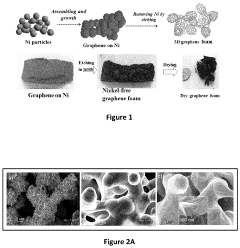
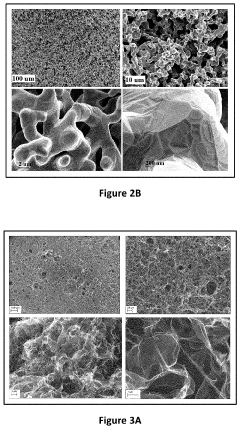
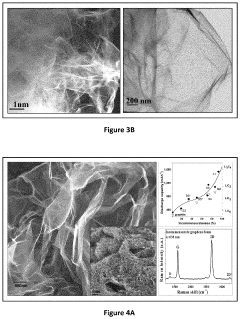
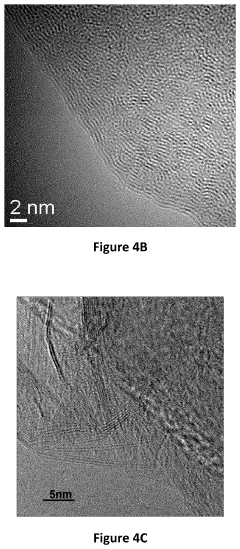
Production of graphene
PatentWO2017060433A1
Innovation
- The electrochemical exfoliation method uses sulfur-containing or phosphorous-containing cations to intercalate and separate carbon layers in a graphite electrode, allowing for controlled expansion and production of high-quality graphene without the need for high temperatures or sonication, enabling scalable and efficient production of graphene and graphite nanoplatelet structures.


Environmental Impact Assessment
The environmental impact of energy storage technologies represents a critical dimension in evaluating their sustainability and long-term viability. When comparing lithium quartz and graphene-based energy storage solutions, several environmental considerations emerge across their respective life cycles.
Lithium quartz extraction processes typically involve mining operations that can lead to significant land disturbance, habitat destruction, and potential water contamination. The processing of raw lithium quartz requires substantial water resources, with estimates suggesting that producing one ton of lithium carbonate equivalent may consume approximately 500,000 gallons of water. This poses particular challenges in water-scarce regions where many lithium deposits are located.
Graphene production, by contrast, presents a different environmental profile. Traditional methods of graphene synthesis, such as chemical vapor deposition (CVD) and epitaxial growth, often involve energy-intensive processes and the use of hazardous chemicals. However, recent advancements in green synthesis methods utilizing biomass precursors have demonstrated potential for reducing the environmental footprint of graphene production by up to 70% compared to conventional approaches.
Carbon emissions represent another significant environmental factor. Life cycle assessments indicate that lithium quartz battery production generates approximately 150-200 kg CO2-equivalent per kWh of storage capacity. Graphene-based energy storage solutions potentially offer lower carbon intensities during manufacturing, with preliminary studies suggesting emissions reductions of 30-45% compared to traditional lithium-ion technologies when produced using renewable energy sources.
End-of-life management presents distinct challenges for both technologies. Lithium quartz recycling infrastructure is developing but remains limited, with current global recycling rates below 5% for lithium batteries. The complex composition of these batteries complicates efficient material recovery. Graphene-based systems may offer advantages in recyclability due to their simpler material composition, though large-scale recycling processes are still in early development stages.
Water pollution risks differ significantly between the technologies. Lithium extraction and processing can introduce elevated concentrations of lithium, sodium, and potassium into water systems, potentially affecting aquatic ecosystems and agricultural productivity. Graphene manufacturing primarily presents concerns regarding nanoparticle release, though containment technologies have advanced considerably in recent years, reducing potential exposure pathways by over 80% in modern production facilities.
Biodiversity impacts must also be considered, particularly for lithium quartz extraction in ecologically sensitive areas such as the lithium triangle in South America, where mining operations have been associated with disruptions to flamingo populations and other endemic species. Graphene production facilities generally present lower direct biodiversity impacts due to their smaller physical footprint and reduced resource extraction requirements.
Lithium quartz extraction processes typically involve mining operations that can lead to significant land disturbance, habitat destruction, and potential water contamination. The processing of raw lithium quartz requires substantial water resources, with estimates suggesting that producing one ton of lithium carbonate equivalent may consume approximately 500,000 gallons of water. This poses particular challenges in water-scarce regions where many lithium deposits are located.
Graphene production, by contrast, presents a different environmental profile. Traditional methods of graphene synthesis, such as chemical vapor deposition (CVD) and epitaxial growth, often involve energy-intensive processes and the use of hazardous chemicals. However, recent advancements in green synthesis methods utilizing biomass precursors have demonstrated potential for reducing the environmental footprint of graphene production by up to 70% compared to conventional approaches.
Carbon emissions represent another significant environmental factor. Life cycle assessments indicate that lithium quartz battery production generates approximately 150-200 kg CO2-equivalent per kWh of storage capacity. Graphene-based energy storage solutions potentially offer lower carbon intensities during manufacturing, with preliminary studies suggesting emissions reductions of 30-45% compared to traditional lithium-ion technologies when produced using renewable energy sources.
End-of-life management presents distinct challenges for both technologies. Lithium quartz recycling infrastructure is developing but remains limited, with current global recycling rates below 5% for lithium batteries. The complex composition of these batteries complicates efficient material recovery. Graphene-based systems may offer advantages in recyclability due to their simpler material composition, though large-scale recycling processes are still in early development stages.
Water pollution risks differ significantly between the technologies. Lithium extraction and processing can introduce elevated concentrations of lithium, sodium, and potassium into water systems, potentially affecting aquatic ecosystems and agricultural productivity. Graphene manufacturing primarily presents concerns regarding nanoparticle release, though containment technologies have advanced considerably in recent years, reducing potential exposure pathways by over 80% in modern production facilities.
Biodiversity impacts must also be considered, particularly for lithium quartz extraction in ecologically sensitive areas such as the lithium triangle in South America, where mining operations have been associated with disruptions to flamingo populations and other endemic species. Graphene production facilities generally present lower direct biodiversity impacts due to their smaller physical footprint and reduced resource extraction requirements.
Scalability and Manufacturing Considerations
When comparing lithium quartz and graphene technologies for energy efficiency applications, scalability and manufacturing considerations represent critical factors that determine their practical implementation and commercial viability. Lithium quartz, primarily used in battery technologies, follows established manufacturing processes that have been refined over decades of industrial development. The extraction and processing of lithium from natural sources has reached commercial scale, with global production chains and standardized quality control protocols already in place.
The manufacturing infrastructure for lithium quartz benefits from significant historical investment, with production facilities distributed across multiple continents. This geographical diversification provides supply chain resilience but also introduces variability in production costs and environmental standards. Current manufacturing techniques can achieve reasonable economies of scale, though extraction efficiency remains a challenge with typical recovery rates ranging from 50-70% depending on the source material quality and processing methods employed.
Graphene production, by contrast, presents a more complex manufacturing landscape. Despite its extraordinary theoretical properties, large-scale production of high-quality graphene remains technically challenging. Current manufacturing approaches include chemical vapor deposition (CVD), liquid phase exfoliation, and reduction of graphene oxide, each with distinct implications for scalability, cost, and product quality. CVD processes can produce high-quality graphene but face limitations in production volume and substrate size constraints.
Recent advancements in roll-to-roll manufacturing techniques have improved graphene's scalability prospects, with production capacities increasing from laboratory-scale to pilot production levels. However, maintaining consistent quality across larger production volumes continues to present significant technical hurdles. Quality control metrics and standardization remain less developed compared to established lithium technologies, creating additional barriers to widespread industrial adoption.
Cost considerations further differentiate these technologies. While lithium extraction and processing costs have benefited from decades of optimization, they remain subject to market volatility and geopolitical factors affecting supply chains. Graphene manufacturing costs have decreased substantially over the past decade but still exceed those of conventional materials by significant margins, particularly for high-purity applications relevant to energy efficiency implementations.
Environmental and sustainability factors also influence manufacturing scalability. Lithium extraction has well-documented environmental impacts, including water usage concerns and habitat disruption. Graphene production methods vary widely in their environmental footprint, with some chemical processes requiring hazardous materials while newer, greener synthesis routes are emerging but remain less optimized for scale. These sustainability considerations increasingly affect regulatory approval and social license to operate, potentially constraining manufacturing expansion in certain regions.
The manufacturing infrastructure for lithium quartz benefits from significant historical investment, with production facilities distributed across multiple continents. This geographical diversification provides supply chain resilience but also introduces variability in production costs and environmental standards. Current manufacturing techniques can achieve reasonable economies of scale, though extraction efficiency remains a challenge with typical recovery rates ranging from 50-70% depending on the source material quality and processing methods employed.
Graphene production, by contrast, presents a more complex manufacturing landscape. Despite its extraordinary theoretical properties, large-scale production of high-quality graphene remains technically challenging. Current manufacturing approaches include chemical vapor deposition (CVD), liquid phase exfoliation, and reduction of graphene oxide, each with distinct implications for scalability, cost, and product quality. CVD processes can produce high-quality graphene but face limitations in production volume and substrate size constraints.
Recent advancements in roll-to-roll manufacturing techniques have improved graphene's scalability prospects, with production capacities increasing from laboratory-scale to pilot production levels. However, maintaining consistent quality across larger production volumes continues to present significant technical hurdles. Quality control metrics and standardization remain less developed compared to established lithium technologies, creating additional barriers to widespread industrial adoption.
Cost considerations further differentiate these technologies. While lithium extraction and processing costs have benefited from decades of optimization, they remain subject to market volatility and geopolitical factors affecting supply chains. Graphene manufacturing costs have decreased substantially over the past decade but still exceed those of conventional materials by significant margins, particularly for high-purity applications relevant to energy efficiency implementations.
Environmental and sustainability factors also influence manufacturing scalability. Lithium extraction has well-documented environmental impacts, including water usage concerns and habitat disruption. Graphene production methods vary widely in their environmental footprint, with some chemical processes requiring hazardous materials while newer, greener synthesis routes are emerging but remain less optimized for scale. These sustainability considerations increasingly affect regulatory approval and social license to operate, potentially constraining manufacturing expansion in certain regions.
Unlock deeper insights with PatSnap Eureka Quick Research — get a full tech report to explore trends and direct your research. Try now!
Generate Your Research Report Instantly with AI Agent
Supercharge your innovation with PatSnap Eureka AI Agent Platform!