
Circulating Fluidized Bed Boiler Shutdown Protocols for Maintenance Efficiency
JUN 26, 20269 MIN READ
Generate Your Research Report Instantly with AI Agent
Patsnap Eureka helps you evaluate technical feasibility & market potential.
CFB Boiler Shutdown Technology Background and Objectives
Circulating Fluidized Bed (CFB) boiler technology emerged in the 1970s as a revolutionary combustion system designed to address environmental concerns and fuel flexibility challenges in power generation. This technology evolved from conventional fluidized bed combustion, incorporating advanced particle circulation mechanisms that enable superior heat transfer, enhanced combustion efficiency, and reduced emissions. The fundamental principle involves suspending fuel particles in a high-velocity air stream, creating a fluid-like behavior that optimizes mixing and combustion processes.
The historical development of CFB boilers has been driven by increasingly stringent environmental regulations and the need for multi-fuel capability. Early implementations focused primarily on coal combustion, but technological advancements have expanded applications to include biomass, waste materials, and various industrial byproducts. This evolution has positioned CFB technology as a critical component in sustainable energy strategies worldwide.
Current industry trends indicate a growing emphasis on operational efficiency and maintenance optimization. As CFB installations mature globally, operators face mounting pressure to minimize downtime while ensuring equipment longevity and safety compliance. The complexity of CFB systems, with their intricate refractory linings, cyclone separators, and heat exchange networks, demands sophisticated shutdown protocols that balance maintenance accessibility with thermal stress management.
The primary objective of advanced CFB boiler shutdown protocols centers on maximizing maintenance efficiency while preserving equipment integrity. This involves developing systematic approaches that minimize cooling time, optimize maintenance window utilization, and reduce thermal cycling damage. Key targets include achieving controlled temperature reduction rates that prevent refractory cracking, implementing staged shutdown procedures that facilitate concurrent maintenance activities, and establishing predictive maintenance integration capabilities.
Secondary objectives encompass safety enhancement through standardized procedures, cost reduction via optimized maintenance scheduling, and environmental compliance during shutdown operations. The ultimate goal is establishing industry-leading practices that transform traditional reactive maintenance approaches into proactive, data-driven strategies that significantly improve overall plant availability and economic performance while maintaining the highest safety standards.
The historical development of CFB boilers has been driven by increasingly stringent environmental regulations and the need for multi-fuel capability. Early implementations focused primarily on coal combustion, but technological advancements have expanded applications to include biomass, waste materials, and various industrial byproducts. This evolution has positioned CFB technology as a critical component in sustainable energy strategies worldwide.
Current industry trends indicate a growing emphasis on operational efficiency and maintenance optimization. As CFB installations mature globally, operators face mounting pressure to minimize downtime while ensuring equipment longevity and safety compliance. The complexity of CFB systems, with their intricate refractory linings, cyclone separators, and heat exchange networks, demands sophisticated shutdown protocols that balance maintenance accessibility with thermal stress management.
The primary objective of advanced CFB boiler shutdown protocols centers on maximizing maintenance efficiency while preserving equipment integrity. This involves developing systematic approaches that minimize cooling time, optimize maintenance window utilization, and reduce thermal cycling damage. Key targets include achieving controlled temperature reduction rates that prevent refractory cracking, implementing staged shutdown procedures that facilitate concurrent maintenance activities, and establishing predictive maintenance integration capabilities.
Secondary objectives encompass safety enhancement through standardized procedures, cost reduction via optimized maintenance scheduling, and environmental compliance during shutdown operations. The ultimate goal is establishing industry-leading practices that transform traditional reactive maintenance approaches into proactive, data-driven strategies that significantly improve overall plant availability and economic performance while maintaining the highest safety standards.
Market Demand for Efficient CFB Boiler Maintenance Solutions
The global power generation industry faces mounting pressure to optimize operational efficiency while minimizing environmental impact, creating substantial market demand for advanced CFB boiler maintenance solutions. Power plant operators worldwide are increasingly recognizing that inefficient shutdown protocols result in significant economic losses through extended downtime periods, increased maintenance costs, and reduced equipment lifespan. This recognition has catalyzed a growing market for sophisticated maintenance optimization technologies.
Industrial power generation facilities, particularly those utilizing CFB technology for coal and biomass combustion, represent the primary market segment driving demand for efficient maintenance solutions. These facilities typically operate on tight schedules where unplanned downtime can cost hundreds of thousands of dollars per day. The market encompasses utility-scale power plants, industrial cogeneration facilities, and waste-to-energy plants that rely on CFB boilers for their operations.
The demand for efficient CFB boiler maintenance solutions is particularly pronounced in regions with aging power infrastructure, including North America, Europe, and parts of Asia. Older facilities face increasing maintenance requirements while simultaneously needing to meet stricter environmental regulations and efficiency standards. This dual pressure creates a compelling business case for investing in advanced shutdown protocol technologies.
Market drivers include regulatory compliance requirements, competitive electricity markets demanding higher efficiency, and corporate sustainability initiatives. Environmental regulations increasingly penalize inefficient operations, while deregulated electricity markets reward facilities that can minimize operational costs through optimized maintenance practices. Additionally, the growing emphasis on carbon footprint reduction has made operational efficiency a critical competitive advantage.
The market also responds to technological advancements in predictive maintenance, automation systems, and data analytics capabilities. Modern CFB facilities seek integrated solutions that can optimize shutdown sequences, predict maintenance requirements, and minimize restart times. This technological evolution has created opportunities for specialized service providers and equipment manufacturers to develop comprehensive maintenance efficiency solutions.
Emerging market segments include retrofit applications for existing CFB installations and integrated maintenance management systems for new construction projects. The retrofit market is particularly significant given the substantial installed base of CFB boilers worldwide that could benefit from modernized shutdown protocols and maintenance optimization technologies.
Industrial power generation facilities, particularly those utilizing CFB technology for coal and biomass combustion, represent the primary market segment driving demand for efficient maintenance solutions. These facilities typically operate on tight schedules where unplanned downtime can cost hundreds of thousands of dollars per day. The market encompasses utility-scale power plants, industrial cogeneration facilities, and waste-to-energy plants that rely on CFB boilers for their operations.
The demand for efficient CFB boiler maintenance solutions is particularly pronounced in regions with aging power infrastructure, including North America, Europe, and parts of Asia. Older facilities face increasing maintenance requirements while simultaneously needing to meet stricter environmental regulations and efficiency standards. This dual pressure creates a compelling business case for investing in advanced shutdown protocol technologies.
Market drivers include regulatory compliance requirements, competitive electricity markets demanding higher efficiency, and corporate sustainability initiatives. Environmental regulations increasingly penalize inefficient operations, while deregulated electricity markets reward facilities that can minimize operational costs through optimized maintenance practices. Additionally, the growing emphasis on carbon footprint reduction has made operational efficiency a critical competitive advantage.
The market also responds to technological advancements in predictive maintenance, automation systems, and data analytics capabilities. Modern CFB facilities seek integrated solutions that can optimize shutdown sequences, predict maintenance requirements, and minimize restart times. This technological evolution has created opportunities for specialized service providers and equipment manufacturers to develop comprehensive maintenance efficiency solutions.
Emerging market segments include retrofit applications for existing CFB installations and integrated maintenance management systems for new construction projects. The retrofit market is particularly significant given the substantial installed base of CFB boilers worldwide that could benefit from modernized shutdown protocols and maintenance optimization technologies.
Current CFB Shutdown Challenges and Technical Limitations
Circulating Fluidized Bed (CFB) boilers face significant operational challenges during shutdown procedures that directly impact maintenance efficiency and overall plant economics. The complex nature of CFB technology, with its intricate fluidization dynamics and high-temperature operations, creates unique difficulties not encountered in conventional pulverized coal boilers.
Temperature management represents one of the most critical challenges during CFB shutdown operations. The refractory-lined combustion chamber and cyclone separators retain substantial thermal mass, requiring extended cooling periods that can span 24 to 48 hours. Rapid temperature changes risk thermal shock damage to refractory materials, potentially leading to costly repairs and extended outage durations. Current protocols often lack precision in temperature gradient control, resulting in conservative cooling schedules that unnecessarily prolong shutdown times.
Bed material handling poses another significant technical limitation. The circulating bed inventory, typically consisting of sand or limestone particles, must be properly drained and managed during shutdown. Incomplete bed drainage can lead to material agglomeration and sintering, creating hard deposits that complicate restart procedures. Existing drainage systems frequently suffer from inadequate design, with limited accessibility to lower loop seal areas and insufficient purging capabilities.
Fluidization system complications emerge during the transition from operational to shutdown states. Maintaining proper air distribution while gradually reducing fluidizing velocities requires precise control to prevent bed slumping and uneven cooling patterns. Many facilities struggle with outdated control systems that lack the sophistication needed for optimal fluidization management during transient conditions.
Equipment accessibility constraints significantly hamper maintenance efficiency during CFB shutdowns. The complex internal geometry of CFB systems, including cyclone internals, return leg components, and in-bed heat transfer surfaces, often requires specialized access procedures and extended preparation time. Limited inspection ports and confined spaces create bottlenecks in maintenance workflows.
Ash handling system limitations further compound shutdown challenges. CFB boilers generate multiple ash streams with varying characteristics, and improper ash system operation during shutdown can result in pluggage and equipment damage. Inadequate ash cooling and transport capabilities often force extended shutdown periods to ensure safe ash removal and system maintenance.
Temperature management represents one of the most critical challenges during CFB shutdown operations. The refractory-lined combustion chamber and cyclone separators retain substantial thermal mass, requiring extended cooling periods that can span 24 to 48 hours. Rapid temperature changes risk thermal shock damage to refractory materials, potentially leading to costly repairs and extended outage durations. Current protocols often lack precision in temperature gradient control, resulting in conservative cooling schedules that unnecessarily prolong shutdown times.
Bed material handling poses another significant technical limitation. The circulating bed inventory, typically consisting of sand or limestone particles, must be properly drained and managed during shutdown. Incomplete bed drainage can lead to material agglomeration and sintering, creating hard deposits that complicate restart procedures. Existing drainage systems frequently suffer from inadequate design, with limited accessibility to lower loop seal areas and insufficient purging capabilities.
Fluidization system complications emerge during the transition from operational to shutdown states. Maintaining proper air distribution while gradually reducing fluidizing velocities requires precise control to prevent bed slumping and uneven cooling patterns. Many facilities struggle with outdated control systems that lack the sophistication needed for optimal fluidization management during transient conditions.
Equipment accessibility constraints significantly hamper maintenance efficiency during CFB shutdowns. The complex internal geometry of CFB systems, including cyclone internals, return leg components, and in-bed heat transfer surfaces, often requires specialized access procedures and extended preparation time. Limited inspection ports and confined spaces create bottlenecks in maintenance workflows.
Ash handling system limitations further compound shutdown challenges. CFB boilers generate multiple ash streams with varying characteristics, and improper ash system operation during shutdown can result in pluggage and equipment damage. Inadequate ash cooling and transport capabilities often force extended shutdown periods to ensure safe ash removal and system maintenance.
Existing CFB Boiler Shutdown Protocol Solutions
01 Advanced monitoring and control systems for maintenance optimization
Implementation of sophisticated monitoring and control systems that can track boiler performance parameters in real-time, enabling predictive maintenance strategies. These systems utilize sensors and data analytics to identify potential issues before they become critical, thereby reducing unplanned downtime and improving overall maintenance efficiency through automated diagnostics and performance optimization algorithms.- Advanced monitoring and control systems for maintenance optimization: Implementation of sophisticated monitoring and control systems that can track boiler performance parameters in real-time, enabling predictive maintenance strategies. These systems utilize sensors and data analytics to identify potential issues before they become critical, thereby reducing unplanned downtime and improving overall maintenance efficiency through proactive intervention.
- Automated cleaning and ash removal mechanisms: Development of automated systems for cleaning heat exchange surfaces and removing ash deposits from circulating fluidized bed boilers. These mechanisms reduce the frequency of manual maintenance interventions and improve cleaning effectiveness, leading to better heat transfer efficiency and extended operational periods between maintenance cycles.
- Enhanced material design for wear resistance: Utilization of advanced materials and coatings specifically designed to withstand the harsh operating conditions in circulating fluidized bed boilers. These materials exhibit superior resistance to erosion, corrosion, and thermal cycling, significantly extending component lifespan and reducing the frequency of replacement maintenance activities.
- Optimized maintenance scheduling and procedures: Development of systematic approaches to maintenance scheduling that balance operational requirements with maintenance needs. These methodologies incorporate statistical analysis of failure patterns, operational data, and maintenance history to optimize maintenance intervals and procedures, maximizing boiler availability while minimizing maintenance costs.
- Modular design for improved accessibility and serviceability: Implementation of modular boiler designs that facilitate easier access to critical components during maintenance operations. These designs incorporate removable panels, standardized connections, and strategic component placement to reduce maintenance time and complexity, enabling more efficient servicing and component replacement procedures.
02 Improved heat exchanger and combustion chamber design
Enhanced design configurations for heat exchangers and combustion chambers that facilitate easier access for maintenance operations while improving thermal efficiency. These designs incorporate features that reduce fouling, enable more effective cleaning procedures, and allow for quicker component replacement, ultimately reducing maintenance time and costs while maintaining optimal boiler performance.Expand Specific Solutions03 Automated cleaning and ash removal systems
Development of automated systems for continuous or scheduled cleaning of boiler components and efficient ash removal mechanisms. These systems reduce the need for manual intervention during maintenance operations, minimize boiler shutdown time, and ensure consistent performance by preventing buildup of deposits that can affect heat transfer efficiency and overall system operation.Expand Specific Solutions04 Modular component design for rapid replacement
Implementation of modular design approaches that allow for quick and efficient replacement of key boiler components during maintenance operations. This design philosophy enables maintenance teams to perform repairs and replacements with minimal system disruption, reducing overall maintenance duration and improving system availability through standardized interfaces and simplified installation procedures.Expand Specific Solutions05 Enhanced material selection and coating technologies
Utilization of advanced materials and protective coating technologies that extend component lifespan and reduce maintenance frequency. These materials and coatings provide superior resistance to corrosion, erosion, and high-temperature degradation, resulting in longer intervals between maintenance cycles and reduced overall maintenance costs while maintaining reliable boiler operation.Expand Specific Solutions
Major CFB Boiler Manufacturers and Service Providers
The circulating fluidized bed (CFB) boiler shutdown protocols market represents a mature industrial segment within the broader power generation sector, characterized by established technological frameworks and standardized maintenance procedures. The industry has reached a consolidation phase where optimization of existing protocols takes precedence over revolutionary innovations. Market size remains substantial, driven by the global installed base of CFB boilers requiring regular maintenance cycles. Technology maturity is evidenced by the sophisticated capabilities of key players including Sumitomo SHI FW Energia Oy's advanced fluidized bed technologies, Mitsubishi Heavy Industries and IHI Corp's comprehensive power systems expertise, and Dongfang Boiler Group's large-scale utility boiler specialization. Research institutions like Korea Institute of Energy Research and North China Electric Power University continue advancing protocol efficiency, while major utilities such as Korea Electric Power Corp. and State Grid Corp. of China drive practical implementation standards, creating a competitive landscape focused on incremental improvements and service excellence.
Mitsubishi Heavy Industries, Ltd.
Technical Solution: Mitsubishi Heavy Industries has developed comprehensive CFB boiler shutdown protocols that emphasize systematic temperature reduction and bed material management. Their approach includes staged cooling procedures that gradually reduce combustion chamber temperatures from operating levels (850-900°C) to safe maintenance temperatures below 200°C over 12-16 hours. The protocol incorporates automated fluidization control during shutdown to prevent bed agglomeration and ensure uniform cooling. Their maintenance efficiency strategy includes predictive maintenance scheduling integrated with shutdown procedures, utilizing advanced monitoring systems to optimize maintenance windows and reduce downtime by up to 25% compared to traditional approaches.
Strengths: Proven track record in large-scale power generation, advanced automation systems, comprehensive technical support. Weaknesses: Higher initial investment costs, complex system integration requirements.
Dongfang Boiler (Group) Holdings Co., Ltd.
Technical Solution: Dongfang Boiler has developed cost-effective CFB boiler shutdown protocols specifically designed for maintenance efficiency in utility-scale applications. Their methodology emphasizes systematic approach to temperature management during shutdown, incorporating staged cooling procedures that protect refractory materials while enabling faster maintenance access. The protocol includes specialized bed material handling systems that facilitate rapid component exposure for maintenance activities. Their approach integrates maintenance planning software that coordinates shutdown procedures with spare parts availability and maintenance crew scheduling, optimizing resource utilization during maintenance windows. The system features standardized maintenance access procedures that reduce setup time and enable more efficient maintenance execution, resulting in reduced overall maintenance costs and improved plant availability.
Strengths: Cost-effective solutions, strong domestic market knowledge, established manufacturing capabilities. Weaknesses: Limited international service network, less advanced digital integration compared to global competitors.
Core Innovations in CFB Shutdown Efficiency Technologies
Method of shutting-down a fluidised bed combustor for solid pulverised fuel
PatentInactiveEP0052163A1
Innovation
- Directing flue gas through the return line into the fuel bed to maintain a fluidized bed and prevent fuel particles from caking, using a switching flap controlled by a servomotor to alternate between air and flue gas supply, ensuring the bed cools without settling and sintering.


Black plant steam furnace injection
PatentActiveUS20090025658A1
Innovation
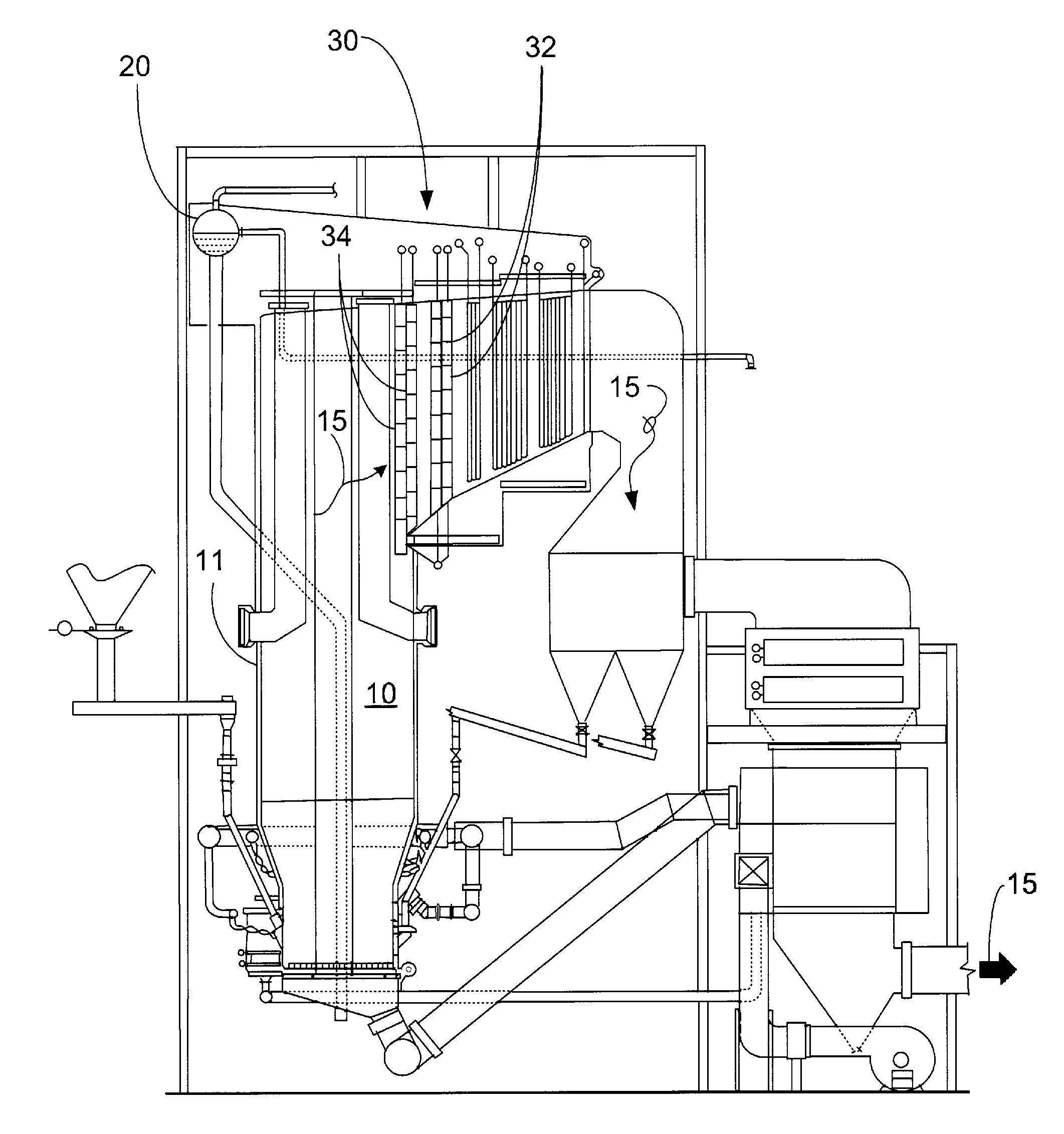
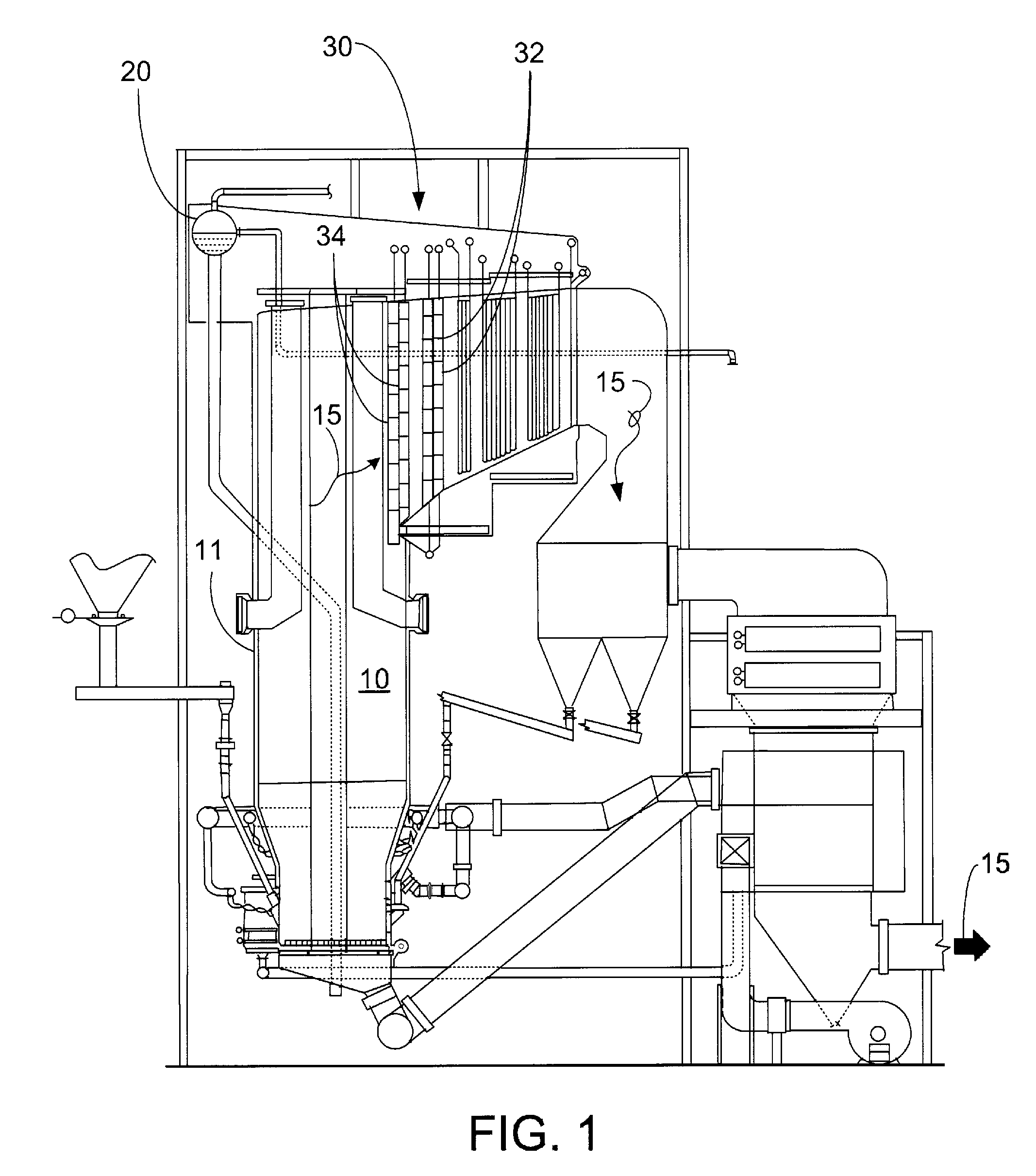
- A steam discharge system that injects steam into the furnace during a black plant condition, using existing SNCR system nozzles to cool hot components and reduce pressure, thereby eliminating the need for additional steam drum capacity and pumps.

Environmental Regulations for CFB Boiler Operations
Environmental regulations governing Circulating Fluidized Bed (CFB) boiler operations have become increasingly stringent worldwide, directly impacting shutdown protocols and maintenance scheduling practices. The regulatory landscape encompasses multiple jurisdictions with varying emission standards, operational requirements, and compliance monitoring protocols that power plant operators must navigate during planned maintenance activities.
The United States Environmental Protection Agency (EPA) enforces comprehensive regulations under the Clean Air Act, including the Mercury and Air Toxics Standards (MATS) and Cross-State Air Pollution Rule (CSAPR). These regulations mandate specific emission limits for sulfur dioxide, nitrogen oxides, particulate matter, and mercury, requiring CFB operators to maintain continuous compliance monitoring systems even during maintenance periods. The EPA's New Source Performance Standards (NSPS) for electric utility steam generating units establish baseline requirements that influence shutdown timing and duration.
European Union regulations under the Industrial Emissions Directive (IED) impose Best Available Techniques (BAT) requirements for large combustion plants, including CFB boilers. The directive mandates emission limit values that must be maintained throughout operational cycles, affecting how maintenance shutdowns are planned and executed. Member states have implemented additional national regulations that further constrain operational flexibility during maintenance activities.
China's environmental regulatory framework, governed by the Ministry of Ecology and Environment, has introduced ultra-low emission standards for coal-fired power plants. These regulations require CFB boilers to meet stringent limits for particulate matter, sulfur dioxide, and nitrogen oxides, necessitating careful coordination between environmental compliance and maintenance scheduling to avoid regulatory violations during startup and shutdown phases.
Regulatory compliance during CFB boiler shutdowns requires adherence to specific protocols for emission control system maintenance, waste handling procedures, and environmental monitoring continuity. Operators must maintain detailed records of maintenance activities, emission levels during shutdown and startup phases, and demonstrate compliance with applicable air quality standards throughout the maintenance cycle.
The regulatory framework also encompasses waste management requirements for maintenance-generated materials, including ash handling, water treatment residuals, and hazardous waste disposal. These regulations directly influence maintenance planning timelines and resource allocation, as operators must ensure proper waste characterization, storage, and disposal in accordance with environmental protection standards while optimizing maintenance efficiency objectives.
The United States Environmental Protection Agency (EPA) enforces comprehensive regulations under the Clean Air Act, including the Mercury and Air Toxics Standards (MATS) and Cross-State Air Pollution Rule (CSAPR). These regulations mandate specific emission limits for sulfur dioxide, nitrogen oxides, particulate matter, and mercury, requiring CFB operators to maintain continuous compliance monitoring systems even during maintenance periods. The EPA's New Source Performance Standards (NSPS) for electric utility steam generating units establish baseline requirements that influence shutdown timing and duration.
European Union regulations under the Industrial Emissions Directive (IED) impose Best Available Techniques (BAT) requirements for large combustion plants, including CFB boilers. The directive mandates emission limit values that must be maintained throughout operational cycles, affecting how maintenance shutdowns are planned and executed. Member states have implemented additional national regulations that further constrain operational flexibility during maintenance activities.
China's environmental regulatory framework, governed by the Ministry of Ecology and Environment, has introduced ultra-low emission standards for coal-fired power plants. These regulations require CFB boilers to meet stringent limits for particulate matter, sulfur dioxide, and nitrogen oxides, necessitating careful coordination between environmental compliance and maintenance scheduling to avoid regulatory violations during startup and shutdown phases.
Regulatory compliance during CFB boiler shutdowns requires adherence to specific protocols for emission control system maintenance, waste handling procedures, and environmental monitoring continuity. Operators must maintain detailed records of maintenance activities, emission levels during shutdown and startup phases, and demonstrate compliance with applicable air quality standards throughout the maintenance cycle.
The regulatory framework also encompasses waste management requirements for maintenance-generated materials, including ash handling, water treatment residuals, and hazardous waste disposal. These regulations directly influence maintenance planning timelines and resource allocation, as operators must ensure proper waste characterization, storage, and disposal in accordance with environmental protection standards while optimizing maintenance efficiency objectives.
Safety Standards and Risk Management in CFB Shutdowns
Safety standards and risk management protocols for CFB boiler shutdowns represent critical operational frameworks that ensure personnel protection and equipment integrity during maintenance operations. International standards such as ASME Boiler and Pressure Vessel Code, NFPA 85 combustion systems guidelines, and IEC 61511 functional safety standards establish fundamental requirements for shutdown procedures. These standards mandate comprehensive hazard identification, risk assessment methodologies, and implementation of safety instrumented systems specifically designed for CFB operations.
Risk assessment frameworks for CFB shutdowns encompass multiple hazard categories including thermal shock risks, pressure system failures, and exposure to hazardous materials such as limestone dust and fly ash. The complexity of CFB systems requires systematic evaluation of interconnected risks, particularly during bed material cooling phases where uneven temperature distribution can cause refractory damage. Advanced risk matrices incorporate probability-consequence analysis specific to CFB operational characteristics, considering factors such as bed inventory management and cyclone system depressurization sequences.
Safety instrumented systems play pivotal roles in CFB shutdown risk mitigation, incorporating redundant monitoring systems for critical parameters including bed temperature profiles, pressure differentials across cyclones, and emergency fuel cutoff mechanisms. These systems must achieve Safety Integrity Level requirements appropriate for identified risk scenarios, typically SIL 2 or SIL 3 classifications for critical shutdown functions. Integration with distributed control systems ensures coordinated response to emergency conditions while maintaining operator oversight capabilities.
Personnel safety protocols during CFB shutdowns address specific occupational hazards including confined space entry procedures for internal inspections, respiratory protection against particulate exposure, and thermal protection during hot maintenance activities. Lock-out tag-out procedures must account for multiple energy sources including electrical, pneumatic, and thermal systems, with particular attention to residual heat in refractory materials and potential for spontaneous combustion in carbon-containing deposits.
Emergency response planning for CFB shutdown operations incorporates scenario-based protocols addressing potential incidents such as refractory failure, bed material spillage, and equipment malfunction during maintenance activities. These plans establish clear communication channels, evacuation procedures, and coordination with external emergency services when required, ensuring comprehensive preparedness for various risk scenarios.
Risk assessment frameworks for CFB shutdowns encompass multiple hazard categories including thermal shock risks, pressure system failures, and exposure to hazardous materials such as limestone dust and fly ash. The complexity of CFB systems requires systematic evaluation of interconnected risks, particularly during bed material cooling phases where uneven temperature distribution can cause refractory damage. Advanced risk matrices incorporate probability-consequence analysis specific to CFB operational characteristics, considering factors such as bed inventory management and cyclone system depressurization sequences.
Safety instrumented systems play pivotal roles in CFB shutdown risk mitigation, incorporating redundant monitoring systems for critical parameters including bed temperature profiles, pressure differentials across cyclones, and emergency fuel cutoff mechanisms. These systems must achieve Safety Integrity Level requirements appropriate for identified risk scenarios, typically SIL 2 or SIL 3 classifications for critical shutdown functions. Integration with distributed control systems ensures coordinated response to emergency conditions while maintaining operator oversight capabilities.
Personnel safety protocols during CFB shutdowns address specific occupational hazards including confined space entry procedures for internal inspections, respiratory protection against particulate exposure, and thermal protection during hot maintenance activities. Lock-out tag-out procedures must account for multiple energy sources including electrical, pneumatic, and thermal systems, with particular attention to residual heat in refractory materials and potential for spontaneous combustion in carbon-containing deposits.
Emergency response planning for CFB shutdown operations incorporates scenario-based protocols addressing potential incidents such as refractory failure, bed material spillage, and equipment malfunction during maintenance activities. These plans establish clear communication channels, evacuation procedures, and coordination with external emergency services when required, ensuring comprehensive preparedness for various risk scenarios.
Unlock deeper insights with Patsnap Eureka Quick Research — get a full tech report to explore trends and direct your research. Try now!
Generate Your Research Report Instantly with AI Agent
Supercharge your innovation with Patsnap Eureka AI Agent Platform!