
Optimizing Flue Gas Recirculation in Circulating Fluidized Bed Boilers
JUN 26, 20268 MIN READ
Generate Your Research Report Instantly with AI Agent
Patsnap Eureka helps you evaluate technical feasibility & market potential.
CFB Boiler FGR Technology Background and Objectives
Circulating Fluidized Bed (CFB) boiler technology emerged in the 1970s as a revolutionary approach to coal combustion, addressing the growing environmental concerns and fuel flexibility requirements of power generation. The technology gained prominence due to its ability to burn low-grade fuels efficiently while maintaining relatively low pollutant emissions compared to conventional pulverized coal boilers.
The fundamental principle of CFB boilers involves suspending fuel particles in a high-velocity air stream within the combustion chamber, creating a fluidized bed that enhances heat and mass transfer. This design enables lower combustion temperatures, typically ranging from 850°C to 900°C, which inherently reduces nitrogen oxide formation and allows for in-situ sulfur capture through limestone injection.
Flue Gas Recirculation (FGR) technology has evolved as a critical enhancement to CFB systems, initially developed to address specific operational challenges. The concept involves redirecting a portion of treated flue gas back into the combustion process, serving multiple functions including temperature control, emission reduction, and combustion optimization. Early implementations focused primarily on NOx reduction, but modern applications have expanded to encompass broader operational benefits.
The integration of FGR systems in CFB boilers has progressed through several technological phases. Initial designs utilized simple extraction and reinjection methods, while contemporary systems employ sophisticated control mechanisms that optimize recirculation rates based on real-time combustion parameters. Advanced FGR configurations now incorporate multiple injection points, variable flow control, and integrated heat recovery systems.
Current technological objectives center on maximizing the synergistic benefits of FGR implementation while minimizing associated energy penalties. Key targets include achieving NOx emissions below 100 mg/Nm³, optimizing fuel burnout efficiency above 98%, and maintaining stable combustion across varying load conditions. Additionally, modern FGR systems aim to enhance fuel flexibility, enabling efficient combustion of biomass co-firing and alternative fuels.
The strategic importance of FGR optimization has intensified with increasingly stringent environmental regulations and the transition toward cleaner energy systems. Contemporary research focuses on developing intelligent control algorithms, improving heat integration efficiency, and reducing auxiliary power consumption associated with FGR operations, positioning this technology as essential for next-generation CFB boiler designs.
The fundamental principle of CFB boilers involves suspending fuel particles in a high-velocity air stream within the combustion chamber, creating a fluidized bed that enhances heat and mass transfer. This design enables lower combustion temperatures, typically ranging from 850°C to 900°C, which inherently reduces nitrogen oxide formation and allows for in-situ sulfur capture through limestone injection.
Flue Gas Recirculation (FGR) technology has evolved as a critical enhancement to CFB systems, initially developed to address specific operational challenges. The concept involves redirecting a portion of treated flue gas back into the combustion process, serving multiple functions including temperature control, emission reduction, and combustion optimization. Early implementations focused primarily on NOx reduction, but modern applications have expanded to encompass broader operational benefits.
The integration of FGR systems in CFB boilers has progressed through several technological phases. Initial designs utilized simple extraction and reinjection methods, while contemporary systems employ sophisticated control mechanisms that optimize recirculation rates based on real-time combustion parameters. Advanced FGR configurations now incorporate multiple injection points, variable flow control, and integrated heat recovery systems.
Current technological objectives center on maximizing the synergistic benefits of FGR implementation while minimizing associated energy penalties. Key targets include achieving NOx emissions below 100 mg/Nm³, optimizing fuel burnout efficiency above 98%, and maintaining stable combustion across varying load conditions. Additionally, modern FGR systems aim to enhance fuel flexibility, enabling efficient combustion of biomass co-firing and alternative fuels.
The strategic importance of FGR optimization has intensified with increasingly stringent environmental regulations and the transition toward cleaner energy systems. Contemporary research focuses on developing intelligent control algorithms, improving heat integration efficiency, and reducing auxiliary power consumption associated with FGR operations, positioning this technology as essential for next-generation CFB boiler designs.
Market Demand for Enhanced CFB Boiler Efficiency
The global power generation industry faces mounting pressure to improve efficiency while reducing environmental impact, creating substantial market demand for enhanced circulating fluidized bed (CFB) boiler technologies. Environmental regulations worldwide are becoming increasingly stringent, with emission standards for nitrogen oxides, sulfur dioxide, and particulate matter driving utilities to seek advanced combustion solutions. CFB boilers, already recognized for their fuel flexibility and lower emission characteristics, represent a critical technology for meeting these evolving regulatory requirements.
Industrial sectors including cement production, petrochemicals, and steel manufacturing are experiencing growing demand for high-efficiency steam generation systems. These industries require reliable, cost-effective boiler solutions that can handle diverse fuel types while maintaining optimal thermal efficiency. The ability to burn low-grade fuels, biomass, and waste materials positions enhanced CFB boilers as attractive alternatives to conventional pulverized coal systems, particularly in regions with abundant alternative fuel resources.
Economic factors significantly influence market demand for CFB boiler efficiency improvements. Rising fuel costs and carbon pricing mechanisms in various jurisdictions create strong incentives for operators to maximize energy conversion efficiency. Enhanced flue gas recirculation systems offer direct pathways to improved thermal performance, reduced fuel consumption, and lower operational costs. The potential for efficiency gains translates directly into competitive advantages for industrial facilities operating in cost-sensitive markets.
Emerging markets in Asia, Africa, and Latin America present substantial growth opportunities for advanced CFB technologies. These regions often rely on locally available fuels with varying quality characteristics, making the fuel flexibility of optimized CFB systems particularly valuable. Additionally, many developing economies are implementing new environmental standards that favor cleaner combustion technologies, creating market pull for enhanced CFB boiler solutions.
The integration of digital technologies and advanced process control systems is expanding market opportunities for CFB boiler optimization. Plant operators increasingly demand intelligent systems capable of real-time performance monitoring and automated optimization of flue gas recirculation parameters. This technological convergence creates new value propositions beyond traditional efficiency improvements, including predictive maintenance capabilities and enhanced operational reliability.
Power sector decarbonization initiatives are reshaping market dynamics, with enhanced CFB boilers positioned as transitional technologies supporting renewable energy integration. The ability to provide flexible, dispatchable power generation while maintaining high efficiency levels makes optimized CFB systems valuable assets in evolving energy portfolios that increasingly incorporate variable renewable sources.
Industrial sectors including cement production, petrochemicals, and steel manufacturing are experiencing growing demand for high-efficiency steam generation systems. These industries require reliable, cost-effective boiler solutions that can handle diverse fuel types while maintaining optimal thermal efficiency. The ability to burn low-grade fuels, biomass, and waste materials positions enhanced CFB boilers as attractive alternatives to conventional pulverized coal systems, particularly in regions with abundant alternative fuel resources.
Economic factors significantly influence market demand for CFB boiler efficiency improvements. Rising fuel costs and carbon pricing mechanisms in various jurisdictions create strong incentives for operators to maximize energy conversion efficiency. Enhanced flue gas recirculation systems offer direct pathways to improved thermal performance, reduced fuel consumption, and lower operational costs. The potential for efficiency gains translates directly into competitive advantages for industrial facilities operating in cost-sensitive markets.
Emerging markets in Asia, Africa, and Latin America present substantial growth opportunities for advanced CFB technologies. These regions often rely on locally available fuels with varying quality characteristics, making the fuel flexibility of optimized CFB systems particularly valuable. Additionally, many developing economies are implementing new environmental standards that favor cleaner combustion technologies, creating market pull for enhanced CFB boiler solutions.
The integration of digital technologies and advanced process control systems is expanding market opportunities for CFB boiler optimization. Plant operators increasingly demand intelligent systems capable of real-time performance monitoring and automated optimization of flue gas recirculation parameters. This technological convergence creates new value propositions beyond traditional efficiency improvements, including predictive maintenance capabilities and enhanced operational reliability.
Power sector decarbonization initiatives are reshaping market dynamics, with enhanced CFB boilers positioned as transitional technologies supporting renewable energy integration. The ability to provide flexible, dispatchable power generation while maintaining high efficiency levels makes optimized CFB systems valuable assets in evolving energy portfolios that increasingly incorporate variable renewable sources.
Current FGR Implementation Challenges in CFB Systems
The implementation of flue gas recirculation systems in circulating fluidized bed boilers faces significant operational and technical challenges that limit their widespread adoption and optimal performance. These challenges stem from the complex interaction between CFB combustion dynamics and FGR system integration requirements.
Flow control and distribution represent primary implementation hurdles in CFB-FGR systems. The recirculated flue gas must be precisely distributed across multiple injection points to maintain uniform bed fluidization and temperature profiles. Conventional flow control valves often struggle with the high-temperature, particle-laden gas streams, leading to erosion, plugging, and inconsistent flow rates. The challenge intensifies when attempting to achieve rapid response times for load changes while maintaining stable combustion conditions.
Heat management poses another critical challenge, as recirculated flue gas temperatures typically range from 150-300°C, requiring sophisticated heat exchanger networks to achieve optimal injection temperatures. The integration of these heat recovery systems increases capital costs and introduces additional maintenance requirements. Thermal cycling effects on ductwork and equipment create expansion joint failures and structural integrity issues that compromise system reliability.
Particulate handling within FGR systems creates operational difficulties due to the inherently high dust loading in CFB exhaust streams. Even with upstream particulate control devices, residual ash content causes erosion in FGR fans, ductwork, and injection nozzles. The abrasive nature of CFB ash, combined with high velocities in recirculation loops, results in accelerated wear rates and frequent maintenance interventions.
System integration complexity emerges from the need to coordinate FGR operation with existing CFB control systems, including bed inventory management, combustion air control, and fuel feeding systems. The interdependencies between these systems require sophisticated control algorithms that many existing CFB installations lack, necessitating extensive control system upgrades.
Economic barriers significantly impact FGR implementation decisions, as retrofit installations often require substantial modifications to existing infrastructure. The cost-benefit analysis becomes challenging when weighing emission reduction benefits against capital expenditure, operational complexity, and potential reliability impacts on base-load power generation units.
Flow control and distribution represent primary implementation hurdles in CFB-FGR systems. The recirculated flue gas must be precisely distributed across multiple injection points to maintain uniform bed fluidization and temperature profiles. Conventional flow control valves often struggle with the high-temperature, particle-laden gas streams, leading to erosion, plugging, and inconsistent flow rates. The challenge intensifies when attempting to achieve rapid response times for load changes while maintaining stable combustion conditions.
Heat management poses another critical challenge, as recirculated flue gas temperatures typically range from 150-300°C, requiring sophisticated heat exchanger networks to achieve optimal injection temperatures. The integration of these heat recovery systems increases capital costs and introduces additional maintenance requirements. Thermal cycling effects on ductwork and equipment create expansion joint failures and structural integrity issues that compromise system reliability.
Particulate handling within FGR systems creates operational difficulties due to the inherently high dust loading in CFB exhaust streams. Even with upstream particulate control devices, residual ash content causes erosion in FGR fans, ductwork, and injection nozzles. The abrasive nature of CFB ash, combined with high velocities in recirculation loops, results in accelerated wear rates and frequent maintenance interventions.
System integration complexity emerges from the need to coordinate FGR operation with existing CFB control systems, including bed inventory management, combustion air control, and fuel feeding systems. The interdependencies between these systems require sophisticated control algorithms that many existing CFB installations lack, necessitating extensive control system upgrades.
Economic barriers significantly impact FGR implementation decisions, as retrofit installations often require substantial modifications to existing infrastructure. The cost-benefit analysis becomes challenging when weighing emission reduction benefits against capital expenditure, operational complexity, and potential reliability impacts on base-load power generation units.
Existing FGR Optimization Solutions for CFB Boilers
01 Flue gas recirculation systems for NOx reduction
Systems designed to recirculate a portion of flue gas back into the combustion chamber to reduce nitrogen oxide emissions. This technique lowers peak combustion temperatures and reduces oxygen concentration in the combustion zone, effectively decreasing NOx formation during the combustion process.- Flue gas recirculation systems for NOx reduction: Systems designed to recirculate a portion of flue gas back into the combustion chamber to reduce nitrogen oxide emissions. This technique lowers combustion temperatures and creates an oxygen-depleted environment that inhibits NOx formation. The recirculated gas acts as a diluent and heat sink, effectively controlling emission levels while maintaining combustion efficiency.
- External flue gas recirculation equipment and components: External systems that utilize separate ducting, fans, and control mechanisms to redirect treated flue gas back to the combustion air intake. These systems include specialized dampers, flow control valves, and monitoring equipment to regulate the amount and timing of gas recirculation. The external approach allows for precise control and can be retrofitted to existing combustion systems.
- Internal flue gas recirculation within combustion chambers: Internal recirculation methods that create gas flow patterns within the combustion chamber itself without external ducting. These systems use specially designed burner configurations, air staging techniques, and internal flow directors to promote mixing of combustion products with incoming air. This approach integrates recirculation directly into the combustion process design.
- Flue gas treatment and conditioning for recirculation: Methods for treating and conditioning flue gas before recirculation to remove contaminants, control temperature, and optimize gas composition. This includes cooling systems, particulate removal, chemical treatment, and gas cleaning processes that prepare the flue gas for safe and effective reuse in the combustion process. Proper conditioning ensures system longevity and performance.
- Control systems and optimization for flue gas recirculation: Advanced control systems that monitor and optimize flue gas recirculation rates based on operating conditions, emission targets, and efficiency requirements. These systems use sensors, feedback loops, and automated controls to adjust recirculation parameters in real-time. The control systems ensure optimal performance while maintaining safety and regulatory compliance across varying load conditions.
02 Flue gas recirculation control and regulation methods
Advanced control systems and methods for regulating the flow rate and temperature of recirculated flue gas. These systems optimize combustion efficiency while maintaining emission control targets through automated monitoring and adjustment of recirculation parameters.Expand Specific Solutions03 Heat recovery integration with flue gas recirculation
Technologies that combine heat recovery systems with flue gas recirculation to improve overall thermal efficiency. These integrated systems capture waste heat from flue gases while simultaneously using recirculation for emission control, maximizing energy utilization in industrial processes.Expand Specific Solutions04 Flue gas treatment and conditioning for recirculation
Methods for treating and conditioning flue gas before recirculation to remove contaminants and optimize gas composition. This includes cooling, cleaning, and chemical treatment processes to ensure the recirculated gas meets quality requirements for effective combustion and emission control.Expand Specific Solutions05 Burner and combustion chamber design for flue gas recirculation
Specialized burner configurations and combustion chamber designs optimized for flue gas recirculation applications. These designs ensure proper mixing of recirculated flue gas with fresh air and fuel, maintaining stable combustion while achieving desired emission reduction targets.Expand Specific Solutions
Major CFB Boiler and FGR System Manufacturers
The flue gas recirculation optimization in circulating fluidized bed boilers represents a mature technology sector experiencing steady growth driven by environmental regulations and efficiency demands. The market demonstrates significant scale with established players spanning academic institutions, equipment manufacturers, and power companies. Technology maturity varies across participants, with leading universities like Tsinghua University, Southeast University, and Harbin Institute of Technology driving fundamental research, while major manufacturers such as Dongfang Boiler Group and specialized firms like Yantai Longyuan Power Technology translate innovations into commercial applications. Power generation companies including Guotou Panjiang Power and various thermal power operators provide real-world implementation platforms. The competitive landscape shows strong collaboration between research institutions and industry players, indicating a well-developed ecosystem with both theoretical advancement and practical deployment capabilities in this established combustion optimization field.
Dongfang Boiler (Group) Holdings Co., Ltd.
Technical Solution: Dongfang Boiler has developed advanced flue gas recirculation systems for CFB boilers that integrate multi-point injection technology with optimized mixing chambers. Their solution employs variable-speed induced draft fans and sophisticated control algorithms to maintain optimal recirculation ratios between 15-25% based on load conditions. The system features automated temperature and oxygen content monitoring to ensure efficient combustion while minimizing NOx formation. Their proprietary design includes corrosion-resistant materials and enhanced heat exchangers that can handle the aggressive environment of recirculated flue gases, achieving NOx reduction of up to 40% compared to conventional systems.
Strengths: Comprehensive system integration, proven track record in large-scale installations, advanced materials technology. Weaknesses: Higher initial capital costs, complex maintenance requirements for sophisticated control systems.
Tsinghua University
Technical Solution: Tsinghua University has pioneered research in computational fluid dynamics modeling for FGR optimization in CFB boilers. Their approach utilizes advanced numerical simulation techniques to predict optimal injection points and recirculation rates based on furnace geometry and fuel characteristics. The university has developed machine learning algorithms that can predict and adjust FGR parameters in real-time, considering factors such as fuel moisture content, particle size distribution, and combustion air temperature. Their research demonstrates that strategic placement of FGR injection ports can improve temperature uniformity by 15-20% while reducing NOx emissions by 35-45%. The technology includes predictive maintenance capabilities and adaptive control systems.
Strengths: Cutting-edge research capabilities, advanced modeling techniques, strong theoretical foundation. Weaknesses: Limited commercial implementation experience, requires significant computational resources for real-time optimization.
Core Patents in CFB Flue Gas Recirculation Systems
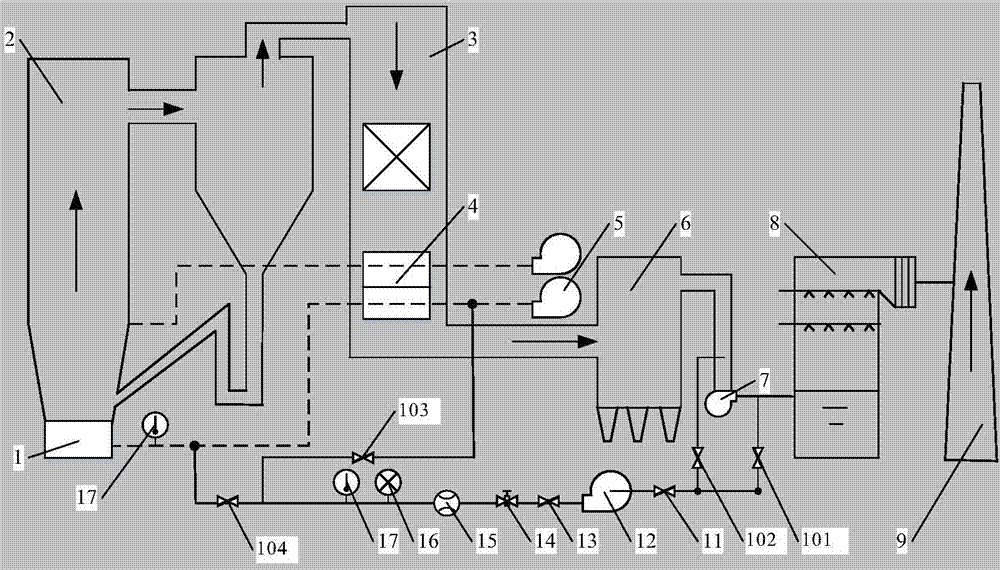
Flue gas recirculation method and flue gas recirculation system capable of reducing NOx emission of circulating fluidized bed boiler
PatentInactiveCN106969351A
Innovation
- The low-temperature flue gas after dust removal is supercharged and mixed with primary air to reduce the primary air volume, increase the proportion of secondary air, and reduce the generation of NOx in the furnace. The flue gas flow and temperature are adjusted through the recirculation fan and valve, and are sent to the bottom of the furnace. Air chamber to achieve low-nitrogen staged combustion.
Flue gas recirculation system for low-power solid fuel heating boilers
PatentInactivePL438249A1
Innovation
- Integration of flue gas distribution valve with temperature and oxygen content sensors for automated control of recirculation flow based on real-time combustion conditions.
- Direct introduction of recirculated flue gases above the combusted fuel in the combustion chamber to enhance mixing and combustion efficiency in low-power applications.
- Compact system design specifically tailored for low-power solid fuel heating boilers with simplified ductwork configuration.
Environmental Regulations for CFB Emission Control
Environmental regulations governing CFB emission control have evolved significantly over the past decades, driven by increasing awareness of air quality impacts and climate change concerns. The regulatory landscape encompasses multiple pollutants including sulfur dioxide, nitrogen oxides, particulate matter, mercury, and carbon dioxide emissions. These regulations directly influence the design and operation of flue gas recirculation systems in CFB boilers, as operators must achieve compliance while maintaining economic viability.
The Clean Air Act and its amendments establish the foundational framework for emission standards in the United States, with the Environmental Protection Agency setting National Emission Standards for Hazardous Air Pollutants and New Source Performance Standards. Similar regulatory structures exist globally, including the European Union's Industrial Emissions Directive and Large Combustion Plant Directive, which impose stringent limits on power plant emissions. These regulations typically specify maximum allowable emission rates, monitoring requirements, and compliance demonstration protocols.
Recent regulatory trends emphasize increasingly stringent emission limits and expanded pollutant coverage. The Mercury and Air Toxics Standards represent a significant milestone, requiring substantial reductions in mercury, acid gases, and organic air toxics from power plants. Additionally, carbon dioxide regulations under various climate policies are reshaping operational strategies, making efficient combustion and emission control technologies more critical than ever.
Compliance with these regulations necessitates sophisticated emission control strategies where flue gas recirculation plays a crucial role. FGR systems must be optimized to reduce NOx formation while ensuring other pollutant control systems, such as fabric filters and scrubbers, continue operating effectively. The regulatory framework also influences the economic justification for FGR optimization projects, as non-compliance penalties can be substantial.
Future regulatory developments are expected to impose even stricter emission limits, particularly for greenhouse gases and fine particulate matter. This regulatory trajectory underscores the importance of developing advanced FGR optimization techniques that can adapt to evolving compliance requirements while maintaining operational flexibility and economic competitiveness in the power generation sector.
The Clean Air Act and its amendments establish the foundational framework for emission standards in the United States, with the Environmental Protection Agency setting National Emission Standards for Hazardous Air Pollutants and New Source Performance Standards. Similar regulatory structures exist globally, including the European Union's Industrial Emissions Directive and Large Combustion Plant Directive, which impose stringent limits on power plant emissions. These regulations typically specify maximum allowable emission rates, monitoring requirements, and compliance demonstration protocols.
Recent regulatory trends emphasize increasingly stringent emission limits and expanded pollutant coverage. The Mercury and Air Toxics Standards represent a significant milestone, requiring substantial reductions in mercury, acid gases, and organic air toxics from power plants. Additionally, carbon dioxide regulations under various climate policies are reshaping operational strategies, making efficient combustion and emission control technologies more critical than ever.
Compliance with these regulations necessitates sophisticated emission control strategies where flue gas recirculation plays a crucial role. FGR systems must be optimized to reduce NOx formation while ensuring other pollutant control systems, such as fabric filters and scrubbers, continue operating effectively. The regulatory framework also influences the economic justification for FGR optimization projects, as non-compliance penalties can be substantial.
Future regulatory developments are expected to impose even stricter emission limits, particularly for greenhouse gases and fine particulate matter. This regulatory trajectory underscores the importance of developing advanced FGR optimization techniques that can adapt to evolving compliance requirements while maintaining operational flexibility and economic competitiveness in the power generation sector.
Energy Efficiency Standards for Industrial Boilers
Energy efficiency standards for industrial boilers have become increasingly stringent worldwide, driving significant technological advancements in flue gas recirculation optimization for circulating fluidized bed (CFB) boilers. The European Union's Industrial Emissions Directive sets minimum efficiency requirements of 87-91% for new industrial boilers, while the United States EPA's Boiler MACT standards mandate specific efficiency thresholds based on fuel type and capacity.
China's GB 24500-2020 standard establishes comprehensive energy efficiency grades for industrial boilers, with Grade 1 efficiency requirements reaching 88-92% depending on boiler type and capacity. These standards directly impact CFB boiler design, particularly in flue gas recirculation systems where optimized heat recovery can contribute 3-5% efficiency improvements.
The International Energy Agency's industrial decarbonization roadmap emphasizes boiler efficiency as a critical pathway to reducing industrial emissions by 2030. This regulatory framework has accelerated adoption of advanced flue gas recirculation technologies, including variable-speed fans, intelligent damper control systems, and integrated heat recovery units.
Recent updates to ASME PTC 4-2013 testing codes provide standardized methodologies for measuring efficiency gains from flue gas recirculation optimization. These protocols enable accurate assessment of compliance with emerging standards that require real-time efficiency monitoring and reporting.
Regional variations in standards create diverse market drivers. European markets prioritize NOx reduction alongside efficiency, favoring selective non-catalytic reduction integrated with optimized recirculation. Asian markets focus primarily on thermal efficiency improvements, driving development of advanced heat exchanger configurations within recirculation loops.
Emerging standards increasingly incorporate lifecycle efficiency assessments, considering degradation patterns in recirculation system components. This shift toward dynamic efficiency requirements necessitates predictive maintenance capabilities and adaptive control algorithms in modern CFB boiler designs, fundamentally reshaping optimization strategies for flue gas recirculation systems.
China's GB 24500-2020 standard establishes comprehensive energy efficiency grades for industrial boilers, with Grade 1 efficiency requirements reaching 88-92% depending on boiler type and capacity. These standards directly impact CFB boiler design, particularly in flue gas recirculation systems where optimized heat recovery can contribute 3-5% efficiency improvements.
The International Energy Agency's industrial decarbonization roadmap emphasizes boiler efficiency as a critical pathway to reducing industrial emissions by 2030. This regulatory framework has accelerated adoption of advanced flue gas recirculation technologies, including variable-speed fans, intelligent damper control systems, and integrated heat recovery units.
Recent updates to ASME PTC 4-2013 testing codes provide standardized methodologies for measuring efficiency gains from flue gas recirculation optimization. These protocols enable accurate assessment of compliance with emerging standards that require real-time efficiency monitoring and reporting.
Regional variations in standards create diverse market drivers. European markets prioritize NOx reduction alongside efficiency, favoring selective non-catalytic reduction integrated with optimized recirculation. Asian markets focus primarily on thermal efficiency improvements, driving development of advanced heat exchanger configurations within recirculation loops.
Emerging standards increasingly incorporate lifecycle efficiency assessments, considering degradation patterns in recirculation system components. This shift toward dynamic efficiency requirements necessitates predictive maintenance capabilities and adaptive control algorithms in modern CFB boiler designs, fundamentally reshaping optimization strategies for flue gas recirculation systems.
Unlock deeper insights with Patsnap Eureka Quick Research — get a full tech report to explore trends and direct your research. Try now!
Generate Your Research Report Instantly with AI Agent
Supercharge your innovation with Patsnap Eureka AI Agent Platform!