

Comparative Efficiency of Various Hydrogen Solid Storage Materials
OCT 27, 20259 MIN READ
Generate Your Research Report Instantly with AI Agent
PatSnap Eureka helps you evaluate technical feasibility & market potential.
Hydrogen Storage Evolution and Research Objectives
Hydrogen storage has evolved significantly over the past decades, transitioning from conventional high-pressure gas cylinders to more sophisticated containment systems. The journey began in the 1970s with the oil crisis, which sparked interest in hydrogen as an alternative energy carrier. Early research focused primarily on physical storage methods such as compression and liquefaction, which remain relevant but face efficiency limitations due to energy-intensive processes and safety concerns.
The 1990s marked a pivotal shift toward solid-state storage materials, initially centered on metal hydrides like LaNi5 and TiFe. These materials offered improved volumetric density but suffered from weight penalties and thermal management challenges. By the early 2000s, complex hydrides including alanates and borohydrides emerged as promising candidates, offering higher gravimetric capacities but requiring significant activation energy for hydrogen release.
Carbon-based materials entered the spotlight in the mid-2000s, with research on carbon nanotubes, graphene, and metal-organic frameworks (MOFs) demonstrating potential for physisorption-based storage. These materials benefit from fast kinetics and reversibility but typically require cryogenic temperatures to achieve meaningful storage capacities, limiting practical applications.
Recent advancements have focused on hybrid systems and nanoscale engineering of materials. Nanostructured materials with tailored pore architectures and surface functionalization have shown enhanced sorption properties. Additionally, chemical hydrogen carriers like ammonia borane and liquid organic hydrogen carriers (LOHCs) have gained attention for their high hydrogen content and relative stability under ambient conditions.
The current research landscape is driven by ambitious targets established by organizations such as the U.S. Department of Energy, which aims for systems achieving 6.5 wt% gravimetric capacity and 50 g/L volumetric capacity by 2025. These benchmarks represent the minimum thresholds for competitive hydrogen storage in transportation applications, particularly for fuel cell electric vehicles.
Our research objectives focus on comparative analysis of various solid storage materials across multiple performance metrics: gravimetric and volumetric capacity, operating temperature and pressure conditions, cycling stability, kinetics of hydrogen absorption/desorption, and system-level energy efficiency. We aim to identify materials that offer the optimal balance between theoretical capacity and practical implementation challenges, with particular emphasis on room-temperature operation and rapid refueling capabilities.
Additionally, we seek to develop standardized testing protocols that enable fair comparison between different material classes, accounting for both intrinsic material properties and engineering considerations in scaled systems. This holistic approach will provide valuable insights for strategic R&D investment and accelerate the development of commercially viable hydrogen storage solutions.
The 1990s marked a pivotal shift toward solid-state storage materials, initially centered on metal hydrides like LaNi5 and TiFe. These materials offered improved volumetric density but suffered from weight penalties and thermal management challenges. By the early 2000s, complex hydrides including alanates and borohydrides emerged as promising candidates, offering higher gravimetric capacities but requiring significant activation energy for hydrogen release.
Carbon-based materials entered the spotlight in the mid-2000s, with research on carbon nanotubes, graphene, and metal-organic frameworks (MOFs) demonstrating potential for physisorption-based storage. These materials benefit from fast kinetics and reversibility but typically require cryogenic temperatures to achieve meaningful storage capacities, limiting practical applications.
Recent advancements have focused on hybrid systems and nanoscale engineering of materials. Nanostructured materials with tailored pore architectures and surface functionalization have shown enhanced sorption properties. Additionally, chemical hydrogen carriers like ammonia borane and liquid organic hydrogen carriers (LOHCs) have gained attention for their high hydrogen content and relative stability under ambient conditions.
The current research landscape is driven by ambitious targets established by organizations such as the U.S. Department of Energy, which aims for systems achieving 6.5 wt% gravimetric capacity and 50 g/L volumetric capacity by 2025. These benchmarks represent the minimum thresholds for competitive hydrogen storage in transportation applications, particularly for fuel cell electric vehicles.
Our research objectives focus on comparative analysis of various solid storage materials across multiple performance metrics: gravimetric and volumetric capacity, operating temperature and pressure conditions, cycling stability, kinetics of hydrogen absorption/desorption, and system-level energy efficiency. We aim to identify materials that offer the optimal balance between theoretical capacity and practical implementation challenges, with particular emphasis on room-temperature operation and rapid refueling capabilities.
Additionally, we seek to develop standardized testing protocols that enable fair comparison between different material classes, accounting for both intrinsic material properties and engineering considerations in scaled systems. This holistic approach will provide valuable insights for strategic R&D investment and accelerate the development of commercially viable hydrogen storage solutions.
Market Analysis for Hydrogen Storage Solutions
The hydrogen storage market is experiencing significant growth driven by the global transition towards clean energy solutions. Current market valuation stands at approximately 213 million USD in 2023, with projections indicating a compound annual growth rate (CAGR) of 11.3% through 2030. This expansion is primarily fueled by increasing investments in hydrogen infrastructure and the growing adoption of fuel cell technologies across various sectors.
Transportation represents the largest market segment, accounting for roughly 45% of the total hydrogen storage demand. The automotive industry's shift towards fuel cell electric vehicles (FCEVs) is creating substantial demand for efficient hydrogen storage solutions, particularly in regions with established hydrogen refueling infrastructure such as Japan, South Korea, Germany, and California.
Industrial applications constitute the second-largest market segment at 30%, where hydrogen is increasingly utilized for power generation, chemical processing, and as a feedstock for various industrial processes. The remaining market share is distributed among stationary power, portable power, and emerging applications.
Geographically, Asia-Pacific leads the market with approximately 40% share, driven by aggressive hydrogen adoption policies in Japan, South Korea, and China. Europe follows at 35%, with North America accounting for 20% of the global market. The remaining 5% is distributed across other regions, with notable growth potential in the Middle East due to increasing investments in green hydrogen production.
The competitive landscape for hydrogen storage solutions is characterized by a mix of established industrial gas companies, specialized material science firms, and emerging startups. Key market players include Air Liquide, Linde plc, Hexagon Composites, Worthington Industries, and Pragma Industries, collectively controlling about 65% of the market share.
Customer demand is increasingly focused on storage solutions that offer higher volumetric and gravimetric densities, improved safety profiles, and cost-effectiveness. End-users are willing to pay premium prices for storage materials that demonstrate superior performance metrics, particularly in terms of hydrogen capacity, cycling stability, and operational temperature ranges.
Market barriers include high costs associated with advanced storage materials, technical challenges related to hydrogen embrittlement and leakage, and the lack of standardized testing protocols for comparing different storage technologies. Additionally, the underdeveloped hydrogen distribution infrastructure in many regions limits market penetration and commercial viability of various storage solutions.
Transportation represents the largest market segment, accounting for roughly 45% of the total hydrogen storage demand. The automotive industry's shift towards fuel cell electric vehicles (FCEVs) is creating substantial demand for efficient hydrogen storage solutions, particularly in regions with established hydrogen refueling infrastructure such as Japan, South Korea, Germany, and California.
Industrial applications constitute the second-largest market segment at 30%, where hydrogen is increasingly utilized for power generation, chemical processing, and as a feedstock for various industrial processes. The remaining market share is distributed among stationary power, portable power, and emerging applications.
Geographically, Asia-Pacific leads the market with approximately 40% share, driven by aggressive hydrogen adoption policies in Japan, South Korea, and China. Europe follows at 35%, with North America accounting for 20% of the global market. The remaining 5% is distributed across other regions, with notable growth potential in the Middle East due to increasing investments in green hydrogen production.
The competitive landscape for hydrogen storage solutions is characterized by a mix of established industrial gas companies, specialized material science firms, and emerging startups. Key market players include Air Liquide, Linde plc, Hexagon Composites, Worthington Industries, and Pragma Industries, collectively controlling about 65% of the market share.
Customer demand is increasingly focused on storage solutions that offer higher volumetric and gravimetric densities, improved safety profiles, and cost-effectiveness. End-users are willing to pay premium prices for storage materials that demonstrate superior performance metrics, particularly in terms of hydrogen capacity, cycling stability, and operational temperature ranges.
Market barriers include high costs associated with advanced storage materials, technical challenges related to hydrogen embrittlement and leakage, and the lack of standardized testing protocols for comparing different storage technologies. Additionally, the underdeveloped hydrogen distribution infrastructure in many regions limits market penetration and commercial viability of various storage solutions.
Current Landscape and Barriers in Solid Storage Materials
The current landscape of hydrogen solid storage materials is characterized by diverse research efforts across multiple material categories, each with distinct advantages and limitations. Metal hydrides, including complex hydrides and intermetallic compounds, demonstrate high volumetric hydrogen density but often suffer from slow kinetics and high operating temperatures. Notable examples include MgH2 with theoretical capacity of 7.6 wt%, which requires temperatures above 300°C for practical desorption rates.
Chemical hydrides, particularly borohydrides like NaBH4, offer impressive gravimetric capacities exceeding 10 wt% but face significant challenges in reversibility and controlled hydrogen release. These materials typically undergo irreversible dehydrogenation, limiting their practical application in systems requiring multiple charge-discharge cycles.
Carbon-based materials, including activated carbons, carbon nanotubes, and graphene derivatives, present advantages in weight, cost, and kinetics but struggle with low volumetric storage capacity at ambient conditions. Even optimized carbon structures rarely exceed 2-3 wt% hydrogen storage at room temperature and moderate pressures.
Metal-organic frameworks (MOFs) have emerged as promising candidates due to their tunable pore structures and high surface areas exceeding 6000 m²/g. However, most MOFs achieve practical storage capacities of only 1-2 wt% at ambient conditions, significantly below DOE targets for vehicular applications.
The primary technical barriers across all material classes include insufficient gravimetric and volumetric capacities at practical operating conditions, poor thermodynamics requiring either high temperatures or pressures, inadequate cycling stability, and slow kinetics. Materials demonstrating high theoretical capacities often require impractical operating conditions, while those functioning at ambient conditions typically show insufficient storage capacity.
Heat management represents another significant challenge, as hydrogen adsorption/desorption processes are typically accompanied by substantial enthalpy changes. This necessitates complex thermal management systems that add weight, volume, and complexity to storage systems.
Material cost and availability present additional barriers, particularly for systems utilizing precious metals or complex synthesis procedures. Scalability remains problematic, with many high-performing materials demonstrated only at laboratory scale with synthesis methods ill-suited for industrial production.
Safety concerns persist across material classes, including pyrophoricity of some metal hydrides, toxicity of certain chemical hydrides, and potential dust explosion hazards with nanomaterials. These issues necessitate additional containment and handling protocols that further complicate system design and implementation.
Chemical hydrides, particularly borohydrides like NaBH4, offer impressive gravimetric capacities exceeding 10 wt% but face significant challenges in reversibility and controlled hydrogen release. These materials typically undergo irreversible dehydrogenation, limiting their practical application in systems requiring multiple charge-discharge cycles.
Carbon-based materials, including activated carbons, carbon nanotubes, and graphene derivatives, present advantages in weight, cost, and kinetics but struggle with low volumetric storage capacity at ambient conditions. Even optimized carbon structures rarely exceed 2-3 wt% hydrogen storage at room temperature and moderate pressures.
Metal-organic frameworks (MOFs) have emerged as promising candidates due to their tunable pore structures and high surface areas exceeding 6000 m²/g. However, most MOFs achieve practical storage capacities of only 1-2 wt% at ambient conditions, significantly below DOE targets for vehicular applications.
The primary technical barriers across all material classes include insufficient gravimetric and volumetric capacities at practical operating conditions, poor thermodynamics requiring either high temperatures or pressures, inadequate cycling stability, and slow kinetics. Materials demonstrating high theoretical capacities often require impractical operating conditions, while those functioning at ambient conditions typically show insufficient storage capacity.
Heat management represents another significant challenge, as hydrogen adsorption/desorption processes are typically accompanied by substantial enthalpy changes. This necessitates complex thermal management systems that add weight, volume, and complexity to storage systems.
Material cost and availability present additional barriers, particularly for systems utilizing precious metals or complex synthesis procedures. Scalability remains problematic, with many high-performing materials demonstrated only at laboratory scale with synthesis methods ill-suited for industrial production.
Safety concerns persist across material classes, including pyrophoricity of some metal hydrides, toxicity of certain chemical hydrides, and potential dust explosion hazards with nanomaterials. These issues necessitate additional containment and handling protocols that further complicate system design and implementation.
Comparative Analysis of Existing Solid Storage Materials
01 Metal hydride materials for hydrogen storage
Metal hydrides are promising materials for solid-state hydrogen storage due to their high volumetric hydrogen density. These materials form chemical bonds with hydrogen, allowing for efficient storage and release under appropriate temperature and pressure conditions. Various metal hydride compositions have been developed to optimize hydrogen storage capacity, kinetics, and thermodynamic properties, making them suitable for different applications including fuel cells and portable power systems.- Metal hydride-based storage materials: Metal hydrides are promising materials for solid hydrogen storage due to their high volumetric hydrogen density. These materials form chemical bonds with hydrogen atoms, allowing for efficient storage and release under appropriate temperature and pressure conditions. Various metal hydrides, including magnesium-based alloys and complex hydrides, have been developed to improve storage capacity and kinetics while reducing operating temperatures and pressures for practical applications.
- Carbon-based hydrogen storage materials: Carbon-based materials such as activated carbon, carbon nanotubes, and graphene have been investigated for hydrogen storage applications. These materials store hydrogen through physical adsorption (physisorption) mechanisms, offering advantages including lightweight properties, fast kinetics, and good cycling stability. Research focuses on increasing the specific surface area and optimizing pore structures to enhance hydrogen storage capacity and efficiency at practical operating conditions.
- Metal-organic frameworks (MOFs) for hydrogen storage: Metal-organic frameworks represent a class of porous crystalline materials with exceptionally high surface areas and tunable pore structures. These characteristics make MOFs promising candidates for hydrogen storage through physisorption mechanisms. By modifying the metal centers and organic linkers, researchers can optimize hydrogen binding energies and storage capacities. Recent developments focus on enhancing room-temperature storage performance and improving the volumetric efficiency of MOF-based storage systems.
- Composite and catalytically enhanced storage materials: Composite hydrogen storage materials combine different storage mechanisms or materials to overcome limitations of individual components. These may include metal hydride-carbon composites, catalyst-doped systems, or nanostructured materials. The addition of catalysts significantly improves hydrogen absorption/desorption kinetics and can lower operating temperatures. Nanostructuring techniques further enhance performance by shortening diffusion paths and increasing active surface areas for hydrogen interaction.
- System design and efficiency optimization: Beyond material development, system-level design plays a crucial role in optimizing hydrogen storage efficiency. This includes thermal management systems to handle heat released during hydrogen absorption, pressure control mechanisms, and integration with fuel cells or other end-use applications. Advanced engineering approaches focus on weight reduction, volume optimization, and energy-efficient hydrogen charging and discharging processes to maximize overall system performance for practical applications in transportation and stationary power generation.
02 Carbon-based hydrogen storage materials
Carbon-based materials such as graphene, carbon nanotubes, and activated carbon offer advantages for hydrogen storage due to their large surface area and lightweight properties. These materials store hydrogen through physisorption mechanisms, which can be enhanced through structural modifications and doping with other elements. Research focuses on improving the hydrogen adsorption capacity and binding energy to increase storage efficiency at practical operating conditions.Expand Specific Solutions03 Metal-organic frameworks for hydrogen storage
Metal-organic frameworks (MOFs) represent a class of porous materials with exceptionally high surface areas that can effectively store hydrogen. Their modular structure allows for tuning of pore size, surface area, and chemical functionality to optimize hydrogen uptake. Recent advances focus on improving the hydrogen binding affinity through metal site engineering and framework modifications to enhance storage capacity and efficiency at ambient conditions.Expand Specific Solutions04 Catalysts for improving hydrogen storage efficiency
Catalysts play a crucial role in enhancing the kinetics of hydrogen absorption and desorption processes in solid storage materials. Various catalytic materials, including transition metals, metal oxides, and nanostructured composites, can significantly reduce the activation energy required for hydrogen uptake and release. These catalysts improve cycling performance, reduce operating temperatures, and increase the overall efficiency of hydrogen storage systems.Expand Specific Solutions05 Composite hydrogen storage systems
Composite hydrogen storage materials combine different storage mechanisms to overcome limitations of single-material approaches. These systems often integrate metal hydrides with carbon materials, polymers, or other supporting structures to enhance both gravimetric and volumetric storage capacities. The synergistic effects between components can improve thermal management, reaction kinetics, and cycling stability, leading to more efficient and practical hydrogen storage solutions for various applications.Expand Specific Solutions
Leading Organizations in Hydrogen Storage Research
The hydrogen solid storage materials market is in a growth phase, characterized by increasing investments in sustainable energy solutions. Market size is expanding due to rising demand for clean energy storage, particularly in automotive applications. Technologically, the field shows varied maturity levels across different storage solutions. Leading automotive manufacturers like Hyundai, Kia, Nissan, Toyota, and Mercedes-Benz are driving commercial applications, while research institutions such as Zhejiang University, Northwestern Polytechnical University, and EPFL are advancing fundamental technologies. Specialized companies like GRZ Technologies and Hydrexia are developing proprietary storage systems based on metal alloys and advanced materials, indicating a competitive landscape balanced between established industrial players and innovative technology developers focused on improving storage efficiency and capacity.
GRZ Technologies SA
Technical Solution: GRZ Technologies has developed a proprietary metal hydride-based solid-state hydrogen storage system that operates at moderate pressures (30-50 bar) and near-ambient temperatures. Their technology utilizes specialized titanium-iron (TiFe) alloys modified with transition metal additives to achieve rapid absorption/desorption kinetics while maintaining stability over thousands of cycles[1]. The company's innovation lies in their unique material processing techniques that create optimized particle morphologies with enhanced surface areas and reduced diffusion distances. GRZ's systems achieve volumetric hydrogen densities exceeding 100 kg/m³, significantly higher than compressed hydrogen at comparable pressures[2]. Their modular design allows for scalable implementation from small portable units to large stationary storage facilities. The technology incorporates advanced heat management systems using integrated heat exchangers that efficiently control the exothermic absorption and endothermic desorption processes, enabling rapid charging and discharging rates without performance degradation[3].
Strengths: Operates at moderate pressures and near-ambient temperatures; achieves high volumetric storage density; demonstrates excellent cycling stability with minimal capacity loss; modular and scalable design. Weaknesses: Higher system weight compared to carbon-based materials; requires precise thermal management during charging/discharging; higher initial cost compared to conventional storage methods.
Mercedes-Benz Group AG
Technical Solution: Mercedes-Benz has developed an advanced hydrogen storage system utilizing complex metal hydrides, specifically focusing on sodium alanate (NaAlH4) materials enhanced with titanium-based catalysts. Their proprietary technology achieves hydrogen storage capacities of approximately 5.5 wt% with significantly improved kinetics compared to conventional metal hydrides[1]. Mercedes-Benz's innovation lies in their multi-component system architecture that combines different hydride materials with complementary properties to optimize both gravimetric capacity and operating conditions. Their system employs a sophisticated thermal management approach with integrated heat exchangers that utilize waste heat from the fuel cell to drive hydrogen desorption, creating a more energy-efficient overall system. The company has engineered specialized nanostructured materials with controlled porosity to enhance hydrogen diffusion pathways while maintaining structural integrity during cycling. Mercedes-Benz's storage technology operates at moderate pressures (20-50 bar) and temperatures (80-150°C), making it compatible with automotive applications while providing volumetric hydrogen densities approximately 50% higher than 700 bar compressed hydrogen systems[2].
Strengths: Higher volumetric storage density than compressed hydrogen; operates at moderate pressures enhancing safety; utilizes waste heat from fuel cell for improved system efficiency; maintains stable performance over numerous cycles. Weaknesses: Lower gravimetric capacity compared to some competing technologies; requires thermal management systems adding complexity; higher cost due to specialized materials and manufacturing processes.
Key Patents and Breakthroughs in Storage Efficiency
Hydrogen storage material
PatentActiveUS20210009409A1
Innovation
- Development of a hydrogenated sp2 carbon allotrope, specifically graphane, which offers high gravimetric and volumetric hydrogen storage densities, allowing for safe and efficient release of hydrogen gas, eliminating the need for heavy pressure vessels and reducing safety risks through thermal or microwave-induced hydrogen release.


Hydrogen storage material, hydrogen storage container and hydrogen supply apparatus
PatentPendingUS20240034622A1
Innovation
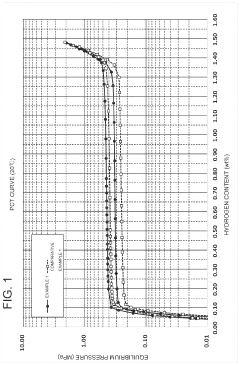
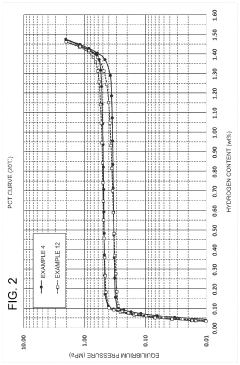
- Alloys with a specific elemental composition represented by LaaCebSmcNidMe, where M is Mn or Co, and specific atomic ratios of La, Ce, Sm, Ni, and M, which reduce hysteresis and enhance hydrogen storage capacity and desorption properties.
Safety and Stability Considerations in Material Selection
When selecting hydrogen storage materials, safety and stability considerations are paramount due to hydrogen's flammability and the potential for uncontrolled release. Different solid storage materials present varying safety profiles that must be thoroughly evaluated before implementation in commercial applications.
Metal hydrides generally offer excellent safety characteristics compared to compressed or liquid hydrogen storage. Materials like LaNi5 and TiFe exhibit stable hydrogen retention under normal conditions, with minimal risk of spontaneous release. However, these materials can generate significant heat during the absorption process, requiring robust thermal management systems to prevent overheating and potential structural damage to containment vessels.
Complex hydrides, including alanates (NaAlH4) and borohydrides (LiBH4), present unique safety challenges due to their high reactivity with moisture and air. Exposure to these elements can lead to rapid hydrogen release and, in some cases, pyrophoric reactions. Consequently, handling and storage systems for these materials must incorporate sophisticated moisture barriers and inert atmosphere controls, significantly increasing system complexity and cost.
Carbon-based materials such as activated carbon and carbon nanotubes demonstrate favorable safety profiles with minimal reactivity concerns. Their primary advantage lies in their chemical stability across a wide temperature range and resistance to degradation upon cycling. However, their relatively low volumetric storage capacity necessitates larger storage systems, potentially introducing different safety considerations related to system size and integration.
Stability during cycling represents another critical selection factor. Metal organic frameworks (MOFs), while promising for their high surface area and tunable properties, often suffer from structural degradation after repeated hydrogen absorption-desorption cycles. This degradation can lead to unpredictable hydrogen release patterns and diminished storage capacity over time, raising reliability concerns for long-term applications.
Temperature stability varies significantly among materials. While some metal hydrides remain stable only within narrow temperature ranges, materials like certain palladium-based alloys maintain consistent performance across broader temperature spectrums, making them suitable for applications with variable operating conditions. However, this enhanced stability typically comes with higher material costs and lower gravimetric capacity.
Mechanical stability under pressure cycling must also be considered, particularly for materials that undergo significant volume changes during hydrogen absorption and desorption. These volume changes can lead to particle fragmentation, reducing effective surface area and ultimately compromising system performance and safety over time.
Metal hydrides generally offer excellent safety characteristics compared to compressed or liquid hydrogen storage. Materials like LaNi5 and TiFe exhibit stable hydrogen retention under normal conditions, with minimal risk of spontaneous release. However, these materials can generate significant heat during the absorption process, requiring robust thermal management systems to prevent overheating and potential structural damage to containment vessels.
Complex hydrides, including alanates (NaAlH4) and borohydrides (LiBH4), present unique safety challenges due to their high reactivity with moisture and air. Exposure to these elements can lead to rapid hydrogen release and, in some cases, pyrophoric reactions. Consequently, handling and storage systems for these materials must incorporate sophisticated moisture barriers and inert atmosphere controls, significantly increasing system complexity and cost.
Carbon-based materials such as activated carbon and carbon nanotubes demonstrate favorable safety profiles with minimal reactivity concerns. Their primary advantage lies in their chemical stability across a wide temperature range and resistance to degradation upon cycling. However, their relatively low volumetric storage capacity necessitates larger storage systems, potentially introducing different safety considerations related to system size and integration.
Stability during cycling represents another critical selection factor. Metal organic frameworks (MOFs), while promising for their high surface area and tunable properties, often suffer from structural degradation after repeated hydrogen absorption-desorption cycles. This degradation can lead to unpredictable hydrogen release patterns and diminished storage capacity over time, raising reliability concerns for long-term applications.
Temperature stability varies significantly among materials. While some metal hydrides remain stable only within narrow temperature ranges, materials like certain palladium-based alloys maintain consistent performance across broader temperature spectrums, making them suitable for applications with variable operating conditions. However, this enhanced stability typically comes with higher material costs and lower gravimetric capacity.
Mechanical stability under pressure cycling must also be considered, particularly for materials that undergo significant volume changes during hydrogen absorption and desorption. These volume changes can lead to particle fragmentation, reducing effective surface area and ultimately compromising system performance and safety over time.
Environmental Impact and Sustainability Assessment
The environmental impact of hydrogen solid storage materials extends beyond their technical efficiency, encompassing their entire lifecycle from production to disposal. Metal hydrides, while offering high storage capacity, often require energy-intensive manufacturing processes that generate significant carbon emissions. The extraction of rare earth elements for certain complex hydrides raises concerns about habitat destruction, water pollution, and ecosystem disruption in mining regions.
Carbon-based materials present a more environmentally favorable profile during production, particularly when derived from sustainable biomass sources. However, the activation processes for some carbon nanostructures involve harsh chemicals that may pose environmental risks if not properly managed. Metal-organic frameworks (MOFs) generally demonstrate lower environmental impact during synthesis compared to metal hydrides, though the long-term stability and degradation pathways of these materials remain inadequately understood.
From a sustainability perspective, material recyclability emerges as a critical factor. Metal hydrides typically offer excellent recyclability potential, with recovery rates exceeding 90% for some systems, significantly reducing their lifetime environmental footprint. Conversely, composite materials often present recycling challenges due to their heterogeneous composition, potentially limiting their long-term sustainability despite favorable storage characteristics.
Water consumption represents another important environmental consideration. Hydrolysis-based hydrogen release systems, while technically efficient, can place substantial demands on water resources in water-scarce regions. This concern is particularly relevant for portable applications where water availability cannot be guaranteed, potentially limiting deployment in arid environments.
Energy return on investment (EROI) calculations reveal significant variations among storage materials. Advanced borohydrides demonstrate promising theoretical EROI values but suffer from energy-intensive regeneration processes that currently limit their practical sustainability. Meanwhile, carbon-based materials generally offer more favorable EROI metrics when considering full lifecycle analysis, despite their typically lower gravimetric capacities.
Regulatory frameworks increasingly emphasize environmental performance alongside technical specifications. The European Union's REACH regulations and similar global initiatives are driving manufacturers toward materials with reduced environmental hazards. This regulatory landscape is accelerating research into environmentally benign catalysts and additives that can enhance hydrogen storage performance without introducing persistent environmental contaminants.
Carbon-based materials present a more environmentally favorable profile during production, particularly when derived from sustainable biomass sources. However, the activation processes for some carbon nanostructures involve harsh chemicals that may pose environmental risks if not properly managed. Metal-organic frameworks (MOFs) generally demonstrate lower environmental impact during synthesis compared to metal hydrides, though the long-term stability and degradation pathways of these materials remain inadequately understood.
From a sustainability perspective, material recyclability emerges as a critical factor. Metal hydrides typically offer excellent recyclability potential, with recovery rates exceeding 90% for some systems, significantly reducing their lifetime environmental footprint. Conversely, composite materials often present recycling challenges due to their heterogeneous composition, potentially limiting their long-term sustainability despite favorable storage characteristics.
Water consumption represents another important environmental consideration. Hydrolysis-based hydrogen release systems, while technically efficient, can place substantial demands on water resources in water-scarce regions. This concern is particularly relevant for portable applications where water availability cannot be guaranteed, potentially limiting deployment in arid environments.
Energy return on investment (EROI) calculations reveal significant variations among storage materials. Advanced borohydrides demonstrate promising theoretical EROI values but suffer from energy-intensive regeneration processes that currently limit their practical sustainability. Meanwhile, carbon-based materials generally offer more favorable EROI metrics when considering full lifecycle analysis, despite their typically lower gravimetric capacities.
Regulatory frameworks increasingly emphasize environmental performance alongside technical specifications. The European Union's REACH regulations and similar global initiatives are driving manufacturers toward materials with reduced environmental hazards. This regulatory landscape is accelerating research into environmentally benign catalysts and additives that can enhance hydrogen storage performance without introducing persistent environmental contaminants.
Unlock deeper insights with PatSnap Eureka Quick Research — get a full tech report to explore trends and direct your research. Try now!
Generate Your Research Report Instantly with AI Agent
Supercharge your innovation with PatSnap Eureka AI Agent Platform!