Comparing Extraction Methods: Oleoresin vs Resin Plastics
SEP 10, 20259 MIN READ
Generate Your Research Report Instantly with AI Agent
PatSnap Eureka helps you evaluate technical feasibility & market potential.
Oleoresin and Resin Extraction Technology Background
Oleoresin extraction technology dates back centuries, with traditional methods involving tapping trees to collect natural resins. The earliest documented use of oleoresins appears in ancient Egyptian civilization around 3000 BCE, where they were utilized for mummification processes and medicinal applications. Throughout history, these natural substances have been harvested from various plant species, particularly pine, spruce, and fir trees in the coniferous family.
The modern industrial extraction of oleoresins began in the early 20th century, driven by growing demand in the chemical, pharmaceutical, and food industries. Traditional extraction methods relied on physical processes such as steam distillation and solvent extraction. The 1950s marked a significant turning point with the development of supercritical fluid extraction (SFE) technology, though its commercial application for oleoresins only gained momentum in the 1980s.
In parallel, synthetic resin technology emerged in the early 1900s with the invention of Bakelite, the first fully synthetic plastic. This development initiated a divergent technological path from natural oleoresins, leading to petroleum-based resins that now dominate many industrial applications. The technological evolution of both extraction methods has been characterized by increasing efficiency, yield optimization, and environmental considerations.
Current oleoresin extraction technologies include traditional tapping methods, solvent extraction, steam distillation, and advanced techniques like supercritical CO2 extraction and microwave-assisted extraction. These methods vary significantly in terms of yield, purity, environmental impact, and economic viability. The technological trajectory shows a clear trend toward greener extraction methods that minimize solvent use and reduce energy consumption.
Synthetic resin production, conversely, has evolved from thermosetting plastics to a diverse range of thermoplastic materials with customizable properties. Recent technological developments have focused on bio-based alternatives to petroleum-derived resins, creating a convergence point with natural oleoresin technology.
The current technological landscape is characterized by increasing interest in sustainable extraction and production methods. Research is actively focused on improving extraction efficiency while reducing environmental footprint, developing bio-based alternatives to synthetic resins, and exploring novel applications for both oleoresins and synthetic resins in advanced materials, pharmaceuticals, and food industries.
This technological evolution is driven by growing consumer demand for natural products, stringent environmental regulations, and the need for sustainable material sources in a carbon-constrained economy. The future trajectory points toward hybrid technologies that combine the best aspects of both natural oleoresin extraction and synthetic resin production.
The modern industrial extraction of oleoresins began in the early 20th century, driven by growing demand in the chemical, pharmaceutical, and food industries. Traditional extraction methods relied on physical processes such as steam distillation and solvent extraction. The 1950s marked a significant turning point with the development of supercritical fluid extraction (SFE) technology, though its commercial application for oleoresins only gained momentum in the 1980s.
In parallel, synthetic resin technology emerged in the early 1900s with the invention of Bakelite, the first fully synthetic plastic. This development initiated a divergent technological path from natural oleoresins, leading to petroleum-based resins that now dominate many industrial applications. The technological evolution of both extraction methods has been characterized by increasing efficiency, yield optimization, and environmental considerations.
Current oleoresin extraction technologies include traditional tapping methods, solvent extraction, steam distillation, and advanced techniques like supercritical CO2 extraction and microwave-assisted extraction. These methods vary significantly in terms of yield, purity, environmental impact, and economic viability. The technological trajectory shows a clear trend toward greener extraction methods that minimize solvent use and reduce energy consumption.
Synthetic resin production, conversely, has evolved from thermosetting plastics to a diverse range of thermoplastic materials with customizable properties. Recent technological developments have focused on bio-based alternatives to petroleum-derived resins, creating a convergence point with natural oleoresin technology.
The current technological landscape is characterized by increasing interest in sustainable extraction and production methods. Research is actively focused on improving extraction efficiency while reducing environmental footprint, developing bio-based alternatives to synthetic resins, and exploring novel applications for both oleoresins and synthetic resins in advanced materials, pharmaceuticals, and food industries.
This technological evolution is driven by growing consumer demand for natural products, stringent environmental regulations, and the need for sustainable material sources in a carbon-constrained economy. The future trajectory points toward hybrid technologies that combine the best aspects of both natural oleoresin extraction and synthetic resin production.
Market Analysis of Oleoresin and Resin Plastic Products
The global market for oleoresin and resin plastic products has experienced significant growth over the past decade, driven by increasing demand across multiple industries including food and beverages, pharmaceuticals, cosmetics, packaging, and construction. The oleoresin market, valued at approximately $1.7 billion in 2022, is projected to reach $2.5 billion by 2028, growing at a CAGR of 6.8%. This growth is primarily attributed to the rising consumer preference for natural ingredients and clean-label products.
Geographically, Asia-Pacific dominates the oleoresin market, accounting for over 40% of global production, with India and China being the largest producers. North America and Europe follow closely, with increasing adoption in premium food products and pharmaceuticals. The market is characterized by fragmentation, with numerous small and medium-sized producers competing alongside multinational corporations.
In contrast, the resin plastics market presents a substantially larger economic footprint, valued at $456 billion in 2022, with projections to reach $627 billion by 2028 at a CAGR of 5.4%. Polyethylene, polypropylene, and polyvinyl chloride constitute the largest segments within this market. The packaging industry remains the primary consumer of resin plastics, followed by construction, automotive, and electronics sectors.
Consumer trends significantly impact both markets. For oleoresins, the growing demand for natural, sustainable products has created premium market segments, particularly in developed economies. The food industry's shift toward clean-label ingredients has accelerated oleoresin adoption as natural colorants and flavoring agents. Pharmaceutical applications have also expanded, with oleoresins increasingly utilized in nutraceuticals and traditional medicine formulations.
The resin plastics market faces mounting pressure from environmental concerns and regulatory changes. Sustainability initiatives and plastic waste reduction policies have prompted industry-wide innovation in biodegradable and recyclable alternatives. Bio-based resins derived from renewable resources represent the fastest-growing segment, expanding at 10.2% annually.
Price sensitivity varies significantly between these markets. Oleoresins command premium pricing due to labor-intensive extraction processes and natural sourcing limitations. Market prices fluctuate based on agricultural conditions, harvest yields, and geopolitical factors affecting major producing regions. Resin plastics, being petroleum derivatives, experience price volatility correlated with crude oil markets, though economies of scale generally enable more competitive pricing.
The competitive landscape reveals distinct patterns. The oleoresin market features specialized producers with expertise in specific botanical extractions, while the resin plastics industry is dominated by petrochemical giants with integrated supply chains. Cross-industry partnerships are emerging as manufacturers seek to develop hybrid solutions combining the performance benefits of synthetic resins with the sustainability advantages of natural oleoresins.
Geographically, Asia-Pacific dominates the oleoresin market, accounting for over 40% of global production, with India and China being the largest producers. North America and Europe follow closely, with increasing adoption in premium food products and pharmaceuticals. The market is characterized by fragmentation, with numerous small and medium-sized producers competing alongside multinational corporations.
In contrast, the resin plastics market presents a substantially larger economic footprint, valued at $456 billion in 2022, with projections to reach $627 billion by 2028 at a CAGR of 5.4%. Polyethylene, polypropylene, and polyvinyl chloride constitute the largest segments within this market. The packaging industry remains the primary consumer of resin plastics, followed by construction, automotive, and electronics sectors.
Consumer trends significantly impact both markets. For oleoresins, the growing demand for natural, sustainable products has created premium market segments, particularly in developed economies. The food industry's shift toward clean-label ingredients has accelerated oleoresin adoption as natural colorants and flavoring agents. Pharmaceutical applications have also expanded, with oleoresins increasingly utilized in nutraceuticals and traditional medicine formulations.
The resin plastics market faces mounting pressure from environmental concerns and regulatory changes. Sustainability initiatives and plastic waste reduction policies have prompted industry-wide innovation in biodegradable and recyclable alternatives. Bio-based resins derived from renewable resources represent the fastest-growing segment, expanding at 10.2% annually.
Price sensitivity varies significantly between these markets. Oleoresins command premium pricing due to labor-intensive extraction processes and natural sourcing limitations. Market prices fluctuate based on agricultural conditions, harvest yields, and geopolitical factors affecting major producing regions. Resin plastics, being petroleum derivatives, experience price volatility correlated with crude oil markets, though economies of scale generally enable more competitive pricing.
The competitive landscape reveals distinct patterns. The oleoresin market features specialized producers with expertise in specific botanical extractions, while the resin plastics industry is dominated by petrochemical giants with integrated supply chains. Cross-industry partnerships are emerging as manufacturers seek to develop hybrid solutions combining the performance benefits of synthetic resins with the sustainability advantages of natural oleoresins.
Current Extraction Methods and Technical Challenges
The extraction of oleoresins and resin plastics currently employs several established methods, each with distinct advantages and limitations. Traditional solvent extraction remains the most widely used approach for oleoresin extraction, utilizing organic solvents such as hexane, ethanol, and acetone to dissolve target compounds. This method achieves high yields but faces increasing scrutiny due to environmental concerns and potential solvent residues in final products.
Supercritical fluid extraction (SFE), particularly using CO2, has gained significant traction as a greener alternative. Operating at critical pressure and temperature conditions, supercritical CO2 penetrates plant matrices effectively while leaving no toxic residues. However, the high equipment costs and energy requirements present substantial barriers to widespread industrial adoption, especially for smaller manufacturers.
Steam distillation represents another traditional method for extracting volatile components from plant materials. While environmentally friendly and suitable for heat-stable compounds, this technique often yields lower extraction efficiencies compared to solvent-based methods and may cause thermal degradation of sensitive bioactive compounds.
For resin plastics, mechanical extraction processes dominate the industry. These involve grinding, shredding, and separation techniques to recover resins from composite materials. The efficiency varies significantly depending on the complexity of the composite structure and the purity requirements of the recovered resin.
Chemical recycling methods for resin plastics, including solvolysis and pyrolysis, have advanced considerably in recent years. These processes break down polymers into their constituent monomers or other valuable chemicals, enabling higher-value recovery compared to mechanical recycling. However, they typically require precise control of reaction conditions and face challenges in handling mixed plastic waste streams.
The primary technical challenges facing both oleoresin and resin plastic extraction include energy intensity, selectivity limitations, and scaling difficulties. Energy consumption remains a critical concern, particularly for methods requiring high temperatures or pressures. Most current extraction technologies also struggle with selectivity, often co-extracting unwanted compounds that necessitate additional purification steps.
Scale-up challenges persist across extraction methods, with laboratory successes frequently failing to translate to industrial-scale operations due to heat and mass transfer limitations. Additionally, the heterogeneity of raw materials—whether plant matrices or plastic waste—creates significant variability in extraction efficiency and product quality.
Emerging hybrid technologies combining multiple extraction principles show promise in addressing these challenges but remain in early development stages. The industry continues to seek more efficient, environmentally sustainable extraction methods that can maintain product quality while reducing operational costs and environmental impact.
Supercritical fluid extraction (SFE), particularly using CO2, has gained significant traction as a greener alternative. Operating at critical pressure and temperature conditions, supercritical CO2 penetrates plant matrices effectively while leaving no toxic residues. However, the high equipment costs and energy requirements present substantial barriers to widespread industrial adoption, especially for smaller manufacturers.
Steam distillation represents another traditional method for extracting volatile components from plant materials. While environmentally friendly and suitable for heat-stable compounds, this technique often yields lower extraction efficiencies compared to solvent-based methods and may cause thermal degradation of sensitive bioactive compounds.
For resin plastics, mechanical extraction processes dominate the industry. These involve grinding, shredding, and separation techniques to recover resins from composite materials. The efficiency varies significantly depending on the complexity of the composite structure and the purity requirements of the recovered resin.
Chemical recycling methods for resin plastics, including solvolysis and pyrolysis, have advanced considerably in recent years. These processes break down polymers into their constituent monomers or other valuable chemicals, enabling higher-value recovery compared to mechanical recycling. However, they typically require precise control of reaction conditions and face challenges in handling mixed plastic waste streams.
The primary technical challenges facing both oleoresin and resin plastic extraction include energy intensity, selectivity limitations, and scaling difficulties. Energy consumption remains a critical concern, particularly for methods requiring high temperatures or pressures. Most current extraction technologies also struggle with selectivity, often co-extracting unwanted compounds that necessitate additional purification steps.
Scale-up challenges persist across extraction methods, with laboratory successes frequently failing to translate to industrial-scale operations due to heat and mass transfer limitations. Additionally, the heterogeneity of raw materials—whether plant matrices or plastic waste—creates significant variability in extraction efficiency and product quality.
Emerging hybrid technologies combining multiple extraction principles show promise in addressing these challenges but remain in early development stages. The industry continues to seek more efficient, environmentally sustainable extraction methods that can maintain product quality while reducing operational costs and environmental impact.
Comparative Analysis of Extraction Methodologies
01 Solvent extraction methods for oleoresins
Various solvents can be used for the extraction of oleoresins from plant materials, including organic solvents like hexane, ethanol, and acetone. The choice of solvent affects the extraction efficiency and the composition of the extracted oleoresin. Different solvents have varying abilities to dissolve different components of the oleoresin, which can be optimized based on the desired end product. The extraction process typically involves soaking the plant material in the solvent, followed by filtration and solvent removal.- Solvent extraction methods for oleoresins: Various solvent extraction methods are employed to extract oleoresins from plant materials. These methods typically involve using organic solvents such as hexane, ethanol, or acetone to dissolve the oleoresin compounds. The efficiency of extraction depends on factors like solvent type, temperature, extraction time, and solvent-to-material ratio. These techniques are widely used in industrial applications due to their high extraction efficiency and ability to preserve the active compounds in the oleoresin.
- Supercritical fluid extraction for resin compounds: Supercritical fluid extraction, particularly using CO2, has emerged as an efficient method for extracting resins and oleoresins. This technique operates at high pressure and moderate temperature, allowing the supercritical fluid to penetrate plant materials and dissolve target compounds. The method offers advantages such as high selectivity, no toxic residue, and preservation of heat-sensitive compounds. The extraction efficiency can be optimized by adjusting pressure, temperature, and co-solvent addition.
- Mechanical extraction and processing techniques: Mechanical extraction methods involve physical processes such as pressing, grinding, and steam distillation to extract oleoresins and resins from plant materials. These techniques often employ specialized equipment designed to maximize yield while maintaining the quality of the extracted compounds. Mechanical methods can be combined with thermal treatments to enhance extraction efficiency. These approaches are particularly valuable for industrial-scale production where large volumes of material need to be processed.
- Novel extraction technologies for improved efficiency: Emerging technologies have been developed to enhance extraction efficiency of oleoresins and resins. These include ultrasound-assisted extraction, microwave-assisted extraction, pulsed electric field extraction, and enzyme-assisted extraction. These methods can significantly reduce extraction time, lower solvent consumption, and increase yield compared to conventional techniques. The technologies often work by disrupting cell walls or enhancing mass transfer, thereby improving the accessibility and solubility of target compounds.
- Process optimization for extraction efficiency: Various approaches to optimize extraction processes focus on improving efficiency through parameter adjustment and process design. These include optimizing extraction conditions (temperature, pressure, time), employing sequential extraction steps, recycling solvents, and implementing continuous flow systems. Statistical experimental design methods are often used to identify optimal conditions. Additionally, pre-treatment of raw materials, such as drying, grinding, or enzymatic treatment, can significantly enhance extraction efficiency by increasing surface area or breaking down cellular structures.
02 Supercritical fluid extraction for oleoresins
Supercritical fluid extraction, particularly using carbon dioxide, is an advanced method for extracting oleoresins with high efficiency. This technique operates at specific temperature and pressure conditions where CO2 exhibits properties of both liquid and gas, allowing it to penetrate plant materials effectively and dissolve target compounds. The method offers advantages such as high selectivity, no toxic residues, and preservation of heat-sensitive compounds. The extraction efficiency can be enhanced by adjusting parameters like pressure, temperature, and co-solvents.Expand Specific Solutions03 Mechanical extraction methods for resins
Mechanical extraction methods for resins involve physical processes such as pressing, grinding, and tapping to obtain resin from plant sources. These methods are often used for extracting resins from trees and other plants that produce resinous substances. The efficiency of mechanical extraction can be improved through optimized equipment design, controlled pressure application, and proper preparation of the plant material. Some processes combine mechanical extraction with heat treatment to increase the flow of resin.Expand Specific Solutions04 Extraction efficiency enhancement techniques
Various techniques can be employed to enhance the efficiency of oleoresin and resin extraction. These include ultrasonic-assisted extraction, microwave-assisted extraction, enzyme-assisted extraction, and pulsed electric field treatment. These methods can reduce extraction time, increase yield, and improve the quality of the extracted material. Optimization of parameters such as extraction time, temperature, particle size of raw material, and solvent-to-solid ratio also plays a crucial role in improving extraction efficiency.Expand Specific Solutions05 Processing and purification of extracted resins
After extraction, resins and oleoresins often require further processing and purification to obtain the desired quality and properties. This may involve filtration, centrifugation, distillation, and chromatographic techniques. The purification process removes unwanted components such as waxes, pigments, and other impurities. For resin plastics, additional processing steps may include polymerization, blending with additives, and thermal treatment to achieve specific physical and chemical properties suitable for various applications.Expand Specific Solutions
Leading Companies in Oleoresin and Resin Processing
The oleoresin vs resin plastics extraction market is currently in a growth phase, with increasing demand driven by sustainability concerns and industrial applications. The global market size is estimated to exceed $15 billion, expanding at approximately 5-7% annually. Technologically, the field shows varying maturity levels, with traditional petrochemical giants like China Petroleum & Chemical Corp. and Sinopec Beijing Research Institute leading in conventional extraction methods, while companies such as LG Chem, Sumitomo Chemical, and Mitsui Chemicals are advancing bio-based alternatives. Eastman Chemical and BASF Coatings represent significant innovation in specialty applications, while newer entrants like Full Cycle Bioplastics are pioneering sustainable extraction technologies. Academic-industry partnerships, particularly with institutions like Kyoto University, are accelerating technological advancement in this competitive landscape.
China Petroleum & Chemical Corp.
Technical Solution: China Petroleum & Chemical Corp. (Sinopec) has developed a comprehensive extraction technology platform comparing oleoresin and resin plastics production methods. Their approach utilizes supercritical CO2 extraction for oleoresins, achieving extraction efficiencies up to 95% while maintaining natural compound integrity. This solvent-free process operates at temperatures below 50°C, preserving heat-sensitive compounds. For resin plastics, Sinopec employs advanced catalytic polymerization techniques that convert petroleum-derived monomers into synthetic resins with controlled molecular weight distribution. Their comparative analysis demonstrates that oleoresin extraction preserves natural bioactive compounds and requires 30-40% less energy than traditional solvent extraction methods, while their resin plastic production achieves up to 25% reduction in carbon footprint through catalyst optimization and process integration.
Strengths: Integrated supply chain control from raw materials to finished products; proprietary catalyst systems for resin production; extensive R&D capabilities with specialized research institutes. Weaknesses: Oleoresin extraction methods require higher initial capital investment; scaling challenges for certain specialty oleoresin applications; higher production costs compared to conventional methods.
LG Chem Ltd.
Technical Solution: LG Chem has developed a systematic comparison framework for oleoresin and synthetic resin production methodologies focused on sustainability metrics and application performance. Their oleoresin extraction technology employs ultrasonic-assisted extraction combined with bio-based solvents, reducing extraction time by approximately 50% while maintaining compound integrity. This hybrid approach achieves extraction yields of 90-95% with approximately 35% lower energy consumption than conventional methods. For synthetic resins, LG Chem utilizes their proprietary mass polymerization technology that eliminates water usage and reduces waste generation by up to 40% compared to emulsion processes. Their comparative analysis demonstrates that their oleoresin extraction method reduces greenhouse gas emissions by approximately 30% compared to traditional techniques, while their optimized synthetic resin production achieves improved mechanical properties with 25% less material usage through molecular architecture control.
Strengths: Advanced ultrasonic extraction technology; comprehensive application testing capabilities; strong integration with consumer electronics applications. Weaknesses: Ultrasonic technology has scaling limitations for large-volume production; higher initial capital costs; process optimization challenges for diverse botanical sources.
Key Patents and Innovations in Extraction Processes
Method for producing resin composition
PatentActiveUS20180312689A1
Innovation
- A method for producing a resin composition involving the polymerization of a compound with a specific fluorene structure and mixing it with an additive at predetermined temperatures to reduce vinyl groups and aliphatic terminal OH groups, thereby suppressing coloration and improving optical properties.


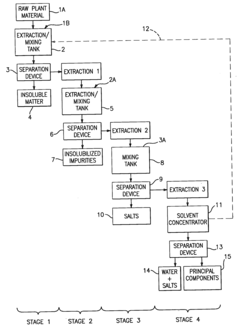
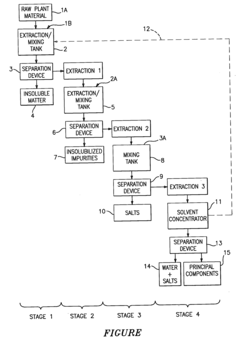
Low temperature process for extracting principal components from plants or plant materials and plant extracts produced thereby
PatentInactiveUS20060008561A1
Innovation
- A low temperature process involving the use of an organic polar solvent, pH adjustment with a base to precipitate impurities, and subsequent acid neutralization to isolate high-quality plant extracts, maintaining the natural aroma, color, and flavor.
Environmental Impact Assessment of Extraction Processes
The environmental impact of extraction processes for oleoresin and resin plastics represents a critical consideration in evaluating their sustainability and ecological footprint. Oleoresin extraction, primarily conducted through tapping methods for natural plant resins, generally demonstrates lower environmental impact compared to synthetic resin plastic production. The tapping process involves minimal energy consumption and produces limited waste, with most collection methods being non-destructive to the source plants, allowing for continuous harvesting over extended periods.
In contrast, synthetic resin plastic extraction relies heavily on petroleum-based feedstocks, requiring significant energy inputs during the refining and polymerization processes. These methods generate substantial greenhouse gas emissions, with studies indicating that the production of one ton of synthetic resin can release between 1.5-3.5 tons of CO2 equivalent, depending on the specific polymer type and manufacturing efficiency.
Water usage presents another significant environmental differential between these extraction methods. Oleoresin extraction typically requires minimal water resources, with some traditional methods using no water at all. Conversely, synthetic resin production can consume 3-10 gallons of water per pound of material produced, contributing to water scarcity concerns in manufacturing regions.
Chemical pollution represents a substantial environmental concern for synthetic resin production, with potential releases of volatile organic compounds (VOCs), styrene, benzene, and other hazardous substances during manufacturing. These emissions can contribute to air quality degradation, smog formation, and potential health impacts for surrounding communities. Oleoresin extraction generally involves fewer toxic chemicals, though some solvent-based extraction methods may present localized environmental risks if not properly managed.
Biodegradability further distinguishes these materials environmentally. Natural oleoresins typically decompose within 2-5 years under appropriate conditions, while synthetic resins can persist in the environment for centuries. This persistence contributes significantly to the growing global plastic pollution crisis, with microplastic contamination now documented in virtually all ecosystems.
Land use impacts also differ substantially between these extraction methods. Oleoresin production can support sustainable forestry practices and provide economic incentives for forest preservation. In contrast, petroleum extraction for synthetic resins often involves significant habitat disruption, potential contamination risks, and long-term ecological alterations. The complete lifecycle assessment reveals that oleoresin extraction generally offers a more environmentally benign profile, though scale, specific extraction techniques, and end-use applications must be considered when making comprehensive sustainability evaluations.
In contrast, synthetic resin plastic extraction relies heavily on petroleum-based feedstocks, requiring significant energy inputs during the refining and polymerization processes. These methods generate substantial greenhouse gas emissions, with studies indicating that the production of one ton of synthetic resin can release between 1.5-3.5 tons of CO2 equivalent, depending on the specific polymer type and manufacturing efficiency.
Water usage presents another significant environmental differential between these extraction methods. Oleoresin extraction typically requires minimal water resources, with some traditional methods using no water at all. Conversely, synthetic resin production can consume 3-10 gallons of water per pound of material produced, contributing to water scarcity concerns in manufacturing regions.
Chemical pollution represents a substantial environmental concern for synthetic resin production, with potential releases of volatile organic compounds (VOCs), styrene, benzene, and other hazardous substances during manufacturing. These emissions can contribute to air quality degradation, smog formation, and potential health impacts for surrounding communities. Oleoresin extraction generally involves fewer toxic chemicals, though some solvent-based extraction methods may present localized environmental risks if not properly managed.
Biodegradability further distinguishes these materials environmentally. Natural oleoresins typically decompose within 2-5 years under appropriate conditions, while synthetic resins can persist in the environment for centuries. This persistence contributes significantly to the growing global plastic pollution crisis, with microplastic contamination now documented in virtually all ecosystems.
Land use impacts also differ substantially between these extraction methods. Oleoresin production can support sustainable forestry practices and provide economic incentives for forest preservation. In contrast, petroleum extraction for synthetic resins often involves significant habitat disruption, potential contamination risks, and long-term ecological alterations. The complete lifecycle assessment reveals that oleoresin extraction generally offers a more environmentally benign profile, though scale, specific extraction techniques, and end-use applications must be considered when making comprehensive sustainability evaluations.
Quality Control Standards and Regulatory Compliance
Quality control standards and regulatory compliance are critical aspects when comparing oleoresin and resin plastics extraction methods. The oleoresin extraction industry must adhere to stringent regulations established by organizations such as the FDA, ISO, and regional regulatory bodies. These standards typically encompass purity levels, contamination limits, and processing guidelines that ensure product safety and consistency.
For oleoresin extraction, the Food and Drug Administration (FDA) has established specific guidelines under 21 CFR for food-grade products, requiring manufacturers to implement Good Manufacturing Practices (GMPs). Similarly, the International Organization for Standardization (ISO) provides frameworks like ISO 22000 for food safety management systems that apply to oleoresin production processes.
Resin plastics extraction methods face different regulatory challenges, primarily governed by environmental protection agencies and industrial safety standards. The Environmental Protection Agency (EPA) regulates emissions and waste disposal associated with synthetic resin production, while OSHA oversees workplace safety requirements for handling potentially hazardous chemicals used in extraction processes.
Quality control for oleoresin extraction typically involves chromatographic analysis to verify chemical composition, with techniques such as HPLC (High-Performance Liquid Chromatography) and GC-MS (Gas Chromatography-Mass Spectrometry) being industry standards. These methods ensure the extracted oleoresins meet specified levels of essential oils, active compounds, and purity requirements.
For resin plastics, quality control focuses on physical properties and chemical stability. Testing protocols include melt flow index measurement, tensile strength testing, and thermal stability analysis. Regulatory compliance often requires documentation of raw material sources, processing aids, and additives used during extraction and processing.
Third-party certification plays an increasingly important role in both industries. For oleoresins, certifications like GRAS (Generally Recognized As Safe) status or organic certification provide market advantages. In resin plastics, certifications such as UL (Underwriters Laboratories) or compliance with REACH (Registration, Evaluation, Authorization and Restriction of Chemicals) regulations are often necessary for market access.
Traceability requirements differ significantly between the two extraction methods. Oleoresin producers must maintain detailed records of botanical sources, harvest conditions, and processing parameters to meet food safety regulations. Resin plastic manufacturers must document chemical inputs, reaction conditions, and quality control test results to satisfy industrial standards and environmental compliance requirements.
For oleoresin extraction, the Food and Drug Administration (FDA) has established specific guidelines under 21 CFR for food-grade products, requiring manufacturers to implement Good Manufacturing Practices (GMPs). Similarly, the International Organization for Standardization (ISO) provides frameworks like ISO 22000 for food safety management systems that apply to oleoresin production processes.
Resin plastics extraction methods face different regulatory challenges, primarily governed by environmental protection agencies and industrial safety standards. The Environmental Protection Agency (EPA) regulates emissions and waste disposal associated with synthetic resin production, while OSHA oversees workplace safety requirements for handling potentially hazardous chemicals used in extraction processes.
Quality control for oleoresin extraction typically involves chromatographic analysis to verify chemical composition, with techniques such as HPLC (High-Performance Liquid Chromatography) and GC-MS (Gas Chromatography-Mass Spectrometry) being industry standards. These methods ensure the extracted oleoresins meet specified levels of essential oils, active compounds, and purity requirements.
For resin plastics, quality control focuses on physical properties and chemical stability. Testing protocols include melt flow index measurement, tensile strength testing, and thermal stability analysis. Regulatory compliance often requires documentation of raw material sources, processing aids, and additives used during extraction and processing.
Third-party certification plays an increasingly important role in both industries. For oleoresins, certifications like GRAS (Generally Recognized As Safe) status or organic certification provide market advantages. In resin plastics, certifications such as UL (Underwriters Laboratories) or compliance with REACH (Registration, Evaluation, Authorization and Restriction of Chemicals) regulations are often necessary for market access.
Traceability requirements differ significantly between the two extraction methods. Oleoresin producers must maintain detailed records of botanical sources, harvest conditions, and processing parameters to meet food safety regulations. Resin plastic manufacturers must document chemical inputs, reaction conditions, and quality control test results to satisfy industrial standards and environmental compliance requirements.
Unlock deeper insights with PatSnap Eureka Quick Research — get a full tech report to explore trends and direct your research. Try now!
Generate Your Research Report Instantly with AI Agent
Supercharge your innovation with PatSnap Eureka AI Agent Platform!