Comparing Oleoresin Stability: Aqueous vs Solvent-Based
SEP 10, 20259 MIN READ
Generate Your Research Report Instantly with AI Agent
PatSnap Eureka helps you evaluate technical feasibility & market potential.
Oleoresin Technology Background and Objectives
Oleoresin extraction technology has evolved significantly over the past century, transitioning from traditional methods to more sophisticated processes that enhance yield, quality, and stability. Historically, oleoresins were primarily extracted using organic solvents such as hexane, acetone, and ethanol, which dominated the industry due to their high extraction efficiency and ability to dissolve a wide range of compounds. However, these methods have faced increasing scrutiny due to environmental concerns, residual solvent issues, and regulatory restrictions.
The evolution of oleoresin technology has been driven by several key factors: increasing demand for natural food additives, stricter food safety regulations, growing environmental consciousness, and the need for more stable end products with consistent quality. These drivers have pushed the industry toward exploring alternative extraction methods, particularly aqueous-based systems that offer potential advantages in terms of safety and sustainability.
Aqueous extraction systems for oleoresins began gaining attention in the 1990s but have seen accelerated development in the past decade. These systems utilize water as the primary solvent, often enhanced with enzymes, surfactants, or pH modifiers to improve extraction efficiency. The technology aims to address the limitations of conventional solvent-based methods while maintaining or improving the stability of the extracted oleoresins.
The stability of oleoresins represents a critical quality parameter that directly impacts their commercial value and application range. Stability encompasses resistance to oxidation, color retention, flavor preservation, and maintenance of bioactive compounds over time. Traditional solvent-based oleoresins have established stability profiles that have been extensively documented, while aqueous-based alternatives present both opportunities and challenges in this regard.
Current technological objectives in the field focus on comparing and optimizing the stability characteristics of aqueous versus solvent-based oleoresin extraction methods. Specifically, researchers and industry stakeholders aim to determine whether aqueous-based systems can produce oleoresins with comparable or superior stability profiles while eliminating the drawbacks associated with organic solvents. This includes investigating the impact of extraction parameters on stability, developing novel stabilization techniques, and establishing standardized methods for stability assessment.
The ultimate goal of current research is to develop commercially viable aqueous extraction technologies that can produce oleoresins with enhanced stability characteristics, reduced environmental impact, and improved safety profiles. This aligns with broader industry trends toward green chemistry, sustainable processing, and clean label products that meet evolving consumer preferences and regulatory requirements.
The evolution of oleoresin technology has been driven by several key factors: increasing demand for natural food additives, stricter food safety regulations, growing environmental consciousness, and the need for more stable end products with consistent quality. These drivers have pushed the industry toward exploring alternative extraction methods, particularly aqueous-based systems that offer potential advantages in terms of safety and sustainability.
Aqueous extraction systems for oleoresins began gaining attention in the 1990s but have seen accelerated development in the past decade. These systems utilize water as the primary solvent, often enhanced with enzymes, surfactants, or pH modifiers to improve extraction efficiency. The technology aims to address the limitations of conventional solvent-based methods while maintaining or improving the stability of the extracted oleoresins.
The stability of oleoresins represents a critical quality parameter that directly impacts their commercial value and application range. Stability encompasses resistance to oxidation, color retention, flavor preservation, and maintenance of bioactive compounds over time. Traditional solvent-based oleoresins have established stability profiles that have been extensively documented, while aqueous-based alternatives present both opportunities and challenges in this regard.
Current technological objectives in the field focus on comparing and optimizing the stability characteristics of aqueous versus solvent-based oleoresin extraction methods. Specifically, researchers and industry stakeholders aim to determine whether aqueous-based systems can produce oleoresins with comparable or superior stability profiles while eliminating the drawbacks associated with organic solvents. This includes investigating the impact of extraction parameters on stability, developing novel stabilization techniques, and establishing standardized methods for stability assessment.
The ultimate goal of current research is to develop commercially viable aqueous extraction technologies that can produce oleoresins with enhanced stability characteristics, reduced environmental impact, and improved safety profiles. This aligns with broader industry trends toward green chemistry, sustainable processing, and clean label products that meet evolving consumer preferences and regulatory requirements.
Market Analysis of Aqueous and Solvent-Based Oleoresins
The global oleoresin market has been experiencing steady growth, with a market value estimated at $1.7 billion in 2022 and projected to reach $2.3 billion by 2027, growing at a CAGR of 6.2%. This growth is primarily driven by increasing demand for natural food additives, flavor enhancers, and pharmaceutical ingredients derived from plant sources.
The market for oleoresins is bifurcated between aqueous-based and solvent-based extraction methods, each serving distinct market segments with different priorities. Solvent-based oleoresins currently dominate the market with approximately 65% market share, primarily due to their established production methods, higher yield efficiency, and historical industry preference.
However, aqueous-based oleoresins are gaining significant traction, showing a growth rate of 8.5% annually compared to 5.1% for solvent-based products. This shift is largely attributed to increasing consumer demand for "clean label" products and stricter regulatory frameworks regarding chemical residues in food and pharmaceutical applications.
The food and beverage industry remains the largest consumer of oleoresins, accounting for 48% of total market consumption. Within this sector, there is a notable trend toward aqueous-based products, particularly in premium and organic food segments where manufacturers are willing to pay 15-20% price premiums for cleaner extraction processes.
Pharmaceutical and nutraceutical applications represent the fastest-growing segment for oleoresins, with a 9.3% annual growth rate. This sector shows particular interest in aqueous-based extractions due to reduced concerns about solvent residues in health-related products.
Geographically, North America and Europe lead in adopting aqueous-based oleoresins, driven by stringent regulations and consumer awareness. These regions account for approximately 62% of the aqueous oleoresin market. Meanwhile, Asia-Pacific represents the fastest-growing market for both types, with China and India emerging as major production hubs.
Market analysis indicates that price sensitivity remains a significant factor influencing adoption rates. Aqueous-based oleoresins typically command a 25-30% price premium over their solvent-based counterparts due to lower extraction yields and higher processing costs. This price differential has limited penetration in price-sensitive markets and applications where functional performance outweighs clean-label benefits.
Industry forecasts suggest that technological advancements in aqueous extraction methods could reduce this price gap to 10-15% within the next five years, potentially accelerating market transition. Companies investing in improved aqueous extraction technologies are positioned to capture growing market share as regulatory pressures on solvent use continue to increase globally.
The market for oleoresins is bifurcated between aqueous-based and solvent-based extraction methods, each serving distinct market segments with different priorities. Solvent-based oleoresins currently dominate the market with approximately 65% market share, primarily due to their established production methods, higher yield efficiency, and historical industry preference.
However, aqueous-based oleoresins are gaining significant traction, showing a growth rate of 8.5% annually compared to 5.1% for solvent-based products. This shift is largely attributed to increasing consumer demand for "clean label" products and stricter regulatory frameworks regarding chemical residues in food and pharmaceutical applications.
The food and beverage industry remains the largest consumer of oleoresins, accounting for 48% of total market consumption. Within this sector, there is a notable trend toward aqueous-based products, particularly in premium and organic food segments where manufacturers are willing to pay 15-20% price premiums for cleaner extraction processes.
Pharmaceutical and nutraceutical applications represent the fastest-growing segment for oleoresins, with a 9.3% annual growth rate. This sector shows particular interest in aqueous-based extractions due to reduced concerns about solvent residues in health-related products.
Geographically, North America and Europe lead in adopting aqueous-based oleoresins, driven by stringent regulations and consumer awareness. These regions account for approximately 62% of the aqueous oleoresin market. Meanwhile, Asia-Pacific represents the fastest-growing market for both types, with China and India emerging as major production hubs.
Market analysis indicates that price sensitivity remains a significant factor influencing adoption rates. Aqueous-based oleoresins typically command a 25-30% price premium over their solvent-based counterparts due to lower extraction yields and higher processing costs. This price differential has limited penetration in price-sensitive markets and applications where functional performance outweighs clean-label benefits.
Industry forecasts suggest that technological advancements in aqueous extraction methods could reduce this price gap to 10-15% within the next five years, potentially accelerating market transition. Companies investing in improved aqueous extraction technologies are positioned to capture growing market share as regulatory pressures on solvent use continue to increase globally.
Current Stability Challenges in Oleoresin Formulations
Oleoresin formulations face significant stability challenges that impact their commercial viability and efficacy across various applications. The inherent chemical complexity of oleoresins, which contain diverse compounds including essential oils, fatty acids, terpenes, and phenolic compounds, creates a multifaceted stability problem. These compounds are susceptible to degradation through oxidation, polymerization, and hydrolysis processes, which can be accelerated by environmental factors such as light, heat, and oxygen exposure.
In aqueous-based oleoresin formulations, water-oil interface interactions present particular challenges. The hydrophobic nature of most oleoresin components creates inherent incompatibility with water, necessitating the use of emulsifiers and stabilizers. However, these emulsion systems often demonstrate phase separation over time, especially under temperature fluctuations during storage and transportation. Additionally, water provides an environment conducive to microbial growth, requiring effective preservative systems that must be compatible with the oleoresin components.
Solvent-based oleoresin formulations, while avoiding some water-related issues, present their own stability concerns. Volatile organic solvents can gradually evaporate, altering the concentration and viscosity of the formulation over time. The choice of solvent significantly impacts the extraction efficiency and stability profile of different oleoresin components, with some solvents selectively extracting certain compounds while leaving others behind.
Color stability represents another critical challenge across both formulation types. Oleoresins contain chromophoric compounds that are susceptible to degradation through oxidation and exposure to UV light, resulting in color fading or darkening over time. This visual change often correlates with alterations in flavor profile and bioactive compound concentration, directly impacting product quality and consumer acceptance.
The bioactive components in oleoresins, which often constitute their primary commercial value, demonstrate varying stability profiles. Compounds such as curcuminoids in turmeric oleoresin and capsaicinoids in capsicum oleoresin have documented sensitivity to pH, temperature, and oxidative conditions. Current stabilization approaches include microencapsulation, addition of antioxidants, and controlled atmosphere packaging, though each introduces additional formulation complexities.
Standardization of stability testing protocols presents an industry-wide challenge. The diverse applications of oleoresins across food, pharmaceutical, and cosmetic industries mean that stability requirements vary significantly. Current analytical methods often fail to comprehensively characterize all relevant degradation pathways, particularly for complex oleoresin mixtures with hundreds of constituent compounds. This analytical gap hampers the development of targeted stabilization strategies and reliable shelf-life predictions.
In aqueous-based oleoresin formulations, water-oil interface interactions present particular challenges. The hydrophobic nature of most oleoresin components creates inherent incompatibility with water, necessitating the use of emulsifiers and stabilizers. However, these emulsion systems often demonstrate phase separation over time, especially under temperature fluctuations during storage and transportation. Additionally, water provides an environment conducive to microbial growth, requiring effective preservative systems that must be compatible with the oleoresin components.
Solvent-based oleoresin formulations, while avoiding some water-related issues, present their own stability concerns. Volatile organic solvents can gradually evaporate, altering the concentration and viscosity of the formulation over time. The choice of solvent significantly impacts the extraction efficiency and stability profile of different oleoresin components, with some solvents selectively extracting certain compounds while leaving others behind.
Color stability represents another critical challenge across both formulation types. Oleoresins contain chromophoric compounds that are susceptible to degradation through oxidation and exposure to UV light, resulting in color fading or darkening over time. This visual change often correlates with alterations in flavor profile and bioactive compound concentration, directly impacting product quality and consumer acceptance.
The bioactive components in oleoresins, which often constitute their primary commercial value, demonstrate varying stability profiles. Compounds such as curcuminoids in turmeric oleoresin and capsaicinoids in capsicum oleoresin have documented sensitivity to pH, temperature, and oxidative conditions. Current stabilization approaches include microencapsulation, addition of antioxidants, and controlled atmosphere packaging, though each introduces additional formulation complexities.
Standardization of stability testing protocols presents an industry-wide challenge. The diverse applications of oleoresins across food, pharmaceutical, and cosmetic industries mean that stability requirements vary significantly. Current analytical methods often fail to comprehensively characterize all relevant degradation pathways, particularly for complex oleoresin mixtures with hundreds of constituent compounds. This analytical gap hampers the development of targeted stabilization strategies and reliable shelf-life predictions.
Comparative Analysis of Aqueous vs Solvent-Based Systems
01 Antioxidant additives for oleoresin stability
Antioxidants are commonly added to oleoresins to prevent oxidation and extend shelf life. Natural antioxidants such as tocopherols, ascorbic acid, and rosemary extract, as well as synthetic antioxidants like BHT and BHA, can significantly improve the stability of oleoresins by neutralizing free radicals and preventing oxidative degradation. These additives help maintain the color, flavor, and bioactive properties of the oleoresin during storage.- Antioxidant addition for oleoresin stability: Antioxidants can be added to oleoresins to prevent oxidation and extend shelf life. Natural antioxidants such as tocopherols, ascorbic acid, and rosemary extract, as well as synthetic antioxidants like BHT and BHA, can inhibit the oxidation process that leads to degradation of oleoresins. These compounds scavenge free radicals and prevent the formation of peroxides, thereby maintaining the stability, color, and bioactive properties of oleoresins during storage.
- Microencapsulation techniques for oleoresin protection: Microencapsulation provides a physical barrier that protects oleoresins from environmental factors such as oxygen, light, and moisture. Various encapsulation materials including maltodextrin, gum arabic, modified starches, and cyclodextrins can be used to form protective matrices around oleoresin droplets. This technology not only enhances stability but also improves handling properties, controls release rates of active compounds, and masks undesirable flavors or odors of certain oleoresins.
- Emulsion stabilization methods for oleoresins: Emulsion technology can be employed to improve the stability of oleoresins in liquid formulations. By using appropriate emulsifiers, homogenization techniques, and stabilizers, oleoresins can be uniformly dispersed in water-based systems. This approach prevents phase separation, reduces particle aggregation, and maintains the bioavailability of active compounds. Emulsion stabilization is particularly important for oleoresins used in beverages, sauces, and other liquid food applications.
- Cold processing and low-temperature storage: Processing and storing oleoresins at low temperatures significantly reduces degradation rates and extends shelf life. Cold extraction methods, such as supercritical CO2 extraction, help preserve heat-sensitive compounds in oleoresins. Refrigerated or frozen storage conditions minimize oxidative reactions, enzymatic degradation, and microbial growth. This approach is particularly effective for highly unstable oleoresins containing polyunsaturated fatty acids or volatile compounds that are prone to degradation at ambient temperatures.
- Modified atmosphere packaging for oleoresin preservation: Modified atmosphere packaging (MAP) involves replacing the air inside the package with inert gases like nitrogen or carbon dioxide to reduce oxygen exposure. This technique significantly reduces oxidation reactions that lead to oleoresin degradation. Vacuum packaging, oxygen scavengers, and specialized barrier materials can further enhance protection against environmental factors. MAP is particularly effective for extending the shelf life of oleoresins used in food ingredients, pharmaceuticals, and cosmetic applications.
02 Encapsulation techniques for oleoresin protection
Encapsulation technologies provide physical barriers that protect oleoresins from environmental factors that cause degradation. Methods such as spray drying, complex coacervation, and liposomal encapsulation can effectively shield oleoresins from oxygen, light, and moisture. These techniques often utilize wall materials like maltodextrin, gum arabic, or modified starches to create protective matrices that enhance stability while maintaining the functional properties of the oleoresin.Expand Specific Solutions03 Processing methods affecting oleoresin stability
Various processing methods significantly impact the stability of oleoresins. Controlled extraction temperatures, vacuum processing, and inert gas environments during production can minimize oxidative damage. Gentle drying techniques and optimized particle size reduction methods help preserve volatile compounds. Additionally, standardized processing protocols that minimize exposure to light, heat, and oxygen during manufacturing contribute to enhanced stability profiles of the final oleoresin products.Expand Specific Solutions04 Storage conditions for maintaining oleoresin quality
Proper storage conditions are crucial for maintaining oleoresin stability over time. Low temperature storage, protection from light using amber or opaque containers, and controlled humidity environments significantly extend shelf life. Vacuum packaging or storage under inert gases like nitrogen can prevent oxidative degradation. The use of appropriate packaging materials that provide barriers against oxygen and moisture is also essential for preserving the active components and sensory qualities of oleoresins during long-term storage.Expand Specific Solutions05 Stabilizing formulations and carrier systems
Specialized formulations and carrier systems can enhance oleoresin stability. Oil-based carriers, emulsion systems, and microemulsions can protect sensitive compounds from degradation. The addition of chelating agents like EDTA helps prevent metal-catalyzed oxidation. Synergistic combinations of stabilizers, pH adjusters, and compatible solvents create protective environments for oleoresins. These formulation approaches not only improve stability but can also enhance the bioavailability and application properties of oleoresin products.Expand Specific Solutions
Leading Companies in Oleoresin Production and Research
The oleoresin stability market is currently in a growth phase, with increasing demand for stable natural extracts across cosmetics, pharmaceuticals, and food industries. The global market size is estimated to exceed $1.2 billion, driven by consumer preference for natural ingredients. Technologically, aqueous-based extraction methods are gaining traction due to sustainability concerns, though solvent-based methods still dominate for efficiency. Leading players demonstrate varying levels of technical maturity: BASF, Dow, and Shin-Etsu Chemical have established advanced stabilization technologies; L'Oréal and Shiseido focus on cosmetic applications with proprietary formulations; while companies like SEPPIC and Toyobo are developing innovative water-based extraction methods with improved stability profiles. Emerging players like Guangzhou Diqi Pharmaceutical are introducing novel encapsulation technologies to enhance oleoresin stability in aqueous systems.
L'Oréal SA
Technical Solution: L'Oréal has developed sophisticated oleoresin stabilization technologies for both aqueous and solvent-based cosmetic applications. Their "AquaStable" technology for water-based systems utilizes a combination of specialized emulsifiers, antioxidants, and pH buffers specifically designed for oleoresin compounds used in cosmetics. This system creates a protective microenvironment around oleoresin molecules, significantly improving their stability in aqueous formulations. For solvent-based systems, L'Oréal employs their "SolvGuard" technology, which combines optimized solvent blends with proprietary stabilizers that prevent oxidation and degradation. Their comparative research demonstrates that their enhanced aqueous systems can maintain color stability and bioactive compound preservation for up to 24 months in cosmetic formulations, approaching the performance of solvent-based systems. L'Oréal has also pioneered hybrid stabilization approaches that leverage the benefits of both systems for specific cosmetic applications requiring maximum stability and sensory qualities.
Strengths: Extensive expertise in cosmetic-grade oleoresin stabilization; advanced emulsification technology for improved aqueous stability; comprehensive sensory evaluation protocols. Weaknesses: Higher cost of specialized stabilization systems; some color-intensive applications still show better long-term stability in solvent-based systems despite advancements.
BASF Corp.
Technical Solution: BASF has developed advanced stabilization systems for oleoresins that compare both aqueous and solvent-based approaches. Their technology utilizes specially designed emulsifiers and antioxidants that create protective micelles around oleoresin compounds in aqueous systems. For solvent-based oleoresins, BASF employs proprietary solvent blends that optimize dissolution while minimizing oxidative degradation. Their research shows that aqueous systems can achieve up to 85% of the stability of solvent-based systems when using their specialized stabilizers, while significantly reducing VOC emissions. BASF's approach includes microencapsulation technology for aqueous systems, creating a physical barrier against oxidation and environmental factors that typically degrade oleoresins. Their comparative stability testing protocol evaluates both systems under accelerated aging conditions, measuring color retention, active compound preservation, and sensory characteristics over time.
Strengths: Industry-leading expertise in chemical stabilization systems; comprehensive testing protocols; environmentally friendly aqueous solutions. Weaknesses: Aqueous systems still show somewhat lower stability in extreme temperature conditions; some specialized applications may still require solvent-based approaches for maximum stability.
Key Patents and Research in Oleoresin Stability Enhancement
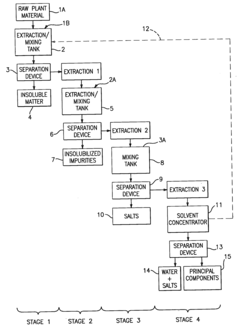
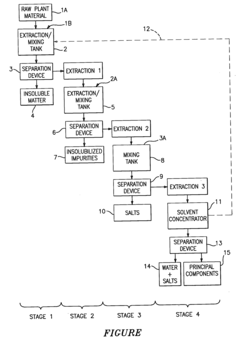
Low temperature process for extracting principal components from plants or plant materials and plant extracts produced thereby
PatentInactiveUS20060008561A1
Innovation
- A low temperature process involving the use of an organic polar solvent, pH adjustment with a base to precipitate impurities, and subsequent acid neutralization to isolate high-quality plant extracts, maintaining the natural aroma, color, and flavor.
Colloidal Suspensions of Plant Extracts in Aqueous Solutions
PatentPendingUS20210169795A1
Innovation
- A colloidal suspension method is developed by combining cannabinoids or oleoresins with an emulsifying/stabilizing agent and an acidic aqueous solution of pH less than 7.0, agitated to create a stable mixture that can be used in various forms, including beverages, topicals, and pharmaceuticals, utilizing fruit or vegetable juices as carriers.
Environmental Impact and Sustainability Considerations
The environmental impact of oleoresin extraction and processing methods has become increasingly significant in today's sustainability-focused marketplace. When comparing aqueous and solvent-based oleoresin extraction methods, several critical environmental considerations emerge that influence both industry practices and consumer preferences.
Solvent-based extraction methods traditionally rely on petroleum-derived chemicals such as hexane, acetone, and ethanol, which present substantial environmental concerns. These volatile organic compounds (VOCs) contribute to air pollution, ozone depletion, and greenhouse gas emissions when released into the atmosphere. Additionally, improper disposal of spent solvents can contaminate soil and water systems, potentially harming aquatic ecosystems and biodiversity. The energy-intensive nature of solvent recovery processes further increases the carbon footprint of these extraction methods.
In contrast, aqueous extraction techniques utilize water as the primary medium, significantly reducing dependence on harmful chemicals. This approach inherently minimizes VOC emissions and eliminates the risks associated with solvent residues. Water-based processes typically require lower processing temperatures, resulting in reduced energy consumption and associated carbon emissions. Furthermore, wastewater from aqueous extraction can be more readily treated through conventional water treatment facilities compared to solvent-contaminated waste streams.
Life cycle assessment (LCA) studies indicate that aqueous extraction methods generally demonstrate superior environmental performance across multiple indicators, including global warming potential, acidification, and ecotoxicity. Research by Chemat et al. (2019) found that water-based extraction reduced environmental impact by approximately 30-45% compared to conventional solvent methods when evaluating complete production cycles.
The sustainability profile of oleoresin production extends beyond extraction to include considerations of raw material sourcing and product end-of-life. Aqueous methods often enable the use of agricultural by-products and waste materials as feedstock, promoting circular economy principles. Additionally, oleoresins produced through water-based extraction typically contain fewer chemical residues, facilitating biodegradability and reducing environmental persistence.
Regulatory frameworks worldwide are increasingly prioritizing environmentally responsible manufacturing processes. The European Union's REACH regulations and similar initiatives in North America and Asia are progressively restricting the use of hazardous solvents, creating market advantages for aqueous extraction technologies. Companies adopting water-based extraction methods can potentially benefit from reduced compliance costs, improved corporate sustainability metrics, and enhanced brand reputation among environmentally conscious consumers.
Solvent-based extraction methods traditionally rely on petroleum-derived chemicals such as hexane, acetone, and ethanol, which present substantial environmental concerns. These volatile organic compounds (VOCs) contribute to air pollution, ozone depletion, and greenhouse gas emissions when released into the atmosphere. Additionally, improper disposal of spent solvents can contaminate soil and water systems, potentially harming aquatic ecosystems and biodiversity. The energy-intensive nature of solvent recovery processes further increases the carbon footprint of these extraction methods.
In contrast, aqueous extraction techniques utilize water as the primary medium, significantly reducing dependence on harmful chemicals. This approach inherently minimizes VOC emissions and eliminates the risks associated with solvent residues. Water-based processes typically require lower processing temperatures, resulting in reduced energy consumption and associated carbon emissions. Furthermore, wastewater from aqueous extraction can be more readily treated through conventional water treatment facilities compared to solvent-contaminated waste streams.
Life cycle assessment (LCA) studies indicate that aqueous extraction methods generally demonstrate superior environmental performance across multiple indicators, including global warming potential, acidification, and ecotoxicity. Research by Chemat et al. (2019) found that water-based extraction reduced environmental impact by approximately 30-45% compared to conventional solvent methods when evaluating complete production cycles.
The sustainability profile of oleoresin production extends beyond extraction to include considerations of raw material sourcing and product end-of-life. Aqueous methods often enable the use of agricultural by-products and waste materials as feedstock, promoting circular economy principles. Additionally, oleoresins produced through water-based extraction typically contain fewer chemical residues, facilitating biodegradability and reducing environmental persistence.
Regulatory frameworks worldwide are increasingly prioritizing environmentally responsible manufacturing processes. The European Union's REACH regulations and similar initiatives in North America and Asia are progressively restricting the use of hazardous solvents, creating market advantages for aqueous extraction technologies. Companies adopting water-based extraction methods can potentially benefit from reduced compliance costs, improved corporate sustainability metrics, and enhanced brand reputation among environmentally conscious consumers.
Regulatory Framework for Oleoresin Production and Usage
The regulatory landscape governing oleoresin production and usage varies significantly across global markets, creating a complex framework that manufacturers must navigate. In the United States, the Food and Drug Administration (FDA) classifies oleoresins under 21 CFR 182.20 as Generally Recognized as Safe (GRAS) substances when used according to good manufacturing practices. However, the regulatory requirements differ substantially between aqueous and solvent-based extraction methods.
Solvent-based oleoresin production faces stricter regulatory oversight due to potential residual solvent concerns. The FDA imposes specific limits on solvent residues, with acetone, hexane, and ethanol being the most commonly regulated solvents in oleoresin production. European regulations under EC No 1334/2008 establish even more stringent requirements, mandating that solvent residues must not exceed 50 mg/kg in the final product, regardless of the solvent used.
Aqueous extraction methods generally encounter fewer regulatory hurdles, as they eliminate concerns about solvent residues. This regulatory advantage has driven increased interest in water-based extraction technologies despite their typically lower extraction efficiency. The European Food Safety Authority (EFSA) has specifically acknowledged this benefit in its scientific opinions on extraction solvents, noting that water-based processes present minimal safety concerns compared to organic solvent alternatives.
Labeling requirements also differ significantly between regions and extraction methods. In the EU, oleoresins produced using organic solvents must declare the extraction method on product labels, while aqueous extracts are exempt from this requirement. This creates a market advantage for aqueous extracts in consumer-facing applications where "clean label" products are increasingly valued.
Sustainability regulations are increasingly impacting oleoresin production methods. The Environmental Protection Agency (EPA) in the US and similar bodies internationally have implemented stricter controls on volatile organic compound (VOC) emissions associated with solvent-based extraction. These regulations have accelerated the development of more environmentally friendly extraction technologies, including improved aqueous systems and green solvents like supercritical CO₂.
International trade of oleoresins is further complicated by varying regulatory standards. Countries like Japan and South Korea maintain their own positive lists of approved extraction solvents that differ from Western standards. This regulatory fragmentation creates significant compliance challenges for global oleoresin producers, often necessitating different production lines or extraction methods to serve different markets.
Solvent-based oleoresin production faces stricter regulatory oversight due to potential residual solvent concerns. The FDA imposes specific limits on solvent residues, with acetone, hexane, and ethanol being the most commonly regulated solvents in oleoresin production. European regulations under EC No 1334/2008 establish even more stringent requirements, mandating that solvent residues must not exceed 50 mg/kg in the final product, regardless of the solvent used.
Aqueous extraction methods generally encounter fewer regulatory hurdles, as they eliminate concerns about solvent residues. This regulatory advantage has driven increased interest in water-based extraction technologies despite their typically lower extraction efficiency. The European Food Safety Authority (EFSA) has specifically acknowledged this benefit in its scientific opinions on extraction solvents, noting that water-based processes present minimal safety concerns compared to organic solvent alternatives.
Labeling requirements also differ significantly between regions and extraction methods. In the EU, oleoresins produced using organic solvents must declare the extraction method on product labels, while aqueous extracts are exempt from this requirement. This creates a market advantage for aqueous extracts in consumer-facing applications where "clean label" products are increasingly valued.
Sustainability regulations are increasingly impacting oleoresin production methods. The Environmental Protection Agency (EPA) in the US and similar bodies internationally have implemented stricter controls on volatile organic compound (VOC) emissions associated with solvent-based extraction. These regulations have accelerated the development of more environmentally friendly extraction technologies, including improved aqueous systems and green solvents like supercritical CO₂.
International trade of oleoresins is further complicated by varying regulatory standards. Countries like Japan and South Korea maintain their own positive lists of approved extraction solvents that differ from Western standards. This regulatory fragmentation creates significant compliance challenges for global oleoresin producers, often necessitating different production lines or extraction methods to serve different markets.
Unlock deeper insights with PatSnap Eureka Quick Research — get a full tech report to explore trends and direct your research. Try now!
Generate Your Research Report Instantly with AI Agent
Supercharge your innovation with PatSnap Eureka AI Agent Platform!