

Pulse Code Modulation vs Code Division Multiplexing Benefits
MAR 6, 20269 MIN READ
Generate Your Research Report Instantly with AI Agent
PatSnap Eureka helps you evaluate technical feasibility & market potential.
PCM vs CDM Technology Background and Objectives
Pulse Code Modulation (PCM) and Code Division Multiplexing (CDM) represent two fundamental yet distinct approaches in digital communication systems, each serving different purposes within the telecommunications infrastructure. PCM emerged in the 1930s as a revolutionary method for converting analog signals into digital format, enabling reliable transmission and storage of voice and audio data. CDM, on the other hand, evolved as a sophisticated multiplexing technique that allows multiple users to share the same frequency spectrum simultaneously through unique spreading codes.
The historical development of PCM traces back to Alec Reeves' pioneering work at International Telephone and Telegraph Company, where the concept of sampling analog signals at regular intervals and quantizing them into discrete digital values was first established. This breakthrough laid the foundation for modern digital communication systems. The technology gained widespread adoption during the 1960s and 1970s as digital switching systems became commercially viable, transforming the telecommunications landscape from analog to digital infrastructure.
CDM technology emerged later as part of spread spectrum communication research, initially developed for military applications requiring secure and interference-resistant communications. The technique gained commercial significance with the advent of cellular communication systems in the 1990s, particularly through CDMA (Code Division Multiple Access) implementations. Unlike traditional frequency or time division methods, CDM utilizes orthogonal codes to differentiate between multiple simultaneous transmissions.
The evolution of both technologies reflects the industry's progression toward more efficient, reliable, and scalable communication solutions. PCM addressed the fundamental challenge of digitizing analog information while maintaining signal integrity, enabling error correction and regeneration capabilities that were impossible with analog systems. CDM tackled the growing demand for spectrum efficiency and user capacity in wireless communication networks.
Current technological objectives focus on optimizing these technologies for emerging applications including 5G networks, Internet of Things deployments, and high-definition multimedia communications. PCM continues to evolve with advanced quantization algorithms and adaptive sampling techniques, while CDM research emphasizes improved code design and interference mitigation strategies.
The comparative analysis of PCM and CDM benefits becomes increasingly relevant as communication systems integrate both technologies to achieve optimal performance across diverse application scenarios, from traditional telephony to modern broadband wireless networks.
The historical development of PCM traces back to Alec Reeves' pioneering work at International Telephone and Telegraph Company, where the concept of sampling analog signals at regular intervals and quantizing them into discrete digital values was first established. This breakthrough laid the foundation for modern digital communication systems. The technology gained widespread adoption during the 1960s and 1970s as digital switching systems became commercially viable, transforming the telecommunications landscape from analog to digital infrastructure.
CDM technology emerged later as part of spread spectrum communication research, initially developed for military applications requiring secure and interference-resistant communications. The technique gained commercial significance with the advent of cellular communication systems in the 1990s, particularly through CDMA (Code Division Multiple Access) implementations. Unlike traditional frequency or time division methods, CDM utilizes orthogonal codes to differentiate between multiple simultaneous transmissions.
The evolution of both technologies reflects the industry's progression toward more efficient, reliable, and scalable communication solutions. PCM addressed the fundamental challenge of digitizing analog information while maintaining signal integrity, enabling error correction and regeneration capabilities that were impossible with analog systems. CDM tackled the growing demand for spectrum efficiency and user capacity in wireless communication networks.
Current technological objectives focus on optimizing these technologies for emerging applications including 5G networks, Internet of Things deployments, and high-definition multimedia communications. PCM continues to evolve with advanced quantization algorithms and adaptive sampling techniques, while CDM research emphasizes improved code design and interference mitigation strategies.
The comparative analysis of PCM and CDM benefits becomes increasingly relevant as communication systems integrate both technologies to achieve optimal performance across diverse application scenarios, from traditional telephony to modern broadband wireless networks.
Market Demand for Advanced Multiplexing Solutions
The telecommunications industry is experiencing unprecedented demand for advanced multiplexing solutions driven by the exponential growth in data consumption and the proliferation of connected devices. Mobile data traffic continues to surge as consumers increasingly rely on streaming services, cloud applications, and real-time communications, creating substantial pressure on network infrastructure to deliver higher capacity and improved efficiency.
Enterprise digitalization initiatives are fundamentally reshaping market requirements for multiplexing technologies. Organizations across sectors are implementing Internet of Things deployments, edge computing architectures, and distributed cloud services that demand sophisticated signal processing capabilities. These applications require multiplexing solutions that can handle diverse data types simultaneously while maintaining signal integrity and minimizing latency.
The emergence of next-generation wireless standards has created specific market segments with distinct multiplexing requirements. Ultra-reliable low-latency communications applications in autonomous vehicles and industrial automation demand precise timing and error-free transmission. Enhanced mobile broadband services require maximum spectral efficiency to support high-definition content delivery. Massive machine-type communications necessitate solutions capable of managing thousands of simultaneous connections with minimal power consumption.
Network operators are increasingly seeking multiplexing technologies that offer superior scalability and flexibility to accommodate varying traffic patterns and service requirements. The shift toward software-defined networking and network function virtualization has created demand for multiplexing solutions that can be dynamically reconfigured and optimized based on real-time network conditions and user demands.
Cost optimization pressures are driving market interest in multiplexing technologies that deliver improved performance per unit of infrastructure investment. Operators require solutions that maximize channel capacity utilization while reducing operational complexity and maintenance requirements. Energy efficiency has become a critical selection criterion as sustainability concerns and operational cost considerations influence technology adoption decisions.
The competitive landscape is intensifying as traditional telecommunications equipment manufacturers face challenges from emerging technology providers offering innovative multiplexing approaches. Market demand increasingly favors solutions that demonstrate clear performance advantages in specific application scenarios rather than general-purpose implementations, creating opportunities for specialized multiplexing technologies that address particular market segments effectively.
Enterprise digitalization initiatives are fundamentally reshaping market requirements for multiplexing technologies. Organizations across sectors are implementing Internet of Things deployments, edge computing architectures, and distributed cloud services that demand sophisticated signal processing capabilities. These applications require multiplexing solutions that can handle diverse data types simultaneously while maintaining signal integrity and minimizing latency.
The emergence of next-generation wireless standards has created specific market segments with distinct multiplexing requirements. Ultra-reliable low-latency communications applications in autonomous vehicles and industrial automation demand precise timing and error-free transmission. Enhanced mobile broadband services require maximum spectral efficiency to support high-definition content delivery. Massive machine-type communications necessitate solutions capable of managing thousands of simultaneous connections with minimal power consumption.
Network operators are increasingly seeking multiplexing technologies that offer superior scalability and flexibility to accommodate varying traffic patterns and service requirements. The shift toward software-defined networking and network function virtualization has created demand for multiplexing solutions that can be dynamically reconfigured and optimized based on real-time network conditions and user demands.
Cost optimization pressures are driving market interest in multiplexing technologies that deliver improved performance per unit of infrastructure investment. Operators require solutions that maximize channel capacity utilization while reducing operational complexity and maintenance requirements. Energy efficiency has become a critical selection criterion as sustainability concerns and operational cost considerations influence technology adoption decisions.
The competitive landscape is intensifying as traditional telecommunications equipment manufacturers face challenges from emerging technology providers offering innovative multiplexing approaches. Market demand increasingly favors solutions that demonstrate clear performance advantages in specific application scenarios rather than general-purpose implementations, creating opportunities for specialized multiplexing technologies that address particular market segments effectively.
Current State and Challenges in Digital Communication
Digital communication systems have reached unprecedented levels of sophistication, with global data traffic projected to exceed 4.8 zettabytes annually by 2025. The proliferation of mobile devices, Internet of Things applications, and high-definition multimedia content has created an insatiable demand for efficient signal processing and transmission technologies. Within this landscape, Pulse Code Modulation and Code Division Multiplexing represent two fundamental yet distinct approaches to handling digital information, each addressing different aspects of the communication chain.
Pulse Code Modulation has established itself as the cornerstone of digital audio processing and telecommunications infrastructure. Modern PCM implementations operate at sampling rates ranging from 8 kHz in traditional telephony to 192 kHz in high-fidelity audio applications. The technology demonstrates exceptional signal fidelity with signal-to-noise ratios exceeding 96 dB in 16-bit implementations. However, PCM faces significant bandwidth efficiency challenges, particularly in spectrum-constrained environments where raw data rates can reach several megabits per second for high-quality applications.
Code Division Multiplexing has emerged as a critical enabler for modern wireless communication systems, supporting simultaneous multi-user access through sophisticated spreading code algorithms. Current CDMA implementations achieve spectral efficiencies of 1.5 to 3 bits per second per hertz, while accommodating hundreds of concurrent users within a single frequency band. The technology's inherent resistance to interference and multipath fading has made it indispensable for cellular networks and satellite communications.
The integration challenges between these technologies present significant technical hurdles. PCM's deterministic sampling requirements often conflict with CDMA's probabilistic access methods, creating synchronization complexities that demand advanced buffering and timing recovery mechanisms. Additionally, the computational overhead of real-time spreading code generation and correlation processing in CDMA systems can introduce latency issues that compromise PCM's time-sensitive applications.
Power consumption optimization remains a critical challenge, particularly in battery-powered devices where PCM's continuous sampling operations and CDMA's intensive signal processing can significantly impact operational lifetime. Current research focuses on adaptive sampling techniques and low-power correlation algorithms to address these limitations while maintaining performance standards required for next-generation communication systems.
Pulse Code Modulation has established itself as the cornerstone of digital audio processing and telecommunications infrastructure. Modern PCM implementations operate at sampling rates ranging from 8 kHz in traditional telephony to 192 kHz in high-fidelity audio applications. The technology demonstrates exceptional signal fidelity with signal-to-noise ratios exceeding 96 dB in 16-bit implementations. However, PCM faces significant bandwidth efficiency challenges, particularly in spectrum-constrained environments where raw data rates can reach several megabits per second for high-quality applications.
Code Division Multiplexing has emerged as a critical enabler for modern wireless communication systems, supporting simultaneous multi-user access through sophisticated spreading code algorithms. Current CDMA implementations achieve spectral efficiencies of 1.5 to 3 bits per second per hertz, while accommodating hundreds of concurrent users within a single frequency band. The technology's inherent resistance to interference and multipath fading has made it indispensable for cellular networks and satellite communications.
The integration challenges between these technologies present significant technical hurdles. PCM's deterministic sampling requirements often conflict with CDMA's probabilistic access methods, creating synchronization complexities that demand advanced buffering and timing recovery mechanisms. Additionally, the computational overhead of real-time spreading code generation and correlation processing in CDMA systems can introduce latency issues that compromise PCM's time-sensitive applications.
Power consumption optimization remains a critical challenge, particularly in battery-powered devices where PCM's continuous sampling operations and CDMA's intensive signal processing can significantly impact operational lifetime. Current research focuses on adaptive sampling techniques and low-power correlation algorithms to address these limitations while maintaining performance standards required for next-generation communication systems.
Existing PCM and CDM Implementation Solutions
01 PCM advantages in signal quality and noise immunity
Pulse Code Modulation provides superior signal quality through digital encoding of analog signals, offering excellent noise immunity and signal regeneration capabilities. The digital nature of PCM allows for error detection and correction, maintaining signal integrity over long transmission distances. PCM systems can achieve high fidelity reproduction of original signals with minimal distortion compared to analog transmission methods.- PCM advantages in signal quality and noise immunity: Pulse Code Modulation provides superior signal quality through digital encoding of analog signals, offering excellent noise immunity and signal regeneration capabilities. The digital nature of PCM allows for error detection and correction, maintaining signal integrity over long transmission distances. PCM systems can achieve high fidelity reproduction of original signals with minimal distortion compared to analog transmission methods.
- CDM capacity and spectrum efficiency benefits: Code Division Multiplexing enables multiple users to share the same frequency band simultaneously through unique code assignments, significantly increasing system capacity. This technology provides efficient spectrum utilization by allowing overlapping transmissions distinguished by orthogonal or pseudo-random codes. The spread spectrum nature of CDM offers inherent security and resistance to interference, making it suitable for wireless communication systems.
- PCM bandwidth and data rate characteristics: Pulse Code Modulation systems require specific bandwidth allocation based on sampling rate and quantization levels, with bandwidth requirements directly proportional to the bit rate. The Nyquist sampling theorem governs PCM bandwidth efficiency, requiring sampling at twice the highest frequency component. PCM offers predictable bandwidth usage and supports various compression techniques to optimize data transmission rates.
- CDM interference management and signal separation: Code Division Multiplexing employs sophisticated signal processing techniques to separate multiple simultaneous transmissions, utilizing correlation properties of spreading codes. The system manages inter-user interference through careful code selection and power control mechanisms. Advanced receiver designs enable effective signal detection even in the presence of multiple interfering signals, with near-far problem mitigation through dynamic power adjustment.
- Hybrid systems combining PCM and CDM technologies: Modern communication systems integrate both Pulse Code Modulation and Code Division Multiplexing to leverage advantages of each technology. These hybrid approaches use PCM for analog-to-digital conversion while employing CDM for multiple access and transmission. The combination enables efficient bandwidth utilization, improved signal quality, and enhanced system capacity for various applications including wireless networks and satellite communications.
02 CDM capacity and spectrum efficiency benefits
Code Division Multiplexing enables multiple users to share the same frequency band simultaneously through unique code assignments, significantly increasing system capacity. This technology provides efficient spectrum utilization by allowing overlapping transmissions distinguished by orthogonal or pseudo-random codes. The spread spectrum nature of CDM offers inherent security and resistance to interference, making it suitable for wireless communication systems.Expand Specific Solutions03 PCM bandwidth and data rate characteristics
Pulse Code Modulation systems require specific bandwidth allocation based on sampling rate and quantization levels, with bandwidth directly proportional to the bit rate. The Nyquist sampling theorem governs PCM bandwidth requirements, ensuring accurate signal reconstruction. PCM offers predictable and consistent data rates, making it suitable for applications requiring guaranteed bandwidth and timing synchronization.Expand Specific Solutions04 CDM flexibility in multi-user access and scalability
Code Division Multiplexing provides flexible multi-user access without requiring strict time or frequency coordination among users. The system can dynamically accommodate varying numbers of users with graceful degradation in performance as user count increases. CDM supports soft handoff capabilities and allows for variable data rates among different users, enhancing overall system flexibility and adaptability to changing traffic conditions.Expand Specific Solutions05 Hybrid and combined modulation techniques
Advanced communication systems combine PCM and CDM techniques to leverage benefits of both technologies, achieving improved performance in terms of capacity, quality, and efficiency. Hybrid approaches utilize PCM for high-quality signal encoding while employing CDM for multiple access and spectrum spreading. These combined systems can optimize trade-offs between bandwidth efficiency, power consumption, and system complexity for specific application requirements.Expand Specific Solutions
Key Players in Digital Communication Industry
The telecommunications industry is experiencing a mature growth phase with substantial market expansion driven by 5G deployment and IoT integration. The competitive landscape for Pulse Code Modulation versus Code Division Multiplexing technologies reveals high technical maturity, with established players like Huawei Technologies, Intel, Samsung Electronics, and Ericsson leading innovation in signal processing and multiplexing solutions. Chinese institutions including Harbin Institute of Technology, Tianjin University, and Xidian University contribute significant research capabilities, while companies like China Mobile Design Institute and State Grid provide infrastructure expertise. The technology comparison benefits from diverse perspectives spanning semiconductor manufacturers, telecommunications equipment vendors, and research institutions, indicating a well-developed ecosystem where both PCM and CDM technologies have reached commercial viability across multiple application domains.
Huawei Technologies Co., Ltd.
Technical Solution: Huawei has developed comprehensive solutions integrating both PCM and CDM technologies across their telecommunications infrastructure. Their approach utilizes advanced PCM implementations for high-fidelity voice transmission in their carrier-grade equipment, achieving sampling rates up to 48 kHz with 16-bit resolution for superior audio quality. Simultaneously, they leverage CDMA-based multiplexing in their wireless base stations and mobile network equipment, enabling multiple users to share the same frequency spectrum through unique spreading codes. Their integrated solution optimizes bandwidth utilization by combining PCM's excellent signal quality preservation with CDM's superior spectrum efficiency, particularly in dense urban deployments where spectrum is premium.
Strengths: Market-leading integration of both technologies, extensive R&D investment, proven deployment scale. Weaknesses: High complexity in implementation, significant power consumption in base stations.
Intel Corp.
Technical Solution: Intel's semiconductor solutions provide hardware acceleration for both PCM processing and CDM signal processing through their specialized DSP architectures. Their latest processors incorporate dedicated PCM codecs supporting up to 192 kHz sampling rates with 24-bit precision, while simultaneously offering hardware-accelerated CDMA processing capabilities through integrated signal processing units. Intel's approach focuses on reducing computational overhead by implementing parallel processing architectures that can handle multiple PCM streams while performing real-time CDM encoding/decoding operations. Their solutions are particularly optimized for software-defined radio applications where flexibility between different modulation schemes is crucial.
Strengths: Hardware acceleration capabilities, flexible software-defined implementations, strong ecosystem support. Weaknesses: Higher cost compared to dedicated solutions, complex software stack requirements.
Core Technical Innovations in PCM and CDM
Code division multiplexing method and system
PatentInactiveUS20110182169A1
Innovation
- The implementation of a code division multiplexing method and system that utilizes Basic Group Perfect Complete Complementary Orthogonal Code Pairs Mate, modulated onto orthogonal carriers, with continuous shifting to achieve high spectral efficiency and overcome near-far effects, while maintaining a "zero correlation window" feature.
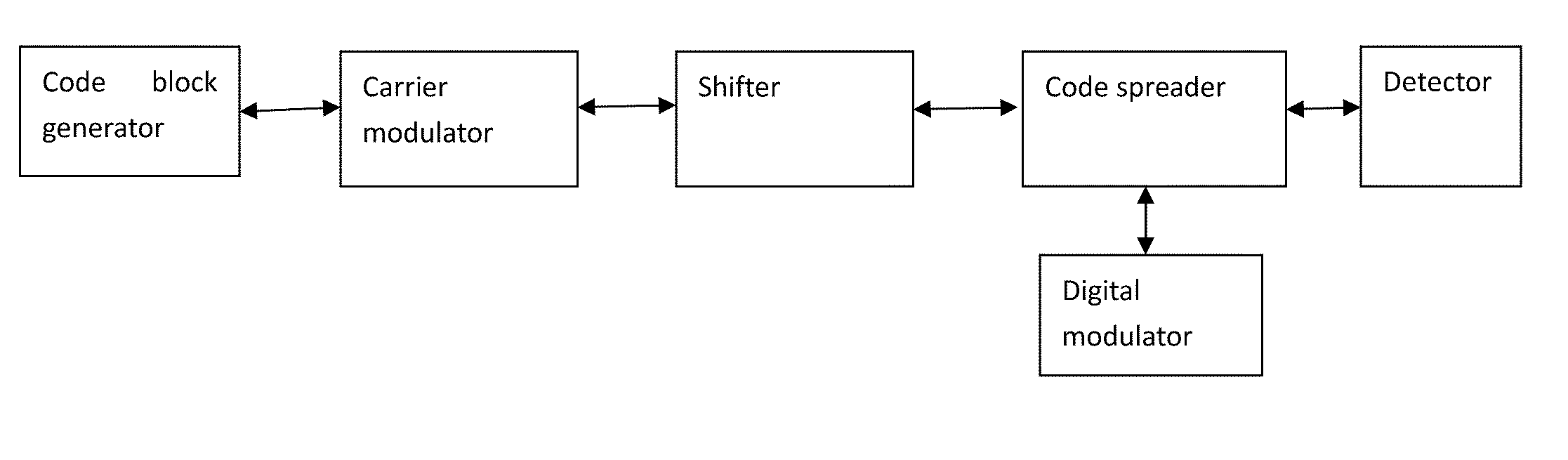
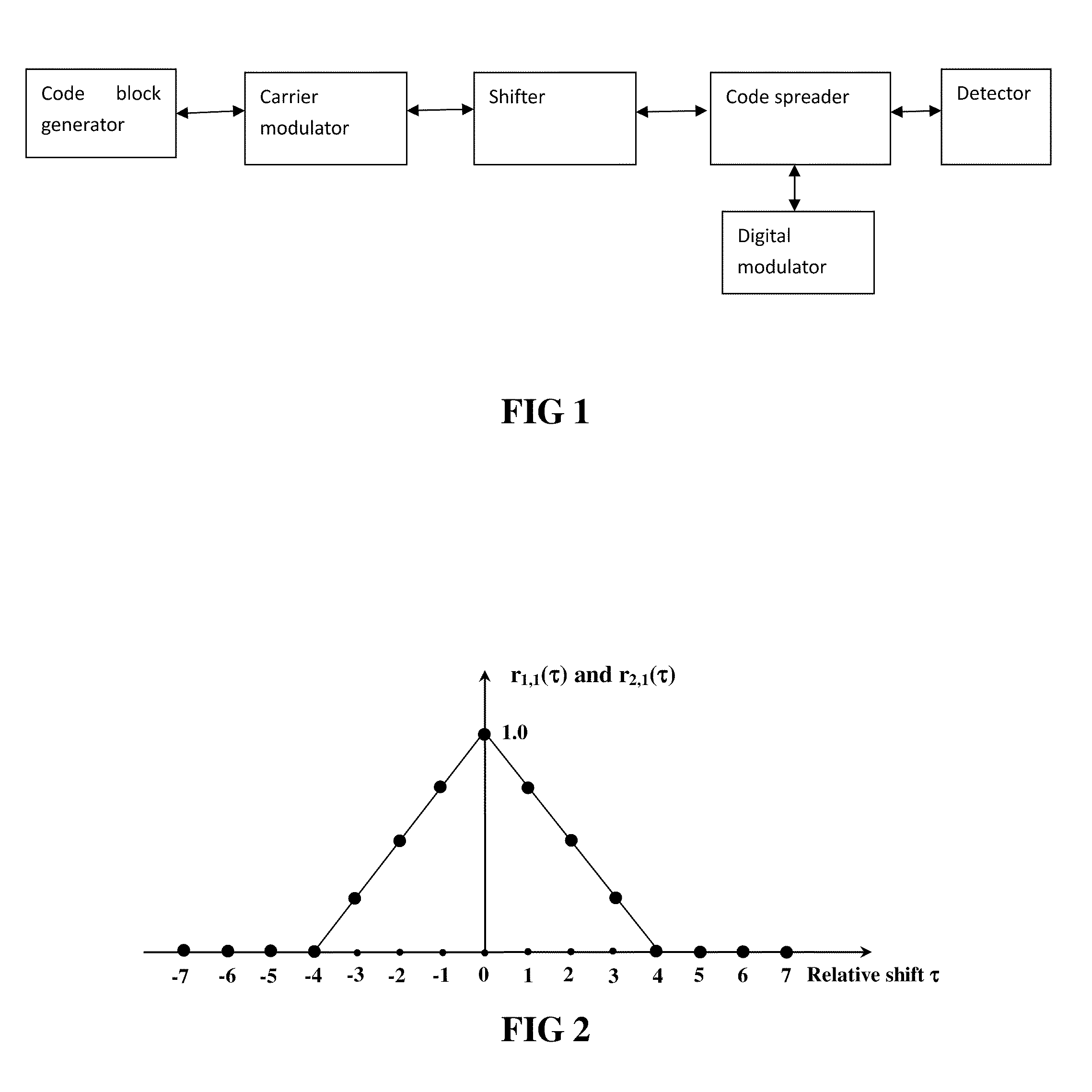
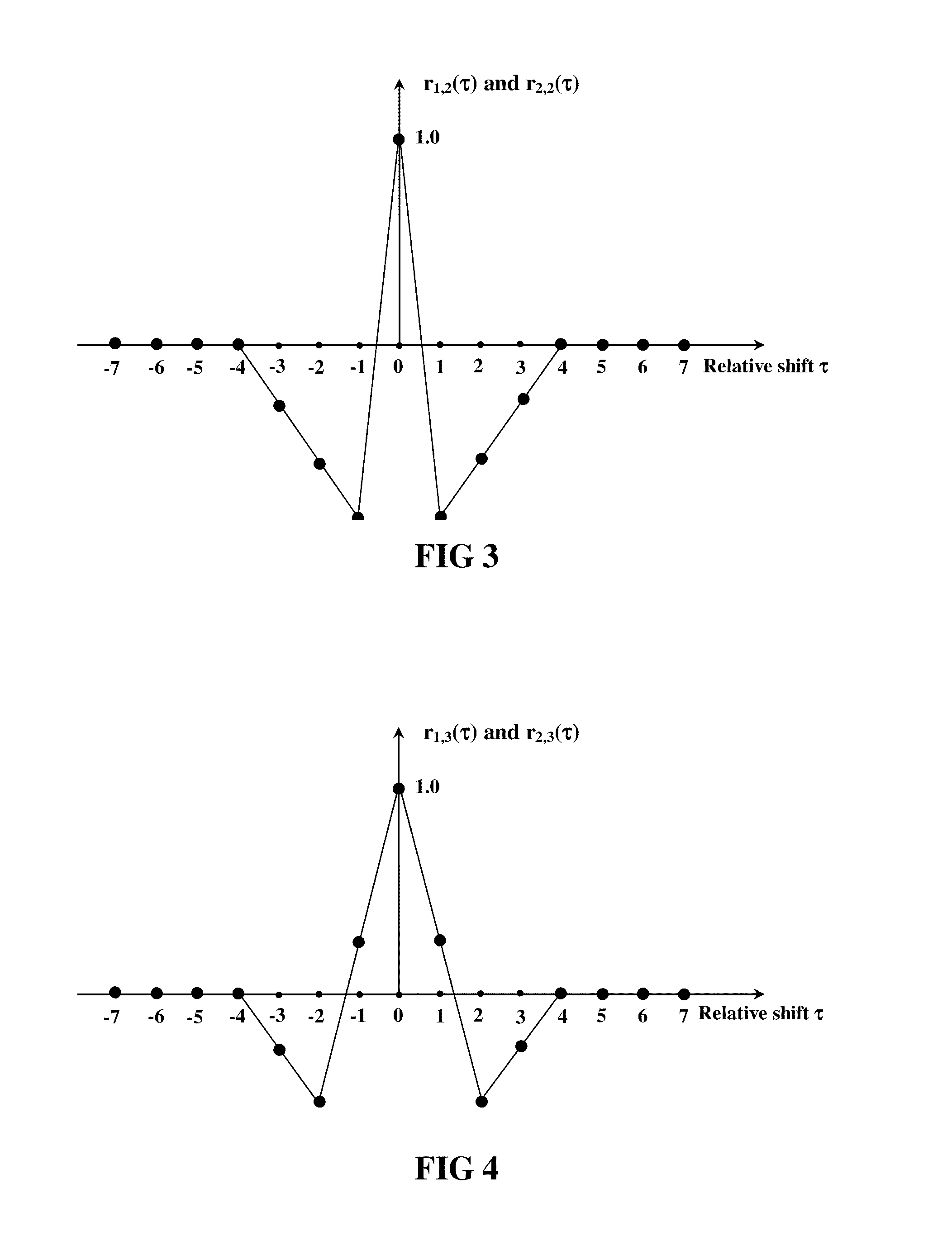

Pulse code modulation multiplex system
PatentInactiveUS3668291A
Innovation
- Implementing a counter-type pulse code modulation encoder with separate logic elements in each channel and a single precision staircase waveform generator common to all channels, allowing simultaneous sampling and encoding, which relaxes sample and hold gate tolerances and extends the sample holding interval significantly.
Spectrum Regulation and Communication Standards
Spectrum regulation frameworks play a crucial role in determining the deployment and effectiveness of both Pulse Code Modulation (PCM) and Code Division Multiplexing (CDM) technologies. Regulatory bodies worldwide have established distinct allocation policies that directly impact how these modulation and multiplexing schemes can be implemented across different frequency bands and communication services.
PCM systems typically operate under traditional spectrum allocation models where specific frequency bands are assigned to particular services or operators. This approach aligns well with established regulatory frameworks such as those defined by the International Telecommunication Union (ITU) and national regulatory authorities. The deterministic nature of PCM makes it easier for regulators to predict interference patterns and establish clear interference protection criteria, facilitating straightforward spectrum planning and coordination processes.
CDM technologies present unique regulatory challenges due to their spread spectrum characteristics and ability to share frequency bands among multiple users simultaneously. Regulatory frameworks have evolved to accommodate CDMA systems through specialized provisions that recognize their interference-averaging properties and statistical multiplexing capabilities. The Federal Communications Commission (FCC) and European Telecommunications Standards Institute (ETSI) have developed specific technical standards that enable CDM deployment while maintaining interference protection for existing services.
Communication standards development has significantly influenced the comparative benefits of these technologies. Standards organizations such as 3GPP, IEEE, and ITU-T have established comprehensive specifications that define performance requirements, interoperability protocols, and quality metrics for both PCM and CDM implementations. These standards directly impact system design choices, equipment certification processes, and international harmonization efforts.
The regulatory treatment of spectral efficiency requirements has created distinct advantages for each technology depending on the specific application context. CDM systems benefit from regulatory frameworks that prioritize spectrum reuse and capacity maximization, while PCM systems excel in environments where regulatory emphasis is placed on signal quality, deterministic performance, and simplified interference analysis.
PCM systems typically operate under traditional spectrum allocation models where specific frequency bands are assigned to particular services or operators. This approach aligns well with established regulatory frameworks such as those defined by the International Telecommunication Union (ITU) and national regulatory authorities. The deterministic nature of PCM makes it easier for regulators to predict interference patterns and establish clear interference protection criteria, facilitating straightforward spectrum planning and coordination processes.
CDM technologies present unique regulatory challenges due to their spread spectrum characteristics and ability to share frequency bands among multiple users simultaneously. Regulatory frameworks have evolved to accommodate CDMA systems through specialized provisions that recognize their interference-averaging properties and statistical multiplexing capabilities. The Federal Communications Commission (FCC) and European Telecommunications Standards Institute (ETSI) have developed specific technical standards that enable CDM deployment while maintaining interference protection for existing services.
Communication standards development has significantly influenced the comparative benefits of these technologies. Standards organizations such as 3GPP, IEEE, and ITU-T have established comprehensive specifications that define performance requirements, interoperability protocols, and quality metrics for both PCM and CDM implementations. These standards directly impact system design choices, equipment certification processes, and international harmonization efforts.
The regulatory treatment of spectral efficiency requirements has created distinct advantages for each technology depending on the specific application context. CDM systems benefit from regulatory frameworks that prioritize spectrum reuse and capacity maximization, while PCM systems excel in environments where regulatory emphasis is placed on signal quality, deterministic performance, and simplified interference analysis.
Performance Optimization in Multi-User Systems
Performance optimization in multi-user systems represents a critical consideration when evaluating Pulse Code Modulation (PCM) and Code Division Multiplexing (CDM) technologies. The fundamental differences in their operational mechanisms directly impact system efficiency, user capacity, and overall network performance under varying load conditions.
PCM-based systems demonstrate predictable performance characteristics in multi-user environments through time-division multiplexing approaches. Each user receives dedicated time slots with guaranteed bandwidth allocation, ensuring consistent quality of service regardless of the number of active users. This deterministic behavior facilitates straightforward capacity planning and resource allocation strategies. However, the fixed allocation model can lead to bandwidth underutilization when users are inactive, limiting overall system efficiency in dynamic usage scenarios.
CDM systems exhibit superior spectral efficiency through simultaneous transmission capabilities, allowing multiple users to share the same frequency spectrum concurrently. The spreading code mechanism enables graceful degradation under increasing user loads, where system performance decreases gradually rather than experiencing abrupt capacity limits. This characteristic provides enhanced flexibility for accommodating varying user demands and traffic patterns.
Interference management presents distinct optimization challenges for each technology. PCM systems minimize inter-user interference through temporal separation, simplifying signal processing requirements and reducing computational overhead. CDM systems require sophisticated interference cancellation techniques and power control mechanisms to maintain acceptable signal-to-interference ratios as user density increases.
Scalability considerations reveal complementary strengths between the technologies. PCM systems offer predictable scaling with linear relationships between user count and required bandwidth, facilitating network planning and quality assurance. CDM systems provide soft capacity limits with the ability to trade service quality for increased user accommodation, enabling dynamic optimization based on real-time network conditions.
Power efficiency optimization differs significantly between the approaches. PCM systems maintain constant power consumption patterns regardless of user activity levels, while CDM systems can implement adaptive power control strategies to minimize interference and extend battery life in mobile applications. The distributed nature of CDM also enables load balancing across multiple base stations, optimizing overall network power consumption and coverage efficiency.
PCM-based systems demonstrate predictable performance characteristics in multi-user environments through time-division multiplexing approaches. Each user receives dedicated time slots with guaranteed bandwidth allocation, ensuring consistent quality of service regardless of the number of active users. This deterministic behavior facilitates straightforward capacity planning and resource allocation strategies. However, the fixed allocation model can lead to bandwidth underutilization when users are inactive, limiting overall system efficiency in dynamic usage scenarios.
CDM systems exhibit superior spectral efficiency through simultaneous transmission capabilities, allowing multiple users to share the same frequency spectrum concurrently. The spreading code mechanism enables graceful degradation under increasing user loads, where system performance decreases gradually rather than experiencing abrupt capacity limits. This characteristic provides enhanced flexibility for accommodating varying user demands and traffic patterns.
Interference management presents distinct optimization challenges for each technology. PCM systems minimize inter-user interference through temporal separation, simplifying signal processing requirements and reducing computational overhead. CDM systems require sophisticated interference cancellation techniques and power control mechanisms to maintain acceptable signal-to-interference ratios as user density increases.
Scalability considerations reveal complementary strengths between the technologies. PCM systems offer predictable scaling with linear relationships between user count and required bandwidth, facilitating network planning and quality assurance. CDM systems provide soft capacity limits with the ability to trade service quality for increased user accommodation, enabling dynamic optimization based on real-time network conditions.
Power efficiency optimization differs significantly between the approaches. PCM systems maintain constant power consumption patterns regardless of user activity levels, while CDM systems can implement adaptive power control strategies to minimize interference and extend battery life in mobile applications. The distributed nature of CDM also enables load balancing across multiple base stations, optimizing overall network power consumption and coverage efficiency.
Unlock deeper insights with PatSnap Eureka Quick Research — get a full tech report to explore trends and direct your research. Try now!
Generate Your Research Report Instantly with AI Agent
Supercharge your innovation with PatSnap Eureka AI Agent Platform!