
Edge Intelligence Framework Comparison: Best Fit for Distributed Sensor Networks
MAY 21, 20269 MIN READ
Generate Your Research Report Instantly with AI Agent
Patsnap Eureka helps you evaluate technical feasibility & market potential.
Edge Intelligence Framework Evolution and Objectives
Edge intelligence frameworks have undergone significant evolution since the early 2010s, driven by the exponential growth of Internet of Things (IoT) devices and the limitations of traditional cloud-centric computing models. The initial phase focused on basic edge computing capabilities, where computational tasks were simply offloaded from centralized cloud servers to edge devices to reduce latency. However, the integration of artificial intelligence and machine learning capabilities at the edge has transformed this landscape into a sophisticated ecosystem of distributed intelligence.
The evolution trajectory began with simple data preprocessing at edge nodes, progressing through local analytics capabilities, and ultimately reaching today's advanced frameworks that support real-time machine learning inference and federated learning across distributed sensor networks. Modern edge intelligence frameworks have emerged as comprehensive solutions that combine edge computing infrastructure with AI/ML capabilities, enabling intelligent decision-making at the point of data generation.
Contemporary frameworks such as TensorFlow Lite, Apache EdgeX, Azure IoT Edge, and AWS IoT Greengrass represent the current state-of-the-art, each offering distinct approaches to distributed intelligence deployment. These platforms have evolved to address specific challenges including resource constraints, network connectivity variations, security requirements, and the need for seamless integration with existing enterprise systems.
The primary objective of modern edge intelligence frameworks centers on enabling real-time, intelligent processing of sensor data while minimizing dependence on cloud connectivity. For distributed sensor networks, these frameworks aim to provide low-latency response times, typically under 10 milliseconds for critical applications, while maintaining high reliability and fault tolerance across geographically dispersed deployments.
Energy efficiency represents another critical objective, particularly for battery-powered sensor nodes in remote locations. Advanced frameworks incorporate sophisticated power management algorithms and adaptive processing capabilities that dynamically adjust computational loads based on available resources and operational priorities. This ensures sustainable operation in resource-constrained environments while maintaining acceptable performance levels.
Scalability objectives focus on supporting heterogeneous sensor networks ranging from small-scale industrial monitoring systems to large-scale smart city deployments with thousands of interconnected devices. Modern frameworks must seamlessly accommodate diverse hardware platforms, communication protocols, and data formats while providing unified management and orchestration capabilities across the entire distributed infrastructure.
The evolution trajectory began with simple data preprocessing at edge nodes, progressing through local analytics capabilities, and ultimately reaching today's advanced frameworks that support real-time machine learning inference and federated learning across distributed sensor networks. Modern edge intelligence frameworks have emerged as comprehensive solutions that combine edge computing infrastructure with AI/ML capabilities, enabling intelligent decision-making at the point of data generation.
Contemporary frameworks such as TensorFlow Lite, Apache EdgeX, Azure IoT Edge, and AWS IoT Greengrass represent the current state-of-the-art, each offering distinct approaches to distributed intelligence deployment. These platforms have evolved to address specific challenges including resource constraints, network connectivity variations, security requirements, and the need for seamless integration with existing enterprise systems.
The primary objective of modern edge intelligence frameworks centers on enabling real-time, intelligent processing of sensor data while minimizing dependence on cloud connectivity. For distributed sensor networks, these frameworks aim to provide low-latency response times, typically under 10 milliseconds for critical applications, while maintaining high reliability and fault tolerance across geographically dispersed deployments.
Energy efficiency represents another critical objective, particularly for battery-powered sensor nodes in remote locations. Advanced frameworks incorporate sophisticated power management algorithms and adaptive processing capabilities that dynamically adjust computational loads based on available resources and operational priorities. This ensures sustainable operation in resource-constrained environments while maintaining acceptable performance levels.
Scalability objectives focus on supporting heterogeneous sensor networks ranging from small-scale industrial monitoring systems to large-scale smart city deployments with thousands of interconnected devices. Modern frameworks must seamlessly accommodate diverse hardware platforms, communication protocols, and data formats while providing unified management and orchestration capabilities across the entire distributed infrastructure.
Market Demand for Distributed Sensor Network Solutions
The global distributed sensor network market is experiencing unprecedented growth driven by the convergence of IoT proliferation, industrial automation demands, and smart city initiatives. Organizations across manufacturing, agriculture, healthcare, and infrastructure sectors are increasingly deploying sensor networks to enable real-time monitoring, predictive maintenance, and data-driven decision making. This surge in adoption has created substantial demand for sophisticated edge intelligence frameworks capable of processing vast amounts of sensor data locally while maintaining low latency and high reliability.
Industrial IoT applications represent the largest segment of market demand, with manufacturing facilities requiring comprehensive monitoring of equipment performance, environmental conditions, and production quality metrics. These deployments typically involve hundreds to thousands of sensors generating continuous data streams that must be processed efficiently to prevent system bottlenecks and ensure operational continuity. The complexity of these networks necessitates advanced edge intelligence frameworks that can handle heterogeneous sensor types and varying data processing requirements.
Smart agriculture emerges as another significant growth driver, where distributed sensor networks monitor soil conditions, weather patterns, crop health, and livestock behavior. Farmers and agricultural enterprises seek solutions that can operate reliably in remote locations with limited connectivity while providing actionable insights for optimizing yields and resource utilization. The seasonal nature of agricultural operations creates specific demands for scalable and cost-effective edge intelligence solutions.
Healthcare and environmental monitoring applications are expanding rapidly, particularly following increased awareness of air quality, water contamination, and public health surveillance needs. These sectors require edge intelligence frameworks with stringent reliability and security standards, as sensor data often relates to critical safety and regulatory compliance requirements.
The market demand is increasingly shifting toward solutions that offer seamless integration capabilities, supporting multiple communication protocols and sensor standards. Organizations prioritize frameworks that can accommodate future expansion while minimizing infrastructure costs and complexity. Energy efficiency has become a critical selection criterion, especially for battery-powered sensor deployments in remote locations where maintenance access is limited.
Emerging applications in autonomous vehicles, smart buildings, and supply chain tracking are creating new market segments with distinct requirements for real-time processing, edge analytics, and distributed decision-making capabilities. These applications demand edge intelligence frameworks that can support machine learning inference and adaptive algorithms while maintaining robust performance under varying operational conditions.
Industrial IoT applications represent the largest segment of market demand, with manufacturing facilities requiring comprehensive monitoring of equipment performance, environmental conditions, and production quality metrics. These deployments typically involve hundreds to thousands of sensors generating continuous data streams that must be processed efficiently to prevent system bottlenecks and ensure operational continuity. The complexity of these networks necessitates advanced edge intelligence frameworks that can handle heterogeneous sensor types and varying data processing requirements.
Smart agriculture emerges as another significant growth driver, where distributed sensor networks monitor soil conditions, weather patterns, crop health, and livestock behavior. Farmers and agricultural enterprises seek solutions that can operate reliably in remote locations with limited connectivity while providing actionable insights for optimizing yields and resource utilization. The seasonal nature of agricultural operations creates specific demands for scalable and cost-effective edge intelligence solutions.
Healthcare and environmental monitoring applications are expanding rapidly, particularly following increased awareness of air quality, water contamination, and public health surveillance needs. These sectors require edge intelligence frameworks with stringent reliability and security standards, as sensor data often relates to critical safety and regulatory compliance requirements.
The market demand is increasingly shifting toward solutions that offer seamless integration capabilities, supporting multiple communication protocols and sensor standards. Organizations prioritize frameworks that can accommodate future expansion while minimizing infrastructure costs and complexity. Energy efficiency has become a critical selection criterion, especially for battery-powered sensor deployments in remote locations where maintenance access is limited.
Emerging applications in autonomous vehicles, smart buildings, and supply chain tracking are creating new market segments with distinct requirements for real-time processing, edge analytics, and distributed decision-making capabilities. These applications demand edge intelligence frameworks that can support machine learning inference and adaptive algorithms while maintaining robust performance under varying operational conditions.
Current State of Edge AI Frameworks for Sensor Networks
The current landscape of edge AI frameworks for sensor networks presents a diverse ecosystem of solutions, each addressing specific aspects of distributed intelligence deployment. TensorFlow Lite stands as one of the most mature options, offering comprehensive model optimization capabilities and broad hardware compatibility across ARM-based processors and specialized accelerators. Its quantization techniques and model pruning features enable efficient deployment on resource-constrained sensor nodes, though memory overhead remains a consideration for ultra-low-power applications.
PyTorch Mobile has emerged as a strong competitor, particularly favoring dynamic computation graphs that align well with adaptive sensor network behaviors. The framework's integration with edge deployment tools and its growing ecosystem of optimization libraries make it increasingly attractive for research-oriented deployments. However, its runtime performance on microcontroller-class devices still lags behind more specialized solutions.
ONNX Runtime represents a vendor-neutral approach, providing cross-platform compatibility that proves valuable in heterogeneous sensor deployments. Its ability to execute models from multiple training frameworks while maintaining optimization capabilities addresses the fragmentation challenges common in distributed sensor networks. The framework's modular architecture allows selective feature inclusion, reducing deployment footprint.
Specialized frameworks like Apache TVM and MLIR-based solutions are gaining traction for their advanced compilation techniques. These frameworks excel in generating highly optimized code for specific hardware configurations, achieving superior performance on custom sensor processing units. Their compilation-based approach enables aggressive optimizations but requires more sophisticated deployment pipelines.
Edge-specific solutions such as AWS IoT Greengrass ML Inference and Azure IoT Edge modules provide cloud-integrated approaches, offering seamless model management and update capabilities. These platforms excel in scenarios requiring frequent model updates and centralized monitoring but introduce dependencies on cloud connectivity that may not suit all distributed sensor applications.
The current state reveals a clear trade-off between ease of deployment and performance optimization. While general-purpose frameworks offer broader compatibility and simpler integration paths, specialized solutions deliver superior efficiency for specific hardware configurations. The choice increasingly depends on network scale, hardware diversity, and operational requirements rather than pure technical capabilities.
PyTorch Mobile has emerged as a strong competitor, particularly favoring dynamic computation graphs that align well with adaptive sensor network behaviors. The framework's integration with edge deployment tools and its growing ecosystem of optimization libraries make it increasingly attractive for research-oriented deployments. However, its runtime performance on microcontroller-class devices still lags behind more specialized solutions.
ONNX Runtime represents a vendor-neutral approach, providing cross-platform compatibility that proves valuable in heterogeneous sensor deployments. Its ability to execute models from multiple training frameworks while maintaining optimization capabilities addresses the fragmentation challenges common in distributed sensor networks. The framework's modular architecture allows selective feature inclusion, reducing deployment footprint.
Specialized frameworks like Apache TVM and MLIR-based solutions are gaining traction for their advanced compilation techniques. These frameworks excel in generating highly optimized code for specific hardware configurations, achieving superior performance on custom sensor processing units. Their compilation-based approach enables aggressive optimizations but requires more sophisticated deployment pipelines.
Edge-specific solutions such as AWS IoT Greengrass ML Inference and Azure IoT Edge modules provide cloud-integrated approaches, offering seamless model management and update capabilities. These platforms excel in scenarios requiring frequent model updates and centralized monitoring but introduce dependencies on cloud connectivity that may not suit all distributed sensor applications.
The current state reveals a clear trade-off between ease of deployment and performance optimization. While general-purpose frameworks offer broader compatibility and simpler integration paths, specialized solutions deliver superior efficiency for specific hardware configurations. The choice increasingly depends on network scale, hardware diversity, and operational requirements rather than pure technical capabilities.
Existing Edge AI Framework Solutions Analysis
01 Distributed computing architecture for edge intelligence
Edge intelligence frameworks utilize distributed computing architectures that enable processing and analysis at the network edge rather than centralized cloud servers. These architectures support real-time data processing, reduce latency, and improve system responsiveness by distributing computational tasks across multiple edge nodes. The framework incorporates load balancing mechanisms and resource allocation strategies to optimize performance across the distributed network.- Distributed computing architecture for edge intelligence: Edge intelligence frameworks utilize distributed computing architectures that enable processing and analysis at the network edge rather than centralized cloud servers. These architectures support real-time data processing, reduce latency, and improve system responsiveness by distributing computational tasks across multiple edge nodes. The framework incorporates load balancing mechanisms and resource allocation strategies to optimize performance across the distributed network.
- Machine learning inference optimization at edge devices: The framework implements optimized machine learning inference capabilities specifically designed for resource-constrained edge devices. This includes model compression techniques, quantization methods, and adaptive algorithms that enable efficient execution of artificial intelligence models on edge hardware. The system supports various neural network architectures and provides dynamic model selection based on device capabilities and performance requirements.
- Real-time data processing and analytics pipeline: The edge intelligence framework incorporates sophisticated data processing pipelines that handle streaming data in real-time. These pipelines support various data formats, implement filtering and preprocessing algorithms, and provide analytics capabilities for immediate decision-making. The system includes data fusion techniques and supports both structured and unstructured data processing with minimal latency requirements.
- Security and privacy preservation mechanisms: The framework implements comprehensive security measures including encryption protocols, authentication mechanisms, and privacy-preserving techniques for edge computing environments. These security features protect data transmission, ensure secure communication between edge nodes, and implement access control policies. The system also incorporates federated learning approaches and differential privacy methods to maintain data confidentiality while enabling collaborative intelligence.
- Resource management and orchestration system: The edge intelligence framework features advanced resource management capabilities that dynamically allocate computational resources, memory, and network bandwidth across edge devices. The orchestration system monitors device performance, predicts resource requirements, and implements adaptive scheduling algorithms to optimize overall system efficiency. It supports heterogeneous device environments and provides seamless integration with cloud services for hybrid edge-cloud deployments.
02 Machine learning inference optimization at edge devices
The framework implements optimized machine learning inference capabilities specifically designed for edge devices with limited computational resources. This includes model compression techniques, quantization methods, and adaptive algorithms that can efficiently execute artificial intelligence tasks on edge hardware while maintaining acceptable accuracy levels. The system supports various neural network architectures and provides dynamic model selection based on device capabilities.Expand Specific Solutions03 Real-time data processing and analytics pipeline
The edge intelligence framework incorporates sophisticated data processing pipelines that handle streaming data in real-time. These pipelines include data preprocessing, feature extraction, pattern recognition, and decision-making capabilities that operate with minimal latency. The system supports various data formats and implements efficient algorithms for continuous data analysis and immediate response generation.Expand Specific Solutions04 Security and privacy preservation mechanisms
The framework implements comprehensive security measures to protect data and computational processes at the edge. This includes encryption protocols, secure communication channels, privacy-preserving computation techniques, and access control mechanisms. The system ensures data integrity and confidentiality while enabling collaborative intelligence across multiple edge nodes without compromising sensitive information.Expand Specific Solutions05 Adaptive resource management and orchestration
The edge intelligence framework features dynamic resource management capabilities that automatically allocate computational resources, memory, and network bandwidth based on current demands and system conditions. The orchestration system monitors device performance, predicts resource requirements, and implements intelligent scheduling algorithms to maximize efficiency and minimize energy consumption across the edge infrastructure.Expand Specific Solutions
Major Players in Edge Intelligence Platform Market
The edge intelligence framework landscape for distributed sensor networks is experiencing rapid evolution, driven by the convergence of IoT proliferation and AI advancement. The market demonstrates significant growth potential as organizations seek to reduce latency and bandwidth costs through localized processing. Technology maturity varies considerably across players, with established telecommunications giants like Ericsson and Huawei leading infrastructure deployment, while technology leaders such as Intel, IBM, and Samsung drive semiconductor and platform innovations. Industrial specialists like Bosch contribute domain-specific sensor expertise, and emerging Chinese companies including Baidu and various research institutions accelerate AI-edge integration. The competitive landscape reflects a transitional phase where traditional cloud-centric approaches are being challenged by distributed intelligence paradigms, creating opportunities for both established corporations and specialized startups to capture market share through differentiated edge computing solutions optimized for sensor network applications.
Huawei Technologies Co., Ltd.
Technical Solution: Huawei's MindSpore Lite framework provides edge intelligence capabilities specifically optimized for distributed sensor networks through their Atlas edge computing platform. The framework supports model quantization achieving 75% memory reduction while maintaining 98% accuracy, and enables distributed inference across multiple edge nodes. Their solution includes automatic model partitioning for sensor clusters, supporting up to 1000 concurrent sensor connections per edge node. The framework integrates with Huawei's 5G infrastructure, providing ultra-low latency communication between distributed sensors with end-to-end latency under 10ms. MindSpore Lite supports federated learning capabilities, allowing sensor networks to collaboratively train models while preserving data privacy.
Strengths: Excellent 5G integration, strong federated learning support, optimized for large-scale deployments. Weaknesses: Limited ecosystem outside Huawei hardware, geopolitical restrictions may limit adoption in certain markets.
Robert Bosch GmbH
Technical Solution: Bosch's IoT Suite combined with their Edge Gateway technology provides industrial-grade edge intelligence framework specifically designed for distributed sensor networks in manufacturing and automotive applications. The platform supports real-time data processing from up to 500 sensors per gateway, with deterministic response times under 100ms for critical control applications. Bosch's framework includes predictive maintenance algorithms that analyze sensor patterns to predict equipment failures with 95% accuracy, reducing unplanned downtime by 40%. The solution integrates with Bosch's MEMS sensors and provides end-to-end security through hardware-based trust anchors. Their edge intelligence platform supports OPC-UA and TSN protocols for industrial communication, enabling seamless integration with existing factory automation systems.
Strengths: Deep industrial domain expertise, excellent sensor integration, proven reliability in harsh environments. Weaknesses: Primarily focused on industrial applications, limited flexibility for general-purpose deployments.
Core Technologies in Distributed Edge Intelligence
Method and System for edge intelligence using federated learning with blockchain, covariance matrix transfer, and artificial intelligence (FLwBC-AI)
PatentPendingUS20260004147A1
Innovation
- Implementing a Federated Learning with Blockchain and Artificial Intelligence (FLwBC-AI) system that enables decentralized model training across edge nodes, using blockchain for secure and immutable updates, Kalman filters for weight adjustment, and containerized environments for efficient model deployment.


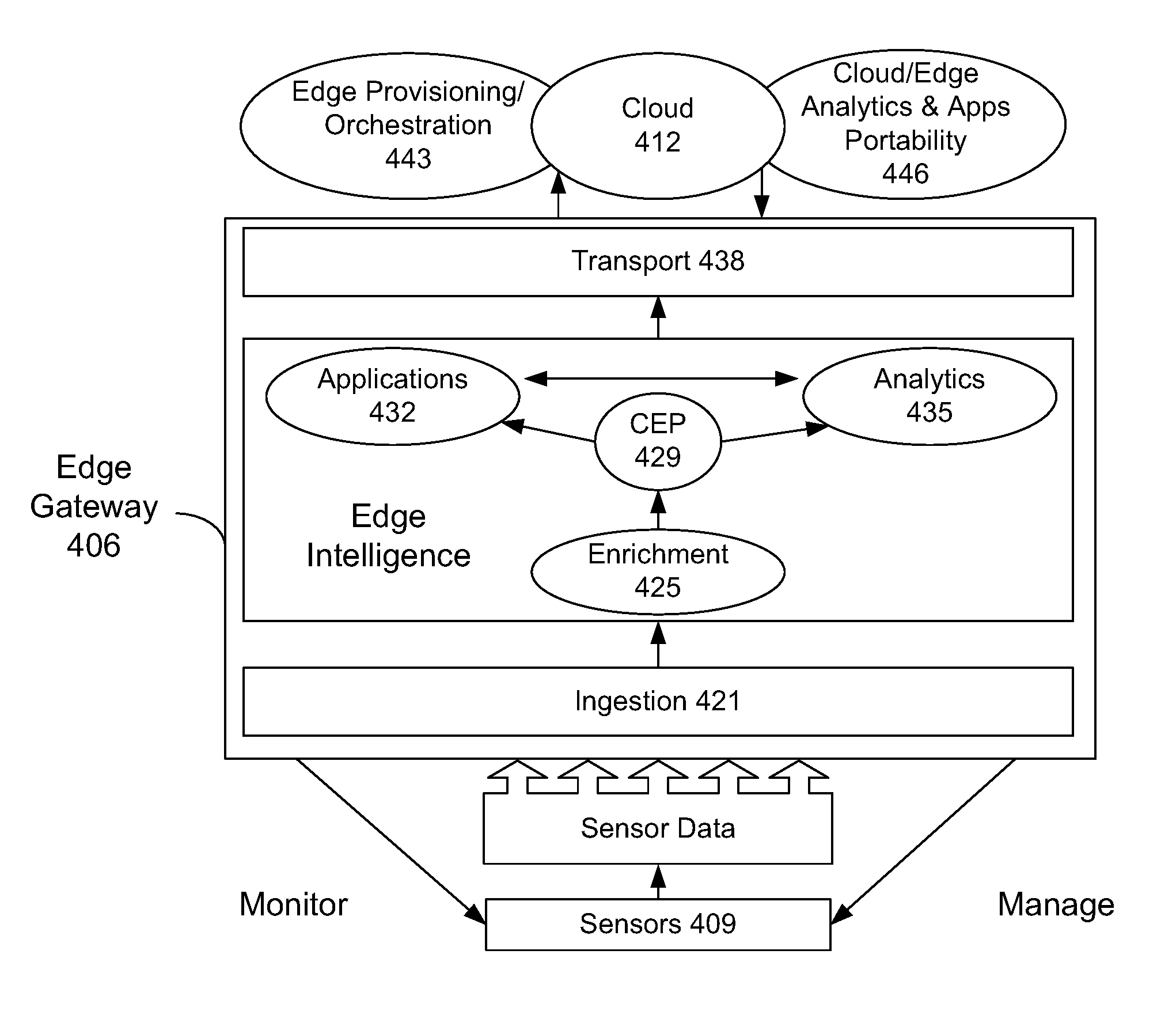
Edge Intelligence Platform, and Internet of Things Sensor Streams System
PatentActiveUS20170060574A1
Innovation
- The implementation of an edge computing platform that processes and analyzes data closer to the source using a software layer hosted on gateway devices or embedded systems, enabling real-time analytics and automated responses through a highly expressive computer language and a complex event processing engine, while also allowing data to be published to the cloud for further machine learning.

Data Privacy Regulations for Edge Computing
The deployment of edge intelligence frameworks in distributed sensor networks operates within a complex regulatory landscape that varies significantly across jurisdictions. The General Data Protection Regulation (GDPR) in the European Union establishes stringent requirements for data processing at the edge, mandating explicit consent for personal data collection and imposing strict limitations on cross-border data transfers. These regulations directly impact framework selection, as systems must incorporate privacy-by-design principles and demonstrate compliance through technical and organizational measures.
In the United States, sector-specific regulations such as HIPAA for healthcare and CCPA for consumer privacy create additional compliance layers for edge computing deployments. The California Consumer Privacy Act particularly affects distributed sensor networks that collect personal information, requiring transparent data handling practices and user control mechanisms. Framework architects must ensure that edge nodes can implement data minimization, purpose limitation, and user rights fulfillment without compromising network performance.
China's Personal Information Protection Law (PIPL) and Cybersecurity Law introduce data localization requirements that significantly influence edge framework design. These regulations mandate that critical information infrastructure operators store personal information and important data within Chinese borders, affecting how distributed sensor networks route and process data across edge nodes. Framework selection must account for geographic data residency requirements and cross-border transfer restrictions.
Emerging regulations in other jurisdictions, including Brazil's LGPD and India's proposed Personal Data Protection Bill, create additional compliance considerations. These laws emphasize data subject rights, consent management, and breach notification requirements that edge intelligence frameworks must support through automated compliance mechanisms and audit trails.
The regulatory landscape continues evolving with specific guidance for IoT and edge computing scenarios. Recent regulatory developments focus on algorithmic transparency, automated decision-making accountability, and enhanced security requirements for distributed systems. Framework comparison must therefore evaluate built-in compliance capabilities, regulatory reporting features, and adaptability to changing legal requirements across different deployment regions.
In the United States, sector-specific regulations such as HIPAA for healthcare and CCPA for consumer privacy create additional compliance layers for edge computing deployments. The California Consumer Privacy Act particularly affects distributed sensor networks that collect personal information, requiring transparent data handling practices and user control mechanisms. Framework architects must ensure that edge nodes can implement data minimization, purpose limitation, and user rights fulfillment without compromising network performance.
China's Personal Information Protection Law (PIPL) and Cybersecurity Law introduce data localization requirements that significantly influence edge framework design. These regulations mandate that critical information infrastructure operators store personal information and important data within Chinese borders, affecting how distributed sensor networks route and process data across edge nodes. Framework selection must account for geographic data residency requirements and cross-border transfer restrictions.
Emerging regulations in other jurisdictions, including Brazil's LGPD and India's proposed Personal Data Protection Bill, create additional compliance considerations. These laws emphasize data subject rights, consent management, and breach notification requirements that edge intelligence frameworks must support through automated compliance mechanisms and audit trails.
The regulatory landscape continues evolving with specific guidance for IoT and edge computing scenarios. Recent regulatory developments focus on algorithmic transparency, automated decision-making accountability, and enhanced security requirements for distributed systems. Framework comparison must therefore evaluate built-in compliance capabilities, regulatory reporting features, and adaptability to changing legal requirements across different deployment regions.
Energy Efficiency Standards for Edge Devices
Energy efficiency has emerged as a critical consideration in the deployment of edge intelligence frameworks for distributed sensor networks. The proliferation of IoT devices and edge computing nodes has necessitated the establishment of comprehensive energy efficiency standards that govern power consumption, thermal management, and operational sustainability across diverse deployment scenarios.
Current energy efficiency standards for edge devices encompass multiple regulatory frameworks and industry guidelines. The IEEE 802.11 series provides power management protocols for wireless communication, while the Energy Star certification program establishes baseline efficiency requirements for computing devices. The International Electrotechnical Commission (IEC) 62430 standard addresses environmentally conscious design principles, emphasizing energy optimization throughout device lifecycles.
Battery-powered edge devices typically adhere to ultra-low power consumption standards, targeting operational lifespans exceeding five years on single battery deployments. These standards mandate sleep mode power consumption below 10 microamperes and active processing power budgets under 100 milliwatts for typical sensor fusion tasks. Dynamic voltage and frequency scaling (DVFS) capabilities are increasingly required to optimize power consumption based on computational workload variations.
Thermal efficiency standards play a crucial role in edge device reliability and longevity. The JEDEC JESD51 series establishes thermal characterization methodologies, while military-grade standards like MIL-STD-810 define operational temperature ranges for harsh environmental conditions. Edge devices must demonstrate stable performance across temperature ranges from -40°C to +85°C while maintaining energy efficiency within specified tolerances.
Emerging standards focus on adaptive power management and energy harvesting integration. The IEEE 1936.1 standard addresses energy harvesting system architectures, enabling self-sustaining edge deployments through solar, vibration, or thermal energy collection. Machine learning-driven power optimization protocols are being standardized to enable predictive energy management based on usage patterns and environmental conditions.
Compliance verification requires standardized testing methodologies that evaluate real-world performance under varying computational loads, communication patterns, and environmental stresses. These standards ensure interoperability and performance predictability across heterogeneous edge intelligence deployments while supporting sustainable and cost-effective distributed sensor network operations.
Current energy efficiency standards for edge devices encompass multiple regulatory frameworks and industry guidelines. The IEEE 802.11 series provides power management protocols for wireless communication, while the Energy Star certification program establishes baseline efficiency requirements for computing devices. The International Electrotechnical Commission (IEC) 62430 standard addresses environmentally conscious design principles, emphasizing energy optimization throughout device lifecycles.
Battery-powered edge devices typically adhere to ultra-low power consumption standards, targeting operational lifespans exceeding five years on single battery deployments. These standards mandate sleep mode power consumption below 10 microamperes and active processing power budgets under 100 milliwatts for typical sensor fusion tasks. Dynamic voltage and frequency scaling (DVFS) capabilities are increasingly required to optimize power consumption based on computational workload variations.
Thermal efficiency standards play a crucial role in edge device reliability and longevity. The JEDEC JESD51 series establishes thermal characterization methodologies, while military-grade standards like MIL-STD-810 define operational temperature ranges for harsh environmental conditions. Edge devices must demonstrate stable performance across temperature ranges from -40°C to +85°C while maintaining energy efficiency within specified tolerances.
Emerging standards focus on adaptive power management and energy harvesting integration. The IEEE 1936.1 standard addresses energy harvesting system architectures, enabling self-sustaining edge deployments through solar, vibration, or thermal energy collection. Machine learning-driven power optimization protocols are being standardized to enable predictive energy management based on usage patterns and environmental conditions.
Compliance verification requires standardized testing methodologies that evaluate real-world performance under varying computational loads, communication patterns, and environmental stresses. These standards ensure interoperability and performance predictability across heterogeneous edge intelligence deployments while supporting sustainable and cost-effective distributed sensor network operations.
Unlock deeper insights with Patsnap Eureka Quick Research — get a full tech report to explore trends and direct your research. Try now!
Generate Your Research Report Instantly with AI Agent
Supercharge your innovation with Patsnap Eureka AI Agent Platform!