
How to Enhance Edge Intelligence for Multi-Platform Predictive Analytics
MAY 21, 20269 MIN READ
Generate Your Research Report Instantly with AI Agent
Patsnap Eureka helps you evaluate technical feasibility & market potential.
Edge Intelligence Background and Predictive Analytics Goals
Edge intelligence represents a paradigm shift in computational architecture, moving processing capabilities from centralized cloud infrastructures to distributed edge nodes positioned closer to data sources. This technological evolution emerged from the convergence of several critical factors: the exponential growth of IoT devices, increasing demands for real-time processing, bandwidth limitations, and privacy concerns associated with cloud-centric approaches. The concept fundamentally transforms how data is processed, analyzed, and acted upon across diverse computing environments.
The historical development of edge intelligence traces back to early distributed computing concepts but gained significant momentum with the proliferation of mobile devices and IoT ecosystems. Traditional cloud computing models, while offering substantial computational resources, introduced latency challenges and bandwidth constraints that became increasingly problematic for time-sensitive applications. Edge intelligence addresses these limitations by embedding artificial intelligence capabilities directly into edge devices, enabling local decision-making and reducing dependency on constant cloud connectivity.
Multi-platform predictive analytics represents the next evolutionary step in data-driven decision making, encompassing the ability to perform sophisticated analytical operations across heterogeneous computing environments. This approach integrates various hardware platforms, operating systems, and computational frameworks to create unified predictive models that can operate seamlessly across different technological ecosystems. The complexity arises from the need to maintain consistency, accuracy, and performance while adapting to diverse computational constraints and capabilities.
The primary objectives of enhancing edge intelligence for multi-platform predictive analytics center on achieving several key technological goals. First, establishing seamless interoperability between different edge computing platforms while maintaining analytical accuracy and model consistency. Second, optimizing resource utilization across diverse hardware configurations, from resource-constrained IoT devices to powerful edge servers. Third, implementing robust data synchronization mechanisms that ensure predictive models remain current and relevant across all platforms.
Another critical goal involves developing adaptive algorithms that can dynamically adjust their computational complexity based on available resources and real-time requirements. This includes creating intelligent model compression techniques, federated learning approaches, and distributed inference mechanisms that maximize predictive accuracy while respecting hardware limitations. The ultimate objective is to create a unified ecosystem where predictive analytics can operate efficiently across any platform, delivering consistent insights regardless of the underlying technological infrastructure.
The historical development of edge intelligence traces back to early distributed computing concepts but gained significant momentum with the proliferation of mobile devices and IoT ecosystems. Traditional cloud computing models, while offering substantial computational resources, introduced latency challenges and bandwidth constraints that became increasingly problematic for time-sensitive applications. Edge intelligence addresses these limitations by embedding artificial intelligence capabilities directly into edge devices, enabling local decision-making and reducing dependency on constant cloud connectivity.
Multi-platform predictive analytics represents the next evolutionary step in data-driven decision making, encompassing the ability to perform sophisticated analytical operations across heterogeneous computing environments. This approach integrates various hardware platforms, operating systems, and computational frameworks to create unified predictive models that can operate seamlessly across different technological ecosystems. The complexity arises from the need to maintain consistency, accuracy, and performance while adapting to diverse computational constraints and capabilities.
The primary objectives of enhancing edge intelligence for multi-platform predictive analytics center on achieving several key technological goals. First, establishing seamless interoperability between different edge computing platforms while maintaining analytical accuracy and model consistency. Second, optimizing resource utilization across diverse hardware configurations, from resource-constrained IoT devices to powerful edge servers. Third, implementing robust data synchronization mechanisms that ensure predictive models remain current and relevant across all platforms.
Another critical goal involves developing adaptive algorithms that can dynamically adjust their computational complexity based on available resources and real-time requirements. This includes creating intelligent model compression techniques, federated learning approaches, and distributed inference mechanisms that maximize predictive accuracy while respecting hardware limitations. The ultimate objective is to create a unified ecosystem where predictive analytics can operate efficiently across any platform, delivering consistent insights regardless of the underlying technological infrastructure.
Market Demand for Multi-Platform Edge Analytics Solutions
The global market for multi-platform edge analytics solutions is experiencing unprecedented growth driven by the convergence of IoT proliferation, 5G network deployment, and increasing demand for real-time decision-making capabilities. Organizations across industries are recognizing the critical need to process and analyze data closer to its source, reducing latency and bandwidth consumption while enabling immediate actionable insights.
Manufacturing sectors represent one of the largest demand drivers, where predictive maintenance, quality control, and operational optimization require instantaneous data processing across diverse equipment platforms. Smart factories are increasingly deploying edge analytics solutions that can seamlessly integrate with legacy systems, modern IoT sensors, and cloud infrastructure to enable comprehensive predictive analytics workflows.
The healthcare industry demonstrates substantial market appetite for edge-based predictive analytics, particularly in remote patient monitoring, medical device management, and clinical decision support systems. The ability to process sensitive health data locally while maintaining compliance with privacy regulations creates significant value propositions for healthcare providers seeking to enhance patient outcomes through predictive insights.
Retail and logistics sectors are driving demand for multi-platform edge analytics solutions to optimize supply chain operations, inventory management, and customer experience enhancement. The need to process data from multiple sources including RFID systems, cameras, sensors, and mobile devices in real-time has created substantial market opportunities for integrated edge analytics platforms.
Financial services organizations are increasingly adopting edge analytics for fraud detection, risk assessment, and algorithmic trading applications where millisecond response times are critical. The requirement to process transaction data across multiple platforms while maintaining security and regulatory compliance continues to fuel market expansion.
The telecommunications industry itself represents both a facilitator and consumer of edge analytics solutions, utilizing predictive analytics for network optimization, customer experience management, and infrastructure maintenance across diverse network equipment and platforms.
Market research indicates strong growth trajectories across geographic regions, with North America and Asia-Pacific leading adoption rates due to advanced digital infrastructure and regulatory support for edge computing initiatives. European markets show increasing momentum driven by data sovereignty requirements and industrial digitization programs.
Manufacturing sectors represent one of the largest demand drivers, where predictive maintenance, quality control, and operational optimization require instantaneous data processing across diverse equipment platforms. Smart factories are increasingly deploying edge analytics solutions that can seamlessly integrate with legacy systems, modern IoT sensors, and cloud infrastructure to enable comprehensive predictive analytics workflows.
The healthcare industry demonstrates substantial market appetite for edge-based predictive analytics, particularly in remote patient monitoring, medical device management, and clinical decision support systems. The ability to process sensitive health data locally while maintaining compliance with privacy regulations creates significant value propositions for healthcare providers seeking to enhance patient outcomes through predictive insights.
Retail and logistics sectors are driving demand for multi-platform edge analytics solutions to optimize supply chain operations, inventory management, and customer experience enhancement. The need to process data from multiple sources including RFID systems, cameras, sensors, and mobile devices in real-time has created substantial market opportunities for integrated edge analytics platforms.
Financial services organizations are increasingly adopting edge analytics for fraud detection, risk assessment, and algorithmic trading applications where millisecond response times are critical. The requirement to process transaction data across multiple platforms while maintaining security and regulatory compliance continues to fuel market expansion.
The telecommunications industry itself represents both a facilitator and consumer of edge analytics solutions, utilizing predictive analytics for network optimization, customer experience management, and infrastructure maintenance across diverse network equipment and platforms.
Market research indicates strong growth trajectories across geographic regions, with North America and Asia-Pacific leading adoption rates due to advanced digital infrastructure and regulatory support for edge computing initiatives. European markets show increasing momentum driven by data sovereignty requirements and industrial digitization programs.
Current Edge Computing Limitations and Technical Challenges
Edge computing faces significant computational constraints that severely limit the deployment of sophisticated predictive analytics models. Most edge devices operate with restricted processing power, limited memory capacity, and constrained storage resources. These hardware limitations prevent the execution of complex machine learning algorithms that require substantial computational overhead, forcing organizations to rely on simplified models that often compromise prediction accuracy and analytical depth.
Network connectivity presents another critical challenge for multi-platform predictive analytics at the edge. Intermittent connectivity, high latency, and bandwidth limitations create substantial barriers for real-time data synchronization and model updates across distributed platforms. Edge devices frequently operate in environments with unreliable network conditions, making it difficult to maintain consistent data flows and coordinate predictive analytics across multiple platforms simultaneously.
Data heterogeneity and standardization issues compound the complexity of implementing unified predictive analytics solutions. Different edge platforms generate data in varying formats, structures, and quality levels, creating significant integration challenges. The lack of standardized data schemas and communication protocols across diverse edge environments makes it extremely difficult to develop cohesive predictive models that can operate effectively across multiple platforms while maintaining data consistency and analytical reliability.
Real-time processing requirements create additional technical bottlenecks for edge intelligence systems. Predictive analytics applications often demand immediate responses to changing conditions, but current edge computing architectures struggle to balance processing speed with analytical sophistication. The trade-off between computational complexity and response time frequently results in oversimplified models that fail to capture the nuanced patterns necessary for accurate multi-platform predictions.
Security and privacy concerns present fundamental challenges for edge-based predictive analytics deployment. Edge devices typically lack robust security frameworks, making them vulnerable to various cyber threats that could compromise sensitive analytical data. The distributed nature of edge computing creates multiple attack vectors, while privacy regulations require sophisticated data protection mechanisms that are difficult to implement within the resource constraints of edge environments.
Model synchronization and version control across distributed edge networks remain significant technical hurdles. Maintaining consistency between predictive models deployed across multiple platforms requires sophisticated orchestration mechanisms that current edge computing frameworks struggle to provide effectively. The challenge intensifies when considering the need for continuous model updates and the coordination of learning processes across heterogeneous edge environments with varying computational capabilities and connectivity patterns.
Network connectivity presents another critical challenge for multi-platform predictive analytics at the edge. Intermittent connectivity, high latency, and bandwidth limitations create substantial barriers for real-time data synchronization and model updates across distributed platforms. Edge devices frequently operate in environments with unreliable network conditions, making it difficult to maintain consistent data flows and coordinate predictive analytics across multiple platforms simultaneously.
Data heterogeneity and standardization issues compound the complexity of implementing unified predictive analytics solutions. Different edge platforms generate data in varying formats, structures, and quality levels, creating significant integration challenges. The lack of standardized data schemas and communication protocols across diverse edge environments makes it extremely difficult to develop cohesive predictive models that can operate effectively across multiple platforms while maintaining data consistency and analytical reliability.
Real-time processing requirements create additional technical bottlenecks for edge intelligence systems. Predictive analytics applications often demand immediate responses to changing conditions, but current edge computing architectures struggle to balance processing speed with analytical sophistication. The trade-off between computational complexity and response time frequently results in oversimplified models that fail to capture the nuanced patterns necessary for accurate multi-platform predictions.
Security and privacy concerns present fundamental challenges for edge-based predictive analytics deployment. Edge devices typically lack robust security frameworks, making them vulnerable to various cyber threats that could compromise sensitive analytical data. The distributed nature of edge computing creates multiple attack vectors, while privacy regulations require sophisticated data protection mechanisms that are difficult to implement within the resource constraints of edge environments.
Model synchronization and version control across distributed edge networks remain significant technical hurdles. Maintaining consistency between predictive models deployed across multiple platforms requires sophisticated orchestration mechanisms that current edge computing frameworks struggle to provide effectively. The challenge intensifies when considering the need for continuous model updates and the coordination of learning processes across heterogeneous edge environments with varying computational capabilities and connectivity patterns.
Existing Multi-Platform Edge Intelligence Frameworks
01 Edge computing architectures and frameworks
Systems and methods for implementing distributed computing architectures at the network edge to enable intelligent processing closer to data sources. These frameworks provide the foundational infrastructure for deploying computational resources and managing workloads across edge nodes, enabling reduced latency and improved performance for real-time applications.- Edge computing architectures and frameworks: Systems and methods for implementing distributed computing architectures that bring computation and data storage closer to the sources of data. These frameworks enable processing at the network edge to reduce latency, improve response times, and enhance overall system performance. The architectures typically involve edge nodes, gateways, and distributed processing units that work together to handle computational tasks locally rather than relying solely on centralized cloud resources.
- Machine learning and AI algorithms for edge devices: Implementation of artificial intelligence and machine learning algorithms specifically optimized for edge computing environments. These solutions focus on lightweight models, federated learning approaches, and inference optimization techniques that can operate efficiently on resource-constrained edge devices. The algorithms are designed to perform real-time decision making and pattern recognition without requiring constant connectivity to central servers.
- Data processing and analytics at network edge: Methods and systems for performing real-time data processing, filtering, and analytics directly at the edge of networks. These approaches enable immediate insights from sensor data, IoT devices, and other edge sources while minimizing bandwidth usage and reducing the need to transmit raw data to centralized locations. The processing capabilities include data aggregation, preprocessing, and preliminary analysis functions.
- Edge device management and orchestration: Systems for managing, monitoring, and orchestrating multiple edge devices and their computational workloads. These solutions provide centralized control over distributed edge infrastructure, including device provisioning, software updates, resource allocation, and performance monitoring. The management systems ensure optimal utilization of edge resources while maintaining security and reliability across the distributed network.
- Security and privacy in edge intelligence systems: Security frameworks and privacy-preserving techniques specifically designed for edge computing environments. These solutions address the unique security challenges of distributed edge systems, including secure communication protocols, data encryption at the edge, access control mechanisms, and privacy-preserving computation methods. The approaches ensure data protection while maintaining the performance benefits of edge processing.
02 Machine learning inference at edge devices
Techniques for deploying and executing machine learning models on resource-constrained edge devices to enable intelligent decision-making without relying on cloud connectivity. These approaches optimize model compression, quantization, and inference acceleration to make artificial intelligence capabilities available at the network edge.Expand Specific Solutions03 Data processing and analytics optimization
Methods for efficient data collection, preprocessing, and analytics at edge locations to minimize bandwidth usage and enable real-time insights. These solutions focus on intelligent data filtering, aggregation, and local processing capabilities that reduce the need for centralized data transmission while maintaining analytical accuracy.Expand Specific Solutions04 Resource management and orchestration
Systems for dynamically managing computational resources, workload distribution, and service orchestration across distributed edge infrastructure. These technologies enable automatic scaling, load balancing, and optimal resource allocation to ensure efficient utilization of edge computing capabilities while maintaining service quality.Expand Specific Solutions05 Security and privacy preservation mechanisms
Approaches for implementing robust security protocols and privacy-preserving techniques in edge intelligence systems. These methods address challenges related to distributed security management, data protection, secure communication between edge nodes, and maintaining privacy while enabling intelligent processing at the network edge.Expand Specific Solutions
Key Players in Edge Computing and Analytics Platforms
The competitive landscape for enhancing edge intelligence in multi-platform predictive analytics represents a rapidly evolving market in its growth stage, with significant expansion driven by increasing demand for real-time data processing and AI-driven insights. The market demonstrates substantial scale potential across telecommunications, manufacturing, and IoT sectors. Technology maturity varies considerably among key players: established giants like IBM, Intel, Samsung Electronics, and Hewlett Packard Enterprise lead with comprehensive edge computing platforms and mature AI capabilities, while telecommunications leaders Ericsson and AT&T focus on network-integrated solutions. Chinese universities including Fudan, Tianjin, and Beijing University of Posts & Telecommunications contribute significant research advancement, and emerging specialists like PPIO and Shenzhen Jianghang Lianjia represent innovative approaches to distributed edge computing architectures.
International Business Machines Corp.
Technical Solution: IBM develops comprehensive edge intelligence solutions through Watson IoT Edge Analytics and IBM Edge Application Manager. Their approach leverages federated learning algorithms that enable distributed model training across edge devices while maintaining data privacy. The platform integrates real-time stream processing with predictive analytics models optimized for resource-constrained environments. IBM's edge computing framework supports multi-platform deployment through containerized microservices architecture, enabling seamless integration across different hardware configurations. Their solution incorporates automated model compression techniques and dynamic resource allocation to optimize performance across heterogeneous edge infrastructure.
Strengths: Enterprise-grade security, robust federated learning capabilities, comprehensive platform integration. Weaknesses: High implementation complexity, significant resource requirements for full deployment.
Hitachi Ltd.
Technical Solution: Hitachi implements edge intelligence through their Lumada IoT platform and Vantara data analytics solutions. Their approach focuses on industrial predictive analytics with edge computing capabilities that support real-time decision making in manufacturing and infrastructure environments. The platform utilizes distributed AI algorithms optimized for operational technology environments, incorporating time-series analysis and anomaly detection specifically designed for industrial applications. Hitachi's multi-platform strategy includes support for various industrial protocols and legacy system integration, enabling predictive analytics deployment across diverse operational environments. Their solution emphasizes reliability and deterministic performance requirements typical in industrial edge computing scenarios with built-in redundancy and failover mechanisms.
Strengths: Deep industrial domain expertise, proven reliability in operational environments, strong legacy system integration. Weaknesses: Limited consumer market presence, higher complexity for non-industrial applications.
Core Innovations in Distributed Predictive Analytics
Methods, devices, and systems for analytics-enhanced edge enabling layer service continuity
PatentPendingUS20250365207A1
Innovation
- Integrate an analytics service (ADAES) to provide predictive analytics for service continuity, enabling proactive detection of ACR triggers, recommendation of T-EES and/or T-EAS, and proactive EAS instantiation.


Edge Intelligence Platform, and Internet of Things Sensor Streams System
PatentActiveUS20170060574A1
Innovation
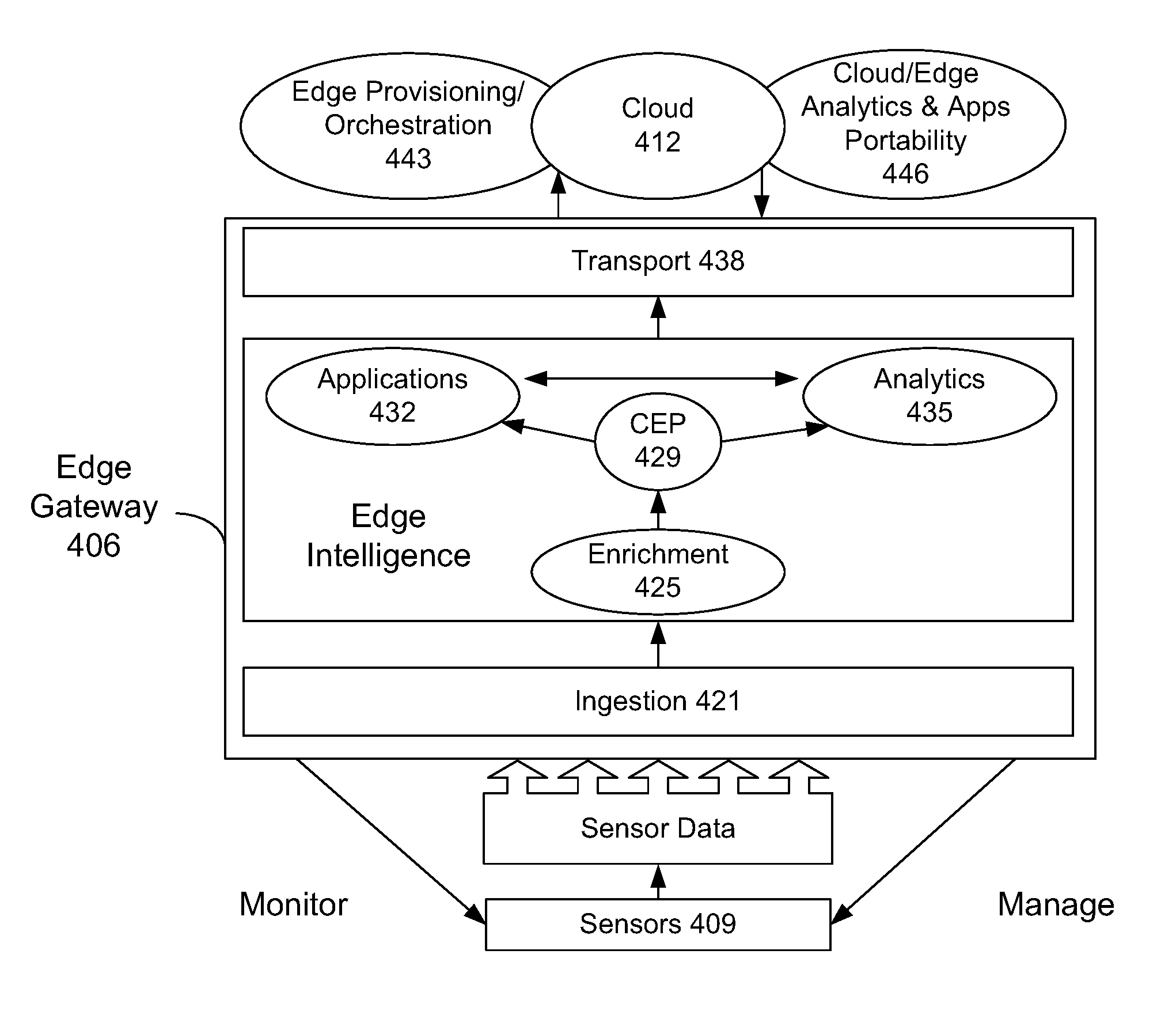
- The implementation of an edge computing platform that processes and analyzes data closer to the source using a software layer hosted on gateway devices or embedded systems, enabling real-time analytics and automated responses through a highly expressive computer language and a complex event processing engine, while also allowing data to be published to the cloud for further machine learning.

Data Privacy and Security in Edge Analytics
Data privacy and security represent critical challenges in edge analytics environments, where sensitive information is processed across distributed computing nodes closer to data sources. The decentralized nature of edge computing introduces unique vulnerabilities that differ significantly from traditional centralized cloud architectures, requiring specialized approaches to maintain data integrity and confidentiality.
The primary security concerns in edge analytics stem from the expanded attack surface created by numerous edge devices operating in potentially unsecured environments. Unlike data centers with controlled physical access and robust security infrastructure, edge nodes often operate in remote locations with limited physical protection. This exposure increases risks of device tampering, unauthorized access, and data interception during transmission between edge nodes and central systems.
Privacy preservation becomes particularly complex when implementing multi-platform predictive analytics across heterogeneous edge environments. Different platforms may employ varying encryption standards, authentication protocols, and data handling procedures, creating potential security gaps at integration points. The challenge intensifies when personal or proprietary data must be processed locally while maintaining compliance with regulations such as GDPR, HIPAA, or industry-specific privacy requirements.
Federated learning approaches have emerged as a promising solution for maintaining privacy while enabling collaborative analytics across edge platforms. This methodology allows models to be trained on local data without requiring raw data transmission, significantly reducing privacy risks. However, implementation challenges include ensuring model integrity, preventing inference attacks, and managing computational overhead across resource-constrained edge devices.
Encryption strategies for edge analytics must balance security requirements with performance constraints inherent in edge computing environments. Lightweight cryptographic algorithms and hardware-based security modules are increasingly deployed to protect data both at rest and in transit. Additionally, zero-trust security frameworks are being adapted for edge environments, implementing continuous authentication and authorization processes that verify every access request regardless of source location.
The integration of blockchain technology and secure multi-party computation protocols offers additional layers of protection for sensitive analytics operations. These technologies enable secure data sharing and computation across multiple parties without exposing underlying datasets, though implementation complexity and computational requirements remain significant considerations for practical deployment in resource-limited edge environments.
The primary security concerns in edge analytics stem from the expanded attack surface created by numerous edge devices operating in potentially unsecured environments. Unlike data centers with controlled physical access and robust security infrastructure, edge nodes often operate in remote locations with limited physical protection. This exposure increases risks of device tampering, unauthorized access, and data interception during transmission between edge nodes and central systems.
Privacy preservation becomes particularly complex when implementing multi-platform predictive analytics across heterogeneous edge environments. Different platforms may employ varying encryption standards, authentication protocols, and data handling procedures, creating potential security gaps at integration points. The challenge intensifies when personal or proprietary data must be processed locally while maintaining compliance with regulations such as GDPR, HIPAA, or industry-specific privacy requirements.
Federated learning approaches have emerged as a promising solution for maintaining privacy while enabling collaborative analytics across edge platforms. This methodology allows models to be trained on local data without requiring raw data transmission, significantly reducing privacy risks. However, implementation challenges include ensuring model integrity, preventing inference attacks, and managing computational overhead across resource-constrained edge devices.
Encryption strategies for edge analytics must balance security requirements with performance constraints inherent in edge computing environments. Lightweight cryptographic algorithms and hardware-based security modules are increasingly deployed to protect data both at rest and in transit. Additionally, zero-trust security frameworks are being adapted for edge environments, implementing continuous authentication and authorization processes that verify every access request regardless of source location.
The integration of blockchain technology and secure multi-party computation protocols offers additional layers of protection for sensitive analytics operations. These technologies enable secure data sharing and computation across multiple parties without exposing underlying datasets, though implementation complexity and computational requirements remain significant considerations for practical deployment in resource-limited edge environments.
Standardization Efforts for Cross-Platform Compatibility
The standardization landscape for cross-platform compatibility in edge intelligence and predictive analytics is rapidly evolving, driven by the need to create unified frameworks that enable seamless interoperability across diverse computing environments. Current standardization efforts focus on establishing common protocols, data formats, and communication interfaces that allow edge devices, cloud platforms, and hybrid systems to work cohesively in multi-platform predictive analytics deployments.
Several key standardization bodies are actively developing frameworks to address cross-platform compatibility challenges. The Industrial Internet Consortium (IIC) has introduced the Industrial Internet Reference Architecture, which provides guidelines for edge-to-cloud integration in predictive analytics scenarios. Similarly, the Open Edge Computing Initiative has established standards for containerized workload deployment across heterogeneous edge infrastructure, enabling consistent predictive model execution regardless of underlying hardware architectures.
Data interchange standardization represents a critical component of cross-platform compatibility efforts. The adoption of standardized formats such as Apache Arrow for in-memory data processing and ONNX (Open Neural Network Exchange) for machine learning model portability has significantly improved interoperability between different predictive analytics platforms. These standards enable seamless model transfer and execution across various edge computing environments without requiring extensive code modifications or platform-specific adaptations.
Communication protocol standardization has emerged as another vital area, with initiatives like MQTT 5.0 and CoAP providing lightweight messaging frameworks optimized for edge environments. These protocols facilitate reliable data transmission between edge devices and centralized analytics platforms while maintaining low latency and minimal resource consumption requirements essential for real-time predictive analytics applications.
Container orchestration standards, particularly those developed by the Cloud Native Computing Foundation, have established consistent deployment methodologies for predictive analytics workloads across different edge platforms. Kubernetes-based edge computing frameworks now provide standardized APIs and resource management capabilities that ensure predictive models can be deployed and scaled uniformly across diverse infrastructure environments, from resource-constrained IoT devices to powerful edge servers.
Several key standardization bodies are actively developing frameworks to address cross-platform compatibility challenges. The Industrial Internet Consortium (IIC) has introduced the Industrial Internet Reference Architecture, which provides guidelines for edge-to-cloud integration in predictive analytics scenarios. Similarly, the Open Edge Computing Initiative has established standards for containerized workload deployment across heterogeneous edge infrastructure, enabling consistent predictive model execution regardless of underlying hardware architectures.
Data interchange standardization represents a critical component of cross-platform compatibility efforts. The adoption of standardized formats such as Apache Arrow for in-memory data processing and ONNX (Open Neural Network Exchange) for machine learning model portability has significantly improved interoperability between different predictive analytics platforms. These standards enable seamless model transfer and execution across various edge computing environments without requiring extensive code modifications or platform-specific adaptations.
Communication protocol standardization has emerged as another vital area, with initiatives like MQTT 5.0 and CoAP providing lightweight messaging frameworks optimized for edge environments. These protocols facilitate reliable data transmission between edge devices and centralized analytics platforms while maintaining low latency and minimal resource consumption requirements essential for real-time predictive analytics applications.
Container orchestration standards, particularly those developed by the Cloud Native Computing Foundation, have established consistent deployment methodologies for predictive analytics workloads across different edge platforms. Kubernetes-based edge computing frameworks now provide standardized APIs and resource management capabilities that ensure predictive models can be deployed and scaled uniformly across diverse infrastructure environments, from resource-constrained IoT devices to powerful edge servers.
Unlock deeper insights with Patsnap Eureka Quick Research — get a full tech report to explore trends and direct your research. Try now!
Generate Your Research Report Instantly with AI Agent
Supercharge your innovation with Patsnap Eureka AI Agent Platform!