
Optimizing Edge Intelligence for Deeper Integration in Smart Ecosystems
MAY 21, 20269 MIN READ
Generate Your Research Report Instantly with AI Agent
Patsnap Eureka helps you evaluate technical feasibility & market potential.
Edge Intelligence Background and Smart Ecosystem Goals
Edge intelligence represents a paradigm shift in computational architecture, emerging from the convergence of artificial intelligence, Internet of Things (IoT), and distributed computing technologies. This technological evolution addresses the fundamental limitations of centralized cloud computing by bringing computational capabilities closer to data sources and end users. The concept gained prominence in the early 2010s as organizations recognized the need for real-time processing, reduced latency, and enhanced privacy in increasingly connected environments.
The historical development of edge intelligence traces back to the proliferation of mobile devices and IoT sensors, which generated unprecedented volumes of data requiring immediate processing. Traditional cloud-centric approaches proved inadequate for applications demanding millisecond response times, such as autonomous vehicles, industrial automation, and augmented reality systems. This technological gap catalyzed the development of edge computing frameworks that could support AI workloads at network peripheries.
Smart ecosystems represent interconnected networks of intelligent devices, sensors, and systems that collaborate to deliver seamless user experiences and optimized operational efficiency. These ecosystems encompass diverse domains including smart cities, intelligent transportation, healthcare networks, industrial IoT, and connected homes. The integration of edge intelligence within these ecosystems enables distributed decision-making, reduces bandwidth consumption, and enhances system resilience through decentralized processing capabilities.
The primary technological objectives for optimizing edge intelligence in smart ecosystems focus on achieving seamless interoperability between heterogeneous devices and platforms. This includes developing standardized communication protocols, implementing adaptive resource allocation mechanisms, and creating unified management frameworks that can orchestrate distributed AI workloads across diverse edge nodes.
Performance optimization goals emphasize minimizing processing latency while maximizing computational efficiency within resource-constrained environments. Advanced techniques such as model compression, federated learning, and dynamic workload distribution are essential for achieving these objectives. Additionally, ensuring robust security and privacy protection across distributed edge networks remains a critical technical challenge.
The ultimate vision encompasses creating self-organizing, adaptive smart ecosystems where edge intelligence enables autonomous optimization of system performance, predictive maintenance, and intelligent resource management. These systems should demonstrate emergent behaviors that enhance overall ecosystem efficiency while maintaining individual component autonomy and user privacy protection.
The historical development of edge intelligence traces back to the proliferation of mobile devices and IoT sensors, which generated unprecedented volumes of data requiring immediate processing. Traditional cloud-centric approaches proved inadequate for applications demanding millisecond response times, such as autonomous vehicles, industrial automation, and augmented reality systems. This technological gap catalyzed the development of edge computing frameworks that could support AI workloads at network peripheries.
Smart ecosystems represent interconnected networks of intelligent devices, sensors, and systems that collaborate to deliver seamless user experiences and optimized operational efficiency. These ecosystems encompass diverse domains including smart cities, intelligent transportation, healthcare networks, industrial IoT, and connected homes. The integration of edge intelligence within these ecosystems enables distributed decision-making, reduces bandwidth consumption, and enhances system resilience through decentralized processing capabilities.
The primary technological objectives for optimizing edge intelligence in smart ecosystems focus on achieving seamless interoperability between heterogeneous devices and platforms. This includes developing standardized communication protocols, implementing adaptive resource allocation mechanisms, and creating unified management frameworks that can orchestrate distributed AI workloads across diverse edge nodes.
Performance optimization goals emphasize minimizing processing latency while maximizing computational efficiency within resource-constrained environments. Advanced techniques such as model compression, federated learning, and dynamic workload distribution are essential for achieving these objectives. Additionally, ensuring robust security and privacy protection across distributed edge networks remains a critical technical challenge.
The ultimate vision encompasses creating self-organizing, adaptive smart ecosystems where edge intelligence enables autonomous optimization of system performance, predictive maintenance, and intelligent resource management. These systems should demonstrate emergent behaviors that enhance overall ecosystem efficiency while maintaining individual component autonomy and user privacy protection.
Market Demand for Integrated Edge Computing Solutions
The global edge computing market is experiencing unprecedented growth driven by the proliferation of IoT devices, autonomous systems, and real-time applications requiring ultra-low latency processing. Organizations across industries are increasingly recognizing the limitations of centralized cloud architectures in supporting time-critical operations, creating substantial demand for integrated edge intelligence solutions that can process data closer to its source.
Manufacturing sectors are leading adoption of integrated edge computing solutions to enable predictive maintenance, quality control, and autonomous production systems. Smart factories require real-time analytics capabilities that can operate independently of cloud connectivity while maintaining seamless integration with broader enterprise systems. The automotive industry similarly demands edge intelligence for autonomous vehicle operations, where millisecond response times are critical for safety and performance.
Healthcare applications represent another significant growth area, with medical devices and diagnostic equipment requiring local processing capabilities for patient monitoring, emergency response systems, and surgical robotics. The need for HIPAA-compliant data processing at the edge while maintaining integration with hospital information systems drives demand for sophisticated edge intelligence platforms.
Smart city initiatives worldwide are creating substantial market opportunities for integrated edge computing solutions. Traffic management systems, environmental monitoring networks, and public safety infrastructure require distributed intelligence that can operate autonomously while contributing to city-wide optimization algorithms. These applications demand edge solutions capable of handling diverse data types and communication protocols.
The telecommunications industry's deployment of 5G networks is accelerating demand for edge computing infrastructure that can support network slicing, mobile edge computing, and ultra-reliable low-latency communications. Service providers require integrated solutions that can dynamically allocate computing resources based on real-time network conditions and application requirements.
Retail and logistics sectors are increasingly adopting edge intelligence for inventory management, customer analytics, and supply chain optimization. These applications require seamless integration between edge devices, local processing systems, and enterprise resource planning platforms to enable real-time decision-making across distributed operations.
The convergence of artificial intelligence with edge computing is creating new market segments focused on intelligent edge solutions that can adapt and learn from local data patterns while maintaining connectivity to broader AI ecosystems for model updates and collaborative learning.
Manufacturing sectors are leading adoption of integrated edge computing solutions to enable predictive maintenance, quality control, and autonomous production systems. Smart factories require real-time analytics capabilities that can operate independently of cloud connectivity while maintaining seamless integration with broader enterprise systems. The automotive industry similarly demands edge intelligence for autonomous vehicle operations, where millisecond response times are critical for safety and performance.
Healthcare applications represent another significant growth area, with medical devices and diagnostic equipment requiring local processing capabilities for patient monitoring, emergency response systems, and surgical robotics. The need for HIPAA-compliant data processing at the edge while maintaining integration with hospital information systems drives demand for sophisticated edge intelligence platforms.
Smart city initiatives worldwide are creating substantial market opportunities for integrated edge computing solutions. Traffic management systems, environmental monitoring networks, and public safety infrastructure require distributed intelligence that can operate autonomously while contributing to city-wide optimization algorithms. These applications demand edge solutions capable of handling diverse data types and communication protocols.
The telecommunications industry's deployment of 5G networks is accelerating demand for edge computing infrastructure that can support network slicing, mobile edge computing, and ultra-reliable low-latency communications. Service providers require integrated solutions that can dynamically allocate computing resources based on real-time network conditions and application requirements.
Retail and logistics sectors are increasingly adopting edge intelligence for inventory management, customer analytics, and supply chain optimization. These applications require seamless integration between edge devices, local processing systems, and enterprise resource planning platforms to enable real-time decision-making across distributed operations.
The convergence of artificial intelligence with edge computing is creating new market segments focused on intelligent edge solutions that can adapt and learn from local data patterns while maintaining connectivity to broader AI ecosystems for model updates and collaborative learning.
Current Edge Intelligence State and Integration Challenges
Edge intelligence has emerged as a transformative paradigm that extends artificial intelligence capabilities from centralized cloud infrastructures to distributed edge devices, enabling real-time processing and decision-making at the network periphery. Current implementations demonstrate varying degrees of maturity across different sectors, with industrial IoT, autonomous vehicles, and smart city applications leading adoption rates. The technology landscape reveals a fragmented ecosystem where edge devices possess heterogeneous computing capabilities, ranging from resource-constrained sensors to powerful edge servers equipped with specialized AI accelerators.
The integration of edge intelligence into smart ecosystems faces significant architectural challenges stemming from the inherent complexity of coordinating distributed intelligence across multiple layers. Existing solutions often operate in silos, creating isolated intelligence pockets that fail to leverage collective insights from interconnected devices. This fragmentation results in suboptimal resource utilization and limits the potential for emergent behaviors that could enhance overall system performance.
Interoperability remains a critical bottleneck, as current edge intelligence implementations rely on proprietary protocols and data formats that hinder seamless communication between devices from different manufacturers. The absence of standardized interfaces creates integration friction, forcing organizations to invest substantial resources in custom middleware solutions and protocol translation layers. This challenge is particularly pronounced in multi-vendor environments where legacy systems must coexist with modern edge intelligence platforms.
Resource management presents another fundamental challenge, as edge devices operate under strict constraints regarding computational power, memory, and energy consumption. Current approaches to workload distribution and task scheduling often lack the sophistication needed to dynamically optimize resource allocation across the entire ecosystem. The static nature of many existing solutions fails to adapt to changing environmental conditions and varying computational demands.
Security and privacy concerns compound integration difficulties, as edge intelligence systems must balance the need for data sharing and collaborative processing with stringent protection requirements. Current security frameworks often impose significant overhead that conflicts with the low-latency objectives of edge computing, creating tension between performance and protection that remains largely unresolved in practical deployments.
Data consistency and synchronization across distributed edge nodes represent ongoing technical hurdles that impact system reliability and decision-making accuracy. Existing consensus mechanisms and data replication strategies frequently prove inadequate for the scale and dynamism characteristic of modern smart ecosystems, leading to potential conflicts and degraded performance during peak operational periods.
The integration of edge intelligence into smart ecosystems faces significant architectural challenges stemming from the inherent complexity of coordinating distributed intelligence across multiple layers. Existing solutions often operate in silos, creating isolated intelligence pockets that fail to leverage collective insights from interconnected devices. This fragmentation results in suboptimal resource utilization and limits the potential for emergent behaviors that could enhance overall system performance.
Interoperability remains a critical bottleneck, as current edge intelligence implementations rely on proprietary protocols and data formats that hinder seamless communication between devices from different manufacturers. The absence of standardized interfaces creates integration friction, forcing organizations to invest substantial resources in custom middleware solutions and protocol translation layers. This challenge is particularly pronounced in multi-vendor environments where legacy systems must coexist with modern edge intelligence platforms.
Resource management presents another fundamental challenge, as edge devices operate under strict constraints regarding computational power, memory, and energy consumption. Current approaches to workload distribution and task scheduling often lack the sophistication needed to dynamically optimize resource allocation across the entire ecosystem. The static nature of many existing solutions fails to adapt to changing environmental conditions and varying computational demands.
Security and privacy concerns compound integration difficulties, as edge intelligence systems must balance the need for data sharing and collaborative processing with stringent protection requirements. Current security frameworks often impose significant overhead that conflicts with the low-latency objectives of edge computing, creating tension between performance and protection that remains largely unresolved in practical deployments.
Data consistency and synchronization across distributed edge nodes represent ongoing technical hurdles that impact system reliability and decision-making accuracy. Existing consensus mechanisms and data replication strategies frequently prove inadequate for the scale and dynamism characteristic of modern smart ecosystems, leading to potential conflicts and degraded performance during peak operational periods.
Existing Edge-Cloud Integration Solutions
01 Edge computing architecture and system integration
Systems and methods for integrating edge computing architectures that enable distributed processing capabilities at network edges. These solutions focus on creating seamless integration between edge nodes and central systems, allowing for efficient data processing and reduced latency in distributed computing environments.- Edge computing architecture and infrastructure integration: Systems and methods for integrating edge computing infrastructure with intelligent processing capabilities. This involves establishing distributed computing architectures that enable processing at the network edge, reducing latency and improving response times. The integration focuses on creating seamless connections between edge nodes and central systems while maintaining computational efficiency and resource optimization.
- Real-time data processing and analytics at edge nodes: Technologies for implementing real-time data processing and analytics capabilities directly at edge computing nodes. This approach enables immediate data analysis and decision-making without requiring data transmission to centralized servers. The integration depth involves sophisticated algorithms and processing frameworks that can operate efficiently within the constraints of edge computing environments.
- Machine learning and AI model deployment in edge environments: Methods for deploying and integrating artificial intelligence and machine learning models within edge computing systems. This involves optimizing AI algorithms for resource-constrained edge devices while maintaining performance and accuracy. The integration encompasses model compression, distributed learning, and adaptive algorithms that can function effectively in edge computing scenarios.
- Network communication and protocol optimization for edge intelligence: Systems for optimizing network communication protocols and data transmission methods specifically designed for edge intelligence applications. This includes developing efficient communication frameworks that support low-latency data exchange between edge devices and intelligent processing systems. The integration focuses on bandwidth optimization and reliable connectivity in distributed edge environments.
- Security and privacy frameworks for integrated edge intelligence systems: Comprehensive security and privacy protection mechanisms designed for edge intelligence integration. This involves implementing robust authentication, encryption, and access control systems that protect data and computational processes at the edge. The integration depth includes privacy-preserving techniques and secure communication protocols that maintain system integrity while enabling intelligent edge operations.
02 Intelligent data processing and analytics at edge devices
Technologies for implementing artificial intelligence and machine learning algorithms directly on edge devices to enable real-time data processing and decision making. These approaches allow for intelligent analysis of data streams without requiring constant communication with centralized servers.Expand Specific Solutions03 Network optimization and communication protocols for edge intelligence
Methods and systems for optimizing network communications and protocols specifically designed for edge intelligence applications. These solutions address bandwidth management, data transmission efficiency, and communication protocols that support distributed intelligence across edge networks.Expand Specific Solutions04 Resource management and orchestration in edge environments
Techniques for managing computational resources, memory allocation, and workload distribution across edge computing environments. These systems provide dynamic resource allocation and orchestration capabilities to optimize performance and efficiency in distributed edge intelligence deployments.Expand Specific Solutions05 Security and privacy frameworks for edge intelligence systems
Security mechanisms and privacy protection frameworks specifically designed for edge intelligence applications. These solutions address data protection, secure communication channels, and privacy-preserving computation methods in distributed edge computing environments.Expand Specific Solutions
Key Players in Edge Intelligence and Smart Ecosystem Industry
The edge intelligence optimization landscape is experiencing rapid evolution as the industry transitions from nascent experimentation to mainstream deployment across smart ecosystems. Market growth is accelerating, driven by increasing demand for real-time processing and reduced latency in IoT applications. Technology maturity varies significantly among key players, with established giants like IBM, Intel, and Huawei leading in comprehensive edge computing platforms and AI integration capabilities. Amazon Technologies and Google's X Development are advancing cloud-edge convergence solutions, while specialized firms like Korea Electronics Technology Institute focus on hardware optimization. Academic institutions including University of Florida and Southeast University contribute foundational research in edge AI algorithms. Companies like Mitsubishi Electric and Gree Electric demonstrate sector-specific implementations in industrial and consumer applications. The competitive landscape shows consolidation around hybrid cloud-edge architectures, with players differentiating through specialized vertical solutions and advanced AI processing capabilities at the network edge.
International Business Machines Corp.
Technical Solution: IBM's edge intelligence approach centers on IBM Edge Application Manager and Watson IoT platform, providing enterprise-grade edge computing solutions with integrated AI capabilities. Their technology stack includes federated learning frameworks, edge analytics engines, and hybrid cloud integration that enables seamless data flow between edge devices and central cloud systems. IBM emphasizes autonomous edge management, security-first design, and industry-specific solutions for manufacturing, healthcare, and smart infrastructure. The platform supports containerized applications, real-time decision making, and maintains data sovereignty while enabling collaborative intelligence across distributed edge networks.
Strengths: Enterprise-grade security and compliance, strong industry partnerships, robust hybrid cloud integration capabilities. Weaknesses: Complex deployment processes, higher costs compared to lightweight edge solutions, steeper learning curve for implementation.
Intel Corp.
Technical Solution: Intel develops comprehensive edge AI solutions through their OpenVINO toolkit and Intel Distribution of OpenVINO, enabling optimized deep learning inference across edge devices. Their approach focuses on model optimization, hardware acceleration using Intel CPUs, GPUs, and VPUs (Vision Processing Units), and provides unified APIs for deploying AI models across heterogeneous computing environments. The company's edge intelligence strategy emphasizes low-latency processing, reduced bandwidth requirements, and enhanced privacy through local data processing, making it particularly suitable for smart city infrastructure, industrial IoT, and autonomous systems integration.
Strengths: Comprehensive hardware-software co-optimization, extensive developer ecosystem, proven scalability across diverse edge environments. Weaknesses: Higher power consumption compared to specialized edge chips, dependency on Intel hardware ecosystem limits flexibility.
Core Innovations in Edge AI Optimization Technologies
Edge intelligence powered security solutions and other applications for a smart city
PatentActiveUS20210302621A1
Innovation
- A modular edge intelligence platform that includes a base station for communication and an application module for specific functionalities, such as weather analysis, deployed atop streetlights to capture images and identify cloud formations using AI, providing detailed weather information through low-bandwidth wireless communication.


Edge Intelligence Platform, and Internet of Things Sensor Streams System
PatentActiveUS20170060574A1
Innovation
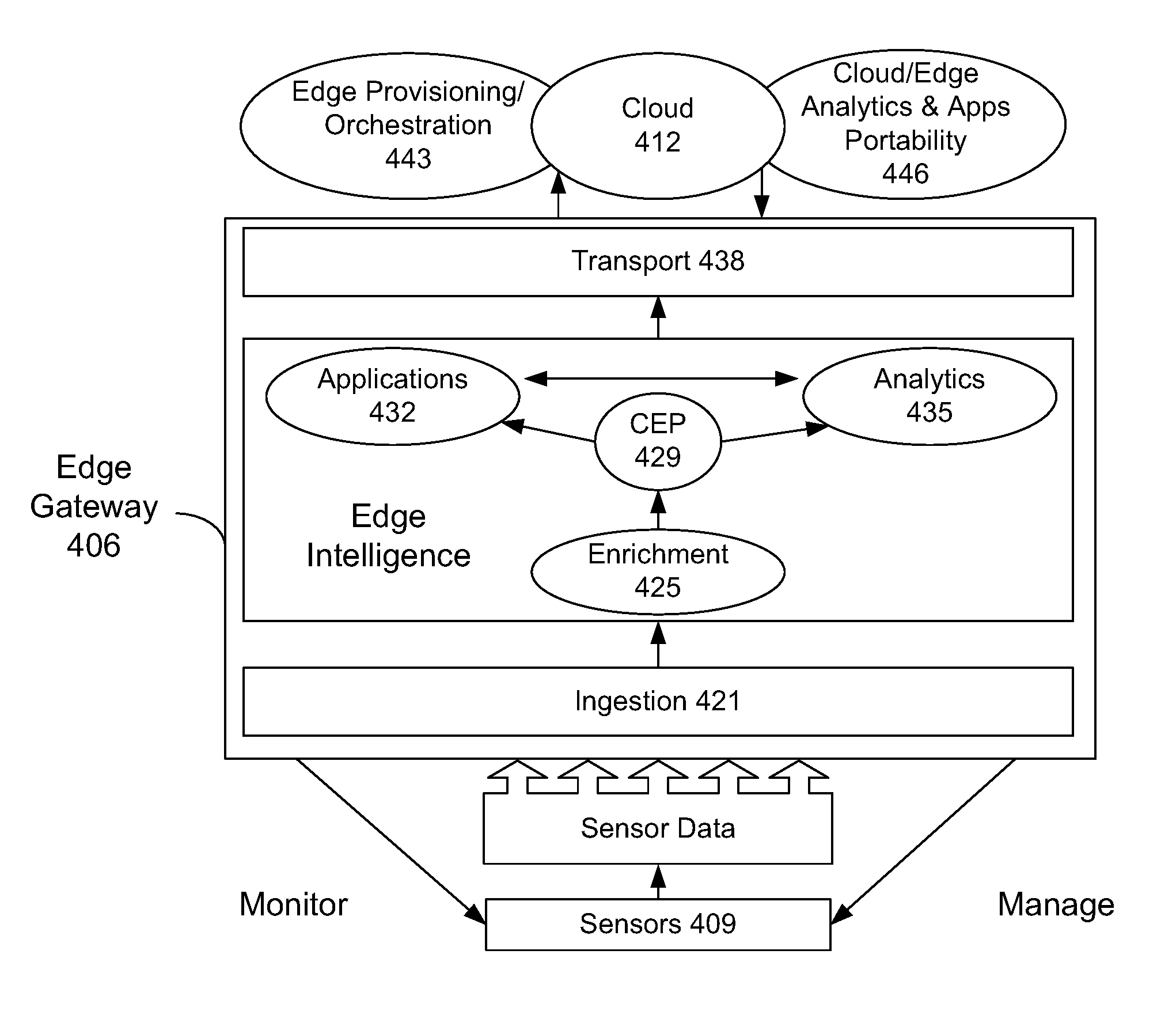
- The implementation of an edge computing platform that processes and analyzes data closer to the source using a software layer hosted on gateway devices or embedded systems, enabling real-time analytics and automated responses through a highly expressive computer language and a complex event processing engine, while also allowing data to be published to the cloud for further machine learning.

Data Privacy and Security Framework for Edge Intelligence
The integration of edge intelligence into smart ecosystems necessitates a comprehensive data privacy and security framework that addresses the unique challenges posed by distributed computing environments. Edge intelligence systems process sensitive data at the network periphery, creating multiple attack vectors and privacy vulnerabilities that traditional centralized security models cannot adequately address. The distributed nature of edge deployments requires innovative approaches to data protection that maintain system performance while ensuring regulatory compliance.
Federated learning emerges as a cornerstone technology for privacy-preserving edge intelligence, enabling model training without centralizing raw data. This approach allows edge devices to collaboratively learn while keeping sensitive information locally processed. Differential privacy mechanisms further enhance protection by adding calibrated noise to data outputs, preventing individual data point identification while maintaining statistical utility for machine learning applications.
Homomorphic encryption presents another critical component, allowing computations on encrypted data without decryption. This technology enables secure data processing across edge nodes while maintaining confidentiality throughout the computational pipeline. However, implementation challenges include computational overhead and key management complexity in distributed environments.
Zero-trust architecture principles become essential for edge intelligence security frameworks. This model assumes no implicit trust within the network, requiring continuous verification of device identity, data integrity, and communication channels. Multi-factor authentication, continuous monitoring, and micro-segmentation strategies help establish secure communication protocols between edge devices and central systems.
Blockchain technology offers decentralized security solutions for edge intelligence networks, providing immutable audit trails and distributed consensus mechanisms. Smart contracts can automate security policy enforcement and access control decisions, while distributed ledgers ensure transparency in data usage and model updates across the ecosystem.
The framework must also address regulatory compliance requirements such as GDPR, CCPA, and industry-specific standards. Data minimization principles, purpose limitation, and user consent management become critical considerations for edge intelligence deployments in smart ecosystems, requiring automated compliance monitoring and reporting capabilities.
Federated learning emerges as a cornerstone technology for privacy-preserving edge intelligence, enabling model training without centralizing raw data. This approach allows edge devices to collaboratively learn while keeping sensitive information locally processed. Differential privacy mechanisms further enhance protection by adding calibrated noise to data outputs, preventing individual data point identification while maintaining statistical utility for machine learning applications.
Homomorphic encryption presents another critical component, allowing computations on encrypted data without decryption. This technology enables secure data processing across edge nodes while maintaining confidentiality throughout the computational pipeline. However, implementation challenges include computational overhead and key management complexity in distributed environments.
Zero-trust architecture principles become essential for edge intelligence security frameworks. This model assumes no implicit trust within the network, requiring continuous verification of device identity, data integrity, and communication channels. Multi-factor authentication, continuous monitoring, and micro-segmentation strategies help establish secure communication protocols between edge devices and central systems.
Blockchain technology offers decentralized security solutions for edge intelligence networks, providing immutable audit trails and distributed consensus mechanisms. Smart contracts can automate security policy enforcement and access control decisions, while distributed ledgers ensure transparency in data usage and model updates across the ecosystem.
The framework must also address regulatory compliance requirements such as GDPR, CCPA, and industry-specific standards. Data minimization principles, purpose limitation, and user consent management become critical considerations for edge intelligence deployments in smart ecosystems, requiring automated compliance monitoring and reporting capabilities.
Standardization and Interoperability in Smart Ecosystems
The optimization of edge intelligence within smart ecosystems faces significant challenges related to standardization and interoperability. Current smart ecosystem implementations often operate as isolated silos, with proprietary protocols and incompatible data formats hindering seamless integration. This fragmentation prevents the realization of truly interconnected intelligent environments where edge devices can collaborate effectively across different platforms and vendors.
The absence of unified standards creates substantial barriers for edge intelligence deployment. Different manufacturers implement varying communication protocols, data structures, and security frameworks, resulting in complex integration requirements. These inconsistencies force organizations to invest heavily in custom middleware solutions and protocol translation layers, significantly increasing deployment costs and system complexity while reducing overall reliability.
Interoperability challenges extend beyond technical protocols to encompass semantic understanding and data interpretation. Edge devices from different ecosystems may use identical sensor types but represent data in incompatible formats or units. This semantic fragmentation prevents intelligent systems from making informed decisions based on comprehensive environmental data, limiting the potential for advanced analytics and autonomous operations.
The lack of standardized security frameworks poses additional complications for edge intelligence integration. Different security models, authentication mechanisms, and encryption standards create vulnerabilities when systems attempt to communicate across ecosystem boundaries. These security gaps can compromise entire smart environments, making organizations reluctant to pursue deeper integration initiatives.
Emerging standardization efforts show promise for addressing these challenges. Industry consortiums are developing unified communication protocols specifically designed for edge computing environments, focusing on low-latency requirements and resource constraints. These initiatives aim to establish common frameworks for device discovery, capability negotiation, and secure data exchange across heterogeneous smart ecosystems.
The development of universal data models and ontologies represents another critical advancement. These frameworks enable semantic interoperability by providing standardized vocabularies and data structures that different systems can understand and process consistently. Such standardization facilitates more sophisticated edge intelligence applications that can leverage data from multiple sources regardless of their origin ecosystem.
Future standardization efforts must balance flexibility with consistency, ensuring that standards can accommodate diverse use cases while maintaining meaningful interoperability. Success in this area will unlock the full potential of edge intelligence, enabling truly integrated smart ecosystems that can adapt and respond intelligently to complex environmental conditions.
The absence of unified standards creates substantial barriers for edge intelligence deployment. Different manufacturers implement varying communication protocols, data structures, and security frameworks, resulting in complex integration requirements. These inconsistencies force organizations to invest heavily in custom middleware solutions and protocol translation layers, significantly increasing deployment costs and system complexity while reducing overall reliability.
Interoperability challenges extend beyond technical protocols to encompass semantic understanding and data interpretation. Edge devices from different ecosystems may use identical sensor types but represent data in incompatible formats or units. This semantic fragmentation prevents intelligent systems from making informed decisions based on comprehensive environmental data, limiting the potential for advanced analytics and autonomous operations.
The lack of standardized security frameworks poses additional complications for edge intelligence integration. Different security models, authentication mechanisms, and encryption standards create vulnerabilities when systems attempt to communicate across ecosystem boundaries. These security gaps can compromise entire smart environments, making organizations reluctant to pursue deeper integration initiatives.
Emerging standardization efforts show promise for addressing these challenges. Industry consortiums are developing unified communication protocols specifically designed for edge computing environments, focusing on low-latency requirements and resource constraints. These initiatives aim to establish common frameworks for device discovery, capability negotiation, and secure data exchange across heterogeneous smart ecosystems.
The development of universal data models and ontologies represents another critical advancement. These frameworks enable semantic interoperability by providing standardized vocabularies and data structures that different systems can understand and process consistently. Such standardization facilitates more sophisticated edge intelligence applications that can leverage data from multiple sources regardless of their origin ecosystem.
Future standardization efforts must balance flexibility with consistency, ensuring that standards can accommodate diverse use cases while maintaining meaningful interoperability. Success in this area will unlock the full potential of edge intelligence, enabling truly integrated smart ecosystems that can adapt and respond intelligently to complex environmental conditions.
Unlock deeper insights with Patsnap Eureka Quick Research — get a full tech report to explore trends and direct your research. Try now!
Generate Your Research Report Instantly with AI Agent
Supercharge your innovation with Patsnap Eureka AI Agent Platform!